
How voluntary was the death of our Lord Jesus! Five times we read that He “gave Himself.” He gave Himself for our sins (Galatians:1:4).
He gave Himself a ransom for all (2 Timothy:2:6).
He loved the church and gave Himself for it (Ephesians:5:25 Husbands, love your wives, even as Christ also loved the church, and gave himself for it).
How blessed it is to know that He gave Himself for us (Titus:2:14).
But what a personal privilege to be able to say that He loved me and gave Himself for me (Galatians:2:20).
—Jim Flanigan, Choice Gleanings 2011 (Quoted in Berean Call)
Tag: Christ
China Detains Beijing house church leaders in latest crackdown on unregistered churches
By Anugrah Kumar, Christian Post Contributor Monday, September 28, 2026
Authorities in China have detained several pastors and church workers from Beijing Jiaquan Church, an independent house church operating in the capital.
The U.S.-based group ChinaAid said it has received firsthand accounts of the arrests, though the number of people held and the charges against them remain unknown.
The group said it was checking whether Jiaquan congregations outside Beijing were hit.
A coordinated operation in several places, if confirmed, would mark another major move against churches outside the state-run religious system, the group said.
ChinaAid’s founder and President Bob Fu said his organization is “urgently concerned for the safety, health and legal rights of every Jiaquan pastor and church co-worker who has been taken away.” He asked authorities to name the detainees, disclose where they’re being held, provide the legal grounds for their apprehension and detention, and allow them to see independent lawyers.
Jiaquan has operated in the capital for over two decades, has 1,000 members, and has built churches and meeting locations in several parts of China, people familiar with the church said. It draws younger Christians in cities with discipleship, contemporary worship music and interactive fellowship.
Its leaders have run Noah Music School in Beijing for over 10 years, training worship leaders and musicians for house churches around China.
The arrests occurred days before Xi’s summit with President Donald Trump, and follow a Sept. 16 Washington forum on religious freedom, where advocates highlighted cases of Christian persecution ahead of Xi’s visit.
Fu called the arrests part of a growing campaign aimed at several of China’s most influential city churches. He said these churches differ in history and ministry and share a resolve to run church life free of government political control.
House churches stay outside the Three-Self Patriotic Movement, the government-approved Protestant body, and other Protestant structures under state control. Rules on unregistered religious groups have tightened in recent years, and there have been verified cases of raids, surveillance and prosecutions.
In October 2025, authorities began coordinated raids on Beijing Zion Church, among the biggest house-church networks in China. Members were detained in several provinces, and 18 were formally arrested.
The group reported on Sept. 10 that eight Zion pastors and co-workers were still in custody in Beihai, a city in the southern autonomous region of Guangxi, on charges of “fraud” and “illegal business operations.”
Police have also repeatedly acted against Early Rain Covenant Church in Chengdu, the Sichuan provincial capital in southwestern China. On June 14, police broke up a church meeting at a hotel in the city of Jiangyou, northeast of Chengdu, and detained more than 30 members.
On Sept. 10, police detained 11 Christians, most of them older than 60, at a small reading group in a teahouse. Authorities banned Early Rain after mass arrests in December 2018, and its founding pastor, Wang Yi, was later sentenced to nine years in prison.
A lawyer for Zion Church pastors has fled China with her spouse and their two children as authorities pressed her law firm to dissolve. Ruth Wang is a partner at the firm, VDoor, and since October 2025 has been on the legal team for Zion founder Pastor Ezra Jin and other detained members.
Taiwan has given the family temporary humanitarian housing, according to the news account Visegrad 24. The Malaysia Sun reported that Wang arrived on the island earlier this month.
Taiwanese officials reportedly told Wang the island cannot grant asylum to mainland Chinese under its rules, citing tensions between Beijing and the island’s ruling Democratic Progressive Party. Wang is considering a move to the U.S. or Canada and has said the family’s future is uncertain.
In a separate case, authorities released Lian Xuliang, pastor of the unregistered Xi’an Church of Abundance in Shaanxi province, over four years after they opened a national security case against him and two others. He went home earlier this month, according to the rights group Weiquanwang.
The rights group Church in Chains said the three spent six months held apart in small rooms of a former hotel while their families heard nothing. It said they were starved, beaten, drugged and denied bathroom use for long stretches.
Why Communist and Leftist Governments Hate Christianity.
Why Communist and Leftist Governments hate Christianity.
Author: Robin Schumacher
Source: Christian Post
If you’re someone who thinks Christians aren’t persecuted much in today’s world, I have a challenge for you. Subscribe to Voice of the Martyrs magazine, read three issues, and then let me know if you’ve changed your opinion.
The current VOM magazine (March 2020) provides an excellent reality check for those who believe Communism is on the way out and gives a drill down into recent activities in Communist China. After the cultural revolution (1966-76) that resulted in China being placed firmly in the hands of Communist control, the campaign to stomp out Christianity has now risen to a point where churches are routinely bulldozed, Christians are consistently harassed, interrogated, and imprisoned, and pastors get ‘disappeared’.
Why is it that Communist and Leftist governments persecute and hate Christianity so much? To answer that question, we need to peel back the theological, philosophical, and historical covers to get a better understanding of what motivates these anti-God worldviews, where their humanistic pursuits take them, and their tragic end results.
The theological foundation
Jesus provides a succinct explanation for why these worldviews and forms of governments hate Christianity when He says, “The world … hates Me because I testify of it, that its deeds are evil” (John 7:7). He speaks to the same thing earlier in the book of John: “This is the judgment, that the Light has come into the world, and men loved the darkness rather than the Light, for their deeds were evil. For everyone who does evil hates the Light, and does not come to the Light for fear that his deeds will be exposed. But he who practices the truth comes to the Light, so that his deeds may be manifested as having been wrought in God” (John 3:19-21).
When you tell an adherent of one of these belief systems and their oppressive government that their actions or ideas are wrong, it produces an egocentric rage that quickly manifests in authoritarian actions that first move to silence such ‘hate speech’ and then go further to squash the persons themselves. The Bible says we shouldn’t be surprised at this kind of aggression because “the mind that is set on the flesh is hostile to God, for it does not submit to God’s law; indeed, it cannot” (Rom. 8:7).
The natural outworking of this, from a governance standpoint, is the rejection and outlawing of liberties and freedoms (especially religious) of the general public. In rejecting God, tyrannical governments and their underlying worldviews suppress the fact that God is a free being, and since we are made in His likeness, we are also free beings who have innate freedoms that naturally flow to us from our Creator.
And for authoritarian governments, that just can’t be allowed.
The philosophical permission slips
Churchill once said that, “the empires of the future will be empires of the mind”.[1] By this he meant worldviews, ideologies, and belief systems power human actions and have consequences. Humanity always looks to some foundation of knowledge or learning to justify what it does, and when we look at the philosophies behind both Communism and Leftism, we find teachings that do everything in their power to reject Christian thinking.
As most know, the philosophy of Karl Marx gave birth to and supports the Communist philosophy. Marx thought religion was a mechanism of control used by society’s elite to manipulate the masses. But he went further to say, “Religion is the self-consciousness and the self-feeling of the man who has either not yet found himself, or else (having found himself) has lost himself once more. This state, this society, produce religion, a perverted world consciousness, because they are a perverted world. Religion is the sigh of the oppressed creature, the heart of a heartless world, just as it is the spirit of a spiritless situation. It is the opium of the people” (Marx’s original emphasis).[2]
While most understand Marxism, what’s not so well known is the philosophy of Leftist thinking. It was given birth to in 18th century France, with the origination of its mindset being cloaked beneath the cover of the Enlightenment and sheltered under seemingly reputable names like Rene Descartes, Sir Issac Newton, Sir Francis Bacon, and John Locke. Much like Marxism and Communism, it purported to use its philosophy to combat poverty and unfairness.
In truth, the actual set of principles powering Leftist thinking came from Voltaire, a French writer, historian, and philosopher who introduced the common argument against religion of ‘reason over superstition’. He and his lover (Émilie du Châtelet) concluded their formal examination of the Bible by saying it was nonsense. Voltaire and Émilie called Jesus’ Sermon on the Mount “trite, ridiculous, absurd” and His resurrection “comedy”.
Voltaire’s snide and caustic attitude are captured by British historian Thomas Babington Macaulay whose words not only portray the man but also define what is representative of the entire Leftist movement: “He could not build – he could only pull down; he was the very Vitruvius of ruin.”[3]
Other philosophers that aided Voltaire included Denis Diderot who provided a sneak peek into the Left’s use of violence with a quote that is commonly attributed to him: “Men will never be free until the last king is strangled with the entrails of the last priest.”[4] Beyond hostility, another attribute characterizing the origins of the Left was muddled thinking, which is represented well by Jean Jacques Rousseau who complained that people’s woes are the result of society, evidently overlooking the fact that societies are comprised of people.
The gods, priests, and prophets of Communism and the Left
It’s a historically verifiable fact that when you hold God’s funeral, someone will take His place. And that replacement is always one of us.
The deification of man that you see today in Communist governments like China and North Korea are nothing new. Look back to ancient Egypt, and you will find the pharaoh being thought divine and elevated above his subjects, who were expected to deliver nothing short of absolute obedience.
Then came other in-place-of-God rulers such as Alexander the Great, Antiochus IV Epiphanes (who assumed the name Theos Epiphanes or “God Manifest”) and various Roman Caesars like Domitian who demanded to be addressed as “Dominus et Deus” (Lord and God).
The interesting thing about emperor worship is noted by historian William Barclay who observed, “The extraordinary fact is that emperor worship was not imposed on the Roman Empire from above; it grew from below.” Romans populations, pleased with their fragile peace and economy, took things too far in the worship of their emperors not realizing the monster they were creating. The exact same thing happened in Nazi Germany.
As the gods of the ancient world had their own priests and prophets, the same is true today. Deified political despots have their enabling politburo members, senators, etc., that the people look to in hope that interventions will be made on their behalf to the current ruler. And the propaganda machines and mouthpieces of the media take the place of prophets with their aim being to serve and glorify their chosen monarch, bury any negative impressions, and proclaim new revelations and insight from on high.[5]
How does it start?
The inauguration of the Communist and Leftist gods, priests and prophets that make up oppressive governments is usually done in a manner that resembles the events that took place during the French revolution of 1789. The American Revolution of 1776, we should remember, was motivated by a faith-based view of humanity and desired freedom from governmental oppression. Its aim was to recognize freedom based on innate human worth, absolute truth, and a morality underpinned by Judeo-Christian values that contained checks and balances to prevent any abuse of power.
By contrast, the French Revolution of 1789 chased a different type of freedom – one that was characterized by the pursuit of absolute power and secularism that included a mob-driven and forceful de-Christianization campaign. Discarding God, it was typified by an untrustworthy moral fluidity that expunged the idea of religious moral boundaries and grounded its ethics in pragmatism and ever-changing right and wrong.
The horrifying end results
The outworking of the French Revolution (and others like them) reflect the worst of modern-day slasher films and bear witness to an important truth for those who participate in them: Communist and Leftist movements are cannibalistic in nature; i.e. they eat their own. Their actions personify what novelist Walter Jon Williams once said: “I’m not afraid of werewolves or vampires or haunted hotels. I’m afraid of what real human beings do to other real human beings.”[6]
The two primary weapons employed by these movements are the lie and violence. History has shown that the tongue of Communist and Leftist governments, and their enablers, is forked and patterned after their spiritual father: “Whenever he [the devil] speaks a lie, he speaks from his own nature, for he is a liar and the father of lies” (John 8:44). Witness the current COVID-19 lies and coverup from Communist China as just one of countless examples.
In addition to falsehood, violence is another hallmark of Communism and the Left. Again, they mirror their spiritual father who is “a murderer from the beginning” (John 8:44).
While these oppressive worldviews have criminal records that wrap around the earth hundreds of times, a tired tactic they employ to take the spotlight off their bloody past is to accuse religion as being the real culprit behind the moral brutality that’s occurred down through history. The only problem with that claim is that it is 100% false.
It’s true that atrocities have been committed in the name of religion (e.g. ISIS, the Crusades, the Thirty Years’ War, etc.), but they barely register on history’s violence Geiger counter compared to the carnage and body count produced by secular governments. Historians Philip and Axelrod’s three-volume Encyclopedia of Wars shows that, of the 1,763 wars waged over the course of human history, only 123 of them have been religious in nature. [7] That amounts to an amazingly low 6.98% of all wars being the result of religion.
Further, when wars carried out in the name of Islam are subtracted, the percentage falls to 3.23%, meaning that all religions combined – minus Islam – have been responsible for less than 4% of all humanity’s wars and violent conflicts.[8]
The sobering fact that secular despotic governments account for over 93% of all violence and war in human history is summed up by political science professor R. J. Rummel this way in his book, Death by Government: “Almost 170 million men, women and children have been shot, beaten, tortured, knifed, burned, starved, frozen, crushed or worked to death; buried alive, drowned, hung, bombed or killed in any other of a myriad of ways governments have inflicted death on unarmed, helpless citizens and foreigners. The dead could conceivably be nearly 360 million people. It is though our species has been devastated by a modern Black Plague. And indeed it has, but a plague of Power, not germs.”[9]
Afraid but not afraid
So why do Communist and Leftist governments and their adherents hate Christianity? “The world . . . hates Me because I testify of it, that its deeds are evil” (John 7:7). “If the world hates you, you know that it has hated Me before it hated you. If you were of the world, the world would love its own; but because you are not of the world, but I chose you out of the world, because of this the world hates you. Remember the word that I said to you, ‘A slave is not greater than his master.’ If they persecuted Me, they will also persecute you” (John 15:18-20).
Ironically, though, for all its hatred of Christian teaching, Marxist and Leftist philosophy end up abducting God’s first commandment of “You shall have no other gods before Me” (Ex. 20:3) and modifying it to be, “You shall not have God before me.”
This anti-God mandate along with today’s prevailing post-truth and anti-Christian thinking of Marxists and Leftists is something that has proven itself to be deadly. Their human condition is summarized well by political researchers Mark L Melcher and Stephen Soukup who speak to the birth of the Left in France: “Their atheism has left them with stunted moral values. Their utopianism has rendered them incapable of assessing the secondary and tertiary consequences of their actions. Their lifestyles provide us with the first glimpse into the sickness inherent in the nihilism that would come to be the progeny of their efforts. Finally, the petulance and outsized egos presage the terrible violence that awaits France.”[10]
However, even in the face of such promised violence and persecution, Christians such as those in China’s Early Rain Covenant Church continue their faithfulness to Jesus. They are afraid but yet not afraid, knowing that God remains sovereign over everything. Theirs is a realism that acknowledges the spiritual evil behind their Communist government’s actions but yet looks upward to pursue a purpose spoken to by their pastor, Wang Yi, before he was arrested:
“The goal of disobedience is not to change the world, but to testify of another world.”[11]
[2] “Contribution to the Critique of Hegel’s Philosophy of Right, Introduction,” in On Religion, by Karl Marx and Friedrich Engels, tr. Reinhold Niebuhr (Chico, CA: Scholar’s Press, 1964), pp. 41-2.
[3] Thomas Babington Macaulay, Life of Frederick the Great (American Book Exchange, 1879), 143-4. Vitruvius was a Roman author, architect, civil engineer, and military engineer during the 1st century BC.
[4] https://www.goodreads.com/quotes/53247-men-will-never-be-free-until-the-last-king-is
[5] One thing different in the current American media is the shift from news reporting to full biased, opinion-driven communication where, in a very real way, the media are actually trying to govern through their bullying tactics.
[6] https://www.brainyquote.com/quotes/walter_jon_williams_250112
[8] For a PowerPoint presentation on this material, see: http://www.slideshare.net/schumacr/does-religion-cause-war.
[10] Mark L Melcher and Stephen Soukup, Know Thine Enemy (Murrells Inlet, SC: 2018), Kindle Edition.
[11] Voice of the Martyrs magazine, March 2020, 7.
Robin Schumacher is a software executive and Christian apologist who has written many apologetic articles, appeared on nationally syndicated radio programs, and presented at various apologetic events. He holds a Master’s in Christian apologetics and a Ph.D. in New Testament.
Sin Triad
Sin will take you further than you want to go.
Sin will cost you more than you want to pay.
Sin will keep you longer than you want to stay.
Unknown Author
The Danger of Complacency
“I will search with lanterns in Jerusalem’s darkest corners to punish those who sit complacent in their sins. They think the LORD will do nothing to them, either good or bad.” Zephaniah 1:12
It’s been said that we become like the gods we worship. Whatever we continually behold, we consistently reflect. Some of God’s own children have so lost sight of His Majesty, power, and authority that they shrugged their shoulders and chose to live the way they so desired. They reduced God’s influence to that of a lifeless idol. Furthermore, they projected their own indifference onto him, thinking he cared very little as to whether people did right or wrong, as if he himself would never react to sin or respond to righteousness. The word complacent in this passage is akin to the process of curdling, thickening, or settling into. In other words, when we let go of our own conviction, and when we stop caring about sin (and worse yet, when we somehow think that God is on the same page), something destructive settles within us. Our faith curdles; our sin becomes like quicksand, and we shrug our shoulders over the consequences of it all. God will have none of it. He is not indifferent about anything. God will have none of it. Never confuse God’s patience with complacency. Sin has its consequences and righteousness has its rewards. If you know someone who is complacent in their sin, pray and fast for them. It’s no small thing to God. A day of reckoning is coming unless they wake up and repent.
Ask the Lord to show you if you’ve misjudged Him in any way.
Author: Susie Larson, Prevail, Day 214
Powerful warning! Let us be people of faith who fear (reverence) God.
Thank you for your time.
Carl
Who Will NOT Inherit the Kingdom of God
The Bible warns that in the last days many will be deceived by false prophets (preachers) and false teachers who proclaim another Jesus and another gospel besides the biblical Jesus and His Gospel. They will lead many to hell instead of heaven.
An example is found in a Christian Post article concerning the former president of Exodus International, a once-prominent Christian ministry that sought to help people with unwanted same-sex attraction. The ministry closed in 2013. He is quoted as saying:
“Someone’s relationship with Christ isn’t dependent on the things that they do or the behaviors that they’re involved in.”
And
“there are so many gay and lesbian people that I know, transgender people, bisexual people, you name it, who have a vibrant relationship with Christ and their sexual narrative doesn’t negate their righteousness or holiness.”
The following Scriptures are presented in love as a warning to show that these type of comments are deceptive and wrong. There are people who the Bible plainly teaches will not inherit the kingdom of God. This means they do not go to heaven but to eternal torment when they physically die. Do not be found among them. Flee to the real biblical Jesus who said, “Repent for the kingdom of heaven is at hand.” Carl
Scriptures:
Everyone therefore who shall confess Me before men, I will also confess him before My Father who is in heaven. But whosoever shall deny Me before men, I will also deny him before My Father who is in heaven.
Lord Jesus – Matthew 10:32-33
But if that evil slave says in his heart, ‘My master is not coming for a long time, and shall begin to beat his fellow slaves and eat and drink with drunkards; the master of that slave will come on a day when he does not expect him and at an hour which he does not know, and shall cut him in pieces and assign him a place with the hypocrites; weeping shall be there and the gnashing of teeth.
Lord Jesus – Matthew 24:48-51
But the one who endures to the end, he shall be saved.
Lord Jesus – Matthew 24:13
Now the deeds of the flesh are evident, which are: sexual immorality, impurity, indecent behavior, 20 idolatry, witchcraft, hostilities, strife, jealousy, outbursts of anger, selfish ambition, dissensions, factions, 21 envy, drunkenness, carousing, and things like these, of which I forewarn you, just as I have forewarned you, that those who practice such things will not inherit the kingdom of God.
Galatians 5:19-21
Or do you not know that the unrighteous will not inherit the kingdom of God? Do not be deceived; neither the sexually immoral*, nor idolaters, nor adulterers, nor effeminate**, nor homosexuals***, 10 nor thieves, nor the greedy****, nor those habitually drunk, nor verbal abusers, nor swindlers, will inherit the kingdom of God. Such were some of you; but you were washed, but you were sanctified, but you were justified in the name of the Lord Jesus Christ and in the Spirit of our God.
*sexually immoral (pornos) is one who engages in sexual immorality (Moody), i.e. fornication, adultery, homosexual, lesbian, bestialities, abuse of children, etc.
**effeminate are “men who fill the sexual role of the female” in homosexual activity. (Moody)
***homosexuals means literally “males who take other males to bed”. (Moody)
****greedy: covetous, “those who would like to have more” and act unethically to get it.” (Moody) This person has made mammon his god and is an idolator.
I Corinthians 6:9-11
But sexual immorality or any impurity or greed must not even be mentioned among you, as is proper among saints; 4 and there must be no filthiness or foolish talk, or vulgar joking, which are not fitting, but rather giving of thanks. 5 For this you know with certainty, that no sexually immoral or impure or greedy person, which amounts to an idolater, has an inheritance in the kingdom of Christ and God. 6 See that no one deceives you with empty words, for because of these things the wrath of God comes upon the sons of disobedience. 7 Therefore do not become partners with them…
Ephesians 5:3-7
…when the Lord Jesus will be revealed from heaven with His mighty angels 8 in flaming fire, dealing out retribution to those who do not know God, and to those who do not obey the gospel of our Lord Jesus. 9 These people will pay the penalty of eternal destruction,away from the presence of the Lord and from the glory of His power…
2 Thessalonians 1:8-9
Therefore, treat the parts of your earthly body as dead to sexual immorality, impurity, passion, evil desire, and greed, which amounts to idolatry. 6 For it is because of these things that the wrath of God is coming upon the sons of disobedience, 7 and in them you also once walked, when you were living in them.
Colossians 3:5-7
For this is the will of God, your sanctification; that is, that you abstain from sexual immorality; 4 that each of you know how to possess his own vessel in sanctification and honor, 5 not in lustful passion, like the Gentiles who do not know God; 6 and that no one violate the rights and take advantage of his brother or sister in the matter, because the Lord is the avenger in all these things, just as we also told you previously and solemnly warned you. 7 For God has not called us for impurity, but in sanctification. 8 Therefore, the one who rejects this is not rejecting man, but the God who gives His Holy Spirit to you.
I Thessalonians 4:3-8
Those who hate the Lord would pretend obedience to Him; and their time of punishment would be forever.
Psalm 81:15
There shall not be found among you anyone who makes his son or his daughter pass through the fire, one who uses divination, a soothsayer, one who interprets omens, or a sorcerer, 11 or one who casts a spell, or a medium, or a spiritist, or one who consults the dead. 12 For whoever does these things is detestable to the Lord; and because of these detestable things [abominations] the Lord your God is going to drive them out before you. 13 You are to be blameless before the Lord your God. 14 For these nations, which you are going to dispossess, listen to soothsayers and diviners, but as for you, the Lord your God has not allowed you to do so.
Deuteronomy 18:10-14
The one who overcomes will inherit these things, and I will be his God and he will be My son. 8 But for the cowardly, and unbelieving, and abominable, and murderers, and sexually immoral persons, and sorcerers, and idolaters, and all liars, their part will be in the lake that burns with fire and brimstone, which is the second death.”
…and nothing unclean, and no one who practices abomination and lying, shall ever come into it, but only those whose names are written in the Lamb’s book of life.
Revelation 21:8, 27
Blessed are those who wash their robes, so that they will have the right to the tree of life, and may enter the city by the gates. 15 Outside are the dogs, the sorcerers, the sexually immoral persons, the murderers, the idolaters, and everyone who loves and practices lying.
Revelation 22:14-15
Conclusion : Jesus warned us that in the last days there would be much deception. Many in the attempt to justify their behavior before God have sought out false preachers who will tickle their ears by misinterpreting the Word of God or outright lying to justify their lifestyle. John, a disciple of Jesus, tells us very plainly about how we can tell we are deceived:
If we say that things in common we are having with Him [God], and thus fellowship, and in the sphere of the aforementioned darkness are habitually ordering our behavior, we are lying, and we are not doing the truth.
[In other words, the person is deceived and God does not approve of their behavior but condemns it and instead of fellowshipping with God, they are actually fellowshipping with a false Jesus/God who is a demon. ] Then John goes on to say:
But if within the sphere of the light we are habitually ordering our behavior as Himself is in the light, things in common and thus fellowship we [God and the believer] are having with one another, and the blood of Jesus His Son keeps continually cleansing us from every sin.
I John 1:6-7 Wuest Expanded Translation
Following Scripture explains the Biblical standard concerning conduct.
Everyone who practices sin also practices lawlessness; and sin is lawlessness. 5 You know that He [Jesus] appeared in order to take away sins; and in Him there is no sin. 6 No one who remains in Him sins continually; no one who sins continually has seen Him or knows Him. 7 Little children, make sure no one deceives you; the one who practices righteousness is righteous, just as He is righteous; 8 the one who practices sin is of the devil; for the devil has been sinning from the beginning. The Son of God appeared for this purpose, to destroy the works of the devil. 9 No one who has been born of God practices sin, because His seed remains in him; and he cannot sin continually, because he has been born of God. 10 By this the children of God and the children of the devil are obvious: anyone who does not practice righteousness is not of God, nor the one who does not love his brother and sister.
I John 3:4-10
Lord Jesus came to free us from our sins and purify us for Himself:
For the grace of God has appeared bringing salvation to all people, 12 instructing us to deny ungodliness and worldly desires and to live sensibly, righteously, and in a godly manner in the present age, 13 looking for the blessed hope and the appearing of the glory of ]our great God and Savior, Christ Jesus, 14 who gave Himself for us to redeem us from every lawless deed, and to purify for Himself a people for His own possession, eager for good deeds.
Titus 2:11-14
The next Scripture tells us how to be saved from our sins:
But what does it say? “The word is near you, in your mouth and in your heart”—that is, the word of faith which we are preaching, 9 that if you confess with your mouth Jesus as Lord, and believe in your heart that God raised Him from the dead, you will be saved; 10 for with the heart a person believes, resulting in righteousness, and with the mouth he confesses, resulting in salvation. 11 For the Scripture says, “Whoever believes in Him will not be put to shame.” 12 For there is no distinction between Jew and Greek; for the same Lord is Lord of all, abounding in riches for all who call on Him; 13 for “Everyone who calls on the name of the Lord will be saved.”
Romans 10:8-12
If you see yourself in these Scriptures and realize that you are continuously practicing one or more of these sins and are subject to God’s wrath, repent (turn) from and confess your sins to God and call upon the Lord Jesus today to wash away your sins with His precious blood. He will save your soul delivering you from the wrath of God. He will give you His Holy Spirit to live in you. He, the Spirit of God, will teach you and empower you to become free from practicing sin and live a life pleasing to Him.
God is merciful to those who are repentant and contrite of heart. He will save you regardless of what you have done if you will confess your sins and ask Him to have mercy on you. Call out to Him today.
Carl
Notes:
- All Scripture is from the New American Standard Bible (1977 Translation or later) unless otherwise indicated.
Xi Jinping’s CCP is rewriting the Bible
by Samuel Ben-Ur, Op-ed contributor – May 13, 2026
Christian Post
The Chinese Communist Party is rewriting the Bible.
As part of Xi Jinping’s “Sinicization of Christianity” campaign, the Chinese Communist Party (CCP) plans to ensure Christianity in China is instilled with “core socialist values.” Pursuant to that effort, the CCP is currently working on its own translation of what it calls the “Chinese Christian Bible.” While it has yet to complete the project, the CCP has already given Christians a glimpse of what the world’s first communist Bible might look like.
In China, the Ten Commandments became nine, then six, then zero.
In 2018, mere months after Xi announced his “Five-Year Plan to Sinicize Christianity,” authorities forced a state-approved church in Henan Province to delete the First Commandment, “You shall have no other gods before Me.” The removal of arguably the single most important line of text not just for Christianity, but for all three Abrahamic faiths, is a strike against the very heart of religion.
Later that year, the government changed the curriculum of a Sunday school in Hong Kong, removing not just the first four Commandments, but all references to “the Lord.” The entire book of Genesis was also removed. In 2019, the CCP completed this progression and replaced the Ten Commandments wholesale with Xi Jinping quotes. Within the span of a year, “You shall have no god before me” became “Use Chinese Culture to permeate faith” and “follow the party.”
The CCP has also targeted John 8:3-11, among the most famous passages in the New Testament. In the original story, when the Pharisees bring Jesus a woman accused of adultery, he replies, “Let him who is without sin among you be the first to cast a stone at her.” He then forgives the woman.
A textbook published by China’s University of Electronic Science and Technology Press, a government-run school, changes the ending. After the Pharisees leave, Christ tells the woman “I too am a sinner. But if the law could only be executed by men without blemish, the law would be dead.” Jesus then personally stones her to death.
These stories reveal the true face of “Sinicization.” Xi seeks to transform the Gospel into banal communist diktats, where mercy is subsumed by oppressive lawfare and the Party is the only higher power.
The CCP is, of course, avowedly atheist, and essentially deifies former Chairman Mao Zedong, who banned all religion during his reign, from the end of the Chinese Civil War in 1949 to his death in 1976.
The CCP views Christians particularly with suspicion, due to perceived Western ties and the role of Christianity in the Taiping Rebellion of the 1850s, in which more than 20 million died.
Xi might similarly desire to ban Christianity, but Xi is not Mao and Xi’s China is not Mao’s China.
When Mao came to power, there were approximately four million Christians living in China. Since Mao’s death and China’s relative relaxation of religious restrictions, the Christian population has exploded. Xi presides over as many as 160 million Christians, though the exact number is opaque, as most worship in underground churches to avoid CCP oversight. If Christianity continues to grow at a steady rate, China may be the world’s largest Christian country by 2030.
Despite CCP propaganda glorifying Mao, the Party is not eager to repeat the insanity of the Cultural Revolution, which spanned from 1966 to 1976. That period brought societal turmoil and more than a million deaths. Coupled with the challenge of forcing disbelief on more than 100 million Christians, today’s CCP is likely unable and unwilling to enforce a zero-tolerance religious policy. Instead of suppressing Christianity, it has sought to adapt it to Chinese Communist ideology — developing Christianity into another propaganda mill for the CCP. Grasping Xi’s endgame is crucial to understanding the unique persecution Chinese Christians face.
Where other forms of Christian persecution are marked by bloodshed, such as in Nigeria, where Islamist terror groups routinely massacre Christians, China instead seeks to replace God with the Party. This is why, of all Christian teachings, the CCP first sought to remove the first of the Ten Commandments, “Thou shalt have no other gods before me.”
Incidents such as these are merely the surface of what Xi’s “Sinicization” program entails.
China has instituted a bevy of religious restrictions since 2020, including loyalty tests for clergy, requiring the inclusion of Xi Jinping’s thought in seminary curricula, and a total ban on minors participating in religious activity.
Surveillance technology now permeates churches across China, monitoring sermons and building a database of Chinese Christians. Resistance to the implementation of surveillance devices can lead to beatings or disappearances for Christians who wish to maintain a degree of independence from the CCP. Authorities have ripped down thousands of crosses and replaced them with portraits of Xi. Churches that refuse to join China’s state-sponsored religious bodies have been targeted with increasing frequency in large-scale raids in which police lock up hundreds of worshipers.
As the Trump administration increasingly seeks to combat the oppression of Christians worldwide, Washington should mandate that the State Department’s International Religious Freedom process explicitly catalog altered biblical texts, approving committees, state-run publishers, and responsible officials. Those findings should be used to drive rolling Global Magnitsky sanctions and visa bans against those involved in clergy loyalty tests, church raids, and scripture rewriting.
The U.S. is the only country in the world that can bring to bear sufficient pressure on China to slow or even stop its corruption of the Christian faith. Standing up to Beijing is essential to any policy of defending persecuted Christians.
Originally published at Providence.
Samuel Ben-Ur is a research analyst focusing on Christian persecution at the Foundation for Defense of Democracies.
What is the Deceitfulness of Sin?
The writer of the Book of Hebrews in the Bible warns us of the following:
Take care, brothers and sisters, that there will not be in any one of you an evil, unbelieving heart that falls away from the living God. But encourage one another every day, as long as it is still called “today,” so that none of you will be hardened by the deceitfulness of sin. Hebrews 3:12-13
Drawing from the history of the Jewish people, the writer exhorts us not to be like those who had unbelieving hearts, fell away from the living God and died in the wilderness.
The Holy Spirit is speaking through the writer to warn us about our heart [our inner man- who we truly are] becoming hard [unbelieving] toward God and His Word [the Bible] because of the deceitfulness of sin.
Here is some of the ways sin deceives us:
Offers False Promises of Pleasure – sin acts as bait, dangling immediate, fleeting satisfaction or gain while hiding the inevitable pain and ruin it produces.
Progressive Hardening of the Heart – sin dulls spiritual sensitivity over time, moving a person toward apathy, disobedience, and an inability to recognize evil.
Self-Deception – The Bible warns that our own hearts are deceitful (Jeremiah 17:9), prompting us to rationalize wrongful behavior and believe we can escape consequences.
Distortion of Truth – Sin mask itself as wisdom or enlightenment, just as it did in the Garden of Eden, causing us to doubt God’s word.
Misleading About God – It makes God’s commands seem unreasonable or restrictive, trying to make us believe that God is against our best interests.
Did you recognize any of sins deceptions? Unfortunately, I recognize them all. They have tricked me at times into forsaking church attendance, not reading/studying my Bible, not praying, being prideful and arrogant, thinking I’m special when I was just sinful, not loving my fellow Christian and the unbeliever, being consumed with my agenda and not God’s, lying, lusting, being rebellious, unloving, and stubborn….and I could go on all day.
What should we do if we find ourselves with a hard, unbelieving heart today? We need to confess our sins and pride to God the Father. He already knows our sins. He is not surprised by them. He has promised the following to His children:
My little children, I am writing these things to you so that you may not sin. And if anyone sins, we have an Advocate with the Father, Jesus Christ the righteous; and He Himself is the propitiation for our sins; and not for ours only, but also for those of the whole world. I John 2: 1-2
and
If we confess our sins, He is faithful and righteous to forgive us our sins and cleanse us from all unrighteousness. I John 1:9
In Proverbs there is a Scripture that says a righteous man falls seven times but he always gets back up. So if you find yourself convicted by this post, get back up, turn from your sins and confess them to God, receive God’s forgiveness, believe God’s Word, be led by the indwelling Holy Spirit and perform the good works God called you to.
Be a blessing and an encourager to someone who needs mercy and grace.
May He richly bless you in your obedience.
Carl
How Wealthy Are You?
…attaining to all the wealth that comes from the full assurance of understanding, resulting in a true knowledge of God’s mystery, that is, Christ Himself, in whom are hidden all the treasures of wisdom and knowledge. I say this in order that no one may delude you with persuasive arguments.” Colossians 2: 2-4
“In short, he says, “You are fabulously rich in Christ; and don’t you let anyone ever tell you otherwise.”
“Do you know how rich you are? The richest man is the one who understands truths the world’s greatest minds have never understood–that the wise and successful life is one focused on Christ. The richest woman is the one who grasps, that at the heart of all God’s plans for the future is, Jesus. We may read about CEOs on enormous salaries, but we are richer.
“Do not let anyone, inside or outside the church, tell you differently with “fine-sounding arguments” (v4). Do not be swayed by entertaining preachers who tell you that life is all about you and your happiness when it is really about Christ. Do not be charmed by highly qualified teachers who try to persuade you that Christ is anything less that the glorious divine being we met in Colossians 1: 15-20. As long as we hold on tight to this Jesus, then our faith will remain strong (v5). I pray that everyone, especially those I love, will never let go of Jesus. ” Journey Through Colossians and Philemon –Mike Raiter
Dear Reader the following Scriptures tell us who this Christ is:
“And He is the image of the invisible God, the first born of all creation. For by Him all things were created, both in the heavens and on earth, visible and invisible, whether thrones or dominions or rulers or authorities –all things have been created by Him and for Him. And He is before all things and in Him all things hold together. He is also the head of the body, the church, and He is the beginning, the first-born from the dead; so that He Himself might come to have first place in everything. For it was the Father’s good pleasure for all the fullness to dwell in Him, and through Him to reconcile all things to Himself, having made peace through the blood of His cross; through Him, I say, whether things on earth or things in heaven.” Colossians 1: 15-20
Do you know this Jesus? Are you fabulously rich because you understand who He is? Are you going to spend eternity with Him or do you have reservations somewhere else? I pray you are holding on to Him. If not, why not today?
Turn to Him, confess your sins and ask Him to forgive you. Then ask Him to be your Savior and Lord based on what He did for you on His cross where He took the guilt and penalty (death) for your sins and mine. You will never regret it.
Thank you for your precious time. May God’s blessings be on your life.
Carl
5 Short Points Concerning UFOs
- All extraterrestrials are in for a big shock because at the end of time God says He is going to roll up the heavens like a scroll and create a new heaven and earth:
“And,
“THOU, LORD, IN THE BEGINNING DIDST LAY THE FOUNDATION OF THE EARTH,
AND THE HEAVENS ARE THE WORKS OF THY HANDS;
11THEY WILL PERISH, BUT THOU REMAINEST;
AND THEY ALL WILL BECOME OLD AS A GARMENT,
12AND AS A MANTLE THOU WILT ROLL THEM UP;
AS A GARMENT THEY WILL ALSO BE CHANGED.
BUT THOU ART THE SAME,
AND THY YEARS WILL NOT COME TO AN END.” (Hebrews 1:10-12)
and also:
But the day of the Lord will come like a thief, in which the heavens will pass away with a roar and the elements will be destroyed with intense heat, and the earth and its works will be burned up. 11Since all these things are to be destroyed in this way, what sort of people ought you to be in holy conduct and godliness, 12looking for and hastening the coming of the day of God, on account of which the heavens will be destroyed by burning, and the elements will melt with intense heat! 13But according to His promise we are looking for new heavens and a new earth, in which righteousness dwells. (II Peter 3:10-13 NASB)
and one more:
And I looked when He broke the sixth seal, and there was a great earthquake; and the sun became black as sackcloth made of hair, and the whole moon became like blood; 13and the stars of the sky fell to the earth, as a fig tree casts its unripe figs when shaken by a great wind. 14And the sky was split apart like a scroll when it is rolled up; and every mountain and island were moved out of their places. (Revelation 6: 12-14 NASB)
If there are other living beings on other planets, they are in for a big surprise when this happens. They and their “advanced civilization” are going to be rolled up and thrown away by God Almighty.
2. The strange creatures from outer space always use the latest technologies.
There is a story in Mormon folklore ( I am not Mormon) that tells of a popular man in a certain community passing away. Later one day while they are having a get together outside, a paddle-wheeler boat (latest technology at that time) comes by IN THE SKY and guess who is standing on the deck waving at everyone. You guessed it… the guy who had just died. So don’t be surprised at the fast moving planes or ships or objects. They are just using the latest technology to dazzle earthlings.
3. Space aliens will be blamed for the disappearance of hundreds of thousands of born again believers after the Rapture of the true Church has occurred.
The leaders of false, work based so-called Christian groups, such as the Pope of the Roman Catholic Church, the Prophet of the Mormons plus the priest of the Hindus, Buddhist, and clerics of the Muslims, are going to need to blame someone when all the truly born again Protestants disappear in the twinkling of an eye. Their followers will clamor for an explanation. These leaders will say something like “The aliens came and got these rebels and removed them for the good of mankind.”
New spirituality believers and New Age adherents will consider the Rapture a fulfillment of what their Ascended Masters have been saying all along. These deceiving spirits are quoted as saying in channeled New Age books that those who reject their teaching will have to be dealt with or eliminated so their movement can spread and take over the earth. They will celebrate the UFOs removing these rebels from their communities.
The UFO deception will be put to good use to deceive the remaining people on earth after the Rapture.
4. Aliens are real and they are already among us.
But they are not from outer space. They are from our space. They are Satan and his demonic hordes that Jesus Christ conquered on the Cross of Calvary. You can read about Jesus Christ casting them out of people in the New Testament. His followers went forth doing the same before the Cross and after His resurrection.
When Jesus encountered people controlled by aliens (demons) the demons knew that He was the Son of God and that there was coming a day when they would be cast into a place of torment. We await that joyous day!
5. To understand how to deal with the aliens (demons) and their tactics, please read the New Testament.
You can actually read what the head alien Satan and his demonic followers said in the New Testament.
Thank you for allowing me to share these thoughts with you.
Blessed is the one who knows the true God!
Carl
.
The Big Difference
How does keeping of the Old Testament Law and walking in New Testament grace compare?
There is a big difference between the Old Testament and the New Testament when it comes to equipping the believer to live a God honoring life. The following saying illustrates this point.
Do this and live, the Old Testament Law demands, but gives neither feet or hands.
A better word the Gospel brings. It bids me fly and gives me wings.
Author Unknown
Born again believers get their “wings” by understanding the truths found in Paul’s letter to the Romans in chapter six through eight. God has given us a new nature and set us free from our old sinful nature and gave us His indwelling Holy Spirit. Now we can say “no” to sin and temptation and escape from the corruption that is in the world through lust.
Apostle Peter said the following about these truths in II Peter 1: 3-4 (Wuest Expanded Translation):
“Seeing that all things to us His divine power has generously given, the things which pertain to life and godliness, through the experiential knowledge [which the believer has] of the One who called us [into salvation] by means of His own glory and virtue, by means of which [glory and virtue] there have been generously given to us the precious and exceedingly great promises in order that through these you might be partakers of the divine nature, having escaped by flight the corruption which is in the world in the sphere of passionate carvings.”
Today let us lay hold of these precious and exceedingly great promises the Father has made to us. As we do so, we can escape the corruption which we will face today in the the world in the sphere of passionate carvings.
May you conquer all temptations and snares today in the Name of Jesus!
Have a blessed day walking in the Spirit!
Carl
“Dreaming” in Jude – A Warning Against Immorality
“Yet in the same manner these men, also by dreaming, defile the flesh,…” Jude 8
Welcome back as we continue our study of the false teachers in Jude:
3. Our opening scripture means they indulged in what we would call pornography. “Dreaming” means metaphorically “to be beguiled with sensual images and carried away to an impious course of conduct” (Thayer). As a result they were defiling their physical bodies with acts of immorality.
The term “in the same manner” refers to verse 5 – 7 where it says:
Now I want to remind you, though you know everything once and for all, that the Lord, after saving a people out of the land of Egypt, subsequently destroyed those who did not believe. 6 And angels who did not keep their own domain but abandoned their proper dwelling place, these He has kept in eternal restraints under darkness for the judgment of the great day, 7 just as Sodom and Gomorrah and the cities around them, since they in the same way as these angels indulged in sexual perversion and went after strange flesh, are exhibited as an example in undergoing the punishment of eternal fire.
Jude compares the false teachers to the fallen angels who left heaven and committed fornication with the wicked women of the earth (Genesis 6) and to the inhabitants of Sodom and Gomorrah who committed “gross immorality” (NASB) or “fornication” (KJV). God has the fallen angels in prison for their sin TODAY awaiting the final judgment and the inhabitants of Sodom and Gomorrah are still “undergoing the punishment of eternal fire” TODAY. Both are held up as an “example” which means “something held up to view as a warning” (Wuest). Jude holds both of these exhibits up to the brethren as a warning that God will not be mocked, He will not be “outwitted or evaded”. These examples are still a warning to us today.
These false teachers, while claiming to be God’s spokesman, were participating in fornication and adultery. Not only them, but, as we will see, the Lord’s bond servants they deceived. God plainly reveals His will about sex outside of marriage and adultery in the New Testament:
“For this is the will of God, your sanctification, that is, that you abstain from sexual immorality; that each of you know how to possess his own vessel in sanctification and honor, not in lustful passion, like the Gentiles who do not know God;…” (I Thessalonians 4:3-5)
May we heed His warning and keep ourselves from sexual immorality.
God bless you.
Carl
Understanding the Threat of Islamism to Christians and Western Values
The global surge of Islamist activity, marked by violent acts, protests, and religious tensions, has sparked significant concern for Christians and Western societies. From terrorist attacks in New Orleans and violent demonstrations in Europe to widespread grooming and abuse scandals in Britain and brutal persecution of Christians in Africa, these events reflect both historical patterns of conquest within Islam and the modern implications of Islamism. This escalating threat underscores the urgent need for vigilance, prayer, and support for persecuted Christians worldwide.
The rough start to 2025 did not start on January 1. On New Year’s Day, a U.S. Army veteran plowed a truck into a crowd in New Orleans in a terrorist attack done in the name of the Islamic State. A few hours later, pro-Palestinian demonstrators blocked Sixth Avenue in New York, calling to globalize the intifada. Across the Atlantic, a report was released about Muslim “grooming gangs” preying on lower-class white girls in Britain, although “grooming” is too mild of a descriptor for what the report claimed.
Since 2000, 250,000 British girls have been drugged, sexually assaulted, and trafficked. Those who reported their assaults were blamed or ignored. Fathers who attempted to rescue their daughters were arrested. People who tried to expose this behavior were imprisoned. Apparently, officials were afraid of being labeled racist or being accused of inciting racial tensions. They were more fearful of being insensitive than protecting girls from sexual abuse and exploitation.
Across Europe, Christmas markets were attacked and disrupted by Muslim demonstrations. In many European cities, Muslims regularly pray publicly in areas in acts designed to cause maximum disturbance. This is something rare in actual Islamic nations and indicates the intent of Muslims to claim new territory as their own. On New Year’s Day, immigrants, mostly Muslim, rioted in Brussels, Berlin, and other cities.
Also, in what’s become a terrible tradition on holy days in Nigeria, Christians again suffered a series of murderous attacks over Christmas at the hands of Islamic Fulani herdsmen and ISIS-related groups. According to a report from Open Doors, at least 25 were killed, some while returning from a Christmas Day church service. 21 Christians were also killed in Christmastide attacks in the Democratic Republic of Congo.
Most Muslims are peaceful and would condemn such attacks in the name of their faith. However, a significant percentage of Muslims are Islamists, and Islamists who believe that Islam is destined to rule the world often think that jihad is how this domination will happen. Islamism is not an aberrant form of Islam, as is often claimed. In view of the history of Islam, Islamists more closely reflect the life of Mohammed and the history of Islam than is often acknowledged.
Mohammed, a merchant turned religious leader turned warlord, initially attempted to convert the surrounding Arabs by preaching to them. When that failed, he turned to raiding and sought conversions by military conquest. As his power expanded and Mohammed’s raiding extended into Persia and the Byzantine Empire, he allowed his warriors to take non-Muslims as sex slaves, similar to what is happening today in Britain.
Mohammed’s successors also expanded Muslim territory by conquest. In fact, conquest is the primary means by which Islam has spread across the world. Some groups, like the Turks, converted to Islam to avoid slave raids. Others allied with the Caliphate for economic reasons or to obtain better military technology. In some areas, Muslims were welcomed as merchants and granted concessions until, when they were strong enough, the Muslims took over those regions. A recent parallel is Lebanon, once a majority Christian country until Palestinian refugees consolidated enough power to topple the government.
Muslims often claim that jihad does not mean “religious war” but rather “struggle” and that the “greater jihad,” according to the Qur’an, is the struggle to submit to the will of Allah. That is true according to the Qur’an, but in Islamic literature and history, jihad overwhelmingly refers to religious warfare. In principle, jihad as warfare is to be defensive. However, in practice, and according to Mohammad, anyone who is called but refuses to convert to Islam is a threat to the Islamic community and subject to jihad.
The early chapters of the Qur’an contain statements prohibiting coercion in religion, as well as positive statements about Christians and Jews. However, these statements are considered by Islamists to be abrogated by later statements prohibiting friendship with Christians and Jews. Included in these later passages are particularly vicious statements against the Jews. Historically, in Muslim countries, Christians and Jews were considered second-class citizens, with limited rights and increasing prohibitions on their behavior, often designed to humiliate them.
Many critics and scholars suggest that Islam needs a Reformation, like what happened in the sixteenth century within Christianity. Arguably, Islamism is that reformation, a return to the authoritative sources of Islam, a literal reading of the Qur’an, an embrace of Sharia law, and an emphasis on the personal example of Mohammad.
Clearly, the rise of Islamism around the world holds serious implications for Christians and the West. Even more, the implications are immediate for our persecuted brethren in Islamic countries and in borderland territories like Nigeria. Pray for these brothers and sisters in Christ living under Islamic rule.
By John Stonestreet – President of the Colson Center for Christian Worldview, and radio host of BreakPoint, a daily national radio program.
Source: Christianity .com
From ‘Borderline Satanism’ to God Encounter: Former Lesbian Says Jesus ‘Completely Transformed’ Her
Melanie Rivas’ joy for Jesus is contagious. In fact, a recent video about how God changed her life has gone viral on social media, garnering nearly 400,000 views.
Yet, just nine months ago, the 22-year-old was homeless, broke, and fleeing from an abusive same-sex relationship.
“My ex-wife stole all my money and locked me out of all of my accounts. So I had nothing,” she told CBN News.
Rivas says she was despondent and on the brink of suicide. However, a strange email notification led her to randomly purchase a Bible at a local Walmart. Rivas said that as she began to read the New Testament, the Spirit of God filled her car and her life was “completely transformed” in that moment.
Early Years
The Chicago native grew up in a Catholic home familiar with the traditions of the faith, such as baptism and communion. She shared, “It almost felt like a routine for me.” Rivas admits her relationship with Jesus was “like (a) procedure,” and devoid of any connection to Him.
She told CBN News that because she didn’t have a solid relationship with Christ, she was led by the wrong influences.
“I was just following the world, and I was super (impressionable), because I didn’t have Jesus,” she said. “When you don’t have Jesus as your anchor, like you’re just looking at what’s around and you want to be a part of it.”
“I go into this high school where they’re telling me that it’s actually weird that I’m not homosexual,” she shared, explaining that was when she began “entertaining homosexual relationships.”
With little guidance and direction, Rivas also began to experiment with drugs.
“I was in a rebellious state too,” she recalled. “I started doing a bunch of drugs. That’s when I got into weed, and then weed turned into acid and then acid turned into shrooms, and then it turned into cocaine. And I’m doing this as a high-schooler!”
Rivas said she also struggled with depression, anxiety, and suicidal thoughts. All of that was exacerbated during the COVID-19 pandemic. At the height of lockdowns, social distancing, and isolation, she turned to TikTok.
As CBN News reported, the popular social media platform known for quick videos, one-minute dance challenges, and viral trends, became a big hub for witches and warlocks around the pandemic.
Videos with the hashtag #WitchTok had amassed more than 30 billion views and made it easier for would-be witches or those interested in the occult to learn more about it, according to a 2022 BBC report.
Rivas was one of its viewers. “Like I said, for a teenager who doesn’t have Jesus, the culture impacts you so much. So it’s almost like being a witch was cool,” she recalled. “I didn’t think of it as like a witch, like a warlock or something like that. I just thought it was cute.”
The young woman explained that she began to go deeper into witchcraft after she met a girl who worshipped the “idol of death.”
“We’re all created to worship God,” she pointed out. “That’s literally why we’re created to have a personal relationship with Him. But when you don’t have that relationship with (Jesus), you look to worship other things. Like you’re so open to it. I was searching for that missing aspect of my life.”
“I’m sitting there worshiping death. And it’s borderline Satanism,” she added.
The 22-year-old said she eventually married that girl, but the relationship was “very controlling and very toxic.”
Rivas said that the woman convinced her to join OnlyFans. The subscription-based platform is widely recognized for its explicit content. Rivas said she joined just before the platform became popular, but she quickly found herself “deep in the rabbit hole.”
Finding Jesus
Rivas shared that things in her life went from bad to worse overnight.
“(My former relationship) got to the point where we had a really bad fight. It ended with the marriage certificate being ripped in my face, my clothes were in trash bags outside, and I was getting kicked out,” she recalled. “In a single day, I lost my home, I lost the person I thought I was going to be with for the rest of my life and I lost my way of getting income…I ended up sleeping in my car.”
Rivas recounts that she spiraled into a depression. “I even tried therapy, and the therapy didn’t work, but the therapist did give me antidepressants.”
The artist said she began to be tormented by thoughts of committing suicide.
“I remember getting to a point where I thought I had tried everything. I tried drugs. I tried spiritual spells… like all this stuff. Nothing worked. I even tried therapy, and the therapy didn’t work. And so I was like, you know what? Like, I am so done with life. I don’t want to be here anymore. And so I ended up planning (to take) my life.”
Rivas remembers sitting in her car with a bottle of pills in her hand. She then made a decision that would change the trajectory of her life – she checked her email.
“I got this weird email from like a horoscope email, and it said, ‘You need to go get a book right now,'” she recalled, adding that she felt deep in her heart to go to the nearest store.
“I had a Walmart two minutes away from me, and I was like, okay, I’ll go,” Rivas said. With five dollars to her name, she perused the book aisle.
“My ex-wife stole all my money and locked me out of all of my accounts. So I had, I had nothing. And so I went to the book section, and there were all these (expensive) books,” she told CBN News. “They’re (books) that are $50, $60. I thought this was pointless.”
“And then I keep looking, and there’s one book, and it’s one dollar, not a $1.50, just a plain dollar,” she said. “It’s the New Testament Bible. And I remember looking at it and was like, ‘You can’t even get a candy bar for a dollar.'”
Rivas says she was shocked and intrigued by her find. She purchased the book, went back to her car, and sobbed as she read the Bible.
“As soon as I opened it…I don’t even know how to explain it. It was like I got this warm feeling in my body,” she said. “I genuinely felt the Holy Spirit.”
Rivas describes feeling God’s love for her, His compassion for her, but also a sense of sadness for how she was living.
“I felt His mourning for me…like He has seen me try and live this life alone…like He’s just been missing me.”
A Voice to Her Generation
It was an encounter with God that has impacted her. Rivas says she has fully surrendered her life to Him and now spends her time proclaiming the Gospel message on social media.
“I got baptized, and that was nine months ago,” she said, adding that God has called her to make an Instagram account to share what He has done for her.
“He’s grown it in like seven months from zero to 78,000 followers. And that’s all Him,” Rivas expressed. “I just proclaim Jesus everywhere I go.”
Her message has been getting out to the masses. Recently, Lila Rose, the president of Live Action, shared one of Rivas’ videos to her social media page, and it has gotten nearly 400,000 views.
Rivas says she will continue to share her story because it reveals “how merciful and how abundant our Father is.”
She is encouraging GenZ to turn to God because a world that promises answers in drugs, sex, and alcohol can only give you destruction in return. Rivas says true peace comes from Jesus alone. She says she hopes her story will help someone open their heart to Him.
“He’ll completely transform your life,” she said.
Source: CBN News
Atheist Filmmaker Abandons Unbelief For Jesus
Please visit the following link for a true fascinating journey of an atheistic filmmaker who finally finds salvation in Jesus Christ. God bless you and yours. Carl
www1.cbn.com/cbnnews/world/2026/january/atheist-filmmaker-abandons-unbelief-for-jesus
God’s Change Agents
“God works in the lives of his people using two agents, his Holy Spirit and his Word. He controls his Holy Spirit, but we are responsible to appropriate his Word in our lives.”
The apostle Paul described it as follows:
“…work out your salvation with fear and trembling; for it is God who is at work in you, both to will and to work for His good pleasure….” Philippians 2:12-13
We are to “work out our salvation” which means to bring our salvation by grace through faith to it’s ultimate conclusion, to become more like Christ and less like the devil.
How are we to do that? We are to cooperate with God’s Spirit “who is at work in you, both to will and to work for His good pleasure.”
And how do we cooperate? Paul says in Philippians 2: 16 “holding fast the word of life.” We read His words recorded in the Bible and we hold fast to them and let the Holy Spirit use them to change us.
As one brother said “As we read our Bible, it is reading us.”
We should approach reading the Bible with awe because it will reveal “us” in ways we never thought possible. Not only sins like unforgiveness, pride, arrogance, perverse morals but also the staggering truths of who we are in Christ and all the marvelous things God has done in us and for us and is going to do in the future for His children.
In closing, I benefited from the following reality check on my relationship with God. I recommend it to you.
If you want to know what your attitude toward God is, check what your attitude to His Word is; that is your attitude toward God.
You do not love God more than you love His Word.
You do not obey God more than you obey His Word.
You do not have room for God in your life than you have room for His Word in your life.
If you want to find out how much God means to you, see how much His Word means to you.
If you want revival and spiritual growth in your life, prayerfully read your Bible, obey it’s truths and let the Holy Spirit do His work in you.
When we are reading our Bible and cooperating with the Holy Spirit, ALL of God’s creative power is working in us…His Word and His Spirit. The same creative agents that created the world.
A staggering thought.
Blessings on your journey with God.
Carl
Are You About To Slip?
Their foot shall slide in due time. (KJV) Deuteronomy 32:35
“As he that walks in slippery places is every moment liable to fall, he cannot foresee one moment whether he shall stand or fall the next; and when he does fall, he falls at once without warning: Which is also expressed in Psalm 73:18,19. “Surely thou didst set them in slippery places: thou castedst them down into destruction: How are they brought into desolation in a moment!”…
“The bow of God’s wrath is bent, and the arrow made ready on the string, and JUSTICE bends the arrow at your heart, and strains the bow, and it is nothing but the mere pleasure of God, and that of an angry God, without any promise or obligation at all, that keeps the arrow one moment from being made drunk with your blood. Thus all you that have never passed under a great change of heart, by the mighty power of the Spirit of God upon your souls, all you that were never born again and made new creatures, raised from being dead in sin, to a state of new, and before altogether unexperienced light and life, are in the hands of an angry God…
“…And now you have an extraordinary opportunity, a day wherein Christ has thrown the door of mercy wide open, and stands calling, and crying with a loud voice to poor sinners; a day wherein many are flocking to him, and pressing into the kingdom of God. Many are daily coming from the east, west, north and south; many that were very lately in the same miserable condition that you are in, are now in a happy state, with thier hearts filled with love to him who has loved them, and washed them from their sins in his own blood, and rejoicing in the hope of the glory of God.”
The preacher Jonathan Edwards spoke these words on July 8, 1741 while preaching his famous sermon “Sinners in the Hands of an Angry God” in Enfield, Connecticut. As he preached some people called out for him to stop. At one point there was so much noise, he had to ask them to be quiet so he could be heard.
He concluded the sermon by saying, “Let everyone that is out of Christ now awake and fly from the wrath to come. The wrath of Almighty God is now undoubtedly hanging over a great part of this congregation. Let everyone fly out of Sodom: ‘Haste and escape for your lives, look not behind you, escape to the mountain, lest you be consumed.’ “
The people of Enfield were never the same.
Have you fled to Christ, the Lamb of God, to be cleansed by his shed blood on Calvary? We all need to flee to Jesus to escape the coming wrath of God. If you have not, why not today?
“They cried to the mountains and the rocks, “Fall on us and hide us from the face of the one who sits on the throne and from the wrath of the Lamb. For the great day of their wrath has come, and who will be able to survive? “ Revelation 6:16
Source: E. Michael and Sharon Rusten, The One Year Christian History. A great daily devotional based on historical events.
Did Jesus Exists? Searching for Evidence Beyond the Bible.
(The following is an article from Biblical Archaeology Society by Lawrence Mykytiuk (bio at end of article). If you are interested in archaeology and its relationship to the Bible, we recommend looking at this organization.)
After two decades toiling in the quiet groves of academe, I published an article in BAR titled “Archaeology Confirms 50 Real People in the Bible.”a The enormous interest this article generated was a complete surprise to me. Nearly 40 websites in six languages, reflecting a wide spectrum of secular and religious orientations, linked to BAR’s supplementary web page.b Some even posted translations.
I thought about following up with a similar article on people in the New Testament, but I soon realized that this would be so dominated by the question of Jesus’ existence that I needed to consider this question separately. This is that article:
Did Jesus of Nazareth, who was called Christ, exist as a real human being, “the man Christ Jesus” according to 1 Timothy 2:5?
The sources normally discussed fall into three main categories: (1) classical (that is, Greco-Roman), (2) Jewish and (3) Christian. But when people ask whether it is possible to prove that Jesus of Nazareth actually existed, as John P. Meier pointed out decades ago, “The implication is that the Biblical evidence for Jesus is biased because it is encased in a theological text written by committed believers. What they really want to know is: Is there extra-Biblical evidence … for Jesus’ existence?”c
Therefore, this article will cover classical and Jewish writings almost exclusively.
Tacitus—or more formally, Caius/Gaius (or Publius) Cornelius Tacitus (55/56–c. 118 C.E.)—was a Roman senator, orator and ethnographer, and arguably the best of Roman historians. His name is based on the Latin word tacitus, “silent,” from which we get the English word tacit. Interestingly, his compact prose uses silence and implications in a masterful way. One argument for the authenticity of the quotation below is that it is written in true Tacitean Latin. But first a short introduction.

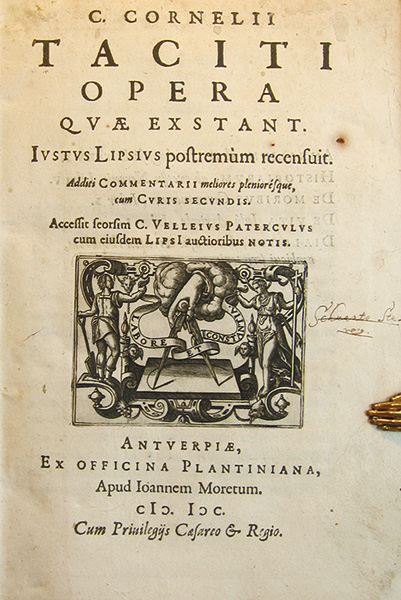
Tacitus’s last major work, titled Annals, written c. 116–117 C.E., includes a biography of Nero. In 64 C.E., during a fire in Rome, Nero was suspected of secretly ordering the burning of a part of town where he wanted to carry out a building project, so he tried to shift the blame to Christians. This was the occasion for Tacitus to mention Christians, whom he despised. This is what he wrote—the following excerpt is translated from Latin by Robert Van Voorst:
[N]either human effort nor the emperor’s generosity nor the placating of the gods ended the scandalous belief that the fire had been ordered [by Nero]. Therefore, to put down the rumor, Nero substituted as culprits and punished in the most unusual ways those hated for their shameful acts … whom the crowd called “Chrestians.” The founder of this name, Christ [Christus in Latin], had been executed in the reign of Tiberius by the procurator Pontius Pilate … Suppressed for a time, the deadly superstition erupted again not only in Judea, the origin of this evil, but also in the city [Rome], where all things horrible and shameful from everywhere come together and become popular.
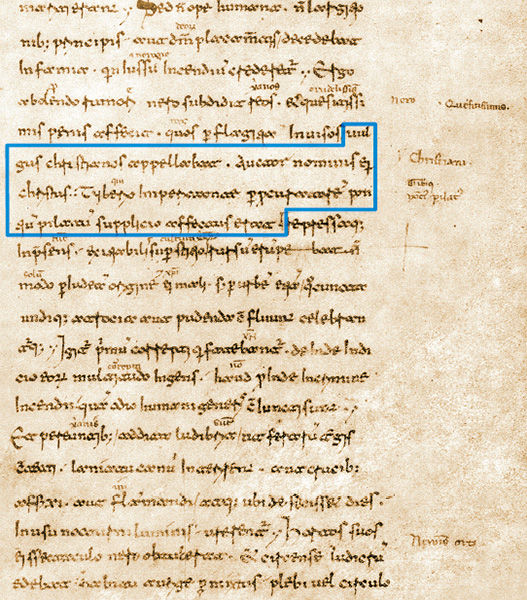
Tacitus’s terse statement about “Christus” clearly corroborates the New Testament on certain historical details of Jesus’ death. Tacitus presents four pieces of accurate knowledge about Jesus: (1) Christus, used by Tacitus to refer to Jesus, was one distinctive way by which some referred to him, even though Tacitus mistakenly took it for a personal name rather than an epithet or title; (2) this Christus was associated with the beginning of the movement of Christians, whose name originated from his; (3) he was executed by the Roman governor of Judea; and (4) the time of his death was during Pontius Pilate’s governorship of Judea, during the reign of Tiberius. (Many New Testament scholars date Jesus’ death to c. 29 C.E.; Pilate governed Judea in 26–36 C.E., while Tiberius was emperor 14–37 C.E.)
Tacitus, like classical authors in general, does not reveal the source(s) he used. But this should not detract from our confidence in Tacitus’s assertions. Scholars generally disagree about what his sources were. Tacitus was certainly among Rome’s best historians—arguably the best of all—at the top of his game as a historian and never given to careless writing.
Earlier in his career, when Tacitus was Proconsul of Asia, he likely supervised trials, questioned people accused of being Christians and judged and punished those whom he found guilty, as his friend Pliny the Younger had done when he too was a provincial governor. Thus Tacitus stood a very good chance of becoming aware of information that he characteristically would have wanted to verify before accepting it as true.
The other strong evidence that speaks directly about Jesus as a real person comes from Josephus, a Jewish priest who grew up as an aristocrat in first-century Palestine and ended up living in Rome, supported by the patronage of three successive emperors. In the early days of the first Jewish Revolt against Rome (66–70 C.E.), Josephus was a commander in Galilee but soon surrendered and became a prisoner of war. He then prophesied that his conqueror, the Roman commander Vespasian, would become emperor, and when this actually happened, Vespasian freed him. “From then on Josephus lived in Rome under the protection of the Flavians and there composed his historical and apologetic writings” (Gerd Theissen and Annette Merz). He even took the name Flavius, after the family name of his patron, the emperor Vespasian, and set it before his birth name, becoming, in true Roman style, Flavius Josephus. Most Jews viewed him as a despicable traitor. It was by command of Vespasian’s son Titus that a Roman army in 70 C.E. destroyed Jerusalem and burned the Temple, stealing its contents as spoils of war, which are partly portrayed in the imagery of their gloating triumph on the Arch of Titus in Rome. After Titus succeeded his father as emperor, Josephus accepted the son’s imperial patronage, as he did of Titus’s brother and successor, Domitian.


Yet in his own mind, Josephus remained a Jew both in his outlook and in his writings that extol Judaism. At the same time, by aligning himself with Roman emperors who were at that time the worst enemies of the Jewish people, he chose to ignore Jewish popular opinion.
Josephus stood in a unique position as a Jew who was secure in Roman imperial patronage and protection, eager to express pride in his Jewish heritage and yet personally independent of the Jewish community at large. Thus, in introducing Romans to Judaism, he felt free to write historical views for Roman consumption that were strongly at variance with rabbinic views.
In his two great works, The Jewish War and Jewish Antiquities, both written in Greek for educated people, Josephus tried to appeal to aristocrats in the Roman world, presenting Judaism as a religion to be admired for its moral and philosophical depth. The Jewish War doesn’t mention Jesus except in some versions in likely later additions by others, but Jewish Antiquities does mention Jesus—twice.
The shorter of these two references to Jesus (in Book 20) is incidental to identifying Jesus’ brother James, the leader of the church in Jerusalem. In the temporary absence of a Roman governor between Festus’s death and governor Albinus’s arrival in 62 C.E., the high priest Ananus instigated James’s execution. Josephus described it:
Being therefore this kind of person [i.e., a heartless Sadducee], Ananus, thinking that he had a favorable opportunity because Festus had died and Albinus was still on his way, called a meeting [literally, “sanhedrin”] of judges and brought into it the brother of Jesus-who-is-called-Messiah … James by name, and some others. He made the accusation that they had transgressed the law, and he handed them over to be stoned.
James is otherwise a barely noticed, minor figure in Josephus’s lengthy tome. The sole reason for referring to James at all was that his death resulted in Ananus losing his position as high priest. James (Jacob) was a common Jewish name at this time. Many men named James are mentioned in Josephus’s works, so Josephus needed to specify which one he meant. The common custom of simply giving the father’s name (James, son of Joseph) would not work here, because James’s father’s name was also very common. Therefore Josephus identified this James by reference to his famous brother Jesus. But James’s brother Jesus (Yehoshua) also had a very common name. Josephus mentions at least 12 other men named Jesus. Therefore Josephus specified which Jesus he was referring to by adding the phrase “who is called Messiah,” or, since he was writing in Greek, Christos. This phrase was necessary to identify clearly first Jesus and, via Jesus, James, the subject of the discussion. This extraneous reference to Jesus would have made no sense if Jesus had not been a real person.
Few scholars have ever doubted the authenticity of this short account. On the contrary, the huge majority accepts it as genuine. The phrase intended to specify which Jesus, translated “who is called Christ,” signifies either that he was mentioned earlier in the book or that readers knew him well enough to grasp the reference to him in identifying James. The latter is unlikely. First-century Romans generally had little or no idea who Christus was. It is much more likely that he was mentioned earlier in Jewish Antiquities. Also, the fact that the term “Messiah”/“Christ” is not defined here suggests that an earlier passage in Jewish Antiquities has already mentioned something of its significance. This phrase is also appropriate for a Jewish historian like Josephus because the reference to Jesus is a noncommittal, neutral statement about what some people called Jesus and not a confession of faith that actually asserts that he was Christ.
This phrase—“who is called Christ”—is very unlikely to have been added by a Christian for two reasons. First, in the New Testament and in the early Church Fathers of the first two centuries C.E., Christians consistently refer to James as “the brother of the Lord” or “of the Savior” and similar terms, not “the brother of Jesus,” presumably because the name Jesus was very common and did not necessarily refer to their Lord. Second, Josephus’s description in Jewish Antiquities of how and when James was executed disagrees with Christian tradition, likewise implying a non-Christian author.
This short identification of James by the title that some people used in order to specify his brother gains credibility as an affirmation of Jesus’ existence because the passage is not about Jesus. Rather, his name appears in a functional phrase that is called for by the sense of the passage. It can only be useful for the identification of James if it is a reference to a real person, namely, “Jesus who is called Christ.”
This clear reference to Jesus is sometimes overlooked in debates about Josephus’s other, longer reference to Jesus (to be treated next). Quite a few people are aware of the questions and doubts regarding the longer mention of Jesus, but often this other clear, simple reference and its strength as evidence for Jesus’ existence does not receive due attention.
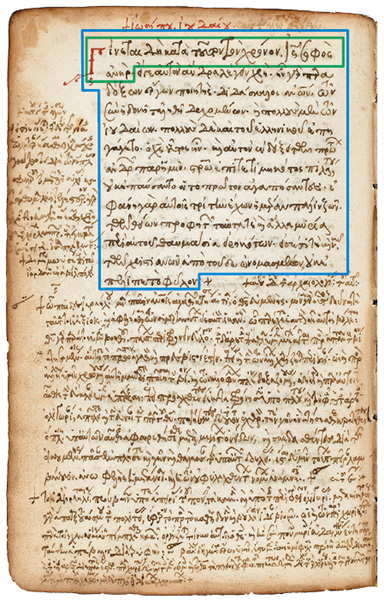
The longer passage in Josephus’s Jewish Antiquities (Book 18) that refers to Jesus is known as the Testimonium Flavianum.
If it has any value in relation to the question of Jesus’ existence, it counts as additional evidence for Jesus’ existence. The Testimonium Flavianum reads as follows; the parts that are especially suspicious because they sound Christian are in italics:
Around this time there lived Jesus, a wise man, if indeed one ought to call him a man. For he was one who did surprising deeds, and a teacher of such people as accept the truth gladly. He won over many Jews and many of the Greeks. He was the Messiah. When Pilate, upon hearing him accused by men of the highest standing among us, had condemned him to be crucified, those who in the first place came to love him did not give up their affection for him, for on the third day, he appeared to them restored to life. The prophets of God had prophesied this and countless other marvelous things about him. And the tribe of Christians, so called after him, have still to this day not died out.
All surviving manuscripts of the Testimonium Flavianum that are in Greek, like the original, contain the same version of this passage, with no significant differences.
The main question is: Did Flavius Josephus write this entire report about Jesus and his followers, or did a forger or forgers alter it or possibly insert the whole report? There are three ways to answer this question:
Alternative 1: The whole passage is authentic, written by Josephus.
Alternative 2: The whole passage is a forgery, inserted into Jewish Antiquities.
Alternative 3: It is only partly authentic, containing some material from Josephus, but also some later additions by another hand(s).
Regarding Alternative 1, today almost no scholar accepts the authenticity of the entire standard Greek Testimonium Flavianum. In contrast to the obviously Christian statement “He was the Messiah” in the Testimonium, Josephus elsewhere “writes as a passionate advocate of Judaism,” says Josephus expert Steve Mason. “Everywhere Josephus praises the excellent constitution of the Jews, codified by Moses, and declares its peerless, comprehensive qualities … Josephus rejoices over converts to Judaism. In all this, there is not the slightest hint of any belief in Jesus” as seems to be reflected in the Testimonium.
The bold affirmation of Jesus as Messiah reads as a resounding Christian confession that echoes St. Peter himself! It cannot be Josephus. Alternative 1 is clearly out.
Regarding Alternative 2—the whole Testimonium Flavianum is a forgery—this is very unlikely. What is said, and the expressions in Greek that are used to say it, despite a few words that don’t seem characteristic of Josephus, generally fit much better with Josephus’s writings than with Christian writings. It is hypothetically possible that a forger could have learned to imitate Josephus’s style or that a reviser adjusted the passage to that style, but such a deep level of attention, based on an extensive, detailed reading of Josephus’s works and such a meticulous adoption of his vocabulary and style, goes far beyond what a forger or a reviser would need to do.
Even more important, the short passage (treated above) that mentions Jesus in order to identify James appears in a later section of the book (Book 20) and implies that Jesus was mentioned previously.
The best-informed among the Romans understood Christus to be nothing more than a man’s personal name, on the level of Publius and Marcus. First-century Romans generally had no idea that calling someone “Christus” was an exalted reference, implying belief that he was the chosen one, God’s anointed. The Testimonium, in Book 18, appropriately found in the section that deals with Pilate’s time as governor of Judea, is apparently one of Josephus’s characteristic digressions, this time occasioned by mention of Pilate. It provides background for Josephus’s only other written mention of Jesus (in Book 20), and it connects the name Jesus with his Christian followers. The short reference to Jesus in the later book depends on the longer one in the earlier (Book 18). If the longer one is not genuine, this passage lacks its essential background. Alternative 2 should be rejected.
Alternative 3—that the Testimonium Flavianum is based on an original report by Josephus that has been modified by others, probably Christian scribes, seems most likely. After extracting what appear to be Christian additions, the remaining text appears to be pure Josephus. As a Romanized Jew, Josephus would not have presented these beliefs as his own. Interestingly, in three openly Christian, non-Greek versions of the Testimonium Flavianum analyzed by Steve Mason, variations indicate changes were made by others besides Josephus. The Latin version says Jesus “was believed to be the Messiah.” The Syriac version is best translated, “He was thought to be the Messiah.” And the Arabic version with open coyness suggests, “He was perhaps the Messiah concerning whom the prophets have recounted wonders.” Alternative 3 has the support of the overwhelming majority of scholars.
We can learn quite a bit about Jesus from Tacitus and Josephus, two famous historians who were not Christian. Almost all the following statements about Jesus, which are asserted in the New Testament, are corroborated or confirmed by the relevant passages in Tacitus and Josephus. These independent historical sources—one a non-Christian Roman and the other Jewish—confirm what we are told in the Gospels:
1. He existed as a man. The historian Josephus grew up in a priestly family in first-century Palestine and wrote only decades after Jesus’ death. Jesus’ known associates, such as Jesus’ brother James, were his contemporaries. The historical and cultural context was second nature to Josephus. “If any Jewish writer were ever in a position to know about the non-existence of Jesus, it would have been Josephus. His implicit affirmation of the existence of Jesus has been, and still is, the most significant obstacle for those who argue that the extra-Biblical evidence is not probative on this point,” Robert Van Voorst observes. And Tacitus was careful enough not to report real executions of nonexistent people.
2. His personal name was Jesus, as Josephus informs us.
3. He was called Christos in Greek, which is a translation of the Hebrew word Messiah, both of which mean “anointed” or “(the) anointed one,” as Josephus states and Tacitus implies, unaware, by reporting, as Romans thought, that his name was Christus.
4. He had a brother named James (Jacob), as Josephus reports.
5. He won over both Jews and “Greeks” (i.e., Gentiles of Hellenistic culture), according to Josephus, although it is anachronistic to say that they were “many” at the end of his life. Large growth in the number of Jesus’ actual followers came only after his death.
6. Jewish leaders of the day expressed unfavorable opinions about him, at least according to some versions of the Testimonium Flavianum.
7. Pilate rendered the decision that he should be executed, as both Tacitus and Josephus state.
8. His execution was specifically by crucifixion, according to Josephus.
9. He was executed during Pontius Pilate’s governorship over Judea (26–36 C.E.), as Josephus implies and Tacitus states, adding that it was during Tiberius’s reign.
Some of Jesus’ followers did not abandon their personal loyalty to him even after his crucifixion but submitted to his teaching. They believed that Jesus later appeared to them alive in accordance with prophecies, most likely those found in the Hebrew Bible. A well-attested link between Jesus and Christians is that Christ, as a term used to identify Jesus, became the basis of the term used to identify his followers: Christians. The Christian movement began in Judea, according to Tacitus. Josephus observes that it continued during the first century. Tacitus deplores the fact that during the second century it had spread as far as Rome.
As far as we know, no ancient person ever seriously argued that Jesus did not exist. Referring to the first several centuries C.E., even a scholar as cautious and thorough as Robert Van Voorst freely observes, “… [N]o pagans and Jews who opposed Christianity denied Jesus’ historicity or even questioned it.”
Nondenial of Jesus’ existence is particularly notable in rabbinic writings of those first several centuries C.E.: “… [I]f anyone in the ancient world had a reason to dislike the Christian faith, it was the rabbis. To argue successfully that Jesus never existed but was a creation of early Christians would have been the most effective polemic against Christianity … [Yet] all Jewish sources treated Jesus as a fully historical person … [T]he rabbis … used the real events of Jesus’ life against him” (Van Voorst).
Thus his birth, ministry and death occasioned claims that his birth was illegitimate and that he performed miracles by evil magic, encouraged apostasy and was justly executed for his own sins. But they do not deny his existence.
Lucian of Samosata (c. 115–200 C.E.) was a Greek satirist who wrote The Passing of Peregrinus, about a former Christian who later became a famous Cynic and revolutionary and died in 165 C.E. In two sections of Peregrinus—here translated by Craig A. Evans—Lucian, while discussing Peregrinus’s career, without naming Jesus, clearly refers to him, albeit with contempt in the midst of satire:
It was then that he learned the marvelous wisdom of the Christians, by associating with their priests and scribes in Palestine. And—what else?—in short order he made them look like children, for he was a prophet, cult leader, head of the congregation and everything, all by himself. He interpreted and explained some of their books, and wrote many himself. They revered him as a god, used him as a lawgiver, and set him down as a protector—to be sure, after that other whom they still worship, the man who was crucified in Palestine because he introduced this new cult into the world.
For having convinced themselves that they are going to be immortal and live forever, the poor wretches despise death and most even willingly give themselves up. Furthermore, their first lawgiver persuaded them that they are all brothers of one another after they have transgressed once for all by denying the Greek gods and by worshiping that crucified sophist himself and living according to his laws.
Although Lucian was aware of the Christians’ “books” (some of which might have been parts of the New Testament), his many bits of misinformation make it seem very likely that he did not read them. The compound term “priests and scribes,” for example, seems to have been borrowed from Judaism, and indeed, Christianity and Judaism were sometimes confused among classical authors.
Lucian seems to have gathered all of his information from sources independent of the New Testament and other Christian writings. For this reason, this writing of his is usually valued as independent evidence for the existence of Jesus.
This is true despite his ridicule and contempt for Christians and their “crucified sophist.” “Sophist” was a derisive term used for cheats or for teachers who only taught for money. Lucian despised Christians for worshiping someone thought to be a criminal worthy of death and especially despised “the man who was crucified.”
Other testimony that has some value, but much less, as evidence regarding the existence of Jesus appears in the writings of the following people:
- Celsus, the Platonist philosopher, considered Jesus to be a magician who made exorbitant claims.
- Pliny the Younger, a Roman governor and friend of Tacitus, wrote about early Christian worship of Christ “as to a god.”
- Suetonius, a Roman writer, lawyer and historian, wrote of riots in 49 C.E. among Jews in Rome which might have been about Christus but which he thought were incited by “the instigator Chrestus,” whose identification with Jesus is not completely certain.
- Mara bar Serapion, a prisoner of war held by the Romans, wrote a letter to his son that described “the wise Jewish king” in a way that seems to indicate Jesus but does not specify his identity.
Other documentary sources are doubt-ful or irrelevant.
One can label the evidence treated above as documentary (sometimes called literary) or as archaeological. Almost all sources covered above exist in the form of documents that have been copied and preserved over the course of many centuries, rather than excavated in archaeological digs. Therefore, although some writers call them archaeological evidence, I prefer to say that these truly ancient texts are ancient documentary sources, rather than archaeological discoveries.
Some ossuaries (bone boxes) have come to light that are inscribed simply with the name Jesus (Yeshu or Yeshua‘ in Hebrew), but no one suggests that this was Jesus of Nazareth. The name Jesus was very common at this time, as was Joseph. So as far as we know, these ordinary ossuaries have nothing to do with the New Testament Jesus. Even the ossuary from the East Talpiot district of Jerusalem, whose inscription is translated “Yeshua‘, son of Joseph,” does not refer to him.
As for the famous James ossuary first published in 2002,d whose inscription is translated “Jacob, son of Joseph, brother of Yeshua‘,” more smoothly rendered, “James, son of Joseph, brother of Jesus,” it is unprovenanced, and it will likely take decades to settle the matter of whether it is authentic. Following well-established, sound methodology, I do not base conclusions on materials whose authenticity is uncertain, because they might be forged. Therefore the James ossuary, which is treated in many other publications, is not included here.
As a final observation: In New Testament scholarship generally, a number of specialists consider the question of whether Jesus existed to have been finally and conclusively settled in the affirmative. A few vocal scholars, however, still deny that he ever lived.
Lawrence Mykytiuk is Emeritus Professor of Library Science and former Associate Professor of History (courtesy) at Purdue University. He holds a Ph.D. in Hebrew and Semitic Studies and is the author of Identifying Biblical Persons in Northwest Semitic Inscriptions of 1200–539 B.C.E. (2004).
MLA Citation
Mykytiuk, Lawrence. “Did Jesus Exist? Searching for Evidence Beyond the Bible,” Biblical Archaeology Review 41.1 (2015): 45–51, 76.
Self-Esteem and Forgiveness
We hear a lot about “self-esteem” today. The “self-esteem movement,” made up of some religious teachers and psychologists, seeks to make people feel better about themselves without making any reference to sin or the need for forgiveness. Some religious teachers have even said that Christianity should stop talking about sin. Because the movement is associated with psychology, many mistakenly believe that the claims of the “self-esteem movement” have a scientific basis. They do not.

Consider the Pharisee who prayed, “God, I thank you that I am not like other men…” From the world’s standpoint, he had no trouble with self-esteem. On the other hand, the world would say that the sinner who prayed, “God be merciful to me, a sinner…” had a serious self-esteem problem. In Jesus’ analysis, however, the Pharisee’s self-righteousness – his “good self-image” – was what kept him from God. It was the sinner’s knowledge of his self-worthlessness, and humble repentance, that brought him the peace of God in a personal relationship with his Maker.
From this vantage point, it is easy to see that the cult of self-esteem promotes self-righteousness. Adding Christ to self-esteem still produces self-righteousness.
Christians and all people need to be encouraged to focus on Christ! The Christian who lives a daily life of repentance in the full knowledge that Christ has redeemed him, making full atonement and peace with God, will have no “self-esteem problem.”
Luke 18:13
“And the publican, standing afar off, would not lift up so much as [his] eyes unto heaven, but smote upon his breast, saying, God be merciful to me a sinner.”
Prayer: Forgive me, dear Lord, for those times when I have thanklessly felt sorry for myself or let my pride come between us. Fill me with the joy and peace that only You can provide through the forgiveness of my sins. Amen.
Photo: Man crying in a support group, Envato.
Source: Creation Moments
Our Only Safety – Christ Jesus
“Our only safety is to have Christ ever before us as our all-governing object; and the more steadfastly we look on Him, the more will His character be mirrored on our souls, and the more distinctly shall we reflect it to others. In looking to Him, we are enlightened; to have any other object before us is to be in blindness of popish bigotry and the clouds that arise in the Christian’s heart of self-occupation. To be true witnesses of a heavenly Christ, we must be heavenly minded, and heavenly in our ways. And heavenly-mindedness is the result, not of trying to be so, but of occupation with a heavenly Christ, according to the revelation which we have of Him, through the power of the Holy Spirit. In what direction is the eye? is always the important question, for the heart is sure to follow the eye, and the feet the heart.
The following passage may be accepted as a practical view of Christianity, both negatively and positively. “For the grace of God that bringeth salvation hath appeared to all men, teaching us, that denying ungodliness and worldly lusts, we should live soberly, righteously, and godly in the present world; looking for that blessed hope, and the glorious appearing of the great God and Saviour Jesus Christ; who gave Himself for us, that He might redeem us from all iniquity, and purifying unto Himself a peculiar people, zealous of good works” (Titus 2: 11-14).”
Source: Andrew Miller, Miller’s Church History (PICKERING & INGLIS LTD, London 1976), p. 898
These two paragraphs express the lesson learned from the Roman Catholic pope and Emperor Philip’s attempt to kill the Reformation in the Netherlands by murdering the Protestants over a span of 40 YEARS. This occurred in the 1500s.
Christ- our only safety and hope.
Carl

