
Xi Jinping’s CCP is rewriting the Bible

by Samuel Ben-Ur, Op-ed contributor – May 13, 2026

Christian Post

The Chinese Communist Party is rewriting the Bible. 

As part of Xi Jinping’s “Sinicization of Christianity” campaign, the Chinese Communist Party (CCP) plans to ensure Christianity in China is instilled with “core socialist values.” Pursuant to that effort, the CCP is currently working on its own translation of what it calls the “Chinese Christian Bible.” While it has yet to complete the project, the CCP has already given Christians a glimpse of what the world’s first communist Bible might look like. 

In China, the Ten Commandments became nine, then six, then zero. 

In 2018, mere months after Xi announced his “Five-Year Plan to Sinicize Christianity,” authorities forced a state-approved church in Henan Province to delete the First Commandment, “You shall have no other gods before Me.” The removal of arguably the single most important line of text not just for Christianity, but for all three Abrahamic faiths, is a strike against the very heart of religion. 

Later that year, the government changed the curriculum of a Sunday school in Hong Kong, removing not just the first four Commandments, but all references to “the Lord.” The entire book of Genesis was also removed. In 2019, the CCP completed this progression and replaced the Ten Commandments wholesale with Xi Jinping quotes. Within the span of a year, “You shall have no god before me” became “Use Chinese Culture to permeate faith” and “follow the party.”

The CCP has also targeted John 8:3-11, among the most famous passages in the New Testament. In the original story, when the Pharisees bring Jesus a woman accused of adultery, he replies, “Let him who is without sin among you be the first to cast a stone at her.” He then forgives the woman.

A textbook published by China’s University of Electronic Science and Technology Press, a government-run school, changes the ending. After the Pharisees leave, Christ tells the woman “I too am a sinner. But if the law could only be executed by men without blemish, the law would be dead.” Jesus then personally stones her to death.

These stories reveal the true face of “Sinicization.” Xi seeks to transform the Gospel into banal communist diktats, where mercy is subsumed by oppressive lawfare and the Party is the only higher power.

The CCP is, of course, avowedly atheist, and essentially deifies former Chairman Mao Zedong, who banned all religion during his reign, from the end of the Chinese Civil War in 1949 to his death in 1976. 

The CCP views Christians particularly with suspicion, due to perceived Western ties and the role of Christianity in the Taiping Rebellion of the 1850s, in which more than 20 million died.

Xi might similarly desire to ban Christianity, but Xi is not Mao and Xi’s China is not Mao’s China. 

When Mao came to power, there were approximately four million Christians living in China. Since Mao’s death and China’s relative relaxation of religious restrictions, the Christian population has exploded. Xi presides over as many as 160 million Christians, though the exact number is opaque, as most worship in underground churches to avoid CCP oversight. If Christianity continues to grow at a steady rate, China may be the world’s largest Christian country by 2030.

Despite CCP propaganda glorifying Mao, the Party is not eager to repeat the insanity of the Cultural Revolution, which spanned from 1966 to 1976. That period brought societal turmoil and more than a million deaths. Coupled with the challenge of forcing disbelief on more than 100 million Christians, today’s CCP is likely unable and unwilling to enforce a zero-tolerance religious policy. Instead of suppressing Christianity, it has sought to adapt it to Chinese Communist ideology — developing Christianity into another propaganda mill for the CCP. Grasping Xi’s endgame is crucial to understanding the unique persecution Chinese Christians face. 

Where other forms of Christian persecution are marked by bloodshed, such as in Nigeria, where Islamist terror groups routinely massacre Christians, China instead seeks to replace God with the Party. This is why, of all Christian teachings, the CCP first sought to remove the first of the Ten Commandments, “Thou shalt have no other gods before me.” 

Incidents such as these are merely the surface of what Xi’s “Sinicization” program entails. 

China has instituted a bevy of religious restrictions since 2020, including loyalty tests for clergy, requiring the inclusion of Xi Jinping’s thought in seminary curricula, and a total ban on minors participating in religious activity. 

Surveillance technology now permeates churches across China, monitoring sermons and building a database of Chinese Christians. Resistance to the implementation of surveillance devices can lead to beatings or disappearances for Christians who wish to maintain a degree of independence from the CCP. Authorities have ripped down thousands of crosses and replaced them with portraits of Xi. Churches that refuse to join China’s state-sponsored religious bodies have been targeted with increasing frequency in large-scale raids in which police lock up hundreds of worshipers. 

As the Trump administration increasingly seeks to combat the oppression of Christians worldwide, Washington should mandate that the State Department’s International Religious Freedom process explicitly catalog altered biblical texts, approving committees, state-run publishers, and responsible officials. Those findings should be used to drive rolling Global Magnitsky sanctions and visa bans against those involved in clergy loyalty tests, church raids, and scripture rewriting. 

The U.S. is the only country in the world that can bring to bear sufficient pressure on China to slow or even stop its corruption of the Christian faith. Standing up to Beijing is essential to any policy of defending persecuted Christians.


Originally published at Providence. 

Samuel Ben-Ur is a research analyst focusing on Christian persecution at the Foundation for Defense of Democracies.
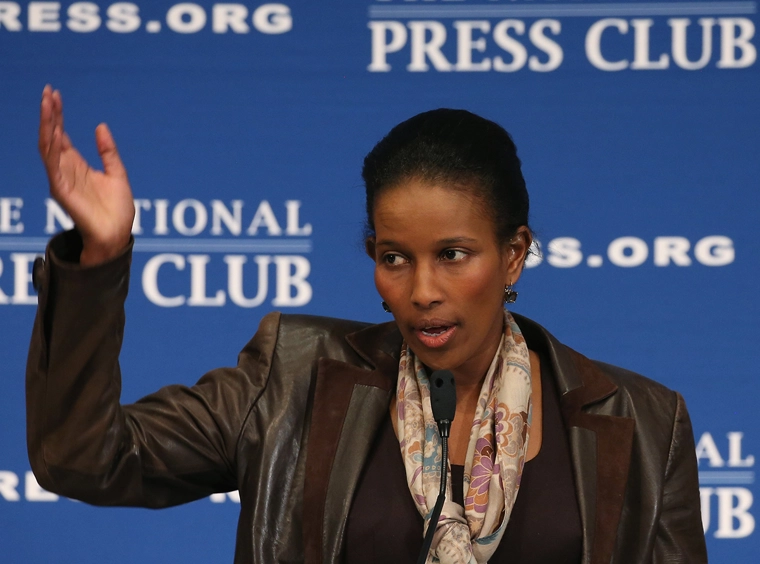
Muslim-turned-atheist rights activist Ayaan Hirsi Ali says she is now a Christian

By Anugrah Kumar, Christian Post Contributor

Ayaan Hirsi Ali, a former Muslim and renowned critic of Islam, has revealed her conversion to Christianity, describing her journey from Islam to atheism and ultimately to Christianity.

In a Weekend Essay published on UnHerd, Hirsi Ali, who is known for her bestselling books and outspoken views, says her encounter with Bertrand Russell’s 1927 lecture “Why I am Not a Christian” led her to atheism, offering solace and escape from the fear instilled by religious doctrine. She found Russell’s views on religion, rooted in fear, resonant with her own experiences.

“It did not cross my mind, as I read it, that one day, nearly a century after he delivered it to the South London branch of the National Secular Society, I would be compelled to write an essay with precisely the opposite title,” adds Hirsi Ali, who is originally from Somalia and is a survivor of genital mutilation.

Hirsi Ali traces her initial disillusionment with Islam following the 9/11 terrorist attacks when she questioned the justifications for the attacks in the name of Islam.

During her teenage years in Nairobi, Hirsi Ali says she was influenced by the Muslim Brotherhood, which instilled in her a strict interpretation of Islam.

This period was characterized by a strict adherence to religious practices and a deep-seated disdain for non-Muslims, particularly Jews. However, her later exposure to atheism through figures like Christopher Hitchens and Richard Dawkins provided a stark contrast to her previous beliefs.

Hirsi Ali attributes her turn to Christianity to a broader concern for the challenges facing Western civilization. She cites threats from authoritarian regimes, global Islamism, and “woke” ideology as catalysts for seeking a unifying force. Christianity, in her view, offers a foundation of values and traditions that uphold human life, freedom, and dignity, and counters the divisiveness she associates with atheism.

Responding to her embrace of the Christian faith, conservative Christian philosopher Dr. Robert George wrote on Facebook: “Two decades ago, under the influence of the writings of Bertrand Russell, she became an atheist. Her thought was that atheism was smart and sophisticated — it was allegedly what really intelligent people believed (the ‘brights,’ as Daniel Dennett embarrassingly labeled himself and his fellow unbelievers). It was the way to a world of rationality and civil liberty. Hirsi Ali is not the first to have gone down that misguided path. She now sees that it is indeed misguided and that there is, if I may quote scripture, ‘a more excellent way.’”

Hirsi Ali’s embrace of Christianity also stems from a personal quest for spiritual solace and meaning in life.

Hirsi Ali critiques atheism for leaving a “God hole,” which she believes has led to the rise of irrational ideologies and the erosion of Western values. She argues that Christianity provides a unifying story and foundational texts, similar to those in Islam, that can engage and mobilize people.

Speaking at the National Press Club in 2015, Hirsi Ali offered five amendments to the religion of Islam that Muslims should take seriously if they really want to bring about a peaceful reformation to their religion.

She suggested Muslims should view the Quran and the hadith as creations of human effort, potentially divinely inspired but ultimately human in origin. This perspective challenges the traditional view of Muhammad as a moral guide post-Mecca, which Hirsi Ali finds problematic.

As the second amendment, Hirsi Ali advocated for a change in how Muslims prioritize life after death over life before death. She called for a reorientation toward valuing earthly life more.

She also argued that Shariah law is responsible for widespread violence and oppression in Muslim cultures, exemplified by regimes like Saudi Arabia, Iran and the Islamic State terrorist group.

As her fourth amendment, she called for the elimination of the principle of “Commanding Right and Forbidding Wrong.” This principle, according to Hirsi Ali, leads to vigilantism and mob justice, as seen in cases where citizens punish individuals for alleged violations of Shariah law or disrespect toward Muhammad.

Hirsi Ali also called for an end to the concept of Jihad as Holy war, advocating instead for a focus on peace.

Source: Christian Post

A Christian Turned Atheist vs An Atheist Turned Christian

Could two highly intelligent men with two entirely different perspectives possibly help you come to your own personal conclusion concerning the central figure of history? Perhaps. Let’s find out. 

History’s central figure, of course, is Jesus Christ. And the two men I have in mind are American New Testament scholar Bart Ehrman and Canadian astrophysicist Hugh Ross. 

Ehrman professed faith in Christ as a teenager but is now an atheist; whereas Ross grew up in a non-religious home but is now a Christian. One man abandoned Christianity, while the other embraced it.

Ross said, “I didn’t know any Christians or serious followers of any religion while growing up.” Ehrman, on the other hand, said, “For most of my life I was a devout and committed Christian.” 

At age 17, Hugh Ross became the youngest person yet to serve as director of observations for Vancouver’s Royal Astronomical Society. And Bart Ehrman is the James A. Gray Distinguished Professor of Religious Studies at the University of North Carolina at Chapel Hill.

Ross came to faith in Christ after first investigating the world’s major religions. Ross said, “I reasoned that if man invented a religion, it would reflect human error. But, if God communicated, His message would be error free and as consistent as the facts of nature. So, I used the facts of history and science to test each of the ‘holy’ books.”

He stated, “One by one each book failed the factuality test, and I gained confidence that my initial skepticism would be affirmed — until I picked up a Bible.” He found that the Bible “described the 4 fundamental features of big bang cosmology.” 

  1. The beginning of space and time coincident with the beginning of matter and energy.
  2. Continual expansion of the universe from the cosmic beginning.
  3. The constancy of physical laws, and
  4. The pervasiveness of entropy (decay).

After much personal Bible study, Ross said, “I clearly understood that Jesus Christ was the Creator of the universe, that He paid the price only a sinless person could pay for all of my offenses against God, and that eternal life would be mine if I received his pardon and gave Him His rightful place of authority over my life.”

Bart Ehrman, on the other hand, reversed course from his earlier profession of faith. Ehrman said, “I had solid Christian credentials and knew about the Christian faith from the inside out … but then … I started to lose my faith. I now have lost it altogether. I no longer go to church, no longer believe, no longer consider myself a Christian.”

In my recent CP op-ed titled, “When Textual Variants are a Convenient Excuse,” I quoted Bart Ehrman in explaining what led him to walk away from Christ: “It wasn’t problems in the Bible I was wrestling with. It was why is there so much suffering in the world? That’s why I left the faith.”

Ehrman’s attitude toward Jesus became darkened, separating him from the One who said: “I am the light of the world. Whoever follows me will never walk in darkness, but will have the light of life” (John 8:12).

Ehrman thinks the Bible misquoted Jesus. Hugh Ross disagrees, and says, “The fact that there is no historical record of called-out mistakes or corrections to the four Gospels by contemporaries of the gospel writers testifies to the accuracy of Jesus’ quotes within them.”

Bart Ehrman no longer believes Christ rose from the dead. Hugh Ross said, “Ehrman is also wrong about the evidence for the bodily resurrection of Jesus being based on visions alone. There is the empty tomb. The powerful enemies of the emergent Christian faith, the Jewish religious leaders and the Romans, were unable to produce the body of Jesus. Also, it would take more than visions to persuade the 10,000+ Jews living in Jerusalem at that time — more than a third of the total population — to become Christians in the few days that followed Jesus’ death on the cross.”

Bart Ehrman’s unanswered questions about suffering in the world spawned his atheism, whereas Hugh Ross discovered that God’s book of nature is in alignment with God’s revelation in Scripture. This remarkable realization led Ross straight into the arms of our Creator.

Dr. John Lennox is a Northern Irish mathematician, bioethicist, and Christian apologist. Lennox said, “Faith is not a leap in the dark; it’s the exact opposite. It’s a commitment based on evidence … It is irrational to reduce all faith to blind faith and then subject it to ridicule. That provides a very anti-intellectual and convenient way of avoiding intelligent discussion.” 

English theoretical physicist and cosmologist Stephen Hawking said, “Heaven is a fairy tale for people who are afraid of the dark.” John Lennox responded, “Atheism is a fairy story for those who are afraid of the light.” 

Hugh Ross has witnessed time and time again how the evidence in nature is fully consistent with the message of the Bible. Dr. Ross established Reasons to Believe in 1986. This ministry helps people “discover how scientific research and clear thinking consistently affirm the truth of the Bible and of the Good News it reveals.”

Bart Ehrman and Hugh Ross are heading in opposite directions. Jesus identified the wide road to Hell and the narrow road to Heaven in Matthew 7:14,13. You can either believe what Jesus said about these eternal destinations, or what Bart Ehrman says about them. 

But know this: Your personal beliefs will not change God’s book of nature, Scripture, the good news of the Gospel, reality, truth, Heaven, Hell, etc. Your beliefs will only change your heart and your eternal destiny. 

Bart Ehrman and Hugh Ross provide some context as you investigate the book of nature, the message of Scripture, and the historical facts of Christianity. Thankfully, there is still time for you to base your faith upon the breathtaking evidence God has graciously provided. 

(In addition to Dr. Ross’s website, you could explore even more reasons to believe in Evidence that Demands a Verdict by Josh McDowell.)

Dan Delzell is the pastor of Redeemer Lutheran Church in Papillion, Nebraska. 

Source: Christian Post