Please visit the following link for a true fascinating journey of an atheistic filmmaker who finally finds salvation in Jesus Christ. God bless you and yours. Carl
www1.cbn.com/cbnnews/world/2026/january/atheist-filmmaker-abandons-unbelief-for-jesus

Please visit the following link for a true fascinating journey of an atheistic filmmaker who finally finds salvation in Jesus Christ. God bless you and yours. Carl
www1.cbn.com/cbnnews/world/2026/january/atheist-filmmaker-abandons-unbelief-for-jesus
Recent survey shows 64% of churchgoers do not understand the biblical way of salvation.
Only 36% correctly affirm: “You will go to Heaven if you repent of sin and accept Christ.” The rest of American churchgoers are completely misguided regarding who goes to Heaven.
The Family Research Council released the study a few months ago. And here is what people in the pew actually think:
Why are two-thirds of churchgoers wrong about something so foundational to Christianity? If your pastor is not preaching the Gospel, you should switch to a church where the truth of Scripture is being taught.
Half of American churchgoers (49%) either do not know who goes to Heaven, or believe that everyone goes to Heaven, or think that everyone is purified and then goes to Heaven. These statistics are shocking! And remember, these are people who actually attend church!
The biggest problem is that many pastors are not firmly rooting believers in the Gospel and the truth of Scripture. How else can you account for this sorry state of affairs among American churchgoers?
Southern Baptist professor Dr. Dustin Benge said, “You don’t need massive platforms, radical ideas, and revolutionary fervor to accomplish great things for God. Do the ordinary things: Serve in a local church, Stand on the truth, Share the Gospel, Love people. God uses ‘ordinary’ people to turn the world upside down.”
The Apostle Paul would have never made an impact if it were not for the power of the Gospel. And the same is true for all of the apostles, as well as anyone who has ever been called by the Holy Spirit to preach God’s Word.
— Read on www.christianpost.com/voices/why-are-64-of-american-churchgoers-wrong-about-heaven.html
I hope you are spreading the biblical gospel in your sphere of influence and beyond. Blessings to you!
Carl
Source: Christian Post (See note at end of article)
What would you do if you had no access to Scripture? Most Americans have multiple Bibles at home, dozens of translations at our fingertips, and devotional apps on every device. Yet for believers living in hostile areas and restricted nations, a single torn page of the New Testament is a treasure worth suffering for.
For many Christians around the world, owning a Bible is illegal. It can cost a believer their freedom or even their life. Yet, in the darkest prison cells and most hostile corners of the world, the Word of God remains the most desired possession.
During 25+ years serving at The Voice of the Martyrs, I’ve had the honor to meet with persecuted Christians living and serving in the most dangerous and difficult places to follow Christ. Often, they share their inspiring testimonies.
Recently I came across five powerful stories about what having access to Scripture meant to imprisoned Christians.
1. Brother Joe
Brother Joe, a former prisoner in North Africa, received a smuggled portion of the Bible — just Psalms and part of the Gospel of John. For him, those verses were life itself.
“I would cry over the words,” he said. “Not because I was sad, but because it was like Jesus Himself was sitting in my cell with me.”
Even as Brother Joe endured torture, he began copying verses by hand to share with other prisoners. The guards tried to stop him, but the Word kept spreading. As the prophet Isaiah wrote, “The word of our God shall stand forever.”
2. Helen Berhane
Helen Berhane, an Eritrean gospel singer who was imprisoned in a metal shipping container for over two years, had no Bible at all — but she had memorized verses before her arrest.
“The Word became my song, my food, my comfort,” she shared. “I had no book, but I had Him.”
Even today, years later, those memorized verses continue to sustain her.
3. Aaron
Aaron, a front-line worker, told me about a woman jailed for leading Bible studies in China, where the underground church is heavily persecuted. Fellow inmates, recalling verses they had memorized, pieced together entire chapters from memory. When a contraband Bible finally arrived, they tore it apart — not to destroy it, but to share it.
“In that cell,” Aaron said, “the Bible wasn’t just a book — it was their breath.”
4. Ali
Perhaps the most startling transformation came in the life of Ali, a former jihadist who encountered the Gospel of Luke in prison. The Bible turned his world upside down.
“I had studied violence all my life,” he said. “Then I met Jesus in a jail cell in the pages of that book. That Bible broke me.”
Ali found, for the first time, a God who loves His enemies and sent His Son to die for them.
The Bible is more than print on paper — it’s living and active. The Word of God has the power to sustain people’s faith under the most intense persecution. For the millions of Christians in hostile nations, a Bible is not just a comfort. It is what carries them through their torture and suffering.
5. Iranian prisoner
Hormoz Shariat, the founder of Iran Alive Ministries known as “the Billy Graham of Iran,” shared how one Iranian prisoner risked his life to possess a single page of Scripture. That page became a spark. He memorized it and passed it to another inmate, who did the same.
“They shared one torn page like it was gold,” Shariat said. “It was enough to bring light into total darkness.”
In Iran, where printing or importing Farsi Bibles is illegal, believers face prison or death for sharing God’s Word. And yet, they do it anyway. The hunger for the Bible is so deep that even a fragment — one Psalm, one parable — is worth everything.
Every April, VOM focuses on getting Bibles to persecuted Christians. This year, our ministry has identified 458,000 Christians, by name, who are waiting for a Bible in hostile areas and restricted nations.
Through front-line workers, the ministry is positioned to deliver these Bibles directly into the hands of those who need them most. Imagine being the reason a believer in prison experiences the presence of Christ in their darkest hour!
There are many lessons to learn from others who have suffered for their faith. The stories here are just a small example of the power of God’s Word to bring hope and strength to our brothers and sisters in Christ.
Maybe our first lesson is not to take for granted what others are risking everything to hold.
Todd Nettleton is Vice President for Message at The Voice of the Martyrs and host of The Voice of the Martyrs Radio. He is the author of When Faith Is Forbidden: 40 Days on the Frontlines with Persecuted Christians.
READER NOTE: Voice of The Martyrs charges $10 per Bible per their donation page. Asia Harvest charges $3 to print and deliver a Bible per their donation page. Asia Harvest and the underground church in China estimate that for every Bible given to a believer in China, at least one other individual comes to Christ. Not a bad $3 investment in the Kingdom of God!
Asia Harvest’s ministry is limited to Asia. They print Bibles in 163 different Asian languages. Our family has supported this effort for about three years.
Voice of the Martyrs ministry is worldwide evidently.
May you do your part to spread His Word in this dark world.
Blessings to all,
Carl
(The following is an article from Biblical Archaeology Society by Lawrence Mykytiuk (bio at end of article). If you are interested in archaeology and its relationship to the Bible, we recommend looking at this organization.)
After two decades toiling in the quiet groves of academe, I published an article in BAR titled “Archaeology Confirms 50 Real People in the Bible.”a The enormous interest this article generated was a complete surprise to me. Nearly 40 websites in six languages, reflecting a wide spectrum of secular and religious orientations, linked to BAR’s supplementary web page.b Some even posted translations.
I thought about following up with a similar article on people in the New Testament, but I soon realized that this would be so dominated by the question of Jesus’ existence that I needed to consider this question separately. This is that article:
Did Jesus of Nazareth, who was called Christ, exist as a real human being, “the man Christ Jesus” according to 1 Timothy 2:5?
The sources normally discussed fall into three main categories: (1) classical (that is, Greco-Roman), (2) Jewish and (3) Christian. But when people ask whether it is possible to prove that Jesus of Nazareth actually existed, as John P. Meier pointed out decades ago, “The implication is that the Biblical evidence for Jesus is biased because it is encased in a theological text written by committed believers. What they really want to know is: Is there extra-Biblical evidence … for Jesus’ existence?”c
Therefore, this article will cover classical and Jewish writings almost exclusively.
Tacitus—or more formally, Caius/Gaius (or Publius) Cornelius Tacitus (55/56–c. 118 C.E.)—was a Roman senator, orator and ethnographer, and arguably the best of Roman historians. His name is based on the Latin word tacitus, “silent,” from which we get the English word tacit. Interestingly, his compact prose uses silence and implications in a masterful way. One argument for the authenticity of the quotation below is that it is written in true Tacitean Latin. But first a short introduction.

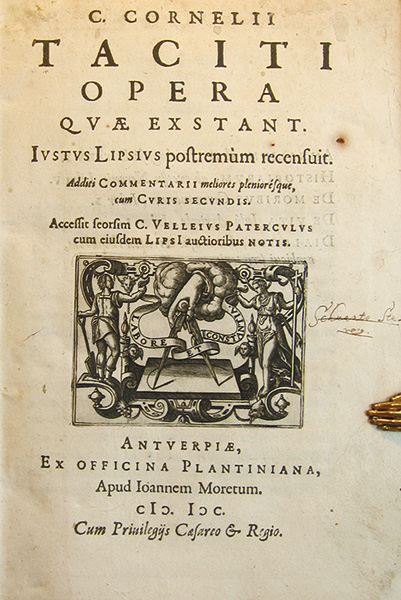
Tacitus’s last major work, titled Annals, written c. 116–117 C.E., includes a biography of Nero. In 64 C.E., during a fire in Rome, Nero was suspected of secretly ordering the burning of a part of town where he wanted to carry out a building project, so he tried to shift the blame to Christians. This was the occasion for Tacitus to mention Christians, whom he despised. This is what he wrote—the following excerpt is translated from Latin by Robert Van Voorst:
[N]either human effort nor the emperor’s generosity nor the placating of the gods ended the scandalous belief that the fire had been ordered [by Nero]. Therefore, to put down the rumor, Nero substituted as culprits and punished in the most unusual ways those hated for their shameful acts … whom the crowd called “Chrestians.” The founder of this name, Christ [Christus in Latin], had been executed in the reign of Tiberius by the procurator Pontius Pilate … Suppressed for a time, the deadly superstition erupted again not only in Judea, the origin of this evil, but also in the city [Rome], where all things horrible and shameful from everywhere come together and become popular.
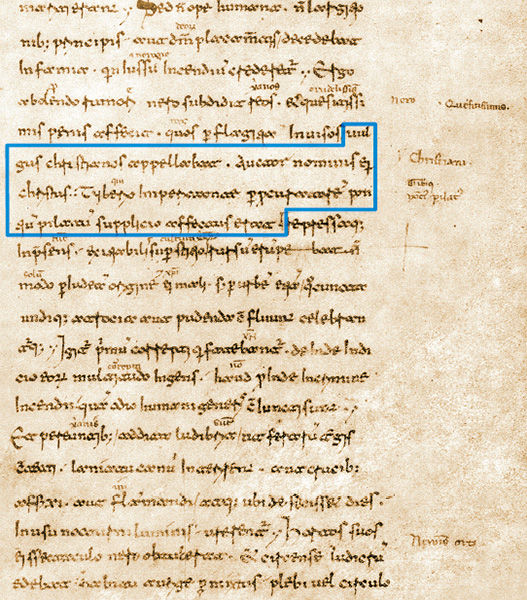
Tacitus’s terse statement about “Christus” clearly corroborates the New Testament on certain historical details of Jesus’ death. Tacitus presents four pieces of accurate knowledge about Jesus: (1) Christus, used by Tacitus to refer to Jesus, was one distinctive way by which some referred to him, even though Tacitus mistakenly took it for a personal name rather than an epithet or title; (2) this Christus was associated with the beginning of the movement of Christians, whose name originated from his; (3) he was executed by the Roman governor of Judea; and (4) the time of his death was during Pontius Pilate’s governorship of Judea, during the reign of Tiberius. (Many New Testament scholars date Jesus’ death to c. 29 C.E.; Pilate governed Judea in 26–36 C.E., while Tiberius was emperor 14–37 C.E.)
Tacitus, like classical authors in general, does not reveal the source(s) he used. But this should not detract from our confidence in Tacitus’s assertions. Scholars generally disagree about what his sources were. Tacitus was certainly among Rome’s best historians—arguably the best of all—at the top of his game as a historian and never given to careless writing.
Earlier in his career, when Tacitus was Proconsul of Asia, he likely supervised trials, questioned people accused of being Christians and judged and punished those whom he found guilty, as his friend Pliny the Younger had done when he too was a provincial governor. Thus Tacitus stood a very good chance of becoming aware of information that he characteristically would have wanted to verify before accepting it as true.
The other strong evidence that speaks directly about Jesus as a real person comes from Josephus, a Jewish priest who grew up as an aristocrat in first-century Palestine and ended up living in Rome, supported by the patronage of three successive emperors. In the early days of the first Jewish Revolt against Rome (66–70 C.E.), Josephus was a commander in Galilee but soon surrendered and became a prisoner of war. He then prophesied that his conqueror, the Roman commander Vespasian, would become emperor, and when this actually happened, Vespasian freed him. “From then on Josephus lived in Rome under the protection of the Flavians and there composed his historical and apologetic writings” (Gerd Theissen and Annette Merz). He even took the name Flavius, after the family name of his patron, the emperor Vespasian, and set it before his birth name, becoming, in true Roman style, Flavius Josephus. Most Jews viewed him as a despicable traitor. It was by command of Vespasian’s son Titus that a Roman army in 70 C.E. destroyed Jerusalem and burned the Temple, stealing its contents as spoils of war, which are partly portrayed in the imagery of their gloating triumph on the Arch of Titus in Rome. After Titus succeeded his father as emperor, Josephus accepted the son’s imperial patronage, as he did of Titus’s brother and successor, Domitian.


Yet in his own mind, Josephus remained a Jew both in his outlook and in his writings that extol Judaism. At the same time, by aligning himself with Roman emperors who were at that time the worst enemies of the Jewish people, he chose to ignore Jewish popular opinion.
Josephus stood in a unique position as a Jew who was secure in Roman imperial patronage and protection, eager to express pride in his Jewish heritage and yet personally independent of the Jewish community at large. Thus, in introducing Romans to Judaism, he felt free to write historical views for Roman consumption that were strongly at variance with rabbinic views.
In his two great works, The Jewish War and Jewish Antiquities, both written in Greek for educated people, Josephus tried to appeal to aristocrats in the Roman world, presenting Judaism as a religion to be admired for its moral and philosophical depth. The Jewish War doesn’t mention Jesus except in some versions in likely later additions by others, but Jewish Antiquities does mention Jesus—twice.
The shorter of these two references to Jesus (in Book 20) is incidental to identifying Jesus’ brother James, the leader of the church in Jerusalem. In the temporary absence of a Roman governor between Festus’s death and governor Albinus’s arrival in 62 C.E., the high priest Ananus instigated James’s execution. Josephus described it:
Being therefore this kind of person [i.e., a heartless Sadducee], Ananus, thinking that he had a favorable opportunity because Festus had died and Albinus was still on his way, called a meeting [literally, “sanhedrin”] of judges and brought into it the brother of Jesus-who-is-called-Messiah … James by name, and some others. He made the accusation that they had transgressed the law, and he handed them over to be stoned.
James is otherwise a barely noticed, minor figure in Josephus’s lengthy tome. The sole reason for referring to James at all was that his death resulted in Ananus losing his position as high priest. James (Jacob) was a common Jewish name at this time. Many men named James are mentioned in Josephus’s works, so Josephus needed to specify which one he meant. The common custom of simply giving the father’s name (James, son of Joseph) would not work here, because James’s father’s name was also very common. Therefore Josephus identified this James by reference to his famous brother Jesus. But James’s brother Jesus (Yehoshua) also had a very common name. Josephus mentions at least 12 other men named Jesus. Therefore Josephus specified which Jesus he was referring to by adding the phrase “who is called Messiah,” or, since he was writing in Greek, Christos. This phrase was necessary to identify clearly first Jesus and, via Jesus, James, the subject of the discussion. This extraneous reference to Jesus would have made no sense if Jesus had not been a real person.
Few scholars have ever doubted the authenticity of this short account. On the contrary, the huge majority accepts it as genuine. The phrase intended to specify which Jesus, translated “who is called Christ,” signifies either that he was mentioned earlier in the book or that readers knew him well enough to grasp the reference to him in identifying James. The latter is unlikely. First-century Romans generally had little or no idea who Christus was. It is much more likely that he was mentioned earlier in Jewish Antiquities. Also, the fact that the term “Messiah”/“Christ” is not defined here suggests that an earlier passage in Jewish Antiquities has already mentioned something of its significance. This phrase is also appropriate for a Jewish historian like Josephus because the reference to Jesus is a noncommittal, neutral statement about what some people called Jesus and not a confession of faith that actually asserts that he was Christ.
This phrase—“who is called Christ”—is very unlikely to have been added by a Christian for two reasons. First, in the New Testament and in the early Church Fathers of the first two centuries C.E., Christians consistently refer to James as “the brother of the Lord” or “of the Savior” and similar terms, not “the brother of Jesus,” presumably because the name Jesus was very common and did not necessarily refer to their Lord. Second, Josephus’s description in Jewish Antiquities of how and when James was executed disagrees with Christian tradition, likewise implying a non-Christian author.
This short identification of James by the title that some people used in order to specify his brother gains credibility as an affirmation of Jesus’ existence because the passage is not about Jesus. Rather, his name appears in a functional phrase that is called for by the sense of the passage. It can only be useful for the identification of James if it is a reference to a real person, namely, “Jesus who is called Christ.”
This clear reference to Jesus is sometimes overlooked in debates about Josephus’s other, longer reference to Jesus (to be treated next). Quite a few people are aware of the questions and doubts regarding the longer mention of Jesus, but often this other clear, simple reference and its strength as evidence for Jesus’ existence does not receive due attention.
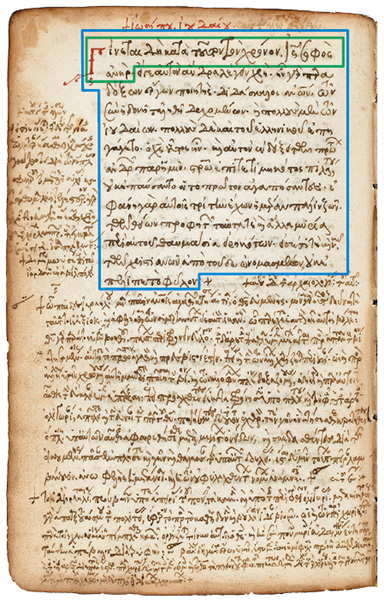
The longer passage in Josephus’s Jewish Antiquities (Book 18) that refers to Jesus is known as the Testimonium Flavianum.
If it has any value in relation to the question of Jesus’ existence, it counts as additional evidence for Jesus’ existence. The Testimonium Flavianum reads as follows; the parts that are especially suspicious because they sound Christian are in italics:
Around this time there lived Jesus, a wise man, if indeed one ought to call him a man. For he was one who did surprising deeds, and a teacher of such people as accept the truth gladly. He won over many Jews and many of the Greeks. He was the Messiah. When Pilate, upon hearing him accused by men of the highest standing among us, had condemned him to be crucified, those who in the first place came to love him did not give up their affection for him, for on the third day, he appeared to them restored to life. The prophets of God had prophesied this and countless other marvelous things about him. And the tribe of Christians, so called after him, have still to this day not died out.
All surviving manuscripts of the Testimonium Flavianum that are in Greek, like the original, contain the same version of this passage, with no significant differences.
The main question is: Did Flavius Josephus write this entire report about Jesus and his followers, or did a forger or forgers alter it or possibly insert the whole report? There are three ways to answer this question:
Alternative 1: The whole passage is authentic, written by Josephus.
Alternative 2: The whole passage is a forgery, inserted into Jewish Antiquities.
Alternative 3: It is only partly authentic, containing some material from Josephus, but also some later additions by another hand(s).
Regarding Alternative 1, today almost no scholar accepts the authenticity of the entire standard Greek Testimonium Flavianum. In contrast to the obviously Christian statement “He was the Messiah” in the Testimonium, Josephus elsewhere “writes as a passionate advocate of Judaism,” says Josephus expert Steve Mason. “Everywhere Josephus praises the excellent constitution of the Jews, codified by Moses, and declares its peerless, comprehensive qualities … Josephus rejoices over converts to Judaism. In all this, there is not the slightest hint of any belief in Jesus” as seems to be reflected in the Testimonium.
The bold affirmation of Jesus as Messiah reads as a resounding Christian confession that echoes St. Peter himself! It cannot be Josephus. Alternative 1 is clearly out.
Regarding Alternative 2—the whole Testimonium Flavianum is a forgery—this is very unlikely. What is said, and the expressions in Greek that are used to say it, despite a few words that don’t seem characteristic of Josephus, generally fit much better with Josephus’s writings than with Christian writings. It is hypothetically possible that a forger could have learned to imitate Josephus’s style or that a reviser adjusted the passage to that style, but such a deep level of attention, based on an extensive, detailed reading of Josephus’s works and such a meticulous adoption of his vocabulary and style, goes far beyond what a forger or a reviser would need to do.
Even more important, the short passage (treated above) that mentions Jesus in order to identify James appears in a later section of the book (Book 20) and implies that Jesus was mentioned previously.
The best-informed among the Romans understood Christus to be nothing more than a man’s personal name, on the level of Publius and Marcus. First-century Romans generally had no idea that calling someone “Christus” was an exalted reference, implying belief that he was the chosen one, God’s anointed. The Testimonium, in Book 18, appropriately found in the section that deals with Pilate’s time as governor of Judea, is apparently one of Josephus’s characteristic digressions, this time occasioned by mention of Pilate. It provides background for Josephus’s only other written mention of Jesus (in Book 20), and it connects the name Jesus with his Christian followers. The short reference to Jesus in the later book depends on the longer one in the earlier (Book 18). If the longer one is not genuine, this passage lacks its essential background. Alternative 2 should be rejected.
Alternative 3—that the Testimonium Flavianum is based on an original report by Josephus that has been modified by others, probably Christian scribes, seems most likely. After extracting what appear to be Christian additions, the remaining text appears to be pure Josephus. As a Romanized Jew, Josephus would not have presented these beliefs as his own. Interestingly, in three openly Christian, non-Greek versions of the Testimonium Flavianum analyzed by Steve Mason, variations indicate changes were made by others besides Josephus. The Latin version says Jesus “was believed to be the Messiah.” The Syriac version is best translated, “He was thought to be the Messiah.” And the Arabic version with open coyness suggests, “He was perhaps the Messiah concerning whom the prophets have recounted wonders.” Alternative 3 has the support of the overwhelming majority of scholars.
We can learn quite a bit about Jesus from Tacitus and Josephus, two famous historians who were not Christian. Almost all the following statements about Jesus, which are asserted in the New Testament, are corroborated or confirmed by the relevant passages in Tacitus and Josephus. These independent historical sources—one a non-Christian Roman and the other Jewish—confirm what we are told in the Gospels:
1. He existed as a man. The historian Josephus grew up in a priestly family in first-century Palestine and wrote only decades after Jesus’ death. Jesus’ known associates, such as Jesus’ brother James, were his contemporaries. The historical and cultural context was second nature to Josephus. “If any Jewish writer were ever in a position to know about the non-existence of Jesus, it would have been Josephus. His implicit affirmation of the existence of Jesus has been, and still is, the most significant obstacle for those who argue that the extra-Biblical evidence is not probative on this point,” Robert Van Voorst observes. And Tacitus was careful enough not to report real executions of nonexistent people.
2. His personal name was Jesus, as Josephus informs us.
3. He was called Christos in Greek, which is a translation of the Hebrew word Messiah, both of which mean “anointed” or “(the) anointed one,” as Josephus states and Tacitus implies, unaware, by reporting, as Romans thought, that his name was Christus.
4. He had a brother named James (Jacob), as Josephus reports.
5. He won over both Jews and “Greeks” (i.e., Gentiles of Hellenistic culture), according to Josephus, although it is anachronistic to say that they were “many” at the end of his life. Large growth in the number of Jesus’ actual followers came only after his death.
6. Jewish leaders of the day expressed unfavorable opinions about him, at least according to some versions of the Testimonium Flavianum.
7. Pilate rendered the decision that he should be executed, as both Tacitus and Josephus state.
8. His execution was specifically by crucifixion, according to Josephus.
9. He was executed during Pontius Pilate’s governorship over Judea (26–36 C.E.), as Josephus implies and Tacitus states, adding that it was during Tiberius’s reign.
Some of Jesus’ followers did not abandon their personal loyalty to him even after his crucifixion but submitted to his teaching. They believed that Jesus later appeared to them alive in accordance with prophecies, most likely those found in the Hebrew Bible. A well-attested link between Jesus and Christians is that Christ, as a term used to identify Jesus, became the basis of the term used to identify his followers: Christians. The Christian movement began in Judea, according to Tacitus. Josephus observes that it continued during the first century. Tacitus deplores the fact that during the second century it had spread as far as Rome.
As far as we know, no ancient person ever seriously argued that Jesus did not exist. Referring to the first several centuries C.E., even a scholar as cautious and thorough as Robert Van Voorst freely observes, “… [N]o pagans and Jews who opposed Christianity denied Jesus’ historicity or even questioned it.”
Nondenial of Jesus’ existence is particularly notable in rabbinic writings of those first several centuries C.E.: “… [I]f anyone in the ancient world had a reason to dislike the Christian faith, it was the rabbis. To argue successfully that Jesus never existed but was a creation of early Christians would have been the most effective polemic against Christianity … [Yet] all Jewish sources treated Jesus as a fully historical person … [T]he rabbis … used the real events of Jesus’ life against him” (Van Voorst).
Thus his birth, ministry and death occasioned claims that his birth was illegitimate and that he performed miracles by evil magic, encouraged apostasy and was justly executed for his own sins. But they do not deny his existence.
Lucian of Samosata (c. 115–200 C.E.) was a Greek satirist who wrote The Passing of Peregrinus, about a former Christian who later became a famous Cynic and revolutionary and died in 165 C.E. In two sections of Peregrinus—here translated by Craig A. Evans—Lucian, while discussing Peregrinus’s career, without naming Jesus, clearly refers to him, albeit with contempt in the midst of satire:
It was then that he learned the marvelous wisdom of the Christians, by associating with their priests and scribes in Palestine. And—what else?—in short order he made them look like children, for he was a prophet, cult leader, head of the congregation and everything, all by himself. He interpreted and explained some of their books, and wrote many himself. They revered him as a god, used him as a lawgiver, and set him down as a protector—to be sure, after that other whom they still worship, the man who was crucified in Palestine because he introduced this new cult into the world.
For having convinced themselves that they are going to be immortal and live forever, the poor wretches despise death and most even willingly give themselves up. Furthermore, their first lawgiver persuaded them that they are all brothers of one another after they have transgressed once for all by denying the Greek gods and by worshiping that crucified sophist himself and living according to his laws.
Although Lucian was aware of the Christians’ “books” (some of which might have been parts of the New Testament), his many bits of misinformation make it seem very likely that he did not read them. The compound term “priests and scribes,” for example, seems to have been borrowed from Judaism, and indeed, Christianity and Judaism were sometimes confused among classical authors.
Lucian seems to have gathered all of his information from sources independent of the New Testament and other Christian writings. For this reason, this writing of his is usually valued as independent evidence for the existence of Jesus.
This is true despite his ridicule and contempt for Christians and their “crucified sophist.” “Sophist” was a derisive term used for cheats or for teachers who only taught for money. Lucian despised Christians for worshiping someone thought to be a criminal worthy of death and especially despised “the man who was crucified.”
Other testimony that has some value, but much less, as evidence regarding the existence of Jesus appears in the writings of the following people:
Other documentary sources are doubt-ful or irrelevant.
One can label the evidence treated above as documentary (sometimes called literary) or as archaeological. Almost all sources covered above exist in the form of documents that have been copied and preserved over the course of many centuries, rather than excavated in archaeological digs. Therefore, although some writers call them archaeological evidence, I prefer to say that these truly ancient texts are ancient documentary sources, rather than archaeological discoveries.
Some ossuaries (bone boxes) have come to light that are inscribed simply with the name Jesus (Yeshu or Yeshua‘ in Hebrew), but no one suggests that this was Jesus of Nazareth. The name Jesus was very common at this time, as was Joseph. So as far as we know, these ordinary ossuaries have nothing to do with the New Testament Jesus. Even the ossuary from the East Talpiot district of Jerusalem, whose inscription is translated “Yeshua‘, son of Joseph,” does not refer to him.
As for the famous James ossuary first published in 2002,d whose inscription is translated “Jacob, son of Joseph, brother of Yeshua‘,” more smoothly rendered, “James, son of Joseph, brother of Jesus,” it is unprovenanced, and it will likely take decades to settle the matter of whether it is authentic. Following well-established, sound methodology, I do not base conclusions on materials whose authenticity is uncertain, because they might be forged. Therefore the James ossuary, which is treated in many other publications, is not included here.
As a final observation: In New Testament scholarship generally, a number of specialists consider the question of whether Jesus existed to have been finally and conclusively settled in the affirmative. A few vocal scholars, however, still deny that he ever lived.
Lawrence Mykytiuk is Emeritus Professor of Library Science and former Associate Professor of History (courtesy) at Purdue University. He holds a Ph.D. in Hebrew and Semitic Studies and is the author of Identifying Biblical Persons in Northwest Semitic Inscriptions of 1200–539 B.C.E. (2004).
Mykytiuk, Lawrence. “Did Jesus Exist? Searching for Evidence Beyond the Bible,” Biblical Archaeology Review 41.1 (2015): 45–51, 76.
By Christopher L. Reese and from Christian Post
Christians hold various opinions about Halloween, but one thing it certainly points to is the human fascination with the supernatural. Although many in the West pride themselves on being secular and scientific, everyone has an innate curiosity about what may lie beyond the world we experience with our five senses. History shows humans have always acknowledged the existence of the supernatural and engaged in practices to worship or manipulate it.
This is unsurprising in light of the fact that humans are spiritual beings (e.g., Matt. 10:28), and that we interact with the spiritual realm — for example, by entering into a relationship with God, who is also spirit (John 4:24). The author of Ecclesiastes tells us that God has “set eternity in the human heart” (Eccles. 3:11), and Augustine echoes this when he writes, “You have made us for yourself, O Lord, and our heart is restless until it rests in you.”1
Although humankind should seek transcendence in God, because of the fall, many seek it elsewhere. If one is coming into contact with the spiritual realm apart from God, they are interacting with the only other spiritual reality that exists, that of Satan and his demons — the world of the occult.
What C. S. Lewis perceptively wrote about demons also applies to the occult in general: “There are two equal and opposite errors into which our race can fall about the devils. One is to disbelieve in their existence. The other is to believe, and to feel an excessive and unhealthy interest in them.”2 In the same way, it is a mistake either to deny or underestimate the reality of the occult, or to spend a great deal of time and energy dwelling on it (unless one is called to a ministry that requires deeper engagement). Yet, since the occult is prevalent in the world, we should be aware, at least, of the main forms that it takes. As Paul wrote, “we are not unaware of [Satan’s] schemes” (2 Corinthians 2:11).
What is the occult and how widespread is it in the US?
The occult can be defined as “[Phenomena], events, and religious practices engaging a practitioner in a realm of the supernatural that is rooted in things secret or hidden.”3 More specifically, “The term frequently refers to certain practices (occult ‘arts’) that include divination, fortunetelling, spiritism (necromancy), and magic.”4
The US government doesn’t keep detailed records on religious affiliation, so precise numbers of occult-oriented religions aren’t available. But the Pew Research Center’s 2014 Religious Landscape Study estimated that 0.4% of the US population, about 1.3 million people, subscribe to a “New Age” religion, with most of these identifying as Wiccan or Pagan. By comparison, the Presbyterian Church (USA) has about 1.2 million members.5
In 2007, an executive with Barnes & Noble estimated the American “Pagan Buying Audience” as numbering 10 million people.6
What are some examples of occult groups and practices in the US?
Since the largest occult-oriented groups cited in the Pew survey above consist of New Age and Wiccan or Pagan adherents, we’ll examine the beliefs of those groups below, followed by a brief discussion of some of the most common occult practices. There is a tremendously diverse spectrum of beliefs among both New Agers and Pagans/Wiccans, so the following survey attempts to identify the beliefs most commonly shared by these respective groups.7
New Age movement
The New Age movement is a “loosely structured network of individuals and organizations who share a vision of a new age of enlightenment and harmony . . . and who subscribe to a common ‘worldview.’”8 As with Wiccans, there is a vast array of beliefs among New Agers (though many don’t necessarily identify with this label). Despite the diversity of beliefs, there are some commonalities, including the following.
Paganism/Wicca
Paganism is an umbrella term that encompasses modern attempts to revive pre-Christian religions (such as Greek, Roman, and Germanic), but mostly consists of those who identify as Wiccans (witches).9 There is no centralized Wiccan teaching authority, or set of beliefs that all adherents agree to, but the following are generally applicable.
Of these two groups, New Age beliefs are far more popular and prevalent in the US. Many of these ideas have taken root in popular culture and are promoted by celebrities, movies and TV shows, music, and bestselling books.
Practices
Necromancy
Necromancy refers to the attempt to contact the spirits of the dead in order to obtain otherwise hidden knowledge or to communicate with deceased relatives or friends, often for the purpose of emotional comfort or closure. Mediums claim the ability to act as a bridge between the living and the dead, and the attempt to contact spirits is sometimes called a séance (from the French word for “session”).
Divination
Divination is the attempt to gain knowledge of future events or other hidden knowledge by interpreting signs, contacting spiritual entities, or through supernatural powers. Divination has been practiced throughout human history and is still prevalent today. Modern forms include the use of tarot cards, psychic readings, astrology, palm reading, and Ouija boards.
Magic
Magic can be defined as the use of rituals or actions performed for the purpose of manipulating natural or supernatural forces or beings. Both necromancy and divination can be considered forms of magic, as well as the casting of spells, which often involve incantations, physical rituals, and the use of herbs, potions, or amulets.10
A Christian response
Space prohibits a detailed response to each of the beliefs and practices listed above, but the following comments briefly address some of the big-picture issues raised by the occult, along with most of the practices described above.11
First, occult beliefs and activities are an attempt to circumvent God’s authority and go beyond the revelation provided in Scripture. This temptation is as old as humankind itself and was precisely what Satan offered Adam and Eve in the garden. Satan insisted that there was knowledge to be had that God was withholding and that gaining this knowledge would elevate the human couple to a godlike status (Gen. 3).
In this light, it’s not surprising that Paul refers to false teachings as “things taught by demons” and that some who abandon the faith “follow deceiving spirits” (1 Tim. 4:1). Much of Satan’s activity in the world involves producing and disseminating ideas that contradict or distort God’s revelation.
The occult is also a form of idolatry — giving ultimate allegiance to someone or something other than God. Whether it’s the Mother Goddess worshiped by some Wiccans, or a deified self-pursued by New Agers, all occult belief systems replace the Creator who has revealed himself in Scripture with some type of counterfeit deity.
In addition, all of the categories of occult activities noted above (necromancy, divination, magic) are expressly prohibited in Scripture. As the Lord warned the Israelites before they entered the promised land:
Let no one be found among you who sacrifices their son or daughter in the fire, who practices divination or sorcery, interprets omens, engages in witchcraft, or casts spells, or who is a medium or spiritist or who consults the dead. Anyone who does these things is detestable to the Lord; because of these same detestable practices the Lord your God will drive out those nations before you (Deut. 18:10-12).
We are all tempted to try to discover what will happen in the future or to gain other knowledge not attainable through natural means. But as the late biblical scholar Merrill Unger pointed out:
“There is everything wrong in prying into the future, which God has not revealed and, for our own welfare, does not want us to know. Such knowledge is contrary to God’s Word and will, but it is the kind of knowledge that Satan and demons give. . . . Although God has revealed His general plan for the future for both the saved and the unsaved, it is not normally His purpose for us to know the specifics of that plan or the details of individual lives.”12
Thus, Moses told the people of Israel, “The secret things belong to the Lord our God, but the things revealed belong to us and to our children forever” (Deut. 29:29).
Finally, participation in occult activities opens a person up to demonic influence. This is true for both Christians and non-Christians. Paul warned the Corinthians that “the sacrifices of pagans are offered to demons, not to God, and I do not want you to be participants with demons. You cannot drink the cup of the Lord and the cup of demons too; you cannot have a part in both the Lord’s table and the table of demons” (1 Cor. 10:20-21).
The following true stories illustrate this danger.
Heath Adamson’s story
Heath Adamson, who is now a leader in his Christian denomination, became interested in the occult as a young boy. “What started out as intrigue and entertainment,” he writes, “quickly led to a lifestyle of encounter with the stuff of Hollywood lore. I remember watching a chair slide across the floor and a candle floating off the coffee table.” He continues, “I had night terrors so bad, so horrific, I was tormented for years. In junior high, the anxiety produced ulcers. Specialists couldn’t confirm what was wrong. I felt trapped, breathless, and alone.”
In high school, he had “regular encounters with the demonic realm, became addicted to numerous drugs, looked like a human skeleton, and lived life in quiet desperation.”
A classmate invited Heath to church, and afterward, at home he felt God’s presence for the first time. “I remember the warm tears falling down my face. Crying wasn’t something I did. It was almost as if the sky opened up and, for the first time in my life, I sensed real and pure love.”
Heath began to pray regularly and continued to attend church services with his classmate. On one Wednesday evening he responded to an invitation to receive Christ, and “[m]y body was supernaturally and instantaneously healed. My substance addictions vanished. It’s almost as if I met myself for the first time.” Like many others, Heath found deliverance from the occult through Jesus Christ.13
The minister and his sister
The late Christian apologist Walter Martin relates meeting a Christian minister and his wife in New York after one of Martin’s lectures. The minister shared with Martin that he had come from a family of spiritists who practiced mediumship and held séances. The minister had come to Christ many years ago, but his sister was still involved and frequently used an Ouija board to communicate with spirits. The minister was concerned about his sister, and one night he and his wife decided to confront her.
In an attempt to show his sister that the Ouija board was evil, he began asking it questions. “What do you feel toward me?” he asked the board, which then spelled out the answer “H-A-T-E.” “What do you think of the Bible?” he asked. The board replied with an obscenity. With that, the minister stood up and exclaimed, “I’ll have no more to do with this. It’s devilish,” and threw his Bible onto the middle of the board. He recounted to Martin what happened next:
At that moment, the board levitated off the table and flipped the Bible into the air with such force that it flew across the room and hit the wall. My sister and my wife screamed.
As I stood there looking at it, something smashed me in my stomach and knocked me to the floor. I was doubled over — breathless — with my head between my knees, and the only thing I could gasp was, “Jesus, Jesus, Jesus. Help!”
But I was lying on the floor in such a convincing position that my wife and sister came over to help me. When we pulled up my shirt, there was a red welt the size of a fist over my solar plexus! At that juncture, my sister recognized that I had been hit — but by nothing visible in that room. The next thing I knew, we were all having a prayer meeting. My sister came out of the occult to Christ, and the Ouija board was splintered and burned.14
Thus, the occult should never be taken lightly, even by Christians.
Deliverance from the occult
The following six steps are crucial for anyone who desires to break free from the occult.15
1. Receive Christ as your Lord and Savior
The first step in departing from the darkness and entering the light is to be born again into God’s kingdom through Jesus’ sacrificial death on the cross for your sins. Those who come to Christ are “called . . . out of darkness into [God’s] wonderful light” (1 Peter 2:9). One of the reasons Christ died was “so that by his death he might break the power of him who holds the power of death — that is, the devil — and free those who all their lives were held in slavery by their fear of death” (Heb. 2:14-15).
2. Confess the sin of involvement in the occult
Scripture declares that “If we confess our sins, [God] is faithful and just and will forgive us our sins and purify us from all unrighteousness” (1 John 1:9).
3. Destroy all occult objects
The book of Acts describes how many who had practiced sorcery in the city of Ephesus came to Christ and “brought their scrolls together and burned them publicly” (Acts 19:18-19). “Having occult items around such as game boards, cards, and statues may provide a source of temptation to return. Removing all such objects helps avoid facing that temptation and dealing with memories.”16
4. Break off all occult associations
Communication with spirits (which in reality are demons) must cease, and you must no longer associate with friends or others who remain involved in the occult. Seek out new friends who are mature Christians who can help you grow in your relationship with Christ, and find a Bible-believing church where you can worship and serve.
5. Immerse yourself in God’s Word
As Paul instructed the Christians in Rome, “Do not conform to the pattern of this world, but be transformed by the renewing of your mind. Then you will be able to test and approve what God’s will is — his good, pleasing and perfect will” (Romans 12:2). Our minds are transformed as we read, study, meditate on, and memorize God’s Word. Scripture is also the “sword of the Spirit” by which we repel Satan’s attacks (Eph. 6:17; see Jesus’ example of doing this in Matt. 4:1-11).
6. If necessary, seek additional help
If you find yourself struggling even after following the steps above, find a Christian counselor or minister to talk to, especially someone who has experience helping people formerly involved in the occult.
Notes
Originally published at The Worldview Bulletin Newsletter.
Christopher L. Reese (MDiv, ThM) is a writer, editor, and journalist. He is the founder and editor of The Worldview Bulletin and a general editor of the Dictionary of Christianity and Science (Zondervan, 2017) and Three Views on Christianity and Science (Zondervan, 2021). His work has appeared in Christianity Today, Bible Gateway, Beliefnet, Summit Ministries, and other sites.
Pliny the Younger (61-113 AD) was a Roman Magistrate appointed by the emperor Trajan over Bithynia, now in modern Turkey. In 112 AD he wrote the emperor requesting direction on how to handle the many Christians that were brought before him. The English translation of Pliny’s letter and Trajan’s response was published by William Harris, Prof. Em. Middlebury College.
Harris said the Christians were brought daily before Pliny for refusing military service, refusing to worship the Roman emperors and for being members of a strange new and secret religion which although harmless, seemed dangerous to the established Roman way of life. I would add “revenge” to this list because of the change in temple economics due to Christians forsaking the idols.
This is the first documented evidence of the “Christian Problem” in the Roman world.
Oh, in case you’re wondering, Pliny the Elder was his uncle who died trying to rescue people from the Pompeii disaster. Here is the translation from Latin:
Gaius Plinius to the Emperor Trajan
It is for me an important point of responsibility to refer to you as Head of State, things about which I have questions, since you are the person best able to set straight my hesitations and correct my lack of information.
Actually I have never been present at a Examination (cognitio) of Christians, so I do not know what punishment is required or how far it is to be carried out. Nor do I understand the legal grounds for a prosecution, or how stringently it is to be prosecuted. I am not clear about prosecutions in respect to the age of the persons, whether no distinction should be made between the young and the old, and furthermore whether a pardon should be granted in cases of recanting, or if there is no advantage for a person completely ceasing to be a Christian. Or is it the name “Christian” which is prosecutable, even if not involved in criminal actions, or is that “criminality” is automatically attached to the name?
In the meantime, I now handle it this way with those who are turned over to me as Christians. I ask them directly, in person, if they are Christian, I ask a second and third time to be sure, and indicate to them the danger of their situation. If they persist, I order them led dispatched (= executed). I have had no trouble with this, since whatever it was they admitted or professed, I decided that their obstinacy and unyielding inflexibility should be sufficient reason for punishment. Some others who were virtually insane with this cult, but Roman citizens, I sent back to Rome for trial.
As I continue with this handling of the situation, as often happens, the numbers and kinds of incriminations are becoming more widespread. An anonymous List has been brought out which contains the names of a great many persons. I decided to dismiss charges again any on this list who stated that they were now not, nor had ever been Christians, if they repeated after me a prayer of invocation to the Gods, and made an offering of wine and incense to your statue, which I had brought in to the court along with the statues of the Gods, for this purpose. And in addition they were to formally curse Christ, which I understand true Christians will never do.
Other named by the anonymous List said they were Christians, and later changed their statement. Some said that they had been and then stopped, some three years before, some longer, some even twenty years before. All these reverenced your statue and those of the Gods, and cursed Christ. They stated that the sum total of their error or misjudgment, had been coming to a meeting on a given day before dawn, and singing responsively a hymn to Christ as to God, swearing with a holy oath not to commit any crime, never to steal or commit robbery, commit adultery, fail a sworn agreement or refuse to return a sum left in trust. When all this was finished, it was their custom to go their separate ways, and later re-assemble to take food of an ordinary and simple kind. But after my edict which forbids all political Societies, they did in fact give this up.I thought at this point that it was necessary to get information from two slave women, whom they call Deaconesses (ministrae) about the actual truth, by means of torture. I found nothing worthy of blame other than the blind and over-wrought nature of their cult-superstition.
I have therefore postponed further Examinations (cognitiones) and made haste to come to you immediately for consultation. This situation seem to demand serious consultation, especially in view of the large number of people falling into this danger. A great many persons of every age, of every social class, men and women alike, are being brought in to trial, and this seems likely to continue. It is not only the cities, but also the towns and even the country villages which are being infected with this cult-contagion.
It seems possible to check and reverse this direction at this point, for it is quite clear that the Temples of the Gods which have been empty for so long, now begin to be filled again, the sacred rites which had lapsed are now being performed and flesh for sacrificial rites is now sold again at the shops, although for a while nobody would buy it. So it seems reasonable to think that a great many people could be persuaded to reform, IF there were a legal procedure for Repentance.
Emperor Trajan to Pliny:
You have done the right thing, my dear Pliny, in handling the cases of those who were brought to you under the charge of being Christians. But it is not possible to make hard and fast rule with one specific formula. These people must not be searched out, if they are brought before your court and the case against them is proved, they must be punished, but in the case of anyone who states that he is not a Christian and makes it perfectly clear that he is not, by offering prayers to out Gods, such a one is to be pardoned on the grounds of his present repentance, however suspect he may have been in the past. But anonymous lists must not have any place in the court proceedings. They are a terrible example and not at all in keeping with our times.
William Harris
Prof. Em. Middlebury College
Go to the Chronological List of all Early Christian Writings
| Chances are you may not have heard of renowned writer and Yale University professor David Gelernter (School of Engineering and Applied Science). He has been making waves since acknowledging that he now rejects Darwinian evolution. In an interview organized in 2019 by the prestigious Hoover Institution (Stanford University, California), Gelernter lamented the obstruction of free speech experienced by anyone trying to voice alternatives to evolution, such as Intelligent Design. Worse still, he said, some pro-Darwinian academics actually seek to destroy the careers of dissenters: “It’s a bitter rejection … a sort of bitter, fundamental, angry, outraged, violent rejection, which comes nowhere near scientific or intellectual discussion. I’ve seen that happen again and again. ‘I’m a Darwinist, don’t you say a word against it, or, I don’t wanna hear it, period.’” Elsewhere, in his review of Stephen Meyer’s excellent book Darwin’s Doubt (see our review here), Gelernter makes this interesting remark about the passionate defenders of evolution: “They remind us of the extent to which Darwinism is no longer just a scientific theory but the basis of a worldview, and an emergency replacement religion for the many troubled souls who need one.” Christians are often despised … for their faith-based acceptance of biblical miracles because these cannot be scientifically tested. Yet these same antagonists get very frustrated if their own beliefs are subjected to the same scrutiny! Everyone knows, of course, that the displaced religion referred to by the good professor is Christianity, more specifically, that which has a high view of Scripture as the inspired, inerrant Word of God—including the belief in supernatural Creation, resting upon a grammatical-historical understanding of Genesis. Gelernter has many predecessors (including secular humanists) who have admitted the religious and philosophical nature of Darwinian evolution. But surely evolution is science, not “an emergency religion” as Gelernter claims? According to the OED, the word ‘religion’ includes “a pursuit, interest, or movement, followed with great devotion”, and “action or conduct indicating belief in, obedience to, and reverence for god, gods, or similar superhuman power”. If you substitute ‘god’ for the alleged power of Darwin’s theory (in any of its modern forms) and factor in the zeal and fervour of its adherents, these definitions fit perfectly. Christians are often despised by secular writers and commentators for their faith-based acceptance of biblical miracles because these cannot be scientifically tested. Yet these same antagonists get very frustrated if their own beliefs are subjected to the same scrutiny! They want an exemption, expecting their own unsupported beliefs (their non-scientific assertions) to be accepted without question or criticism. Far too often, popular science is reported in a way that portrays evolution as hard science—whether radio, news outlets, social media or magazines. Refreshingly honest admissions among evolutionary writers are few and far between, but there are some. Writing about human racial origins Angela Saini acknowledges: “It’s impossible to escape our beliefs, our upbringing, our environment, even the pressure of wanting to be correct, when it comes to interpreting the facts. Our stories get in the way.” Evolutionists seldom question the narrative because it is their substitute origins story. It permits the secular ‘faithful’ to ignore the claims of the Creator. Quite right, and we have seen supporting examples of just how true this is for many who tenaciously hold onto evolution. They seldom question the narrative because it is their substitute origins story. It permits the secular ‘faithful’ to ignore the claims of the Creator (see also Getting behind the evolution facade). But does this replacement religion offer its devotees answers to the big questions of life: • Questions of origins—Where did we come from? • Questions of meaning—Why am I here? • Questions of destiny—What happens after I die? Many claim that evolution does answer these questions. While it is fundamentally an alternative theory of origins it is far more than that, as a re-reading of David Gelernter’s earlier-quoted words confirms. For example, British physicist and TV personality Brian Cox (a confessed humanist) admits: “… there is self-evidently meaning in the universe because my own existence, the existence of those I love, and the existence of the entire human race means something to me. I think this because I have had the remarkable luxury of spending time in education.” Sadly, he rejects the existence of his Creator, the One from whom life emanates and whose revealed scriptures give the only reliable answers about the meaning of human existence and destiny. David Gelernter is surely right in his opinion that “Darwinism is … an emergency replacement religion for the many troubled souls who need one.” But that spiritual craving in human beings can only be satisfied by embracing the undiluted truth of the Creation/Fall/Gospel message of the Bible. Compromises like ‘God used evolution’ will not do. https://creation.com/evolution-replacement-religion |
| For some believers in restricted nations and hostile areas, following Christ means beatings, torture and even death. For others, the decision to follow Christ means losing jobs, income, homes and relationships. That was the case for a Pakistani man after he placed his faith in Christ. Asif was a well-liked supervisor at a garment factory in Pakistan. As a Christian, he led 10 coworkers in prayer before work every morning. But the factory owner, a Muslim man, wanted Asif to convert to Islam and told him to stop the prayers. Asif responded by giving the man a Bible so he could learn about the Christian faith. The factory owner continued to harass Asif. He brought an Islamic cleric in to persuade Asif to accept Islam, and he tried to force Asif to join in Muslim prayers. But Asif refused each of the owner’s efforts to convert him. Finally, the owner gave him an ultimatum: Accept Islam or lose your job. “My God will provide me with everything,” Asif replied. Asif’s commitment to Christ cost him his job, and it may be difficult for him to find another source of income. Many Christians in Pakistan are trapped in poverty because they have few job opportunities. “Good jobs are hard to get for Christians in Pakistan,” VOM’s field leader for Pakistan said. “Asif knew exactly what the consequences could be for him, and he chose to remain faithful.” VOM has been supporting Asif and his family, who are now in hiding after receiving death threats for refusing to convert to Islam. |
Chine Creating “system of persecution for the future”, Open Doors warn.
WASHINGTON — China is creating a “blueprint” “system of persecution for the future” that could be sold to persecute people across the globe, head of the prominent Christian persecution watchdog agency Open Doors USA has warned.
Open Doors CEO David Curry, joined by pastors from China, issued the dire warning about how China could be shaping the future of international religious minority oppression through its use of surveillance technologies to monitor Christians and other religious adherents.
Open Doors, which operates in 60 countries, released its influential annual World Watch List data report Wednesday at an event attended by representatives of the Trump administration, Congress and human rights activists. The annual report ranks the top 50 countries where Christians are most persecuted.
During a briefing, Curry warned that the “greatest threat,” in his opinion, to human rights worldwide is China, which rose in the rankings from No. 27 to No. 23 in the 2020 report.
Although the communist nation is not ranked as highly as other violators on the list, Curry stressed that the implications lie in China’s development of surveillance to control its people.
“Its implications are not just for Christians within China but for every country and for religious freedom generally,” Curry said. “Let me put it together. It is like a puzzle. The pieces are there but it is not until you put it together that you see it clearly. When you see it clearly, it is frightening.”

David Curry, president and CEO of Open Doors USA, addresses the rise of global Christian persecution at the 2020 Open Doors’ World Watch List press conference in Washington, D.C., on Jan. 15, 2020. | Open Doors USA
The pieces of this puzzle, Curry said, involve China’s use of a social score system that grades its citizens based on their actions and the government’s creation of a network of surveillance cameras that have been put on street corners and in churches.
“Imagine a system where citizens are given 2,000 points and every time you do something they government disagrees with, you are marked down for it,” Curry detailed. “Eventually, your travel is restricted, your children won’t get into the best schools. You lose points for taking your children to Sunday School. That is what the experience is like for many Christians in China.”
Curry traveled to China just a few weeks ago.
“I saw with my own eyes the surveillance on the street but also in the churches, watching their congregation,” he said. “Facial scans when you come in and then tracking you and generating reports [with] assumptions built into their artificial intelligence system that is tracking Christian behavior.”
Curry said that the more often a person is seen going to church, the more often they are to be labeled a “radical.”
“They are shutting down house churches at a massive rate — 5,596 churches shut down, many because they refuse to put surveillance cameras up to watch their congregation.”
Pastor Jian Zhu, who was raised in China but now is the director of the China Institute at Lincoln Christian University in Illinois, told those in attendance that China’s persecution against house churches is now the worst he has seen since 1979.
“The Chinese government now has placed severe restrictions and policies on the house churches, asking neighbors to spy on one another, pressures school teachers and college professors to betray and sign a statement to denounce their faith as well as to do the same to the students,” Zhu said.
Zhu explained that many churches are asked to take down crosses inside and outside their buildings and put up pictures of President Xi Jinping at the center of their worship stages. Underground churches are also accused of illegally fundraising because they collect offerings from congregants.
Zhu said he has heard of cases where some cities have shut down all house churches.
“Now, they are trying to eliminate Christianity from public life,” he said. “Cameras are all over to watch church and Christians go to Sunday service. Families are threatened to not go to church or they will be punished or their relatives could be in trouble.”
One Christian from China who attended the Open Doors event told The Christian Post that he and his family fled from China after the house church he attended was shut down.
Curry stressed that the data “seems to point to the fact that China seems to be resurrecting the god-as-government state.”
“We are all threatened by this: atheists, Jews, Muslims, everyone,” Curry said.
“They are using this artificial intelligence and surveillance to a whole new level,” he added. “All indications show that in 2020 — and this is why we are highlighting this — they are bringing these two systems together. They are merging the social scoring system and surveillance and artificial intelligence to give them the tools and the power to oppress the people.”
Curry said that the indications are not “just fear” or “unfounded.”
“It is already happening in a very grave way: not to Christians but to Uighur Muslims,” he said, noting that hundreds of thousands if not millions of Uighur Muslims have been sent to “re-education centers” in Western China.
“Muslims are forced to give up their faith and their culture. It’s only a matter of time before the world is going to jump on this technology because China is selling it to Iran, they’re looking to sell it to Egypt and other countries as well.”
When asked why China was not ranked lower on the World Watch List, Curry told CP that the World Watch List scores across measurements of private life, national life, violence, and others.
“So while China is No. 23, we are highlighting it because of what I think is this blueprint,” Curry contended. “They are creating a system of persecution for the future and we have to call it out now. Otherwise, it will be too late. Otherwise, they will sell it to Iran and others to oppress their religious minorities. That is why it needs to be really highlighted. Within five years, it would be almost too late to stop them.
Curry said that Open Doors has asked the White House and others to support proposed legislation that he says would provide steps to “control the use of artificial intelligence and facial recognition around the world.”
“What assumptions are being built into this that we need to know?” Curry asked. “Does going to church make you a terrorist in China? These are things we need to know.”
From The Christian Post

 Psalm 119: 38