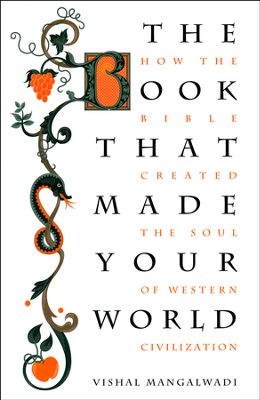
How the Bible Created the Soul of Western Civilization: An Interview with Vishal Mangalwadi – Part 2

PART TWO

Bible Gateway interviewed Vishal Mangalwadi about his book, The Book That Made Your World: How the Bible Created the Soul of Western Civilization (Thomas Nelson, 2012).

How did the Bible trigger the West’s passion for medical advancement?

Vishal Mangalwadi: Mainstream Hinduism taught that matter (including the human body) was evil—illusion or maya. In contrast, the first chapter of the Bible declared the material realm, including the human body, to be very good. Genesis 3 taught that sickness and death came as a curse upon human sin. The Lord Jesus came to give us abundant and eternal life. His soul did not reincarnate. His crucified body was resurrected and glorified. The Bible teaches that God will resurrect our perishable bodies as immortal and glorified bodies.

Because of God’s high view of the human person, including his body, the Lord Jesus healed the sick and commissioned his disciples to a ministry of healing. Therefore, medieval Roman Catholic monasteries did not simply pray, preach, and practice piety. Many of them took care of the sick. They studied, and taught medicine. The Schola Medica Salernitana became the world’s first medical school in the South Italian city of Salerno. It grew out of a 9th century dispensary in a monastery. This monastic tradition blossomed into modern medicine after the 16th century biblical Reformation.

What is the biblical ideal of human dignity and how did it inform the West’s social structure?

Vishal Mangalwadi: Gautam Buddha, the founder of Buddhism, saw human life as suffering. Thomas Hobbes, the only atheist in English Enlightenment, viewed life as “nasty, brutish, and short.” Pope Innocent III detailed “The Misery of Man.” Secular intellectuals have no option but to see man as nothing more than an evolved animal.

Species, races, and individuals do not evolve equal. Evolution does not bestow any rights upon any animal. Western notions of human dignity, equality, and inalienable rights are the Bible’s unique contribution to the modern world. Pico della Mirandela (1463-94) articulated the Bible’s case for human dignity in An Oration on the Dignity of Man. His case rested upon (a) creation of man in God’s own image and (b) God’s incarnation in the Jesus of Nazareth.

God became man in order to save man, because man was made in God’s image – precious and immortal. Full implications of these doctrines are still being worked out. Yet, much of our future will be shaped by the question: Is man merely another animal (organic intelligence) or is he uniquely God’s image—so precious to God that He would come to this earth to save him?

How did the Bible equip the West to cultivate compassion?

Vishal Mangalwadi: Through parables such as that of the Good Samaritan, the Lord Jesus explained the command ‘Love your neighbor as yourself.’ He exemplified it by blessing those who cursed and killed him. Jesus courted the wrath of religious establishment by caring for the sick even on Sabbath. He reinforced prophets such as IsaiahJeremiah, and Amos, by teaching that God’s holy law was made for man’s good. Therefore, a religiosity that did not care for individuals was worse than worthless. It was obnoxious. What we do for the littlest of his brothers, we do for him.

What is your response to people who say the Bible subjugates women?

Vishal Mangalwadi: The women’s lib movement started in America because social inequality between men and women was obvious. Many women got paid less then men for the same work. They were allowed to serve coffee after worship, but not communion during the worship. They could play piano in a church but not pray. Yet, crucial questions are: who told America that men and women were created equal; that sin brought subjugation as a curse; that the curse was nailed upon the cross of Calvary? The question that triggered my reflections was: Why didn’t the Saudi women burn their burqas and their bras? What empowered American women to launch the women’s lib movement? Was it because American women were more oppressed than the Muslim of Hindu women? Or was it because something had already made American women stronger than other women around the world? My counter-intuitive discovery was that it was the Bible that empowered women.

No culture has ever required a husband to love his wife. Every culture, including Jewish and post-Christian Western cultures, have permitted husbands to divorce their wives and/or take other women. In 1831-32, French magistrate Alexis de Tocqueville observed that American women had become much stronger than European women because the biblical ideal of marriage had had the biggest impact in America. No country in the world will even try to impeach a president who lies about his private sex life.

The Bible emancipated Western women because it alone asserted theological equality of male and female and also because it defined God’s idea of marriage as a one-man one-woman lifelong and exclusive relationship. A woman is liberated to develop herself and to strive for her dignity when she knows that her fallen husband is not permitted to despise her, divorce her, covet his neighbor’s wife or to take another woman as a girlfriend, concubine, or wife. He has to love her, irrespective of the level of her intelligence, charm, abilities, and fallenness.

Roman wives were the victims of Rome’s playboy culture. Many of them followed and financed the Apostle Paul and (over time) won the Roman empire for Christ, because they understood better than modern feminists that Paul was emancipating them.

Men and women are equal, but husbands and wives (like parents and children and all other formal relations) have to live in a hierarchical relationship. No institution can function on the basis of equality-without-hierarchy. Christian marriages are being destroyed because the Western church has surrendered to the world’s folly that equality precludes authority. The Christian idea of marriage is unique. It can be sustained only if we take seriously the Bible’s idea of the fallenness of men and women and the necessity of wives submitting to fallen husbands, and husbands loving fallen wives.

How is human equality a biblical principle?

Vishal Mangalwadi: Sociologically, the modern idea of human equality was born when Martin Luther discovered the New Testament doctrine of the “priesthood of all believers.” Gradually, this truth began to challenge the West’s social/racial injustices.

George Whitfield was the first white revivalist in America, who began preaching to the blacks. His preaching evoked protests: “Do you really want us to kneel with our slaves and drink communion from the same cup?”

In order to counter deep rooted prejudices, in 1740, Whitfield began writing a series of articles. These explained how and why the Bible teaches human equality. Whitfield’s writings created the consensus which Thomas Jefferson articulated in the original draft of the Declaration of Independence as, “We hold these truths to be sacred and undeniable that all men are created equal.” By “sacred” Jefferson meant derived from sacred Scriptures. Under pressure from Benjamin Franklin, the Declaration was changed to read, “We hold these truths to be self-evident that all men are created equal.”

To Indian sages, inequality was self-evident. That is why they invented the caste-system which still survives. Equality was “self-evident” even to American Deists because their worldview was shaped by the Bible. Now that evolution is shaping everyone’s intellectual lenses, only a fool will be able to assert that all men have evolved equal.

What role did the Bible play in the establishment of the university?

Vishal Mangalwadi: No Hindu ashram ever grew into a university. No Orthodox Christian monastery developed into a university in Eastern Europe, Greece, or Russia. Augustinian monasteries and Cathedral schools blossomed into West European universities such as Oxford, Cambridge, Paris, Prague, Heidelberg, and Wittenberg because St. Augustine taught that the human mind was God’s supreme gift to mankind. The mind was made in God’s image, therefore, in order to be godly, one had to cultivate the mind as well as piety.

These monasteries were different than every other center of religious education. Young boys came to a monastery to learn to pray and become a priest. But in these monasteries they had to study logic, literature, philosophy, mathematics, and rhetoric as well. This is what created the West’s uniquely rational religious leader, who prayed as well as studied birds and the solar system.

Following the Reformation, Christian thinkers realized that God wants all men to be saved and come to the knowledge of the truth (1 Timothy 2:4-7). In order to know truth, man has to study three books: The book of God’s words (the Bible), the book of God’s works (in nature and culture), and the book of God’s reason (logic and mathematics that run the human mind and physical universe.) This insight was captured in Harvard Crest in 1643. VERITAS is written on these three books. Today, the university has degenerated into a factory producing laborers for the market and the state because, without God’s word, the university has been forced to shy away from the very concept of truth.

Since the Bible is not a “fax from Heaven,” explain how sentences written by humans can be considered the Word of God?

Vishal Mangalwadi: Prophet Elijah said to king Ahab, “As the Lord, the God of Israel, lives, before whom I stand, there shall be neither dew nor rain these years, except by my word” (1 Kings 17:1). By the end of the chapter, the Sidonian widow of Zarephath exclaimed, “Now I know that you are a man of God, and the word of the Lord in your mouth is truth.” (vs. 24). Eventually Ahab was forced to acknowledge that Elijah’s words—a man’s words—were, in fact, the word of God.

God said to Jeremiah, “Behold, I have put my words in your mouth…I am watching over my word to perform it.” (Jeremiah 1:8-11). God’s word includes the words He gives His men and also men’s words which He watches to perform, fulfill, and honor. Daniel and his friends were willing to go into the lions’ den and fiery furnace because 70 years of Jewish history had confirmed to them that Jeremiah’s words, disregarded by their fathers, were in fact God’s word.

The gospel is that Jesus Christ died “according to the Scriptures,” was buried and rose again the third day, “according to the Scriptures” (1 Corinthians 15:3-4). That means that Jesus didn’t have to die. In the Garden of Gethsemane Peter gave him the opportunity to evade arrest. During his trial, Pilate gave to Jesus plenty of room to escape crucifixion. The Lord Jesus sacrificed his life because he believed that the words of Scripture, written by fallen and fallible men, were in fact God’s words.

As you observe the West’s treatment of the Bible, where do you see western society headed?

Vishal Mangalwadi: Germany, the birthplace of biblical Reformation, became the arch villain of the 20th century, because during the 19th century, German theology undermined the Bible’s authority. I see post-biblical America as the greatest terror to the 21st century. I think the future of greed-driven American capitalism is best captured by James Cameron in his terrible, pagan, and commercially hit movie, Avatar.

Muslim nations cannot be the world’s biggest threats because while Islam can build a strong Caliphate, it does not and cannot build nations. Protestantism has built history’s greatest nations; therefore, the world has the most to fear from Protestant nations that destroy the very foundations of their morality and civility.

What are your thoughts about Bible Gateway as a way to reinvigorate civilization’s soul?

Vishal Mangalwadi: Bible Gateway is the only site I use to get into the Bible. (Though I am yet to cultivate the discipline to use everything that it offers.) I appreciate this interview because the new generation needs to learn why the Bible must be studied, trusted, obeyed, and applied.

Is there anything else you’d like to say?

Vishal Mangalwadi: Christianity has lost America because the church forgot that “God wants all men to be saved and come to the knowledge of the truth…” for this reason Paul the apostle was appointed a “preacher” and a “teacher of the gentiles in faith and truth” (1 Timothy 2:4-7). The American church has the capacity to disciple the nation, but for over a century it has lacked the theology for discipling nations. It has been preoccupied with saving souls, not with discipling nations.

The good news is that the state of Minnesota just started an education revolution that can disciple America. Students will enroll in an accredited college, but go to the local church to study online as a cohort in a face-to-face mentorship with a credentialed Academic Pastor. A student will get a college degree for under $10,000 a year. Check out www.VirtuesCampus.com.

Bio: Vishal Mangalwadi, LLD, was born and raised in India. He studied eastern religion and philosophy in India, Hindu ashrams, and at L’Abri Fellowship in Switzerland. He is a dynamic and engaging speaker who has lectured in 35 countries. He is a social reformer, political columnist, and author of 14 books. Christianity Today calls him ‘India’s foremost Christian intellectual.’

SOURCE: The Bible Gateway Blog – Jonathan Petersen

How the Bible Created the Soul of Western Civilization: An Interview with Vishal Mangalwadi

(Blog note: every Christian needs to read this article. Please share it with someone you know. Carl)

Part 1

What triggered the West’s passion for scientific, medical, and technological advancement? How did the biblical notion of human dignity inform the West’s social structure and how it intersects with other worldviews? How did the Bible create a fertile ground for women to find social and economic empowerment? How has the Bible uniquely equipped the West to cultivate compassion, human rights, prosperity, and strong families? What is the role of the Bible in the transformation of education? How has the modern literary notion of a hero been shaped by the Bible’s archetypal protagonist?

Bible Gateway interviewed Vishal Mangalwadi about his book, The Book That Made Your World: How the Bible Created the Soul of Western Civilization (Thomas Nelson, 2012).

Click to buy your copy of The Book That Made Your World in the Bible Gateway Store

Why did you dedicate The Book That Made Your World to Arun Shourie, a Hindu who is critical of the Bible?

Vishal Mangalwadi: In 1994, Arun Shourie, at that time one of India’s foremost public intellectuals, attacked Western missions and the Bible. He powerfully rehashed some of Thomas Paine’s arguments from The Age of Reason (1793-94). Mr. Shourie studied in the best Christian college in India before getting a PhD from an American university that had been founded by Methodists. I realized that this good and learned gentleman was clueless about what the Bible is and what it has done because his Christian professors in India and in America had no idea.

Therefore, moved by the Holy Spirit, I began responding to him with books such as Missionary Conspiracy: Letters to a Postmodern Hindu (1995), Fascism: Modern & Postmodern (1998—my intro to a book by Gene Edward Veith), and then The Book That Made Your World: How the Bible Created the Soul of Western Civilization (2012).

In spite of Western skepticism, many Chinese intellectuals sense that the Bible was the foundation of the West’s amazing development. In contrast, Hindus such as Mr. Shourie follow ill-informed, in fact, arrogant and foolish, Western repudiation of the Bible. They think that India can be made a great nation by returning to Hindu worldview, which destroyed India in the first place.

One book will not convince skeptics, but it can become a seed that multiplies into many PhD theses, popular books, TV shows, and films. I dedicated the book to Arun Shourie to help intelligent Indians discover the rock upon which India can realize its potential to be a great civilization—a blessing to all the nations.

You write that your book is not so much about the Bible as it is about great literature, art, science, technology, heroism, and virtues. Explain what you mean.

Vishal Mangalwadi: My book is not “Bible study.” It is a study of the global impact of the Bible and it’s worldview. The Bible was the book of the last millennium. No other book was translated, published, distributed, studied, or debated like it. What impact did it have on the world? That is the question my book explores.

Why do you call the Bible the soul of Western civilization?

Vishal Mangalwadi: Although the West has amputated its soul, I call the Bible the soul of Western Civilization because it propelled the development of everything good in the West: its notion of human dignity, human rights, human equality, justice, optimism, heroism, rationality, family, education, universities, technology, science, culture of compassion, great literature, heroism, economic progress, political freedom. Take, for example, democracy.

The myth that modern democracy came from Greece was invented only in the 20th century by John Herman Randall of Columbia College (New York) and Mortimer Adler and Robert Maynard Hutchins of the University of Chicago. The reality is that in his classic, Republic, Plato, the greatest of Greek philosophers, had already condemned democracy as Mobocracy—the worst of all political systems. Plato proposed that the ideal republic should be ruled by philosopher-kings. His disciple, Aristotle, trained Alexander-the-Great to be a philosopher-king, who turned out to be one of the most ruthless conquerors in history. In turn, Alexander inspired India’s first empire builder, Chandragupta Maurya.

Later Alexander inspired Machiavelli’s The Prince—which examines how a successful prince acquires and retains power. Machiavelli was the flowering of European Renaissance that produced tyrants such as Napoleon. The biblical Reformation led to the birth of modern democracy. Without the Bible, western democracy will become obnoxious as did the Greek democracies.

To give another example, the West’s confidence in human reason came not from Greece, but from the Bible via Augustine. Hinduism, Buddhism, and their products such as Greek gnosticism knew that unaided intellect cannot know truth. The Enlightenment corrupted western confidence in reason by (over time) separating it from revelation. After Nietzsche and Freud, everyone knows that here is no reason to trust human reason, unless it is made in the image of Logos and strives to conform to it.

Why do you begin your book recounting the suicide of rock musician Kurt Cobain and then contrasting him with Johann Sebastian Bach?

Vishal Mangalwadi: The first chapter uses music as an entry point into the West’s soul. It contrasts Christian West with (post-Christian) West without its soul. The chapter inquires: What made the West a uniquely optimistic and musical civilization, able to sing “Joy to the world (fallen, miserable and full of suffering)?”

Bach and Cobain were musical geniuses. Both lost their parents at nine. Bach’s parents died and Cobain’s separated. Bach’s faith in resurrection enabled him to celebrate “The Passion” (Suffering) of St. Matthew and St. John. Cobain inherited Bach’s musical tradition without its philosophy. Therefore, his music could only scream at suffering, making him an icon of a generation lost without a map of reality. Buddhism offered no hope to Cobain. Therefore, he cursed life and committed suicide.

Buddhism originated in India. Its pessimistic philosophy gave us great art and literature, but no hope, music, or musical instruments. Islam (and Orthodox Christianity) also ruled out music; therefore, it too pre-empted development of technology.

The German publisher published 10,000 copies of the first chapter as a stand-alone booklet. It is proving to be an excellent work of worldview evangelism. I hope someone will print it in Japanese, since Bach is Japan’s fifth evangelist.

How was the Bible “the force that created modern India”?

Vishal Mangalwadi: Why are “native” Americans Indians? Why are “native” Australians Indians? Why is Indonesia, Indian-Asia? Why were Columbus and Vasco de Gama looking for sea-routes to India (and not to “Spice-land”)?

The European mind was fascinated with India, because India, not Japan, Korea, or China, is the Eastern-most land mentioned in the Bible (Esther 1:1). By “India” the Persians meant “Sindustan,” the land around the river Sind (now in Pakistan). Up until the 1850s, no one living in Bengal or Kerala ever thought that he was living in “India.” That is why Michael Madhusudan Dutt (1824-1873), the pioneer of ‘Indian’ nationalism, actually wrote only about ‘Bengali nationalism.’

The pre-Columbus European concept of geographic India came from the Roman Catholic reading of the Bible. That is why Vasco de Gama’s coming to Kerala and Goa was the sea-route to “India.” Protestant reading of the Bible coined the ‘abstract’ concept of India as a geo-political nation state, half-a-century before England actually made India a nation in 1858. Prior to William Carey, no “Indian” had ever existed who started a paper (or organization) such as Friend of India (1818).

Lord Thomas Babington Macaulay, persuaded British Parliament in 1833, that Britain must govern Indians in such a way as to train them to govern themselves as an independent nation. Macaulay grew up in the company of the evangelical member of Parliament, William Wilberforce, in the Calpham community. He followed up his rhetoric by coming to India to give us the ‘Indian Penal Code’ along with the Jewish-biblical idea of rule of law. He helped transform our education and civil services. He played a critical role in the establishment of our first universities in Calcutta, Bombay, and Madras in 1858. These began as examination-conducting institutions to fulfil the vision of Macaulay’s brother-in-law, Charles Travelyan. The latter had defined the mission of Christian education in 1838 in his classic On the Education of the People of India. The objective of that herculean mission, he said, was to prepare Indians to govern themselves as a free nation.

After Macaulay and Travelyan, it took five more decades before an Englishman could inspire a few graduates of Calcutta’s Christian education to create the “Indian National Congress” (1885). Then it took 70 more years to prepare leaders such as Gandhi, Ambedkar, and Nehru, who could, in fact, lead and govern a free India.

India became a free nation in 1947. It could have attained that status if it had even one Indian, who thought of India as a nation during the “Mutiny” of 1857. When Indian soldiers started killing Englishmen and liberated Delhi, educated Brahmins and Hindu merchants organized prayer meetings around the country to pray for British victory over Indian mutineers. This was partly because the rebels who succeeded in defeating the British in Meerut and Delhi decided to revive the Mogul Empire by declaring Bahadur Shah as their emperor.

Most Hindu, Muslim, and Sikh soldiers and rulers disapproved of the revival of that exploitative and useless empire. Many decided to fight against fellow Indians to defend the British Raj. This was because, contrary to current, ill-informed (or deceptive?) debaters such as Shahi Tharoor, most of the Indians who actually lived under the British, perceived it as better than all other options available to “India”.

Mogul Empire had been so corrupt and inept that in 1738-39, the Persian invader Nadir Shah, met hardly any resistance as he travelled 1000 KMs. within the Mogul’s (Indian) empire, from Ghazani to Delhi to plunder the Mogul capital. The Empire’s rottenness had encouraged the Marathas to conquer and plunder Hindu and Muslim kingdoms. This threat of the Marathas and/or invaders from the Khyber Pass had forced Hindu/Muslim kings to take refuge under the Company Raj. Most Indians opposed the 1857 Mutiny, now called the First War of National Independence, because they could not trust Indians to rule India with justice and equity.

While the Hindu and Muslim rulers, intelligentsia, and merchants preferred the Company Raj over Indian rajas, it was the Bible-shaped conscience that saw the Company as a “gang of public robbers” (Macaulay) and its rule as the “rule of evil genii.” Yet, Independent India chose to remain a member of British Commonwealth and import its political, economic, and social ideals and institutions, because the Bible succeeded in (a) transforming India’s governance under the British, and (b) training enough Indians to govern India as a modern, democratic, nation-state.

Dr. Babu Verghese’s massive study, Let There Be India: The Bible’s Impact on Nation-Building, details how the Bible translators created modern India by turning our dialects into literary languages, bringing modern education, printing, literature, and modern press, and the modern ideas of human equality, dignity, and rights (his book is available from ManagerGoodBooks@gmail.com).

Part 2 will follow Part 1 on Psalm 119:38 Blog. Thank you, Carl

Source: Bible Gateway Blog -Jonathan Petersen

Mysticism and The Coming World Religion – Part 2 (Revised)

May 1, 2023

T. A. McMahon

Originally published November 1, 2016

As noted in Part 1 of this series, there is a coming world religion (CWR), and it is advancing rapidly. One of the significant elements that expedites its growth is mysticism, which is a belief system that ultimately rejects teachings that involve objective laws, rules, requirements, obligations, dogmas, doctrines, and the like, in favor of subjective experiences and intuitive feelings.

The goal of the CWR (also known as the religion of the Antichrist) is to bring all religions under its patronage and control. Since all religions have doctrines that separate them from one another, even to the point of hostility in some cases, their doctrines must be compromised or altered in order to be acceptable to all—or they must be removed altogether. Mysticism facilitates doctrinal compromise because of its subjective nature. In other words, the objective meaning of a doctrine must give way to one’s subjective interpretation, i.e., how one feels about it. When such a belief system is in place, there can be no absolute truth; so-called truth is whatever an individual feels it is. It’s in the mind of the beholder.

Religions that are heavily legalistic in their theology must change in order to fit in with the ecumenical CWR. Two such religions are Roman Catholicism and Islam. In part one of this series we documented how the Church of Rome is well along the way of shifting from its highly legalistic system of rules and obligations toward a more mystical process. The Catholic Church has more than a billion followers, and they also must be included in the religion of the AntichristIslam, too, has greater than a billion adherents, so it also must become a part of the CWR. However, it is legalistic—and aggressively so—in its doctrine and practices, far more so than any other religion in the world. Consequently, many doubt that it could ever change.

Some have suggested, therefore, that the religion of the Antichrist will be Islam itself. For that to happen, the conversion of the world to Islamic beliefs would follow its historical method, which is at the point of a sword. Although that worked to a large degree in the past, it falls far short of what is necessary to spiritually transform the entire world. Additionally, there are obvious problems for this belief system regarding the coming religion of the Antichrist. The fact that the entire world will worship the Antichrist as God is inconsistent with and opposed by the Muslim worship of Allah. Sharia law, which is the Islamic code of law, is derived from the Qur’an and the Sunnah (Muhammad’s teachings and examples). Consequences for disobeying Sharia laws are the harshest among religions. Its rules are overtly abusive regarding women. Furthermore, Islam’s collectively intense hatred of Jews and Christians, as well as “all infidels,” is diametrically opposed to the CWR’s necessary ecumenism. These doctrines of Islam work against its efforts to attract followers to the coming world religion. What then, if anything, is there within Islam that might reconcile the billion-plus Muslims to the religion of the Antichrist, with its mystical underpinnings? The answer is Sufism.

Sufism is the mystical Islamic belief and practice through which Muslims seek to find the truth of divine love and knowledge by way of a direct personal experience with Allah. This is Islam in the throes of experiential and subjective beliefs and practices. Being functionally at odds with Sharia laws and practices, many Sufi practitioners reject the rules of Sharia outright, regarding mysticism as the most direct way to achieve union with Allah. Moreover, where it has been historically practiced throughout the world, Sufism has had no problem coexisting with other religions. This is not the case, as we’re well aware, for Islamic Sharia Law.

One mystical aspect of Sufism is for its practitioners to put themselves into an ecstatic trance or altered state of consciousness through whirling. These individuals are known as Whirling Dervishes. According to one source, “The hundreds of the Dervish twirling rotations (20-30 per minute) coincide with the theta rhythm in the brain, and the chanting (they repeat the word ‘God’ [more likely ‘Allah,’] about 99 times) makes the dancers dissociate from reality and enter a different state of mind. When the ceremony is over, the dervishes return, side by side, in front of the sheikh [master and guide] and then move to another room to meditate. The physiological goal of the whirling is for the dervish to ‘empty’ himself of all distractions” (https://bit.ly/3ZgY9sm). It should be obvious that this is just another form of Eastern mystical meditation along with the contemplative forms practiced by more and more professing Christians in the West.

The various exercises of mysticism are similar throughout the world, even where there has been no connection between the cultures or people groups. For example, Sufi meditation and yoga employ the same lotus sitting position and a hasta mudra (with the thumb curled and touching the tip of the forefinger). Sufi whirling has the same effect as the uncontrollable shaking in the Dynamic Meditation practiced by the followers of Bhagwan Shree Rajneesh. The Sufi Shaykh is similar to the guru in yoga in terms of the practitioner’s absolute submission to him and obedience to the guidance given. In some practices, the Shaykh is a transcended spiritual entity channeled by the meditator. 

The Encyclopedia of Islam lists a number of manifestations found within the meditation practices of Sufism, e.g., “barking and howling” (MacDonald, D. B. “Darwish [Darwesh],” Encyclopedia of Islam, Second Edition, edited by: P. B. Bearman, Th. Bianquis, C. E. Bosworth, E. van Donzel and W. P. Heinrichs, Brill Online, Augustana, 21 Sept 2009), behavior that was also exhibited through the so-called impartation of the Holy Spirit in places such as the Toronto Airport Vineyard, Pensacola and Lakeland, Florida, International House of Prayer (IHOP), and Bethel Church in Redding, California, among numerous others. 

These experiences taking place throughout the world should offer more than a hint that spirit entities, contacted through altered states of consciousness and meditation, as well as some people’s faith in the false signs-and-wonders methods, have been facilitating Satan’s goal of seducing and controlling the consciousness and beliefs of mankind. “Now the Spirit speaketh expressly, that in the latter times some shall depart from the faith, giving heed to seducing spirits, and doctrines of devils” (1 Timothy:4:1).

Mehmet Oz, better known as Dr. Oz, is someone whom I would describe as the poster boy for everything that I’ve been noting in this article, which is the acceptance of all religions in the formation of a one-world religion. He is a Muslim—a Sufi Muslim. He is also a New Ager and a national spokesman for Transcendental Meditation or TM (https://bit.ly/3GjqXKc). TM is the pseudo-scientific title conjured up by Hindu guru Maharishi Mahesh Yogi. The Maharishi, who came to fame as the spiritual advisor and guru to the Beatles, began teaching meditation in US schools as the Spiritual Regeneration Movement, but it was shut down because the courts realized that it was clearly a religion. The Maharishi simply renamed it The Science of Transcendental Meditation (emphasis added). This incredibly important alteration was not only successful in promoting his Hinduism in schools, but it also opened the door for other pseudoscientific forms of meditation such as Mindfulness and MindUP, which have been overwhelmingly accepted by our school systems here in the US.

To continue reading click here:

Did Jesus Study in India Under Gurus?

Question: The gospels are silent about the approximately 18 years between the last time we hear of Jesus in the temple as a boy of 12 (Luke 2:41–52) and the beginning of His ministry at about 30 years of age (Luke 3:23). I have come across the report a number of times, not only in The Aquarian Gospel, but in newspapers as well, that during these missing years Jesus was in India studying under the gurus. The wisdom He acquired there supposedly became the basis for His ministry. Why not?

Response: The most widely circulated report involved an alleged Nicholas Notovitch, who claimed that while traveling in Tibet in the late 1800s he was told by Tibetan lamas that a record reporting the visit of Jesus existed in a Himalayan monastery. In the early 1900s another visitor to Tibet was allegedly told the same thing. However, no one capable of reading and translating such “records” ever saw them, no copy was brought to the West for examination, and now the story is that the “records” have been destroyed.1

If the Bible were based upon no better evidence than that, the critics would have justifiably dismissed it long ago. Yet such speculative claims are instantly given credence by those who demand proof for anything the Bible says. That double standard betrays an intense bias on the part of skeptics who claim to be interested only in the truth.

All of the Evidence Is to the Contrary

First of all, there is not a particle of historical or archaeological evidence that Jesus ever visited India, much less studied there. Moreover, this theory is refuted by everything that Jesus said and did during His ministry. The teachings that Jesus brought to the Jews were in agreement with all of their Scriptures (which He frequently quoted as authoritative) and without the slightest taint of either Hinduism or Buddhism. Had He studied under the Masters of India or Tibet, He would have been obligated to uphold their teaching and to honor His guru. In fact, His teachings were the very antithesis of Eastern mysticism of any kind.

Furthermore, the New Testament account, which holds together consistently, is not compatible with Jesus ever having made such extensive travels. The people in his hometown of Nazareth knew him as “the carpenter, the son of Mary, the brother of James and Joses and of Juda and Simon” (Mark 6:3). The implication certainly is that He was a familiar hometown personality who had grown up and continued in the local community, not that He was a Jewish Marco Polo who had traveled to exotic and distant places.

Friends and acquaintances were astonished when Jesus suddenly began to travel about Galilee and preach to great crowds. To family and neighbors it was a scandal for Jesus to present Himself as a religious teacher. They treated him with a contempt born of familiarity, not with the awe they surely would have given one who had traveled widely and studied in such far-off lands as India and Tibet.

Every guru who comes to the West lauds and honors his Master, because every Hindu, including the gurus themselves, must have a guru whom he follows. Yet the alleged “Guru Jesus” never referred to His guru or quoted any religious writings except the Jewish Scriptures. He claimed to have been sent not by some Master in the East but by His Father in heaven (John 5:23, 30, 36; etc.), a term unknown to the gurus and hated by the rabbis.

The gurus claim to be men who, through yoga and ascetic practices, have attained to the mystical “realization” that “Atman [individual soul] is identical with Brahman [universal soul]” and have thereby become “Self-realized” gods. Had Jesus studied under them, He would have taught the same delusion. Yet in complete contradiction to that impossible dream and far from claiming to be a man struggling upward to godhood, Jesus presented Himself as the very I AM (Yahweh) of the Old Testament, the God of Israel who had stooped down to become a man:

If ye believe not that I AM, ye shall die in your sins. . . . Before Abraham was, I AM. . . . Now I tell you [this] before it come to pass, that, when it is come to pass, ye may believe that I AM. . . . A little while, and ye shall not see me . . . because I go to the Father. . . . I came forth from the Father and am come into the world; again, I leave the world and go to the Father. . . . I and my Father are one. [Emphasis added] (John 8:24, 58; 13:19; 16:16, 28; 10:30)

Irreconcilable Differences Between Christ and the Gurus

The gurus deny the existence of sin or of any absolute moral standards. Each person’s dharma is different and an individual matter to be discovered on the mystical journey to union with Brahman. In complete contrast, Christ claimed to be the “light of the world” (John 8:12), whose very life exposed the evil in mankind. Moreover, He promised to send the Holy Spirit to convince the world of “sin, and of righteousness, and of judgment” (John 16:8). Jesus announced that He had come to call sinners to repentance (Mark 2:17) and to save them from eternal judgment by His sacrifice of Himself for the sins of the whole world.

Christ’s life and teachings stand in the fullest contradiction to the Hinduism He would have learned in India had He studied there and which He surely would have practiced and taught to the Jews when He returned to Israel. This theory finds absolutely no support in the New Testament record given to us by eyewitnesses:

  • The gurus teach a continuing cycle of death and reincarnation, whereas Jesus was resurrected as He said He would be, and He promised the same deliverance from death to His followers. Reincarnation and resurrection are opposites; one cannot believe in both.
  • The gurus teach a continual returning to this earth in life after life to work out one’s supposed “karma,” while Jesus taught forgiveness of sins by grace, thus fitting one for heaven.
  • To the gurus, heaven is a mystical state of oneness with the Absolute. Jesus, on the other hand, taught that being in heaven is to dwell forever in His Father’s house of “many mansions” (John 14:1–4).
  • The gurus are all vegetarians. Jesus ate the Passover lamb, fed the multitudes with fish, and even after His resurrection ate fish as a demonstration to His doubting disciples that He was bodily resurrected and not a “ghost,” as they supposed.
  • There have been thousands of gurus, but Jesus claimed to be the one and only Son of God, the only Savior of sinners.
  • The gurus teach that there are many ways to God. Jesus declared: “I am the way, the truth, and the life; no man cometh unto the Father but by me” (John 14:6).
  • Everything Jesus said and did opposes the teachings of Hinduism and Buddhism and disproves the false claim that He studied in India or Tibet.

This fraudulent theory demonstrates once again how impossible it would be to invent a fictitious history of Jesus and to make it fit into actual events on this earth. The erroneous theory that Jesus studied in India under the gurus simply won’t fit into the New Testament record at all—and if it did, the New Testament would be incompatible with the Old instead of being its fulfillment, as it had to be. Nor would either the Old or New Testament records fit into the history of the world unless both were true. The perfect harmony of Scripture with established history is revealed by any careful and honest study of both.

1. Larry Whitham, “Book backs theory Jesus visited India before public life,” in Washington Times, November 27, 1987, p. E6.

—An excerpt from In Defense of the Faith (pp. 123-27) by Dave Hunt

Source: Berean Call

A Trip to India—to Learn the Truth About Hinduism and Yoga

By Caryl Matrisciana

Thirteen years had passed since my family had left India. Now I found myself on an airplane returning there. I was filled with excitement and nostalgic memories. Would I bump into old friends with whom I had lost contact over the years? Would anything have changed?

I was travelling with a small group of international cult experts. We had received a grant enabling our research group to travel around India, visiting gurus and their ashrams.

Calcutta
Our plane landed in Calcutta, the former capital of the British Indian Empire and the city of my birth—I was breathless with excitement. Yet my enthusiasm was tinged with fear and apprehension: I knew the India I would encounter over the next few weeks would be a very different India from that of my youth.

This time I would experience the hardships of living an ascetic life with gurus and their disciples, a lifestyle as foreign to me as it was to my companions.

We planned to examine various popular-in-the-West gurus. We would interview them as well as their disciples, trying to glean a basic understanding of their teachings, so that we could better educate our various organizations back home.

I anticipated hardships, knowing that many gurus hid themselves in the outbacks of India’s countryside. I knew that the diets and accompanying Hindu religious activities would be arduous and draining. If all this weren’t spiritually exhausting, it would definitely take its toll physically.
Any disappointments I expected certainly didn’t match up to the overwhelming reality, which I soon encountered. Calcutta is named after the frightful Hindu goddess Kali, the female counterpart of the male god Shiva. Both depict death and destruction, and the city clearly reflects this. Kali also has the benign title of Mother of Love. Calcutta, or Kali-ghat, “the steps to Kali,” embodies all the complex contradictions of the Hindu god-goddess makeup. Calcutta is also one of the biggest cities in the world, with a population of nearly thirteen million. Its harbors and industries make it a key center of Eastern commerce.

The first thing to overwhelm me as I stepped into Dum Dum, the bustling Calcutta airport, was the wild confusion resulting from overpopulation. Being in the midst of shoulder-to-shoulder people was a sensation I had almost forgotten after spending years in the West.

I recalled a conversation with an Indian friend who had visited America. He had commented on the emptiness of American streets. “Where are all the people?” he had asked in bewilderment. “I see houses with cars parked outside, open shops, offices, and restaurants . . . but where are all the people?” That question might seem peculiar to those who have not experienced India’s swarming mass of humanity.

My thoughts were soon flooded with other unpleasant recollections. Besides the pushing and shoving, we had to deal with stealing and lying—almost-forgotten aspects of my childhood memories.

Upon swift recall of necessary survival instincts, I made immediate efforts to beat the corruption of “the system.” Unfortunately, I wasn’t fast enough to protect our little group from the first “criminal.”

One of our party was taken in by a fellow claiming to be a porter. Our naïve traveling companion had paid an up-front deposit. Without hesitation, the imposter had proceeded to put our collective baggage onto a trolley. He had then wheeled it off down the road toward points unknown.

Because I was fluent in Hindi, I was assigned the recovery operation. Eventually, I caught up to the thief and ordered him to return our baggage to the airport lobby. He did so, but, of course, we lost the deposit. He stubbornly claimed it had not been paid to him. After this incident, I quickly learned to stay on my toes.

The next minor incident (our last show of naiveté) was a deliberately elongated taxi drive from the airport. Since I vaguely remembered the surroundings enough to put our cab driver back on course, we were spared the expense of being driven around and around the city. But, oh, the streets of Calcutta we drove through. Pitiful shacks made up of sackcloth, rags, and sticks engulfed the sidewalks and spilled onto the streets.

When our cab stopped for a moment at a traffic light, I was able to peek into the dark interiors of some of those “homes.” I was still horrified, after all the years, to see the number of people living inside. Sisters and brothers were curled against each other like young gerbils in a cage. I saw one pathetically skinny child in tattered rags with cow-dung matted in her hair. She was attempting to soothe a wailing toddler. She cuddled and caressed him, with a comforting smile on her sweet, sad face.

How could the Western spiritual seekers I had spoken to in England, Europe, and America overlook so much tragedy? How could they bypass it to focus on the “wisdom and love” of the East? Couldn’t they see that it was the very aloofness and madness of India’s religion, her so-called wisdom and love, that created such obvious agony for the poor and such cruel apathy in the rich?

They had only to look at any of the ever-present beggars. As a member of one of the largest professions there, each beg­gar belongs to a master. He is assigned to a specific territory where he collects money for his owner. In return, he is provided with a cramped space in some hovel for sleeping and an occasional meager meal.

Some of these homeless derelicts are horribly diseased. Others are intentionally mutilated by their masters. Some children are maimed from birth in order to elicit sympathy from prospective donors.

Equally heartbreaking are India’s prostitutes. According to one government-commissioned study, there are three million prostitutes in India, with many of them between the ages of twelve and fifteen.1 Young girls are often recruited by pimps who tour rural villages, making wild financial promises to poverty-stricken parents. Male prostitution in India is on the rise too.

In Mumbai, there is an infamous street where young girls are kept behind iron bars. Cage after cage exposes scantily clad, heavily made-up teenagers. Some are extraordinarily beautiful. Others are barely ten years old. Many have been beaten and tortured into submission.2

How does the higher class Indian deal with all this cultural madness? With sure escape in mind, he does what any Westerner might do when stressed—he goes to the movies!

India has the largest film industry in the world, far surpassing the number of films made in the United States, and there are over 13,000 theaters. Every three months a billion people in India buy tickets to the cinema.3 Even in the poorest regions of the country, people would go short of food rather than give up their night with the movie stars.

In an impoverished, starving country some films cost their producers tens of millions of rupees. The controversial 1981 film, Gandhi, was all the rage in fashionable Indian circles. One-third of the film’s nine million pound (English sterling) budget was paid for by the Indian government.4 Such were India’s political priorities.

Meanwhile, alluring tourist propaganda puts out impressive statistics documenting India’s achievements. But these glowing reports fail to address the nation’s most sobering problems.

India is the seventh largest landmass in the world. Her population of over 1.1 billion makes her the second most inhabited country on earth.5

Yet, in spite of her size, a spectacular array of natural resources, and economic growth due to developing technological industries, India places twelfth among the economies of the world.6 And although India is rising economically, malnutrition, lack of educational opportunity, and overall poverty is still extremely high: nearly half of India’s children are underweight for their age;7 there are seventeen million child laborers in India; less than half of India’s children between the ages of six and fourteen go to school; more than one in three women in India and over sixty percent of the children in India are anemic.8

Ashrams of India
The first ashram our group visited was the Sivananda Ashram in Monghyr. Also known as the Bihar School of Yoga, it was founded in 1964 by Tantric Swami Satyananda Saraswati. When we arrived there, the powers-that-be required that we pay the exorbitant overnight accommodation fees in advance. We consented. We were tired and hungry and didn’t have the energy to complain over the high costs. We had had an exhausting overnight train journey from Calcutta. Jamalpur Junction, the train station nearest the ashram, was located six miles away. To make matters worse, we had arrived in the wee hours of the morning.

The station guard had warned us not to venture out of the station. “You’ll be robbed or murdered!” he had declared. He said that the State of Bihar was one of the most violent in all of India. Our kind friend felt it would be wiser if we stayed on the station platform until dawn. We did so, along with hundreds of other passengers.

Tired, but grateful for the sage advice, we settled down for a long night’s vigil. The gangways were festooned with sleeping bodies and the debris of luggage. The only place we could find to sit in was the filthy, dimly lit station restaurant. This was a far cry from the crisply clean and hygienic eating houses of my childhood I recalled so vividly.

A waiter appeared, wearing the same uniform of three decades past. It looked as though it hadn’t been laundered for almost that long! His faded red turban and cummerbund sadly reflected years of deterioration. It was barely discernible that his gray, permanently stained tunic had once been white. His gloves, once a colonial symbol of cleanliness, were almost too filthy to look at; the frayed seams at his fingertips exposed grease-stained nails.

I looked up into his face. “How many years have you been working for the railroad?” I asked him in Hindi.

“Since I was a child,” he smiled proudly. “Since the time of the British Raj.” His eyes looked back into the past and filled with sorrow at the reminiscence. “Things have changed a lot.” He looked around him, waving his arm slowly as if pointing out something. He glanced at the bedraggled uniform that he still wore with an element of pride, and shrugged. “Things have changed,” he repeated. Then he sighed and smiled in weary resignation, “What would you like to order, Mehemsahib?” His tiny, blunt pencil was poised above a pad that had been written on over and over again.

As dawn brightened the skyline, we collected our small bundles of luggage and hailed a rickshaw-puller. He took us a mile or so short of the Sivananda community. We walked the rest of the way.

The accommodations at the ashram were sparse; the spiritual tasks were arduous. All the disciples were Westerners who had to work hard for their keep. They did the most menial chores—cleaning lavatories, peeling vegetables, sweeping floors. All the jobs that my family’s untouchable servants had done in my youth were done by the residents there. Any Indians present were presumably the guru’s aides. They held “higher” responsibilities. The Westerners regarded their work as religious service. This fell under the category of Karma Yoga, the Yoga of “selfless labor” performed for the sake of “spiritual evolution.”

I slept in a large dormitory with about ten other girls. We were awakened at 4:00 a.m. each morning; some of the disciples gathered in meditation classes, while others involved themselves in private practice. On our first morning, the girl in the rope bed next to me woke me up. Her quiet alarm clock had sounded, making her sit bolt-upright. She then pulled her blanket over her head. She was getting herself poised in a lotus position, ready for her own brand of Yoga.

The girl sat still for quite some time, long enough for me to get comfortable and doze off to sleep again. Then she started an uncanny humming, low and monotonous. She hardly seemed to breathe in at all. She just kept blowing out one long, scary tone. It sent goose bumps up and down me. At last I could stand it no longer. I got up and watched the morning activities in the rest of the ashram.

There were those who practiced neti, the cleansing of the nose with warm salted water. The small container used could hold up to two cups of water and had a long spout. It looked rather like a strange teapot. The spout was shoved up the nostril. (It looked most uncomfortable to me.) The devotee breathed in and out, sneezing, choking, coughing.

Neti is said to cleanse the membranes inside the nose and to stimulate and strengthen the surrounding area, which includes the eyebrow center. To Hindus this is an important contact point for the anja chakra—the third eye.

Physical perversions are aspects of Kriya Yoga—the type Gandhi practiced. Perhaps it was part of the madness that had led him to administer enemas to his favorite female devotees. His weird sexual quirks had had him sleeping with nude teenage girls in an attempt to confirm his celibacy. And his extraordinary perspectives on fitness caused him to prescribe cow-dung pills for health!9

Gandhi had been a guru with his own ashram long before he became a political figure. Like a score of other god-men, he had believed that Kriya Yoga balances the psychic energies and awakens the chakras.

A young Australian girl sat next to a neti disciple as I spoke with him. Later that night she paid me an unexpected visit. Perched on a log with my rationed half-bucket of water, I was contemplating how to wash my face, teeth, hair, and underwear. Can I accomplish such a feat? I was wondering when I heard the cracking of a twig nearby. In a few seconds, I saw someone hesitantly come out of the shadows.

I recognized the girl and warmly asked her to join me. She did. There was probably about a minute of silence. Then she gathered up enough courage to say shyly, “You seem as though you have come from another planet. You’ve got such a warm and friendly glow of color all around you.”

I had learned not to laugh at such statements. I dipped my washcloth into the bucket and started wiping my face.

“You’ve got a different kind of life in you. Where are you from?” she questioned. We ended up talking for a couple of hours, until regulations caused the ashram to fall silent at 9:00 p.m.

I learned that Premananda was only twenty-one. She had been a disciple of Satyananda for five years, recruited while still at school. There are numerous branches of this guru’s ashram in many different countries. How quickly the different schools of Yoga are growing all over the world, I thought. That very morning I had read a large sign there at the ashram that said: “Yoga will emerge as a mighty world power and will change the course of world events.”10

“Do you practice all the methods of Kriya Yoga, such as Amoroli?” I asked the young girl. By that time, she trusted me.

“Well, I’m meant to do it,” she said apologetically. “But it tastes so terrible that it makes me feel sick.”

Poor girl, I thought. What a ghastly spiritual duty. Those poor devotees had to drink urine as part of their Yogic discipline. They had been taught that it contained redemptive qualities.

“Do you know what urine really is?” She shook her head. “Well,” I tried to explain, “it’s the body’s waste product. There’s nothing in it that the body needs anymore. So of course it makes you feel sick. And how can it possibly save you?”

Premananda went on to confide that one of her friends had been told to drink her guru’s urine. “I wouldn’t know what to do if that were to happen to me!” Her eyes grew wide at the prospect.

My research had shown that it was believed anything that touched the body of a guru was holy, from the dust of his feet to his dirty dishes. Drinking a guru’s bathwater is said to be enlightening. Should the guru desire sex, the disciple (whether male or female) is to look upon the act as a step up his spiritual ladder. So I knew that drinking the guru’s urine was a devotional duty of great significance.
All these specifics are spelled out in the Guru-gita, a Hindu scripture. “Meditate ceaselessly on the form of the Guru,” this ancient document commands. It also states:

[A]lways repeat his name, carry out his orders, think not of anything except the Guru. . . . Through service at the feet of the Guru the embodied soul becomes purified and all its sins are washed away.11

After a few days, we moved on to the next ashram, leaving behind many spiritual prisoners. I couldn’t help but pray for those poor victims. I also thanked God for the opportunity to speak to a handful of them. Some of the followers were closed, like the neti disciple. Others were open, like Premananda. Her guru, Satyananda, had demanded that his devotees cut themselves off from the outside world, but I had been able to encourage her to get in touch with her parents. I was able to activate her conscience regarding the rights and wrongs of some of her practices. Perhaps it would help her reconsider her commitment to a god of India.

Orthodox Hinduism teaches four stages of life: the learning stage of childhood, the stage of marital responsibilities, the stage of career obligations, and the stage of spiritual preparation for death. The Yoga disciplines teach how to cease the body’s functions, in preparation for death, or as Hindus believe, to enter into reincarnation. The traditional purpose of the Indian ashram had always been to teach people how to die through Yoga meditation.

West Goes East
It was only after the 1960s that young Westerners, inspired by the Beatles, began to flood India’s ashrams to sit spellbound at the feet of gurus. Initially, they used India’s spiritual communities as hostels. They provided cheap accommodations for the young seekers while they explored their mystical whims.

By the 1980s, their presence had changed the traditional atmosphere at many ashrams. Along with the youthful Westerners came children and a more family-oriented environment. The influx of Westerners also altered the ashrams’ structure: new requirements for ashram life and the practice of Yoga bypassed the ancient Brahmin qualifications; regardless of sex, nationality, caste, or creed, everyone was accepted. And what was once only available to elderly Hindus became available to all.

Although ashrams have been made available to outsiders, the message of the gurus and the purpose of Yoga remain unchanged. People in the West have been deceived into thinking it is the art of living; but to people in the East, it is the art of dying.

Many of the Western converts to Yoga have helped spread it in the West. One Westerner who spent time in a Hindu ashram and has had significant influence upon the Western world is Michael Ray, a Stanford University professor. Ray created the “Creativity in Business” course, which takes “much of its inspiration from Eastern philosophies, mysticism, and meditation techniques.”12 Ray describes his ashram experience:

I attended a meditation-intensive day at an ashram to support a friend. As I sat in meditation in what was for me an unfamiliar environment, I suddenly felt and saw a bolt of lightning shoot up from the base of my spine out the top of my head. It forced me to recognize something great within me . . . this awareness of my own divinity.13

Ray now tells his students they can get in touch with their “inner person” or “spirit-guide,” who will guide them through life.14 Since his visit to an ashram, Ray has passed on his Eastern wisdom to thousands through books and seminars.

Even Christianity has been indirectly affected by Ray. In 1982, Jim Collins, a speaker at Christian conferences, took Ray’s course, “Creativity in Business.” He was so inspired by the course that he wrote the foreword for Ray’s 2004 book The Highest Goal. Collins says he discovered “the path to my highest goal” by reading the book. What is this highest goal that Michael Ray speaks of? His “own divinity.” In The Highest Goal, Ray speaks openly about Eastern meditation techniques and quotes Hindu gurus such as Ram Dass, Jiddu Krishnamurti, and Swami Shantananda.

Silence: The Only True Religion?
The influence of Eastern thinking and Yoga upon the West continues in many forms. In October 2007, television talk-show host Oprah Winfrey introduced fifty million viewers to a book titled, Eat, Pray, Love. The book, written by Elizabeth Gilbert, recounts how she left her husband and former way of life and found what she came to call the only true religion: the silence. Her journey took her around the world, and finally to India where she learned to meditate in an ashram.

Gilbert explained that the first step in her journey was to go on an eating binge in Italy:

I would not have been able to physically do the Yoga, the meditation, the hard rigor of spiritual work. So I went to Italy first and I ate my guts out for four months.15

From Italy, Gilbert traveled to India where she learned to meditate:

There was something about that Yoga path that really appealed to me—and you do that through silence and the discipline of meditation—and I really wanted to go pursue that full out.

None of this works without stillness . . . One of the great teachings that I learned in India is that silence is the only true religion.16

During her time at the ashram, Gilbert had a meditative experience in which she says, “the scales fell from my eyes and the openings of the universe were shown to me.”17

Interestingly, Gilbert related a story of how a newfound meditating friend experienced “colors,” “sounds,” “whirling,” and “twirling” during his meditation times.18 This is a description of the kundalini (meaning serpent power in Hinduism) effect experienced by Yoga practitioners. Kundalini is said to be lying dormant, coiled at the base of the spine. When it is awakened and encouraged up the spinal passage it ultimately achieves cosmic union with the third eye. The serpent’s journey passes through ‘chakras’ or psychic centers. And mystical powers are aroused as it progresses. A similar experience led to mystic and Catholic priest Philip St. Romain hearing the voices of other beings, which he called his “inner adviser[s].”19

Eat, Pray, Love was on the New York Times Best Sellers List for over 200 weeks and has sold over ten million copies thus far. Sadly, a popular Christian writer and speaker, Anne Lamott, wrote an endorsement for the book, which sits on the back cover. Lamott is best known for her own book, Traveling Mercies. Of Eat, Pray, Love she says: “This is a wonderful book, brilliant and personal, rich in spiritual insight.”20 But the “spiritual insight” from Gilbert’s book is the same “insight” the Hindu gurus teaching Yoga in India have been passing along to the masses for centuries.

The aim of all Hinduism is to escape the hopeless cycle of reincarnation, wherein the soul passes on from body to soul, to body to soul, over and over again. The purpose of Yoga is to prepare a person to cut off the relationship between himself and the physical world, in preparation for death. He is trained to stop his life processes, to stop thinking, to stop the senses, to stop breathing. Hindus believe the escape from all this living and dying is through Yoga.

Returning to India after thirteen years as a Christian on a research team, I was able to recognize how complicated and contradictory the philosophy of Hinduism really is. Through Yoga, the practitioner trains himself to slow down and eventually stop his life processes. Even the breathing exercises taught in Yoga are not intended to be a health benefit. They are not designed to enable one to breathe more efficiently, but to control one’s breathing. The purpose is to enable one to slow the breathing down to a minimum in order to stop it one day altogether. Yoga’s gift is merely a form of suicide.

In contrast, Jesus said He came to give those who follow Him life. He is the antithesis of death—His resurrection is a powerful illustration of this:

I am the resurrection, and the life: he that believeth in me, though he were dead, yet shall he live: And whosoever liveth and believeth in me shall never die. (John 11: 25, 26)

Source: Lighthouse Trails Research Ministry

Endnotes
1. Upasana Bhat, “Prostitution ‘increases’ in India” (BBC News, Delhi, July 3, 2006, http://news.bbc.co.uk/2/hi/south_asia/5140526.stm).
2. Robert I. Friedman, “India’s Shame: Sexual Slavery and Political Corruption Are Leading to An AIDS Catastrophe” (The Nation, Vol. 262, No. 14, New York, April 8, 1996).
3. Central Board of Film Certification (Government of India, http://www.cbfcindia.tn.nic.in).
4. G.B. Singh, Gandhi: Behind the Mask of Divinity (Prometheus Books, 2004), p. 76.
5. “Population of India,” from http://www.indianchild.com/population_of_india.htm.
6. List of countries by GDP (nominal): taken from http://en.wikipedia.org/wiki/List_of_countries_by_GDP_(nominal), the CIA’s World Factbook for 2007.
7. “Work Among Children” (South Asian Council for Community and Children in Crisis, http://www.sac-ccc.org/2006/index.php?option=com_content&task=view&id=16&Itemid=33).
8. Ibid.
9. Richard Grenier, “The Gandhi Nobody Knows” (“Commentary,” March 1983, published monthly by the American Jewish Committee, New York, NY, http://history.eserver.org/ghandi-nobody-knows.txt).
10. Quote by Satyananda Saraswati, accessed at http://www.7centers.com/10daytransformation.html.
11. The Gura Gita passages, accessed at: http://www.srinannagaru.com/articles/gurugita/gurugita.pdf.
12. Michael Ray, Creativity in Business (Garden City, NY: Doubleday & Co., Inc, 1986, 1st Edition), back flap.
13. Michael Ray, The Highest Goal (San Francisco, CA: Berrett-Koehler Publishers, Inc., 2004), p. 28.
14. Michael Ray, Creativity in Business, op. cit., p. 37.
15. Elizabeth Gilbert, quotes from Oprah Winfrey’s website: http://www.oprah.com/slideshow/oprahshow/slideshow1_ss_20071005_350/6.
16. Ibid.
17. Ibid.
18. Ibid.
19. Philip St. Romain, Kundalini Energy and Christian Spirituality (Crossroad Pub. Co., 1995), p. 39.
20. Anne Lamott, on the back cover of Eat, Pray, Love by Elizabeth Gilbert.

To Yoga or Not To Yoga

Following is a question and an answer about yoga from The Berean Call. I hope you will find it informative.  Remember, Lord Jesus said the mark of the end times would be great deception.  God bless you and yours.  Carl

Question: Recently I joined a yoga class for fitness and relaxation. During the class, mantras are used. The teacher explained the meanings such as “all is truth.” Is it wrong to participate in these mantras? Can I just substitute Christian words such as “Jesus”? Or should I not participate in the class at all? Everyone I have asked seems to think there is no problem with this but I feel uncomfortable and do not know why.

Response: I am glad that you feel uncomfortable about being involved in yoga. Drop the class immediately! Yoga is the very heart of Hinduism. It is sold in the West as science but in fact is religion. It is promoted in the West as beneficial to health, but in the East it is a technique for dying. The goal is to reach moksha, allegedly escaping the world of illusion (maya) of time and sense into liberation from the endless cycle of birth and death and rebirth through reincarnation.

The latter is another of Satan’s appealing lies that offers endless chances by denying God’s declaration that it is “appointed unto man once to die” (Heb:9:27). Many Roman Catholic priests and nuns practice yoga, and some who have become deeply involved in Eastern mysticism of various kinds, such as Thomas Merton, are highly honored among Catholics.

Yoga is a sanskrit word that means “yoking” and refers to union with Brahman, the ultimate god in Hinduism. The goal of yoga is “self-realization,” to realize that atman, the individual soul, is identical with Brahman, the universal soul, i.e., that you and god are one; indeed, that you are god but just don’t know it and need, through yoga, to discover this great “truth.”

Your yoga teacher will probably deny all of this, but he (or she) cannot deny that this practice comes from Hinduism. It was not invented in the West. Yoga was introduced by Lord Krishna in the Bhagavad Gita as the sure way to the Hindu heaven. Shiva, one of the most feared Hindu deities, known as The Destroyer, is addressed as Yogeshwara, which means “Lord of Yoga.”

Hatha yoga, known as physical yoga, is alleged to be devoid of the mysticism in other forms. Not so. One of the most authoritative hatha yoga texts, the fifteenth-century Hathayoga-Pradipika, declares that Lord Shiva was the first hatha yoga teacher. As for the mantras, if one of them means “all is truth,” that should give you the pantheistic Hindu connection. You know that all is not truth; indeed, this very idea is a satanic lie!

Substitute “Jesus” as your “Christian mantra”? No! Any mantra (like the Catholic rosary) violates Christ’s command to “use not vain repetitions as the heathen” (Mt 6:7). I don’t know what mantras you have been taught, but the fact is that true yoga mantras are all the names of Hindu gods. Furthermore, the greatest yoga teachers all declare that the repetition of a mantra is a call to that god (i.e., the demon it represents) to come and possess the meditator. I have interviewed people who became demon possessed through yoga. The great yogis all warn of the grave dangers involved, even though at the same time they promote the alleged benefits.
Yes, you could benefit physically from stretching your muscles, etc. However, the spiritual price you pay is not worth it. If you are interested in physical fitness, then practice exercises designed for that, not those designed specifically for achieving union with Brahman!

One of the most popular forms of yoga in the West is Transcendental Meditation (TM). Maharishi Mahesh Yogi at first introduced TM to the West as a Hindu religious practice. He openly taught that its purpose was to produce in the meditators’ bodies “soma,” a legendary substance that would allegedly feed and awaken the pantheon of Hindu gods. But when TM was excluded from public schools and government funding, Maharishi quickly and dishonestly deleted all reference to religion and began presenting TM as pure science. Such deliberate deceit says much about Maharishi’s integrity. Nothing was changed except the labels.

Former TMers have filed lawsuits asking millions of dollars in damages because of the traumas they suffered through the practice of TM. More recently, TM has practically taken over the town of Fairfield, Iowa, where Maharishi University of Management is located.

The latest push in the promotion of TM comes from television personality Dr. Mehmet Oz. This protégé of Oprah Winfrey is a national spokesman for Transcendental Meditation, as well as being a medical advisor/teacher in Rick Warren’s “Daniel Plan,” an alleged biblical health and fitness program begun at Saddleback Church. The curriculum features occult meditation advocated by Oz and two other medical consultants.

The Berean Call – T.A. McMahon