Please visit the following link for a true fascinating journey of an atheistic filmmaker who finally finds salvation in Jesus Christ. God bless you and yours. Carl
www1.cbn.com/cbnnews/world/2026/january/atheist-filmmaker-abandons-unbelief-for-jesus

Please visit the following link for a true fascinating journey of an atheistic filmmaker who finally finds salvation in Jesus Christ. God bless you and yours. Carl
www1.cbn.com/cbnnews/world/2026/january/atheist-filmmaker-abandons-unbelief-for-jesus
Recent survey shows 64% of churchgoers do not understand the biblical way of salvation.
Only 36% correctly affirm: “You will go to Heaven if you repent of sin and accept Christ.” The rest of American churchgoers are completely misguided regarding who goes to Heaven.
The Family Research Council released the study a few months ago. And here is what people in the pew actually think:
Why are two-thirds of churchgoers wrong about something so foundational to Christianity? If your pastor is not preaching the Gospel, you should switch to a church where the truth of Scripture is being taught.
Half of American churchgoers (49%) either do not know who goes to Heaven, or believe that everyone goes to Heaven, or think that everyone is purified and then goes to Heaven. These statistics are shocking! And remember, these are people who actually attend church!
The biggest problem is that many pastors are not firmly rooting believers in the Gospel and the truth of Scripture. How else can you account for this sorry state of affairs among American churchgoers?
Southern Baptist professor Dr. Dustin Benge said, “You don’t need massive platforms, radical ideas, and revolutionary fervor to accomplish great things for God. Do the ordinary things: Serve in a local church, Stand on the truth, Share the Gospel, Love people. God uses ‘ordinary’ people to turn the world upside down.”
The Apostle Paul would have never made an impact if it were not for the power of the Gospel. And the same is true for all of the apostles, as well as anyone who has ever been called by the Holy Spirit to preach God’s Word.
— Read on www.christianpost.com/voices/why-are-64-of-american-churchgoers-wrong-about-heaven.html
I hope you are spreading the biblical gospel in your sphere of influence and beyond. Blessings to you!
Carl
What do Mormon women and Prozac have in common? Quite a bit, because research has shown that “Utah residents currently use more antidepressant drugs, notably Prozac, than the residents of any other US state.”* Since over 70% of Utahans are members of the Church of Jesus Christ of Latter-day Saints, there is an obvious link between Mormonism and depression. According to this same research, the problem is more noticeable among women than men. This data can be shocking if all someone knows about the LDS church is what is seen on the TV commercials. These families seem so happy and the husband and wife seem to have such a great marriage. Why this apparent contradiction?
What most people do not see is the “pressure-cooker” environment that these women endure day-in and day-out. When you peel off the mask of Mormonism from these women’s faces, what you see is immense pain. Does LDS theology contribute to the problem? Most definitely. Basic Mormon teaching emphasizes the need for perfection. The most inexperienced LDS missionary will be able to quote Mathew 5:48 “Be ye therefore perfect, even as your Father in heaven is perfect.” The LDS take this command very seriously. When you combine this requirement with the role of having larger-than-average families, the problem is understandable for the women. She is expected to bear and raise as many children as possible, take care of the home, be supportive of her husband in his career (sometimes even work outside the home to pay for his higher education), be active in her church callings and duties, and serve in the community. Sometimes the pressure to fulfill all these roles becomes unbearable.
A story may illustrate this in a more vivid way. This is taken from the LDS Stephen E. Robinson’s book … where he tells us about his wife, Janet. Mr. Robinson is a religion professor at Brigham Young University.
“A number of years ago our family lived in Williamsport, Pennsylvania. Things were pretty good there…Janet had a particularly exciting year that year. Besides being Relief Society president, she graduated from college for the second time (in accounting), she passed the CPA exam and took a job with a local firm, and she gave birth to our fourth child (Michael)—all in her spare time, of course. Actually, Janet was under a lot of pressure that year, but like many husbands, I didn’t notice or appreciate how much pressure she was under until something blew. And blow it did.
One day the lights just went out. It was as though Janet had died to spiritual things; she had burned out… One of the worst aspects of this sudden change was that Janet wouldn’t talk about it; she wouldn’t tell me what was wrong.
Finally, after almost two weeks, I made her mad with my nagging one night as we lay in bed, and she said, “All right. Do you want to know what’s wrong? I’ll tell you what’s wrong—I can’t do it anymore. I can’t lift it. My load is just too heavy. I can’t do all the things I’m supposed to. I can’t get up at 5:30, and bake bread, and sew clothes, and help the kids with their homework, and do my own homework, and make their lunches, and do the housework, and do my Relief Society stuff, and have scripture study, and do my genealogy, and write my congressman, and go to PTA meetings, and get our year’s supply organized, and go to my stake meetings, and write the missionaries . . . “I’m just not perfect—I’m never going to be perfect, and I just can’t pretend anymore that I am. I’ve finally admitted to myself that I can’t make it to the celestial kingdom, so why should I break my back trying?”
Janet Robinson’s feelings are very typical of how many Mormon women feel. She had obviously come to the place where she was facing the doctrine that her church had taught her and being honest with herself about her inability to live up to it. When Mormon women become born-again Christians, many of these pressures are still hard to gain freedom from. It has been so ingrained in them from childhood that they must be perfect. One of my favorite verses to help in this process when discipling these women is Romans 8:1&2 – “Therefore, there is now no condemnation for those who are in Christ Jesus. Because through Christ Jesus, the law of the spirit of life set me free from the law of sin and death.” I always like to point out what it doesn’t say. It doesn’t say that there is “some” condemnation. Also, the spirit of life “sets me free”, not “keeps me bound”. These truths are part of what it takes to free these women from what the LDS church has led them to believe that God requires.
When discussing this topic with some of the women that I’m discipling, the conversation became very lively! They all agreed that many more are clinically depressed who don’t do anything about it. They cannot even acknowledge or call attention to the fact that they’re struggling because to do so would be an admission that they are not living up to the Church’s standards. When they had these feelings themselves, they immediately assumed that the problem was with them, not their Church, because the Church is perfect. They just needed to try harder. One woman illustrated it this way from her life’s experience: “LDS women are put up on a pedestal for all to see…This is NOT the abundant life that Jesus talked about in John 10:10.
Why discuss the life of the LDS woman in this way? My purpose is to enlighten as many as I can so that, as Christians, our hearts will break for the LDS women that we know and compel us to reach out to them and share the truly good news of Jesus with them.
Source: Evidence Ministries, Posted by Keith on Aug 10, 2011 in Mormons
Source: Asia Harvest
“Some want to live within the sound of church or chapel bell. I want to run a rescue shop within a yard of hell.” William Booth, founder of the Salvation Army
From time to time, we receive very sensitive reports from our partners in Asia. We often refrain from sharing such stories to protect the safety of our partners, while striving to create a balanced newsletters that don’t overly burden our readers and leave them with broken hearts.
Sadly, many of the stories include suffering and reflect some of the worst depravity of mankind.
While we love to encourage readers with stories of revival and Gospel breakthroughs, to only share those would be unbalanced. Asia is also a place of intense spiritual darkness, and sometimes things that are difficult to read are necessary to share so that believers around the world can know how to pray.
Now take a moment to consider William Booth’s quote cited above. Have you ever considered what it might actually look like to run a rescue shop just outside the boundary of hell? What we are about to share with you in this newsletter is the result of believers doing just that in Myanmar today.
Last year, we were excited to receive a call from one of our dearest ministry partners on the field in Asia. He is seeing God move powerfully among hungry hearts, with thousands of people having been added to the family of God.
However, what he shared that day caused our hearts to grieve and tears to fill our eyes. …the Lord is saving countless beautiful children in Myanmar. Yet Satan does not let any genuine move of God go unchallenged, and the story we are about to share is both gripping and heavy. Please read it through to the end, as there is a message of hope at its conclusion.
THE FOLLOWING TRUE STORY IS NOT RECOMMENDED FOR CHILDREN. READER DISCRETION IS ADVISED.
Eva (not her real name) was just 11 years old when a great darkness visited the slum she calls home…
It happened on a sunny day, just like any other. The streets were buzzing with life as schoolchildren were on holiday and were making the most of their young lives in the impoverished neighborhood.
“Following me for some free candy!” one child shouted to groups of playing children. Eva’s belly growled at the thought of eating something sweet. She frequently felt hunger pangs at home due to a lack of food, so she welcomed the invitation and hurried over along with the other children for some free candy.
Eva had noticed that some of her friends as well as others had disappeared from time to time, never to return. This made many in her village aware of the dangers around them and suspicious of strangers. But the young boy leading them to get candy was a familiar face in the neighborhood, and his parents met the group of children along the way, putting Eva’s heart at ease.
As the group walked quite a distance from the village, the boy’s parents excitedly told them about a free medical clinic that would be distributing candy along with a free vaccine for each child. Coming from destitute families who can’t afford the most basic medical procedures without becoming enslaved by debt to violent gang lenders, the children considered the offer of medical help one less cost for their parent to worry about.
Finally, beyond earshot of the village, the group of now 20 children, along with a pregnant mother, entered the local graveyard. It seemed like an odd place for candy and vaccines to be distributed, but sure enough, there was a table set up with medical instruments operated by staff dressed in white lab coats.
The children formed a line and quickly, one by one, received an injection in the arm, followed by a piece of candy. While they were all enjoying their candy, Eva noticed something very odd beginning to happen to each one of them.
A strange fog clouded their judgement and made them dizzy.
And then it happened.
The pregnant mother was suddenly murdered right in front of the children by these criminals dressed as doctors and nurses. With no concern for the sanctity of human life, they proceeded to slash open the deceased mother’s stomach, pulling her precious unborn child from her womb.
Terror of the worst kind gripped every child. Drugged beyond the point of being able to resist and now threatened with death themselves if they did not cooperate, the children were herded into the backs of open-bed trucks and driven through their village to a nearby fishing pier, where they were placed on boats.
Eva inwardly screamed for help, but no words made it to her lips because of the drug-induced state she was in. It was at that horrifying moment that she remembered the words she had heard at a Christian meeting she had attended since she gave her life to Jesus. It was there that she first learned that Jesus cares for everyone and can save people when they call upon His name.
“Jesus!” she cried out in Burmese. It was all she was capable of saying.
The boat that took the children across the river docked on the far side, and each child was whisked through the fish market and hurriedly pushed into cars that drove them away. Eva watched with crippling fear as she was pushed closer to one of the cars, its door opening for her as she approached.
Then, out of nowhere, two very tall white, angelic beings appeared! They released her from the arms of her captors, brought her back to the pier, and put her on a boat returning to her village on the other side of the river. Eva made it safely home and has been slowly recovering from the trauma, but sadly, none of the 19 other children have returned to their families since that day.
Most children who disappear in Myanmar under these circumstances do not live to tell their stories. Asia Harvest has since learned from our partners in the slums that the 19 children were most likely sent to various hospitals, where they were sedated before surgeons removed all their organs, killing them in the process. The murder of the pregnant mother and the nature of the diabolical events of that day confirm these children were victims of human organ harvesting. Key organs, such as livers, kidneys, hearts, and lungs, are sold for transplant in wealthier countries.
Ongoing civil war in Myanmar has torn the country apart and resulted in the breakdown of society and the failure of the justice system. As a result, the police do nothing to assist victims, creating an environment in which such monstrous evil can thrive.
While the Church in Myanmar lacks the human ability to get judicial help against these threats, God’s children there have learned that the Lord Jesus is the true source of their rescue. The Scriptures have become very real in their lives, such as Psalm 20:7: “Some trust in chariots and some in horses, but we trust in the name of the Lord our God.”
Perhaps God moving so mightily in Myanmar today –the likes of which have never been seen before among the Buddhist majority — is Heaven’s response to the cries of desperate believers who lack an army of chariots and human forces to rescue them. With no such resources outside of Christ, they have been discovering the blessing that this “last resort” was all along their only lasting hope.
Through this profound discovery, God’s revival fires are burning ever brighter amidst Myanmar’s darkest hours.
Please pray for Eva to completely heal from the deep trauma she endured and for the 19 families who now live with the painful void of their children having been so brutally snatched from them.
Every day our coworkers help precious children like Eva, and multitudes of young children and teenagers have been rescued who would have otherwise been trafficked by gangs in sex work, drug dealing, and many other types of modern-day slavery. By the power of the Holy Spirit, thousands of at-risk families have come to a saving knowledge of Jesus. Not only have many vulnerable individuals come to Christ and been radically transformed, but many traffickers and gang members have also repented and surrendered their lives to the Lord Jesus!
Last year, Asia Harvest leaders visited the very slum where this diabolical incident occurred, and we even crossed on the same boats that took the kidnapped children across the river. We have personally witnessed the powerful work the Holy Spirit is doing in those poor communities, and we can declare with great conviction that Jesus IS the answer and the only hope for Myanmar and the world.
The End.
Thank you for taking time to read this article. Please pray for the people and Christians of Myanmar. Please visit Asia Harvest if you wish to learn more about how to help their work through The Children’ Fund or Bibles for Asia ($3 each) fund. While seeking an Asia ministry we could trust, we were directed to Asia Harvest by a close friend who worked as an underground missionary in communist China for many years. We give monthly to their work.
May God bless you! Carl
By Anugrah Kumar, Christian Post Contributor Thursday, February 20, 2025
Seventy Christians were discovered beheaded inside a Protestant church in the Democratic Republic of Congo’s North Kivu Province, according to reports, which say the victims had been kidnapped by suspected Allied Democratic Forces terrorists.
The terrorists arrived in Mayba, a village in the territory of Lubero, at around 4 a.m. last Thursday and ordered residents to quietly get out, said Open Doors, adding that at least 20 Christian men and women had to leave their homes, leading to their capture.
Later, concerned residents gathered to plan a rescue, but the armed group is said to have surrounded the village and managed to seize 50 more believers. The abducted residents were then taken to a Protestant church in Kasanga, where they were found beheaded, said the ministry.
Families in the area could not immediately bury their relatives because of persistent security threats.
The U.S.-based persecution watchdog International Christian Concern called the attack “a brutal massacre,” and said the ADF held the hostages for days before executing them.
“This recent massacre, where 70 Christians lost their lives, is not an isolated incident but part of a grim tapestry of violence that has claimed over 6 million lives in the DRC over two decades of on-and-off war,” said ICC President Jeff King in a statement provided to The Christian Post. “The vast majority of the DRC’s residents are Christian, so this is a religious genocide carried out by radical Islamic terrorists (the ADF).”
He continued, “It’s time for more than prayers; we must demand an all-African military force to intervene in this failed state, to restore order and save countless more people from becoming victims of this endless cycle of bloodshed.”
Open Doors quoted a local primary school director, speaking from Kombo school, as saying that churches and health centers in the region had already halted operations due to widespread violence. They had to relocate all their activities.
Many Christians have reportedly fled Lubero for safety. One community elder from the local CECA20 church commented, “We don’t know what to do or how to pray; we’ve had enough of massacres. May God’s will alone be done.”
The ADF, which is associated with the Islamic State terror group, has intensified assaults in northeastern Congo for several years. In 2014, the group escalated attacks in Beni territory of North Kivu province, later expanding into Irumu and Mambasa in Ituri province.
A local news outlet reported that more than 200 individuals were killed in Baswagha chiefdom last month.
DRC moved six places higher on the World Watch List, ranking 35th in the most recent evaluation. Recorded deaths for faith-related reasons rose from 261 to 355 last year, and thousands of people were internally displaced.
Houses in affected regions have been looted, churches closed and some Christian villages left abandoned. In the midst of this turmoil, the presence of M23 rebels, reportedly supported by Rwanda, has contributed to the insecurity.
Rwanda has been accused of supporting M23 in the hope of annexing some of its mineral rich territory. Rwanda, in turn, has accused DRC of supporting anti-government militias in its territory and of harboring those responsible for the 1994 Rwandan genocide.
Amid the exchange of blame between Rwanda and the DRC, M23 recently claimed control of the eastern Congolese city of Goma. Local Christian leaders have pledged to work toward peace and harmony among neighbors.
Meanwhile, John Samuel, Open Doors’ legal expert for sub-Saharan Africa, described the violence as taking place “in a context of impunity, where almost no one is held accountable.”
Samuel urged the international Christian community to “remain in prayer for Christians and vulnerable communities in eastern DRC” and to seek “an end to violence” while advocating “impartial” and “transparent” efforts by the government.
A previous report by the U.S. State Department noted, “The Islamic State of Iraq and Syria-Democratic Republic of the Congo (ISIS-DRC), known locally as the Allied Democratic Forces (ADF), a U.S.-designated terrorist organization, continued to attack civilians indiscriminately in North Kivu and Ituri Provinces, on occasion targeting churches and religious leaders. The violence targeted all communities, but most victims were Christian, the religious majority.”
It is believed that there are around 7 million internally displaced people in the DRC, more than any other country in the world. Christian charity World Vision has called on the international community to do more to help child refugees in the country. Since 1998, it is believed that over 6 million people have been killed in the conflict.
By John Doane, Op-ed contributor Sunday, October 20, 2024
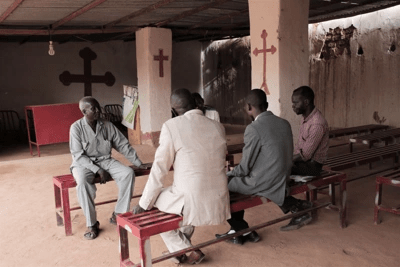
Lutheran reverend Yousef Zamgila (L) speaks to members of his congregation at the small improvised church they helped set up in a neighbours yard in Omdurman, Khartoums twin city, on August 22, 2019. Sudan’s Christians suffered decades of persecution under the regime of Islamist general Omar al-Bashir. | JEAN MARC MOJON/AFP via Getty Images
Several years ago Tony Campolo wrote, “I place my highest priority on the words of Jesus, emphasizing the 25th chapter of Matthew, where Jesus makes clear that on Judgment Day the defining question will be how each of us responded to those he calls ‘the least of these.’”
President Obama, speaking to the Pope at the occasion of his visit to the White House in 2015, stated “You call on all of us, Catholic and non-Catholic alike, to put the ‘least of these’ at the center of our concerns.” And then the President went on to identify “the poor and the marginalized” as the “least of these.”
Others identify those needing adoption or the homeless as “the least of these.” Former NIH director Francis Collins in his recent book The Road to Wisdom identified “the poor, the sick, the orphans, the prisoners, [as] the least of these that Jesus said we are most called to help.”
Since Jesus makes this such an important issue, it would behoove us to identify those whom the Bible itself would call the “least of these.”
Notice that in Matthew 25:40 Jesus said, “… inasmuch as you did it to one of the least of these my brethren, you did it to Me.” So the “least of these” are His brethren. Who are Jesus’ brethren? Hebrews 2:11 answers, “For both He who sanctifies and those who are being sanctified are all one, for which reason He is not ashamed to call them brethren.” Romans 8:29 calls Jesus “the firstborn among many brethren.” 1 John 3:13-14 counsels us “Do not marvel, my brethren, if the world hates you,” but “We know that we have passed from death to life because we love the brethren.”
So, love for the brethren (Christians) is a sign that we have eternal life, just as in Matthew 25 Jesus indicates that those who care for the least of His brethren are welcomed into His eternal Kingdom.
Some Christian writers have identified the brethren of Jesus in Matthew 25 as disciples called to preach the Gospel, such as those sent out by Jesus in Matthew 10. Those may indeed risk hunger, loneliness, nakedness and imprisonment, but the ones mentioned in Matthew 25 evidently refer to those who actually suffer such things.
Now we know from the rest of the Bible (e.g. Romans 4:3-8 and Romans 10:9) that our righteousness is based on our faith in the finished work of Jesus for the forgiveness of sins and belief in His resurrection. So, the works on behalf of the least of Jesus’ brethren mentioned in Matthew 25 do not earn us salvation. Rather, they are a sign that we are already saved, as James said, “I will show you my faith by my works” (James 2:18).
Why is this important? First of all, this passage from Matthew should not be used for virtue signaling, to drum up support for one’s favorite charity, or to promote a government program. Our salvation is never based on our works, however good they may seem. Secondly, notice that the passage in Matthew 25 is part of the so-called Olivet Discourse starting in Matthew 24 where Jesus spoke to his disciples in private. In that context, Matthew 25: 31-46 gives His brethren, His disciples, a way to distinguish between others “blessed of My Father” (v. 34) and those deserving of “everlasting fire prepared for the devil and his angels” (v. 41).
As in other places, Jesus was sorting out appearances from reality. For example, before the breakup of the Soviet Union, many leaders in the World Council of Churches and major Christian denominations refused to believe that Christians were in prison for their faith in communist countries, even when presented with exhaustive evidence. Such leaders preferred to associate with leaders of state-controlled churches in those countries. Other nominal Christians either deny that Christians were suffering persecution in communist countries, or they were indifferent about helping them. The ones suffering persecution were indeed in prison. Their families were naked and hungry, because they had no income, and the governments forbade others from helping them. Like St. Paul, they were made “the filth of the world, the offscouring of all things” (1 Corinthians 4:13), surely the “least” ones.
Meanwhile, laymen supported efforts to bring relief to families of Christian martyrs and those in prison. When the communist governments of Eastern Europe collapsed, more Christians understood the magnitude of the persecution that had occurred. More Christians also became involved in helping our persecuted brethren elsewhere.
Nevertheless, one can still discern differences in how Christians and the world respond to the persecution of Jesus’ brethren. Believers still suffer severe persecution in communist China, North Korea, and Cuba. Recently it has also become fashionable to discourage criticism of Islam. However, it’s not fashionable to help Christians persecuted by Muslims in Nigeria or Iran, by Hindus in India or by Buddhists in Myanmar.
The worldly media generally ignores or downplays such persecution, and so it takes effort by Christians to identify it. Christians suffering this persecution are the “least” of Jesus’ brethren, hated by the world (1 John 3:13). But while they are persecuted, practical help provides encouragement that they are not forsaken (2 Corinthians 4:9). One can “visit” them also through prayer and letter writing.
Our priority is always our own household (1 Timothy 5:8) and our brothers and sisters in the household of faith (Galatians 6:10). When we help our persecuted brothers and sisters we exhibit our love for Christ, since Christ dwells within each believer (Colossians 1:2 and 1:27). Unbelievers do not have that love, because suffering for the name of Christ is foolishness to them. It is God Himself who puts that love into our hearts, so it is no cause for boasting.
John Doane received a bachelor’s degree from Yale, a PhD from MIT, and worked in microwave technology for Bell Laboratories, Princeton University and General Atomics. He served on the Board of Directors of Jesus to the Communist World (which later became Voice of the Martyrs). His recent articles have been published in the Creation Research Society Quarterly and The Christian Post.
Source: Christian Post
Bryan Loritts provides a great challenge to build relationships that last in his new book Enduring Friendships: Sticking Together in an Age of Unfriending. The book uses Paul’s New Testament letter to Philemon as a backdrop for thinking deeply about friendship. And it does challenge us to think deeply about our relationships. Onesimus, the slave to Philemon, who likely stole and then ran away from his servitude, making him deserving of severe consequences if not death. Philemon, the enslaver, and partner in the gospel with Paul. Paul, the missionary, who led both of these men to Christ and now pleads with them to do hard things for their relationship and for the glory of God.
We don’t know “the rest of the story”, but can imagine that repentance was had, forgiveness was extended, and God was glorified, because Onesimus is later counted as a Bishop in the early church.
This book reminds us that relationships are hard but worth fighting for. And enduring relationships are costly and take courage to pursue through the messiness of life. What a mess the book of Philemon offers up. But what a beautiful picture of grace and forgiveness if Paul’s formula is lived out. The offender repents, the offended forgives, and the beauty of reconciliation is witnessed by all.
I wish I could say I didn’t have any tangled messes of relationships in my 49 years, but I can’t. I wish I could say that I’ve always done the right and hard thing for the sake of reconciliation. In ministry, the slights received often make us callous toward deep relationships and make it easier just to let people walk away or not make the journey back to the one we offended. People come and go. Sometimes close relationships are resisted because we begin to expect slights, disrespect, betrayal, and eventual departure. Enduring Friendships reminds us that relationships are worth it.
The key to it all of course is Jesus. He empowers us to forgive, to receive grace, and to repent. And he did the hardest thing of all so that we could experience reconciliation by offering up his own body on the cross.
Some great thinking and maturing to be stirred up by Bryan Loritts’ new book. Grab a copy.
Here’s a few of my favorite quotes:

I am – Follower of Jesus Christ – Husband to the beautiful and patient Heather Corley – Father of three. – Church Planter/Church Planting Catalyst for Send Network – When I can, I’m reading, raised bed gardening, and on mission with my church. – Hoping to be helpful.
The Chinese government has tightened its reign on its citizens by announcing that all religious personnel of any faith must submit to and evangelize about the Chinese Communist Party.
“In practice, your religion no longer matters, if you are Buddhist, or Taoist, or Muslim, or Christian: the only religion allowed is faith in the Chinese Communist Party,” said a Chinese Catholic priest, according to CBN.
Starting on Feb 1, all religious groups must adhere to the new rules, which consist of six chapters and 41 articles. They require government approval for any type of gathering and total submission to the Communist Party.
One law, Article 17, states: “Religious organizations must spread the principles and policies of the Chinese Communist Party, as well as national laws, regulations, rules to religious personnel and religious citizens, educating religious personnel and religious citizens to support the leadership of the Chinese Communist Party, supporting the socialist system, adhering to and following the path of socialism with Chinese characteristics…”
Manuscripts from each religion are also not immune to censorship. The Daily Mail reports that the Communist Party intends to complete a “comprehensive evaluation of the existing religious classics aiming at contents which do not conform to the progress of the times.” As Christian Headlines previously reported, this means that books such as the Bible or the Quran will be rewritten to “reflect socialist values” and any paragraphs that the government deems “wrong” will be changed.
“In many ways, the Chinese government’s control, including censorship of the Bible and the Quran, has twisted the doctrines of these religious texts and thus the religions,” said Patrick Poon, a China Researcher at Amnesty International. “There is simply no genuine religious freedom.”
The new laws come after finishing off 2019 with the “worst religious persecution in the country’s history,” according to the Federalist. A pastor of house church Early Rain Covenant Church, Wang Yi, caught international attention last year when he was arrested and later sentenced to nine years in prison for “inciting subversion of state power” and “illegal business activities.” His family wasn’t even sure if he was alive until they heard about his sentencing.
(Mikaela Mathews, “New Law Requires Chinese Christians Fully Submit to Communist Party,” ChristianHeadlinesOnline Tuesday, January 7, 2020)
“…, that one is he who is loving me…”
If you ask people if they love Jesus and what is the evidence of their love, you would get a variety of answers. Some would say that they go to church frequently or are church members. Others would say that they love their fellow man and do no harm to others; maybe some would say they fast certain things during the year or that they pray. Some would say they go on pilgrimages to holy sites, give of their money or keep their denominational traditions.
In the Gospel of John, the Lord Jesus told us how He determines if we really love Him or we are just honoring Him with our words, but our hearts (who we really are) are far from Him. Listen to what He said in John 14: 21 (Wuest Expanded Translation):
“He who has my commandments and habitually keeps them, that one is he who is loving me with a divine and self-sacrificial love.”
On this blog we have quoted the Apostle John in I John numerous times writing about habitually practicing righteousness. John was at the last supper when Jesus said this. That is where he received this truth.
Lord Jesus goes on to describe what happens when we habitually keep His commandments:
“And he who is loving me thus, shall be loved with this same kind of love by my Father, and I shall love him with a divine and self-sacrifical love, and I shall disclose myself to him.” (22)
God the Father poured out this kind of love on the world (John 3:16) when He sent His Son to the cross to bear the guilt and penalty of our sins. And He continues to do so when we are obedient to the gospel and are born again.
But there is more. His disciples thought that Jesus was about to “disclose” Himself as the conquering Messiah to the nation of Israel. The mother of James and John had already approached Jesus about her two sons being seated in places of honor in His messianic court. So one of the disciples asked Him why He was going to disclose Himself to them and not the whole world. Here is His reply:
“Answered Jesus and said to him, If anyone as a habit of life loves me with a divine and self-sacrificial love, my word he will keep, and my Father will love him, and to him we shall come, and an abiding place with him we shall make for ourselves. He who is not habitually loving me with a divine and self-sacrificial love, my words he is not keeping. And the word which you are hearing is not mine but belongs to Him who sent me, the Father.” (23-24)
Now this is very amazing! The God of the universe is going to come and abide in us. How does this happen?
“This things I have spoken to you while abiding with you. And the Counsellor, the Holy Spirit, whom the Father will send in my Name, that One will teach you all things and recall to your mind all things which I spoke to you.” (25-26)
In Acts 2: 38 the people cried out , “What shall we do”, after hearing the first gospel message. Peter told the Passover crowd to repent and be baptized for the forgiveness of your sins and you shall receive the gift of the Holy Spirit. These people were obedient to the gospel message and the Holy Spirit set them apart (i.e. sanctified them) to the Lord Jesus and they were sealed by the Holy Spirit until the day of redemption (Ephesians 1). In other words, the Lord Jesus and The Father came and made their abode with these converts through the Holy Spirit. And God does the same for us when we are obedient to the gospel message.
This is what the Apostle John is telling us in I John 1: 3-4 when he writes:
“…what we have seen and heard we proclaim to you also, that you also may have fellowship with us; and indeed our fellowship is with the Father, and with His Son Jesus Christ. (NASB)
Amazing! We born again believers in Jesus Christ have the privilege of fellowshipping with God Almighty today and everyday. John goes on to tell us how our behavior affects this fellowship. I John 1: 5-10 says the following:
“And it is the message which we have heard from Him and at present is ringing in our ears and we are bringing back tidings to you, that God as to His nature is light, and darkness in Him does not exist, not even one particle. If we say that things in common we are having with Him, and thus fellowship, and in the sphere of the aforementioned darkness are habitually ordering our behavior, we are lying, and we are not doing the truth. But if within the sphere of the light we are habitually ordering our behavior as Himself is in the light, things in common and thus fellowship we [the believer and God] are having with one another, and the blood of Jesus His Son keeps continually cleansing us from every sin.”
“If we say that [indwelling ] sin we are not having, ourselves we are leading astray [nobody else], and the truth is not in us. If we continue to confess our sins, faithful is He and just to forgive us our sins and to cleanse us from every unrighteousness. If we say that we have not sinned and are now in a state where we do not sin, a liar we are making Him, and His word is not in us.” (Wuest Expanded Translation)
The reason John is telling us this he states next in I John 2: 1:
“My little children … these things I am writing to you in order that you may not commit an act of sin. And if anyone commits an act of sin, One who pleads our cause we constantly have facing the Father, Jesus Christ the righteous One. ” (Wuest Expanded Translation)
In closing, two things.
First, is there enough evidence in my life to convict me of really being in love with Jesus, per His definition, or am I a hypocrite like the people in Mark 7:6 to which the Lord said:
“And He said to them, “Rightly did Isaiah prophesy of you hypocrites, as it is written, ‘THIS PEOPLE HONORS ME WITH THEIR LIPS, BUT THEIR HEART IS FAR AWAY FROM ME.
In Luke 6:46 Jesus asked the question “And why do you call Me, ‘Lord, Lord’ and do not do what I say?
Secondly, the Apostle John is telling the born again believer that our indwelling sinful nature, though we are dead to it, has not been eradicated from our being. Therefore, we will occasionally sin and, when we do, we need to confess that sin to maintain fellowship with our Father. (Notice I said fellowship and not relationship. Because of our faith in the work of Christ on the Cross, our relationship is secure with the Father.)
He not only immediately forgives us but the blood of Jesus cleanses us from all unrighteousness, i.e. habitual sins of ignorance that we are walking in but are not aware of yet. What a merciful God!!!
My friends, it all boils down to a simple question for everyone: Is Christ Lord of your life?
I hope you enjoy the fellowship with your heavenly Father and His Holy Son today. Walk in the light as He is in the light.
Carl

 Psalm 119: 38