UNDERSTANDING CHRISTENDOM

It is impossible to understand the present condition of Christendom except in the light of History.      Henry H. Halley

If we wish to understand why the “visible” Christian church looks like it does today, we need to understand what has transpired since Lord Jesus ascended into heaven as recorded in the Book of Acts in the Holy Bible.  I would also add if we wished to properly understand the End Times, we need to understand what transpired in the past.

To help my descendants understand church history and to preserve it for my yet to be born descendants, I have created a website called Christian Church History. Though it is still under construction, I want to now open it up to the readers of this blog.

The site contains videos I have made and on the Resource page there are certain documents I believe are relevant.

Please drop in and look at the site when you have time. You can reach it by going to https://www.carljohnsonministry.com/ or clicking on any of the links in this post.

Any comments, corrections, suggestions, etc. are welcome.

Thank you.

God bless,

Carl

Archeology Confirms The Holy Bible

Pray you and your family are having a great Christmas and New Year Season.

God has a sense of humor.

When the 19th century university elites of Germany began to say the Holy Bible was just a collection of old tales compiled from stories told around the campfire for generations and not reliable, God just sent some men with shovels and spades to the Middle East and had them dig in the ground to show these university elites who professed to be wise that they were fools. 

I was recently reminded of this fact when I discovered a new YouTube Channel entitled “Expedition Bible” (link to website) that shows how archeology and ancient history confirms the Bible. 

The videos take one archeological discovery in the Middle East (Iraq, Jordan, Israel, etc.) and shows how what was discovered confirms the places, people, and events mentioned in the Bible. The author adds certain tools (arrows, lines, camera angles, graphics, context, etc.) to the videos to help you understand what you are looking at, from what viewpoint and how it fits into the Bible narrative. The explanations and subject matter are the most comprehensive I have viewed.

An example would be the YouTube video concerning Nineveh. I understand if you’re afraid to click on published links, so in that case just go to YouTube and search for Expedition Bible.

Another bonus of the videos is that the author, Joel Kramer, a born-again archeologist, refers to some of the earliest published writings of archeologists who were early or the first to excavate places like Ur, the homeplace of Abraham; Babylon, where the Jews spent seventy years in exile and the birthplace of worldwide idolatry, and Nineveh, where Jonah preached and contains the palace of Sennacherib, who conquered parts of Israel.  I have been able to find these out-of-print old titles online for free and in downloadable formats. If you are interested in ancient history, these books are a must have.

An example is the title Ur of Chaldees – A Record of Seven Years of Excavation by Leonard Woolley and published in 1929. Woolley was the archeologist in charge. Ur was where the biblical Abraham lived at one time and today is in modern Iraq.

Following is a link to the About page where you can learn about the author and his goals and, by scrolling down, you can see his statement of faith.

I hope you will check out the content and see how archeology confirms the Bible. Then share the information with your friends who still believe the lies of those old foolish university professors.

Happy New Year

Brother Carl

Our Focus

If you want to be distracted, look around; if you want to be disgusted, look within; if you want to be delighted, look at Him.”

If we want to be distracted from our fruit bearing produced by our reverence for God, all we have to do is look around at the world and the seemingly hopelessness and futility of it all. We will soon find ourselves depressed and hopeless, distracted and overcome in spirit and soul by the world.

If we start to focus on our lack of fruit bearing and the sin that so easily besets us, we will be disgusted by what we see within ourself. We surely have sinned and come short of the glory of God…as born-again believers. We find ourselves still carrying on our back the corpse of the “old self”, our crucified sinful nature (Romans 6:5-7 & 7: 15-25). Truly disgusting.

But, if we focus on our Savior and Deliverer Jesus Christ and all He accomplished for us through His death and resurrection and His continued intercession for us, there is bright, living hope and assurance and Holy Spirit power for living a Christian life that is pleasing to Him.

And He alone can truly delight our soul!

Amen. 

Carl

One Example of The Dangers of Yoga

AP Photo/Mariam Ilies

The following article concerns the arrest of a Romanian yoga guru who is the leader of a multi-national tantric yoga organization called Atman Yoga Federation and is charged with the indoctrination of his female followers for sexual exploitation. The sexual abuse of female and male followers by yoga gurus is well documented going back to when the Beatles started going to India in the 1960s to receive “enlightenment” which was actually a descent into spiritual darkness. Carl

PARIS (AP) – A 71-year-old Romanian yoga guru and 14 others were handed preliminary charges by a Paris magistrate on a raft of counts linked to an international ring that for years allegedly subjected followers seeking enlightenment to sexual exploitation.

The Paris prosecutor’s office said that six of the 15 people interrogated were ordered held on Friday, while nine others were freed but under judicial surveillance.

Gregorian Bivolaru was among two of the six handed a string of preliminary charges that included human trafficking in an organized band, kidnapping, sequestration or arbitrary detention of numerous people along with rape and “abusing the weakness of a group” via psychological or physical subjection. None of the 15 was named but a judicial source said that Bivolaru was among the two facing the longest list of charges.

A trimmed-down version of the preliminary charges were handed to the other suspects. An investigation will now determine whether the preliminary charges lead to a formal indictment and a trial.

The arrest this past week of Bivolaru and 40 others in the Paris region ended a six-year manhunt in several countries. The police unit that combats sect-related crimes freed 26 people described by authorities as sect victims who had been housed in deplorable conditions.

Accounts from alleged victims detailed in the French media portray Bivolaru as a guru who coerced women into sexual relationships under the guise of spiritual elevation in a career spanning decades and continents.

Bivolaru’s group, initially known as MISA, for Movement for Spiritual Integration Toward the Absolute, was later known as the Atman yoga federation. Non-consensual sexual activities under the facade of tantric yoga teachings were allegedly at the heart of the organization, according to a French judicial official who spoke last week on condition of anonymity because the person, like other judicial officials, wasn’t authorized to discuss the ongoing investigation.

The group’s “ashrams” were centers for indoctrination and sexual exploitation disguised as spiritual enlightenment, according to the official. One appeared to be exclusively dedicated to satisfying the desires of the leader, with women transported there from elsewhere, the official added.

MISA said in a statement on its website in Romanian that Bivolaru had been targeted by media campaigns since the 1990s to “discredit and slander” him, calling any charges against him in France “absurd accusations.”

The Atman federation meanwhile described the situation to The Associated Press in an email as a “witch hunt,” disclaiming responsibility for the private lives of students and teachers at its member schools. It also highlighted that some member schools had won cases at the European Court of Human Rights, demonstrating human rights violations against them.

The alleged sexual abuses spanned Europe. In 2017, Finland’s National Bureau of Investigation issued an international arrest warrant for him for alleged aggravated human trafficking. Bivolaru had obtained political refugee status in Sweden in 2005, which delayed legal proceedings in Romania. In France, yoga retreats were held in and around Paris and in the southern Alpes-Maritimes region. However, it was not immediately clear how long he had been in France.

Source: Breitbart News

The Point of Departure

The heart is more deceitful than all else and is desperately sick; who can understand it? Jeremiah 17: 9

Many years ago, in the early days of radio, an incident took place which I may well recount as a crystallization of the aims and purposes I had before me in undertaking this task: the exposition of the epistle to the Romans. In a certain city in central Pennsylvania, listeners were attempting to get my program from a distant station that was broadcasting on a wavelength so near to that of another station that the two programs sometimes became confused. From New York a certain minister was preaching his sermon at the same time that my Bible study was going forth. Friends told me that a woman who was trying to unscramble the two broadcast said, “If I hear a voice talking about the dignity of human personality, I know that I have the New York station. If the voice says that a man must be born again, I know that I have Dr. Barnhouse from Philadelphia.”

Within that exaggeration there is a profound truth, and within that truth there is the expression of the ministry which I seek to exercise. I am convinced that the ministry which seeks to exalt mankind can, in the end, do no good for mankind. On the contrary, the ministry which will reach the truths of man’s complete ruin in sin and God’s perfect remedy in Christ, can best reach the heart of the need of the human race and can bring the only remedy that can heal the heart which God has declared to be humanly incurable.

Quotation from: Donald Gray Barnhouse, Man’s Ruin – Romans 1: 1-32 (Wm. B. Eerdmans Publishing Company 1952) p. 1

Iranians secretly translating the Bible into their heart languages to share Christ with their People

Iranian Christians attend the New Year mass at the Saint Targmanchats Armenian Church in Tehran on Jan. 1, 2023. | Atta Kenare/AFP via Getty Images

(Dear Reader please pray for our brother and sisters in Iran. Carl)

As the underground Church continues to grow in Muslim-majority Iran, Bible translators are putting their lives on the line to bring the Gospel into the local dialects so that their friends and neighbors can have access to the written word of God for the first time. 

Through the work of the translation agency unfoldingWord, Christians in Iran and across the globe have been able to translate the Gospel themselves into more native languages.

The Christian Post interviewed a representative from unfoldingWord, Evan Thompson, who preferred to use a fake name or pseudonym for his safety.

“There are 1.45 billion people in the world who speak about 5,500 languages that do not have the whole Bible in their heart languages. … The Church has expanded exponentially in the last 20 years. And what these folks have learned is that you can lead someone to Christ, but if they don’t have a church, they don’t survive on their own,” Thompson said. 

“You can start a church, but if that church doesn’t have the Bible in its heart language, it will typically only last one generation. Iran, for example, has churches operating underground. And there are thousands of underground churches in many other parts of the world,” he added. 

UnfoldingWord, a nonprofit organization that has been around for roughly seven years, “works with Church leaders around the world who are seeking to establish their churches in sound doctrine, but lack access to Bible translations in the languages their people speak.”

A day in the life of Iranian Bible translators 

The Christian Post heard from two Iranian women risking their lives to help translate unfoldingWord’s Open Bible story resources from Farsi into other Iranian dialects for evangelizing.

Both women Bible translators have chosen not to give their real names for this article to protect their identities and maintain their safety. 

The first woman, using the name Miriam, said she gave her heart to Christ after coming to the realization that she is “God’s child and daughter.”

Miriam is part of a people group in Iran that is made up of millions of natives. She says she is often treated as a second-class citizen because of how those from other people groups view her status in her people group.

Miriam’s life could be in danger if the Iranian government finds out that she follows Jesus in the Islamic Republic, which Open Doors ranks as the eighth-most hostile country for Christians.

“God is my Father. I feel deeply honored to be part of this work of bringing God’s Word to my people,” Miriam said. 

Despite having children and knowing that her life is at risk for believing in Jesus, Miriam said she will not stop working to translate the Gospel into her heart language. 

“I cannot even imagine leaving this work unfinished. I must complete this work and see the result. I want to see my beloved ones experience salvation in Christ. This is my dream; that my people can talk about God and speak His name freely without any hesitation; without any fear they can talk about God,” she said. 

Miriam was introduced to Christianity through a friend in college who gave her a Farsi New Testament. She had to read the Bible alone and in secret, an act that left her without much of a clear understanding of the Christian faith. 

After college, Miriam married into a strict Muslim family. But, no matter how hard she tried to adapt to the strict religious practices of Islam, she could not find God as a Muslim.  

Miriam said she didn’t give her life entirely to Jesus until after she heard about Transform, an online class offered in Iran that covered the basic teachings of Christianity. 

She watched the classes secretly through various digital platforms. And during one of the class sessions, she gave her life to Christ. 

Following her conversion, Miriam’s husband caught her one day watching the Transform Iran pastor on television.

Miriam could no longer hold back the truth about her faith from her husband. 

“By the grace of God, he did not get angry. He said, ‘I know you are a serious-minded woman, and if this is important to you, it’s OK,'” Miriam recalled. 

Miriam’s husband began watching the class with her, and several months later, he also gave his life to Christ. 

Before her husband’s conversion, the Transform Iran pastor asked her if she would get involved in Bible translation because of her expertise in her heart language. 

Miriam accepted the offer even if that meant risking her life to help translate the Bible into more Iranian tongues. 

“We are not allowed to study our heart languages in Iranian public schools. This is a limitation for our people. I have this language specialty and experience, this expertise so that I can help my own people. People like my mother can read this book,” Miriam said. 

“I have a Bible in Farsi, and I can read it. But I cannot understand the more complicated concepts in it because Farsi is not my heart language. I couldn’t establish a relationship with the Bible in Farsi. I’m very fluent in Farsi. I studied hard and had great teachers. Still, I cannot establish a relationship with the Bible in Farsi,” she continued. 

“How about other people who don’t have my educational advantages? My family and friends? Having the Gospel in my heart language makes it much easier to talk to my family about Jesus. They can understand and accept Him easily.”

‘Jesus fed me’

Another Iranian Bible translator who is using the pseudonym Stella accepted Jesus into her heart after her husband died of cancer.

Following her husband’s death, Stella was left alone to care for her young son. During that time, she relied on the peace of God as her only hope. 

“God has helped me. The Name of Jesus Christ was in my life. I didn’t need anybody. Jesus fed me, put clothes on me and gave me peace,” she said. 

​​Stella learned more about God through a Bible translated into Farsi. At first, she thought Christianity was a religion. But, now she understands that Christianity is a relationship. 

“When I was a new believer, I was thinking that, ‘OK, I’m going to just switch religions.’ But, when I got to know the Holy Spirit, I understood that this is a relationship, not religion,” Stella said. 

Stella is currently working on a Bible translation in her heart language. Her sister-in-law became a Christian thanks to her work translating the Bible. Stella worked for five years alongside her family as they helped her review the translation of the Bible, and now she works as part of a larger Bible translating group.

“I love my mother language. I’m telling the poetry; I write the context. I write the sentence. I record it. … I know all of this is God’s work for us. God wants us to do this. … I am thinking about my mom, my father, my childhood. And everyone that doesn’t have it right now. I really want to bring God to my town and my people,” she said.

A dire need for Bible translations

Before unfoldingWord was launched, traditional Bible translation agencies across the globe have done “marvelous work” and continue to do so, Thompson noted. 

However, he said the number of Western Bible translators that Bible translation agencies can send overseas is dropping, and the demand for Bible translation is increasing rapidly. 

“The group that founded unfoldingWord developed a way to address this problem. We call it church-centric Bible translation. … It’s Bible translation incorporated into the life of the Church as part of its discipleship,” Thompson noted.  

“Most of those unreached people have neighbors who know Christ, and they’re taking the Gospel to them. And what unfoldingWord does is we equip the Church in every people group with a goal of translating the Bible in every language.” 

To help local churches translate the Bible, unfoldingWord provides people groups with open-source software and open-licensed biblical content that’s breaking the copyright barriers to source texts.

The organization also has comprehensive translation guides to answer difficult Bible translation questions. The organization offers essential doctrinal education to protect the theological integrity of the translations.

“unfoldingWord provides training for indigenous Bible translation teams over Zoom and sometimes in neutral locations,” Thompson said.

The training locations are kept secret to protect participants in certain countries where practicing Christianity is not accepted.  

“Our training allows for indigenous Bible translation teams to be able to use best practices when they are translating the Bible for themselves. One of the ways that I like to say it is: ‘We don’t make Bible translations. We help develop Bible translators.’ Because that’s what the Church really needs all over the world.”

Issues bringing translations to Iran  

Thompson said unfoldingWord has aided Iranian natives who have translated the Bible into dozens of native languages.

However, he said there are some unfortunate limitations to the organization’s ability to aid translators in Iran. He cited strict government policies prohibiting Iranians from studying their heart languages or their native tongues in public schools. 

“All of these oppressive countries, like Sudan, like Iran, and some others we could name, are trying to Islamasize their whole population. And one of the ways that they do that is by forcing them to speak this one national language, and it’s causing their heart languages to die out,” Thompson said. 

In Iran, the government recognizes Farsi as the national language. However, many natives speak other Iranian dialects more fluently.  

“It’s very much like anybody that comes to America from someplace else, and we put them in American schools to learn English. Unless their family makes it a point to keep their native languages … alive in their families, by the second or third generation, the kids can’t speak their native language anymore,” Thompson said. 

The few responsible for the many

Miriam believes God has blessed her with a huge responsibility to help translate the Bible into more Iranian languages.  

“This is not just a scientific book. This is God’s Word. I felt some tension. I was scared that I would not do the work well enough, but I’m very happy to make it available so that my people can establish a relationship with the Bible. That’s why I got involved with this Bible translation project,” she said. 

When asked if she can imagine the day when the Bible is completed in even more  Iranian languages, Miriam said it will take many years, and she doesn’t know if she’ll live long enough to see the project’s conclusion. 

“I want my children to experience the result of my work so that they can know Jesus through their heart language. I never thought this project would grow like this. But I’ve learned that it’s not just about me,” Miriam said.  

“I need this team that has been pulled together. For safety, we have many people working on this project secretly. There may be several Christians in one Iranian family, but they cannot share their faith with each other openly,” she continued.  

“We need more people who can speak my heart language to continue working on this project. … I want to ask for prayer … to recruit people into the project who know our language well.”

By: Christian Post staff

What does the Bible say about homosexuality?

 JIM DENISON, PHD

(Dear Reader: a video of this teaching can be found on YouTube here.)

Homosexuality, LGBTQ+ issues, and same-sex marriages are divisive issues in today’s culture, especially within American Christianity. This leads many people to wonder, “What does the Bible say about homosexuality?”

Denison Forum has compiled the following resource to help you know more about God’s word on this issue.


Guide to “What does the Bible say about homosexuality?”

Homosexuality is one of the most divisive issues in American culture. The pejoratively named “Don’t Say Gay” bill in Florida shows just how divisive this issue is. It seems that the acceptance of homosexuality is so widespread that schools are teaching it in sex-ed at younger and younger ages. Some Americans are actively raising and guiding their children toward queer relationships as young as toddlers

But, that leaves the question, how should Christians respond to this issue? 

  • Although same-sex marriage has been legalized and accepted in American culture, should it stay legal? 
  • Should practicing homosexuals be ordained into Christian ministry?
  • What does the Bible say on this controversial and emotional issue?
  • Does the Bible allow for these relationships, and is it even a big deal to God? 

On such a controversial and emotional issue, we need to know whose word we are going to trust. We can find scholars who support any of the variety of positions that are advocated on the subject.

It is not my intention to treat fully the multitude of interpretive comments that deal with the biblical texts on the subject. My goal is simply to review what the Bible says about homosexuality, as clearly, succinctly, and practically as possible. And, at the end of the day, champion love first and foremost. 

Seek the intended meaning of the Bible

And so I must begin with an interpretive word.

When I taught principles of biblical interpretation at Southwestern Baptist Theological Seminary, I often told my students, “The Bible can never mean what it never meant.” We must seek the intended meaning of the text as understood in its original context.

I also said often, “The only word God is obligated to bless is his word.” What matters to us today is not my opinions or yours, but God’s.

Such a position is not held universally on this subject.

For instance, Dr. Walter Wink states in his thoughtful booklet, Homosexuality and the Bible, “Where the Bible mentions homosexual behavior at all, it clearly condemns it. I freely grant that. The issue is precisely whether that Biblical judgment is correct” (p. 12).

Dr. Wink then compares homosexuality to the issue of slavery: he argues that the Bible condones slavery, states that the Bible was wrong on that subject, and concludes that it is equally wrong on the issue before us (pp. 12-13).

I greatly respect Dr. Wink’s enormous contributions to New Testament studies, especially on the subjects of spiritual warfare and nonviolence. But I could not disagree more strongly with his assertion, “The issue is precisely whether that Biblical judgment is correct.”

Without digressing into an extended defense of biblical authority, I wish to state clearly that I believe every word of the Bible to be the word of God. I believe the Scriptures to possess the same authority for our lives today as they possessed for their first hearers and readers.

For my purposes, the only question we’ll seek to answer is: What does the Bible say about homosexuality?

Does “the sin of Sodom” condemn homosexuality?

The Supreme Court made history on June 27, 2003, when it struck down the “sodomy laws” of the state of Texas. In a 6-3 decision, the justices reversed course from a ruling seventeen years ago that states could punish homosexuals for private consensual sex. Such activity is typically called “sodomy” because of the text we’ll study today.

In a survey of passages typically cited on the divisive issue of homosexuality, Genesis 19 and the sin of Sodom is usually listed first. Lot entertained two angels who came to the city to investigate its sins. These angels appeared as men. Before they went to bed, “all the men from every part of the city of Sodom—both young and old—surrounded the house. They called to Lot, ‘Where are the men who came to you tonight? Bring them out to us so that we can have sex with them’” (vv. 4-5 NIV). For such sin, “the Lord rained down burning sulfur on Sodom and Gomorrah” (v. 24), destroying them.

Is this text a condemnation of homosexuality?

Dr. Walter Wink believes not: “That was a case of ostensibly heterosexual males intent on humiliating strangers by treating them ‘like women,’ thus demasculinizing them” (p. 1). However, Dr. Wink offers no textual evidence that the men were “ostensibly heterosexual.” His view is only conjectural and stands against the vast majority of interpretation across the centuries.

Dr. Peter Gomes, the minister at Harvard’s Memorial Church and Plummer Professor of Christian Morals at Harvard College, offers a different approach. He has written an extremely erudite introduction to the Bible and its message, The Good Book. Dr. Gomes, himself a homosexual (p. 164), treats this passage as an attempted homosexual rape and argues that it does not condemn homosexuality per se (pp. 150-52).

A third approach is suggested by D. Sherwin Bailey in his influential book, Homosexuality and the Western Christian Tradition. Dr. Bailey argues that the Hebrew word for “know,” translated “have sex” by the New International Version, relates not to sexual activity but to hospitality. The word appears more than 943 times in the Old Testament and only twelve times in the context of sexual activity.

However, ten of these twelve times are in the book of Genesis, the context for our text. Lot’s response to the crowd, offering his daughters so they can “do what you like with them,” makes clear that he interpreted their desires as sexual (v. 8). Everett Fox’s excellent translation of Genesis includes the note, “the meaning is unmistakably sexual” (p. 80). And Jude 7 settles the question as to whether sexual activity is meant by our text: “Sodom and Gomorrah and the surrounding towns gave themselves up to sexual immorality and perversion.”

It is also the case that Jewish and later Christian interpretation of the passage has historically and commonly seen the sin in Sodom as homosexuality itself, not just attempted rape. While this fact does not settle the interpretative question, it is worth noting as we proceed.

What about Leviticus 18:22?

The next text typically cited on our subject is Leviticus 18:22, and it is far less ambiguous: “Do not lie with a man as one lies with a woman; that is detestable.” The Hebrew is as clear as the English translation.

The obvious sense of the command seems to be: homosexual sexual relations are forbidden by Scripture. This is the way the text has typically been understood by Jewish and Christian interpreters across the centuries. It is the way most read the text still today.

But those who advocate homosexuality as an acceptable biblical lifestyle have found ways to dissent. Dr. Walter Wink admits that this text “unequivocally condemn[s] same-sex sexual behavior.” But he theorizes that the ancient Hebrews saw any sexual activity which could not lead to the creation of life as a form of abortion or murder. He adds that the Jews would have seen homosexuality as “alien behavior, representing yet one more incursion of pagan civilization into Jewish life.”

He then cites the penalty for homosexual behavior: “If a man lies with a man as one lies with a woman, both of them have done what is detestable. They must be put to death; their blood will be on their own heads” (Leviticus 20:13). In his reasoning, if we see this punishment for homosexuality as obsolete today, we should see its prohibition of this behavior as equally outdated. He concludes his argument against making Leviticus 18:22 normative for sexual ethics today by citing a list of other biblical ethics he considers to be obsolete or in need of reinterpretation, e.g., intercourse during menstruation, polygamy, concubinage, and slavery among them.

And that’s not all. Other critics see the Levitical laws as expressive of worship codes, not universal moral standards. And they argue that all such laws were intended only for their day and time, such as kosher dietary laws and harvest regulations.

Is there an objective way to respond to these assertions?

First, let’s consider the claim that this Old Testament law has no relevance for New Testament believers but should be classified with kosher laws and such.

A basic rule of biblical interpretation is that any Old Testament teaching repeated in the New Testament carries the weight of command to the Christian church and faith. And the prohibition against homosexual activity is most certainly present there (see Romans 1:26-27, a passage we will consider in due time).

Even those Old Testament statements that are not repeated in the New Testament carry the force of principle. For instance, kosher laws tell us, at the least, that God cares about our bodies and health.

Second, it is claimed that the Leviticus passage expresses a worship code, not a moral standard.

The logic is that Leviticus is written with regard to the Levitical priests and their duties of worship preparation and leadership and does not apply as such to the larger family of faith. However, the chapter in question begins, “The Lord said to Moses, ‘Speak to the Israelites and say to them . . . .’” (18:1).

Nothing in the chapter limits its application or significance to the Levites. Rather, the chapter exhorts all Israel to “keep my decrees and laws, for the man who obeys them will live by them” (v. 4). It proceeds to forbid incestuous relationships, child sacrifice, and bestiality—standards I presume critics of Leviticus 18:22 would consider universal.

Third, it has been argued that the Leviticus prohibition of homosexuality is to be classed with other biblical statements that can be considered obsolete, such as the apparent biblical endorsement of slavery. This claim is cited frequently, so much so that we need to consider it next.

Slavery and the Scriptures

My move to Atlanta in 1994 gave me my first exposure to the remarkable colonial history of the East Coast. (Now that I live in Texas, I’ve learned that Texans think something is historical if it happened while Tom Landry was the coach of the Cowboys.) When people living in South Carolina speak of “the War,” they could mean the Civil War (though they’ll say “there was nothing civil about it”) or the Revolutionary War.

It is a fascinating region.

With one exception.

While traveling in Charleston one day, my wife, Janet, and I came upon the “slave trading warehouse,” the place where slaves were brought to America on ships and sold at market. I can still remember the building and my revulsion upon seeing it.

I believe that racism is the greatest sin in America, the failure that keeps us from addressing our other failures. Racism makes crime in south Dallas a “black” problem and drug abuse in north Dallas a “white” problem—when they’re all our problems.

Given our tragic history with racism, treating the subject of slavery in the Bible is a bit repugnant for us. However, a very common assertion regarding the topic of homosexuality and the word of God is that the biblical injunctions against this lifestyle are outdated, as is its acceptance of slavery. If we can prove that the Bible was wrong on the latter, we can believe that it is wrong on the former.

The issue of slavery in the Bible is a large and comprehensive subject, far more wide-ranging than we will consider in this article. I’ll try to limit our study to the barest of essentials so we can relate it to the larger question that brings it to our attention.

Slavery was an accepted part of life in Old Testament times. We know of no culture or ancient literature that questioned its existence or necessity. Persons became slaves in a variety of ways:

Slaves in Israel were considered to be property and could be bought and sold (Exodus 21:32). They were granted protection against murder, permanent injury, or undue physical labor (cf. Exodus 21:202623:12). Hebrew household slaves were circumcised (Genesis 17:12) and included at religious meals (Exodus 12:44).

Why did the Old Testament not decry slavery in general and move to free all those enslaved?

In many ways, it did.

There were several ways a Hebrew slave could be freed (a process called “manumission”):

  • An individual could be purchased and set free (Exodus 21:8).
  • A slave permanently injured by his master was to be set free (Exodus 21:26).
  • Hebrews were to be held as slaves for no longer than six years (Deuteronomy 15:12).
  • And the Jubilee Year, which occurred every forty-nine years, was to free all Israelite slaves (Leviticus 25:50).

But still we ask: Why did the Old Testament sanction this practice at all?

In fact, it simply recognized a fact of all ancient civilization. And its rules minimized this evil, protected its victims more fully than did any other society, and provided means for their eventual freedom. But the New Testament would bring God’s word on the subject to much fuller expression.

In the Old Testament era, the primary way persons were enslaved was through capture in war. But in the first century AD, the breeding of slaves swelled their numbers enormously. And large numbers of people sold themselves into slavery as a means of improving their quality of life. Owning and using people as slaves was so commonplace in the Roman Empire that not a single ancient writer is known to have condemned the practice. But all that would begin to change with the advent of the Christian movement.

What was the New Testament attitude toward slavery?

And how does this stance affect our study of the issue of homosexuality?

Slavery in the Roman era was dramatically different from the despicable practice as we know it in American history. If you had been walking through any first-century Roman city, you would not have been able to distinguish between slaves and free. Patterns of work, relationships, or faith were no different between the two. Slaves served not only to do manual labor but also as doctors, nurses, household managers, and intellectuals. They administered funds and cities. They were typically given an excellent education at the expense of their owners so that philosophers and tutors were typically slaves.

Even more amazing to us, it was common for people to sell themselves into slavery to secure such privileges. A person who desired citizenship in the Empire could achieve it by enslaving himself to a citizen, then purchasing his freedom. Slavery was more a process than a condition.

While there is no doubt that many slaves were abused physically, sexually, and socially, it is also true that at least as many were part of the more privileged strata of society. And the total dependence of the Roman economy upon the labor of slaves made it impossible for the Empire to conceive of abolishing this institution. If an economist were to propose that we refuse all goods and services imported from outside America, we’d be equally surprised.

Does the New Testament then argue for slavery? Absolutely not.

In summary, what is the New Testament’s view of slavery?

No writer attempted to lead his readers to end the institution per se, as this was not possible in the Roman Empire. Those initiating such an uprising would have been quickly annihilated as rebels and threats to Caesar. But several other facts should be noted as well.

First, Paul abolished even the possibility of racial or social discrimination for followers of Jesus: “You are all sons of God through faith in Christ Jesus, for all of you who were baptized into Christ have clothed yourselves with Christ. There is neither Jew nor Greek, slave nor free, male nor female, for you are all one in Christ Jesus” (Galatians 3:26-28).

Every believer is our sister or brother. The ground is level at the foot of the cross.

Second, wherever the apostolic church spoke to this issue, it did so with a view to freedom and equality. Paul appealed to Philemon to see his slave, Onesimus, “no longer as a slave, but better than a slave, as a dear brother” (v. 16).

Clement, a friend of Paul, wrote in his letter to the Corinthians (ca. AD 90), “We know many among ourselves who have given themselves up to bonds, in order that they might ransom others. Many, too, have surrendered themselves to slavery, that with the price which they received for themselves, they might provide food for others” (ch. 55).

And Ignatius (died AD 107) wrote to Polycarp: “Do not despise either male or female slaves, yet neither let them be puffed up with conceit, but rather let them submit themselves the more, for the glory of God, that they may obtain from God a better liberty.”

Third, the New Testament church gave those who were enslaved a family and a home.

This was one reason why so many of the earliest believers were slaves. Pastors and congregational leaders were drawn from the ranks both of slaves and free. Christians made no distinction between the two, for their Father welcomed all as his children.

Last, not a single New Testament leader owned slaves or condoned such, even though many had the means to purchase them (cf. Nicodemus, Joseph of Arimathea, Barnabas). Their example inspired William Wilberforce and countless other Christians to do all they could to abolish slavery, and we thank God that they were successful.

It is therefore an extremely unfair accusation to claim that the Bible was “wrong” or “outdated” on the issue of slavery and thus on the subject of homosexuality.

The Bible and the punishment of homosexuals

One objection to the Leviticus statement remains. Dr. Walter Wink and others point out its punishment for homosexuality: “If a man lies with a man as one lies with a woman, both of them have done what is detestable. They must be put to death; their blood will be on their own heads” (Leviticus 20:13).

If we no longer execute those who practice homosexuality, are we justified in ignoring the prohibition against such activity entirely?

Those who argue that homosexuality is a biblical lifestyle point to this “outdated” penalty as reason to consider the prohibition to be equally irrelevant to society today.

No one I know would argue that homosexual practice should result in the death penalty today. But let’s consider two facts.

First, the Levitical code was given to Israel at a crucial time in her early formation.

The nation had no functional law process or court system. Her moral character was not yet formed. And so the Lord gave the nation clear and enforceable standards that would help solidify and preserve her spiritual future. The spirit of the Levitical prohibition is clear: homosexuality is not to be practiced or accepted by the nation.

Second, a reinterpretation of the penalty prescribed by a law does not justify the decision to ignore the law itself.

Leviticus also prescribes the death penalty for child sacrifice (20:2), adultery (v. 10), and bestiality (vv. 15-16). I presume we would not accept these practices as moral and lawful today on the basis that their prescribed punishments are not prosecuted by our society.

And so we have surveyed arguments for ignoring the Levitical prohibitions against homosexual practice and have concluded that these laws are indeed timeless in import, expressive of moral standard, relevant to our culture, and a valid basis for moral standards today. An objective reading of the Levitical prohibitions leads to the clear conclusion that this part of God’s word considers homosexual practice to be wrong.

A survey of the biblical materials relating to this issue would also include Deuteronomy 23:17-18, which outlaws prostitution, whether male or female. But interpreters are divided as to whether the passage relates to homosexuality in general.

What does the New Testament say about homosexuality?

Turning to the New Testament, three passages are typically cited.

Homosexuality in the New Testament: Romans 1:26-27

The first is Romans 1:26-27: “Because of this, God gave them over to shameful lusts. Even their women exchanged natural relations for unnatural ones. In the same way the men also abandoned natural relations with women and were inflamed with lust for one another. Men committed indecent acts with other men, and received in themselves the due penalty for their perversion.”

At first reading, Paul seems clearly to consider homosexual activity to be unbiblical. But there is another way to interpret the passage, suggested by those who support homosexuality as a biblical lifestyle.

In their reading, Paul is addressing the issue of heterosexual men and women who choose homosexual activity, which is “unnatural” for them. If this is true, Paul’s statement bears no relevance to those who consider themselves homosexual by innate or “natural” orientation.

Is such an interpretation the most objective way to read the text?

No, for two reasons.

First, Paul describes homosexual acts themselves as “shameful lusts” (v. 26), “indecent acts,” and “perversion” (v. 27). To suggest that his descriptions relate only to the (supposed) decision to engage in such activity by heterosexuals is to strain the Greek syntax beyond its meaning.

Second, Paul states that men who engage in homosexual activity “abandoned natural relations with women,” making clear the fact that he considers heterosexuality to be “natural.” Likewise, he describes lesbian activity as “unnatural.”

One can conclude that Paul was wrong, that homosexual orientation can be “natural” and its sexual expression therefore “natural relations.” But one cannot argue on the basis of this text that homosexuality is biblical, for Paul’s scriptural words clearly state the opposite.

Homosexuality in the New Testament: 1 Corinthians 6:9-10

The next New Testament text typically included in our topic is 1 Corinthians 6:9-10: “Do you not know that the wicked will not inherit the kingdom of God? Do not be deceived: Neither the sexually immoral nor idolaters nor adulterers nor male prostitutes nor homosexual offenders nor thieves nor the greedy nor drunkards nor slanderers nor swindlers will inherit the kingdom of God.”

“Male prostitutes” could refer to men who sold themselves sexually, either in heterosexual or homosexual activity. As translated by the New International Version, the word would not necessarily speak to our subject, as prostitution of any kind is almost universally understood to be immoral.

But the Greek word so translated is more likely a technical term for the passive partner in homosexual activity (Fritz Rienecker, A Linguistic Key to the Greek New Testament, 2:56). And so it may well refer to one who engages in homosexuality, without a necessary connection to prostitution. The activity it describes makes it harder to assert that Paul had no concept of homosexual orientation but meant his words only for heterosexuals who practice (for unexplained reasons) homosexual behavior.

The other term germane to our discussion is translated by the NIV as “homosexual offenders.” The Greek word is defined by Fritz Rienecker as “a male who has sexual relations with a male, homosexual.” Here the word has no connection with prostitution. Again, one can claim that Paul was wrong in his understanding of human sexuality. But it seems to me that we cannot read his words in their intended meaning as accepting of homosexual activity.

Homosexuality in the New Testament: 1 Timothy 1:8-11

The last passage for our study is part of Paul’s first letter to Timothy. Here is the paragraph in which our verse is found: “We know that the law is good if one uses it properly. We also know that law is made not for the righteous but for lawbreakers and rebels, the ungodly and sinful, the unholy and irreligious; for those who kill their fathers or mothers, for murderers, for adulterers and perverts, for slave traders and liars and perjurers—and for whatever else is contrary to the sound doctrine that conforms to the glorious gospel of the blessed God, which he entrusted to me” (1 Timothy 1:8-11).

The phrase in question is found in verse 10, translated by the NIV as “adulterers and perverts.” “Adulterers” renders the root Greek word pornos, from which we get “pornography,” and means one who practices sexual immorality. When accented on the second syllable, it frequently refers to one who operates a brothel. When accented on the first syllable, as in our text, it can refer to homosexual activity.

“Perverts” renders the Greek word arsenokoites, typically translated as “homosexual.” We see it in 1 Corinthians 6:9, where it is translated by the NIV as “homosexual offenders.” The word means literally “one who has sexual relations with men.” While some attempt to interpret the word as it is found in 1 Corinthians 6 with reference to prostitution, such a connection is even more difficult to maintain in the present text.

And so, once more, we find Paul addressing the subject at hand with what appears to be the clear position that homosexuality is an unbiblical practice or lifestyle.

Such is the consistent teaching of the New Testament on the subject.

Does the Bible endorse homosexuality?

I am not gay, have no family members who are, and have no experience with this lifestyle. So who am I to judge? Why don’t we just let consenting adults do what they wish so long as no one else is hurt?

Many in our society take this approach to the subject, whatever their own sexual preferences might be. To do otherwise seems to be intolerant and judgmental, two words our postmodern, relativistic society condemns.

On the other hand, believers and those interested in the Christian faith do well to ask what God’s word says to every subject present in our culture. An objective reading of history and Scripture will inform our faith and make it more relevant to our problems and issues. For many paragraphs, we’ve considered such a survey. Now let’s summarize what we’ve found and ask how it all applies to our lives and relationships.

We have surveyed the seven passages typically cited with regard to this issue.

In Genesis 19, we find the attempt by men in Sodom to “have sex” with Lot’s angelic visitors (v. 5) and God’s consequent punishment against the city. While homosexual practice is clearly part of the text, the passage is less clear as to whether God’s judgment is against homosexuality itself or the crowd’s abusive attempt to commit homosexual rape.

Next, we found Leviticus 18:22, with its clear prohibition against homosexual activity, and Leviticus 20:13, with its prescription of the death penalty for such activity.

Since some consider these passages as “outdated” as the Bible’s (supposed) endorsement of slavery, we next took a brief side journey through the latter issue. After noting the biblical abolition of social and racial discrimination (Galatians 3:26-28) and the fact that followers of Jesus were the leaders in abolishing the institution of slavery, we concluded that the Bible is being unfairly interpreted by its critics on this issue.

We briefly considered Deuteronomy 23:17-18, which outlaws all prostitution, whether male or female. And we focused at some length on Romans 1:26-27, with its description of homosexual acts as “unnatural” and “indecent.”

We closed our survey with brief studies of 1 Corinthians 6:9-10 and 1 Timothy 1:8-11, passages that are considered by some to refer to homosexual prostitution but which seem more objectively to forbid homosexual practice in any context.

As we have seen, proponents of homosexuality as a biblical lifestyle have arguments by which they attempt to reinterpret these passages. It may be of interest, however, to note that no biblical passage can be cited with confidence as an endorsement of this activity. No biblical leader or ethical model taught by the Scriptures can be effectively construed as practicing this lifestyle.

The Old Testament prohibitions we have discussed in our survey are too unambiguous to ignore, and are renewed in the New Testament. A basic principle of biblical interpretation is that an Old Testament teaching that is renewed or endorsed in the New Testament retains the force of precept and principle for Christians today (see Gordon D. Fee and Douglas Stuart, How To Read The Bible For All Its Worth, 2d ed. [Grand Rapids: Zondervan, 1993] 153).

So, in completing our brief biblical survey of this issue, it seems clear to me that Scripture intends us to see homosexual practice as unbiblical.

Practical questions about homosexuality

Several questions come immediately to mind.

What about the argument that homosexuality is inherited?

If this is true, at least for some, how can such activity be wrong?

“God made me this way” is a typical testimony. A very brief response would be that the connection between genetics and homosexuality is tenuous at best.

Where research has seemed to indicate some physical propensity toward homosexual orientation, others in the field have refuted such a conclusion. It is widely believed that alcoholism can be an inherited genetic propensity, but no one would therefore endorse its practice. While this is a very unfortunate analogy regarding homosexuals, it perhaps illustrates the fact that not every genetic tendency should be endorsed (if homosexuality is, in fact, such).

What about environmental conditions?

Studies have been conducted of identical twins who were separated at birth, where one developed a homosexual lifestyle but the other did not. Particular family or circumstantial patterns are sometimes seen in these cases to contribute to sexual orientation. But again, other interpreters disagree with such conclusions.

What does all this mean for those who deal with homosexuality on a personal basis?

Those who practice homosexuality seem to fall into two categories.

Some can remember decisions, choices, and circumstances by which they moved into this lifestyle. Others believe this lifestyle to be a sexual orientation which, for them, existed from birth or prior to conscious choice and intention. It is obviously both impossible and wrong for me (or any other person) to say which category is appropriate to a specific individual.

At the same time, it seems clear to me that homosexuality is an unbiblical lifestyle. So, what practical conclusions can guide those who interpret Scripture as I do as we seek to relate biblically and positively to those who are homosexual?

First, I need to state clearly that homosexuality is not the “unpardonable sin” (cf. Mark 3.29).

The only sin God cannot forgive is that sin that rejects his forgiveness. To be more specific, the Holy Spirit works to convict us of our need for salvation through Christ. If we refuse this offer of saving grace, God cannot forgive us, as we have rejected the only means by which his forgiveness can be given.

As a result, whether homosexuality is a person’s choice or orientation, he or she does not stand outside of the grace and love of God. Such sexual activity is no more unbiblical than many other sins listed in Scripture, including hatred, slander, gossip, and gluttony. We are wrong to reject the person because he or she is practicing a lifestyle we consider unbiblical. In other ways, so are we.

Second, and in contrast to my first statement, we do others no good if we endorse that which is unbiblical or hurtful to them.

There are twin temptations here. One is to refuse any statement that might appear judgmental with regard to homosexuality, lest we appear to be rejecting the individual. The other is to condemn the person rather than the behavior.

Our Father never falls into either mistake. He always exposes that which hurts his children, all the while loving them as his children.

And so we are to maintain that difficult balance that loves the person while opposing that which is unbiblical in his or her life. We want others to do the same for us, don’t we?

How should Christians respond to homosexuals?

I’m writing today with several personal friends especially in mind: a mother of a gay son, a brother of a gay sister, a son whose father is divorcing his wife and announcing his homosexuality, and a close college friend who several years ago declared his homosexuality and is no longer in vocational Christian ministry.

What would I say to these four people if they were reading this essay?

Two comments are easy to make, the other two not as much so.

God loves each of us.

He is not willing that any should perish, but that all should come to repentance and faith in his Son (2 Peter 3:9). He so loved the world that he gave his Son for us all (John 3:16). Nothing we do, no matter how unbiblical, can separate us from his love for us.

Your son, sister, father, or friend is loved by our Father in heaven.

A homosexual person deserves to be treated with dignity and respect.

He or she is acting out a lifestyle that many of us understand to be unbiblical—but so are any of us who practice slander, gossip, heterosexual lust, or egotistical pride.

So-called “gay bashing” is always wrong. Any action or attitude that demeans a person or makes them less valuable is the opposite of the grace and unconditional love of Christ.

While we wish to offer the dignity and respect of Christian grace to all persons, we cannot truly love them while endorsing that which is unbiblical in their lives.

As intolerant as the next sentence may seem, it is honestly motivated by a sincere desire to speak the truth in love: we can and should pray for those in the homosexual lifestyle to come to repentance and transformation.

After including homosexuality in his list of sins (1 Corinthians 6:9), Paul next told the Corinthians: “And that is what some of you were. But you were washed, you were sanctified, you were justified in the name of the Lord Jesus Christ and by the Spirit of our God” (v. 11).

I recognize that some will read this paragraph as bigoted prejudice. However, any of us would want to help those we care about to practice a biblical lifestyle that leads to the fullest abundance of Christ’s joy (John 10:10). This is the honest motivation behind my suggestion that such intercession is appropriate for the gay people we know and love.

I must offer one last suggestion, a statement that will engender further resistance from many in the gay community:

Those who consider themselves to be homosexual by sexual orientation should practice sexual celibacy.

Many will counter that I have no idea how difficult such a lifestyle decision would be. They’re right.

But given that I understand the Bible to teach clearly that homosexuality is an unbiblical lifestyle, the only conclusion I can draw is that the practice of this lifestyle will lead the person out of the will of God and into harmful behavior.

Abstinence is, by this logic, the option that is in that person’s best personal interest. I can only hope that my heart is clear in offering this suggestion. My desire is not to condemn but to offer biblical truth as I understand it.

This article is offered with the prayer that the Lord of Scripture will use his word to bring healing, hope, and help to hearts and homes troubled by the issue of homosexuality. To the degree that these thoughts have shed more light than heat, my prayer will be answered.

British University Offers A Master’s Degree in Witchcraft

With Halloween behind us, the witch and warlock costumes can be put away for another year. But the real witches are still very much with us.

News comes to us that a British university is scheduled to offer a master’s degree in witchcraft, magic, and occult science in the 2024 school year. Professor Emily Selove is the director of the new program at Exeter University.

She justifies the degree’s development to:

“A recent surge in interest…. Magic and the occult inside and outside academia lies at the heart of the most urgent questions of our society.”

The university website says that the classes will take place in the Institute of Arab and Islamic studies. Selove goes on to explain that the classes will:

“Allow people to reexamine the assumption that the West is the place of rationalism and science while the rest of the world is a place of magic and superstition.”

Actually, this university class is an interesting accumulation of viewpoints, all of which have Satan’s fingerprints all over them.

There is no doubt that there is “a recent surge in interest” in witchcraft and the occult. The Pew Research Center reported in 2014 that there were about 730,000 adult pagans and wiccans in the United States.

This desperate search for meaning has led to the creation of:

“…sea witches, city witches, cottage witches, kitchen witches, and influencer witches, who share recipes for moon water or dreamy photos of altars bathed in candlelight. There are witches living all over the world, hosting moon rituals in public parks and selling hangover cures that ‘adjust the vibration of alcohol so that it doesn’t add extra density and energetic ‘weight’ to your aura,’” according to The Atlantic magazine.

However, one church in Florida has demonstrated a highly effective biblical approach to the solution of these people’s problems.

Bill Losasso, senior pastor of Pathways Community Church in Largo, Florida observed that his state was “one of the three hotbeds of witchcraft, along with Texas and California.” because witches have actually come in and attempted to disrupt his worship service.

Apparently, the pastor had trained his people well because when the witches came in expecting a fight, they were, instead, welcomed by a loving concern for their spiritual welfare.

Over time, some were converted and baptized. It became sort of a contest with other witches coming for revenge and meeting the same joyous fate. Losasso says that:

“There have been no more physical attacks by the witches, but, of course, a ton of spiritual warfare. But everyone involved learned the power of the scripture: ‘…greater is He that is in you than he that is in the world.’” (1 John 4: 4.)

Everyone witnessing to a real witch needs to understand that they are generally more afraid of us than we are of them. Bill Gordon, an associate of the Southern Baptist North American Mission Board, says that:

“It has been my experience that witches are normally more afraid of us than we are them.”

Just as an individual has that God-shaped vacuum in their heart, there is also that vacuum in a culture such as ours.

We have spent many decades systematically eliminating God from our culture and now we are watching His evil replacement. Man is essentially a spiritual being who cannot long tolerate a secular-based worldview.

But to the Bible believer, spiritual darkness is only a challenge. The longer that people are lost, the deeper their despair and the more ready they are to respond to the gospel. And salting a community with gospel tracts that people love to read will ferret out those who are ready to respond. Any effort you make will be worth it because Chick tracts get read and God promises that:

“…So shall my word be that goeth forth out of my mouth: it shall not return unto me void, but it shall accomplish that which I please, and it shall prosper in the thing whereto I sent it.” (Isaiah 55:11)

Source: Chick.com

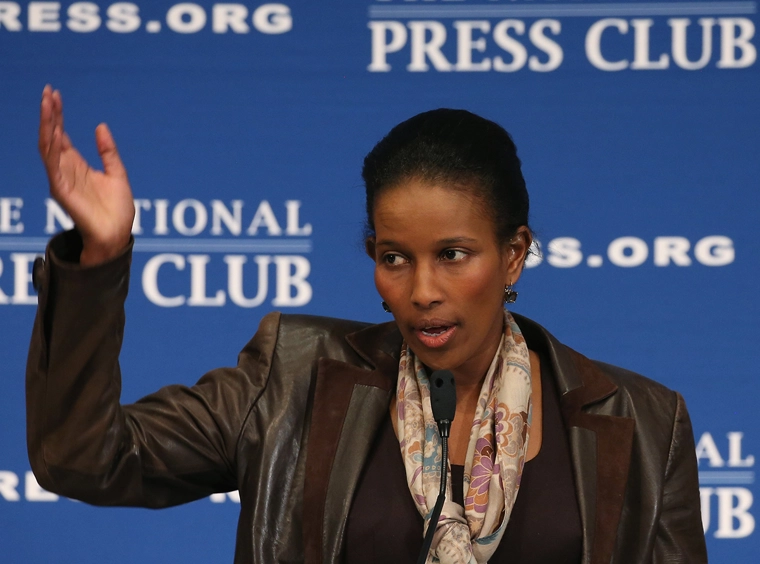
Muslim-turned-atheist rights activist Ayaan Hirsi Ali says she is now a Christian

By Anugrah Kumar, Christian Post Contributor

Ayaan Hirsi Ali, a former Muslim and renowned critic of Islam, has revealed her conversion to Christianity, describing her journey from Islam to atheism and ultimately to Christianity.

In a Weekend Essay published on UnHerd, Hirsi Ali, who is known for her bestselling books and outspoken views, says her encounter with Bertrand Russell’s 1927 lecture “Why I am Not a Christian” led her to atheism, offering solace and escape from the fear instilled by religious doctrine. She found Russell’s views on religion, rooted in fear, resonant with her own experiences.

“It did not cross my mind, as I read it, that one day, nearly a century after he delivered it to the South London branch of the National Secular Society, I would be compelled to write an essay with precisely the opposite title,” adds Hirsi Ali, who is originally from Somalia and is a survivor of genital mutilation.

Hirsi Ali traces her initial disillusionment with Islam following the 9/11 terrorist attacks when she questioned the justifications for the attacks in the name of Islam.

During her teenage years in Nairobi, Hirsi Ali says she was influenced by the Muslim Brotherhood, which instilled in her a strict interpretation of Islam.

This period was characterized by a strict adherence to religious practices and a deep-seated disdain for non-Muslims, particularly Jews. However, her later exposure to atheism through figures like Christopher Hitchens and Richard Dawkins provided a stark contrast to her previous beliefs.

Hirsi Ali attributes her turn to Christianity to a broader concern for the challenges facing Western civilization. She cites threats from authoritarian regimes, global Islamism, and “woke” ideology as catalysts for seeking a unifying force. Christianity, in her view, offers a foundation of values and traditions that uphold human life, freedom, and dignity, and counters the divisiveness she associates with atheism.

Responding to her embrace of the Christian faith, conservative Christian philosopher Dr. Robert George wrote on Facebook: “Two decades ago, under the influence of the writings of Bertrand Russell, she became an atheist. Her thought was that atheism was smart and sophisticated — it was allegedly what really intelligent people believed (the ‘brights,’ as Daniel Dennett embarrassingly labeled himself and his fellow unbelievers). It was the way to a world of rationality and civil liberty. Hirsi Ali is not the first to have gone down that misguided path. She now sees that it is indeed misguided and that there is, if I may quote scripture, ‘a more excellent way.’”

Hirsi Ali’s embrace of Christianity also stems from a personal quest for spiritual solace and meaning in life.

Hirsi Ali critiques atheism for leaving a “God hole,” which she believes has led to the rise of irrational ideologies and the erosion of Western values. She argues that Christianity provides a unifying story and foundational texts, similar to those in Islam, that can engage and mobilize people.

Speaking at the National Press Club in 2015, Hirsi Ali offered five amendments to the religion of Islam that Muslims should take seriously if they really want to bring about a peaceful reformation to their religion.

She suggested Muslims should view the Quran and the hadith as creations of human effort, potentially divinely inspired but ultimately human in origin. This perspective challenges the traditional view of Muhammad as a moral guide post-Mecca, which Hirsi Ali finds problematic.

As the second amendment, Hirsi Ali advocated for a change in how Muslims prioritize life after death over life before death. She called for a reorientation toward valuing earthly life more.

She also argued that Shariah law is responsible for widespread violence and oppression in Muslim cultures, exemplified by regimes like Saudi Arabia, Iran and the Islamic State terrorist group.

As her fourth amendment, she called for the elimination of the principle of “Commanding Right and Forbidding Wrong.” This principle, according to Hirsi Ali, leads to vigilantism and mob justice, as seen in cases where citizens punish individuals for alleged violations of Shariah law or disrespect toward Muhammad.

Hirsi Ali also called for an end to the concept of Jihad as Holy war, advocating instead for a focus on peace.

Source: Christian Post

Formed in Secret, Revealed in Time

In the early 1950s, oil and gas were discovered by seismograph crews deep in the earth on land owned by many of my relatives in South Louisiana. In 1957, the first well was drilled on my grandparents’ farm on what became known as the Perry Point Oil Field. Over the next few years, many wells were drilled, and most became oil producers that revolutionized the lives of those who had leased acreage within the survey pool. Rice farmers who owned lots of acreage were richly blessed.

The greatest resources discovered by man have been formed by unusual events and elements deep in the earth over thousands of years. This was all done in secretly, known only to its Creator, Almighty God. In His infinite wisdom, God knew that there would be a time when man would need resources to sustain his progress and existence. That which He formed in secret has been revealed in the fullness of time by man’s increasing knowledge and ingenuity.

There is a greater creation of God that surpasses the temporal value of oil, gas, coal, gold, diamonds, and all precious metals, which were also formed in secret. The Psalmist identifies that in Psalm 139:13-18: “For You created my inmost being; You knit me together in my mother’s womb. I praise You for I am fearfully and wonderfully made; Your works are wonderful; I know that full well. My frame was not hidden from You when I was made in the secret place. When I was woven together in the depths of the earth, Your eyes saw my unformed body. All the days ordained for me were written in Your book before one of them came to be. How precious to me are Your thoughts, O God! How vast are the sum of them!”

You and I are extremely valuable in God’s sight. He allowed His own son, Jesus Christ, to be involved in His creation and then to provide through His earthly birth, life, death, resurrection, and ascension to Heaven the promise of salvation and hope of eternal life for all who will believe in His name. Remember, God Loves You!

Author: Chaplain Ron Perry with Marketplace Chaplain

The Good God Had Prepared For You

“Whatever you do, He will make good of it. But not the good He had prepared for you if you had obeyed Him. That is lost forever.” C.S. Lewis

While the government is not God—a truth they tend to forget from time to time—their burgeoning relationship with the companies developing artificial intelligence serves as a helpful parable for understanding a key component of our relationship with the Lord.

Scripture is clear that when our sin takes us outside of God’s will, there will be consequences (Galatians 6:7). And though that cost may be delayed at times, it doesn’t go away. As such, it is much better to work with God than to wait for him to correct us when we go off the right path. That doesn’t mean the Lord can’t redeem our mistakes, but it’s still far better to have never committed them in the first place.

C. S. Lewis described this principle well when he said of God, “Whatever you do, He will make good of it. But not the good He had prepared for you if you had obeyed Him. That is lost forever.”

As Christians, we must not make the mistake of giving up the good that God has prepared for us simply because it’s not what appeals to us in the moment. The Lord wants to direct our path because he alone knows what is ultimately best for us and for his kingdom. But he also loves us enough to give us the freedom to make that choice for ourselves.

So which path will you choose?

Will you take the road that seems best to you, deciding that it’s worth the risk of God “bringing down the hammer” to correct you in the future? Or will you let the Lord lead and submit to his will as you partner with him in advancing his kingdom?

Put that way, the choice should be simple. And, ultimately, it is. But it’s also one that all of us get wrong from time to time when we lose sight of what is really at stake.

So take some time now to pray and ask God if there are any ways that you have strayed from his will. If the Holy Spirit brings any to mind, repent and commit to whatever steps are required to correct those mistakes.

And don’t wait to do so. Every day spent outside of his will is filled with moments and opportunities you can’t get back.

Let’s make sure we don’t miss them today.

Source: Ryan Denison, PhD, Is “Safe, Secure, and Trustworthy” AI Possible? Biden Issues Executive Order on Artificial Intelligence. November 3, 2023, Denison Forum.

World’s Greatest Problem

THE WORLD’S GREATEST PROBLEM IS LOSTNESS.

Today, over 3,000 people groups have no missionary presence and likely have no access to the Good News of Jesus Christ.

The lack of accurate knowledge about God’s saving grace is not limited to just these distant groups. You and I are surrounded by THE LOST every day regardless of what nation we live in.

Fellow Christian, what are you doing to fulfill the Lord’s commandment to:

“Go therefore and make disciples of all the nations, baptizing them in the name of the Father and the Son and the Holy Spirit, teaching them to observe all that I commanded you…” (Matthew 28: 18-20)

Do Something. Please!

Carl

Red China: The Body of Christ and The Political Situation

Source: Asia Harvest Newsletter

(Dear Reader: This ministry was recommended to us by a friend who served in Communist China for years and it is worthy of your support. May God bless you and the church in China. Carl)

This newsletter shares insights into the current situation in China, both politically and for the Body of Christ. In addition to our standard newsletter, we want to share links to articles and videos that give further context into some of the claims we have made.

For those who are serious about learning more of the situation in China today, please click on this link to go to a page with a list of links to extra resources on the situation in China.

Please note we have selected just a few of the most interesting and helpful pages out of hundreds that are available online. Pages from other websites should open in separate windows on your browser.

President Xi Jinping and His Role in the World

“How long, Lord, will the wicked, how long will the wicked be jubilant? They pour out arrogant words; all the evildoers are full of boasting. They crush your people, Lord; they oppress your inheritance….

Does he who disciplines nations not punish? Does he who teaches mankind lack knowledge? The Lord knows all human plans; he knows that they are futile.”     –    Psalm 94:3-5, 10-11 

OVER THE PAST SEVERAL YEARS many people from around the world have asked us to help them understand what’s going on in China.

Many Christians are shocked, because for years all they heard was how revival was bringing millions of Chinese into God’s kingdom.

Suddenly, all news from the Church in China stopped in its tracks, as a new Emperor, Xi Jinping, caused the Body of Christ to adopt a defensive posture.

Who is this man who has “purged” (i.e., killed or imprisoned)
hundreds of thousands of people, and who has created such a
stench across Asia that 20 neighboring countries — from Central
Asia to India and the Philippines — now have disputes with China.

Let’s take a closer look at this man who has so enlarged the Chinese military and covert influence that a World War seems inevitable if things continue on their present trajectory.

We deliberately used the term “Emperor” to describe Xi Jinping. While technically he is the atheistic head of the Chinese Communist Party, for thousands of years China was ruled by Emperors whose authority was absolute. 

There were no elections, debates, or protests against emperors. Any perceived hesitancy to obey an emperor’s edict was met with swift and severe punishment. In there paranoia, many Chinese emperors killed millions of their subjects to consolidate their power.

Although emperors have not officially ruled China since 1912, in reality Communist leaders like Mao and Xi have been emperors in all but name. It is important to understand that Chinese emperors were never viewed merely as leaders of China.

You may know that the Chinese name for their country, Zhong Guo, means “Middle Kingdom.” The belief that their country is the center of the world is deeply ingrained in the hearts and minds of every Chinese generation.

Emperors are believed to have a “Mandate of Heaven,” by which they receive the authority to rule. This philosophy, which dates back 2,500 years, assumes that because there is only one heaven, there can only be one emperor and one state with legitimacy in the whole world.

Over the years we have frequently met Chinese from all walks of life who are glad and proud that China is now throwing its weight around in the world. From taxi drivers in Singapore to businessmen in San Francisco, countless Chinese believe that now is the time for China to rise up and seize its destiny as world leader—economically, culturally, and militarily. It

is not so much a desire as a statement of fact. Even among Chinese Christians we have met few who would ever dare to openly criticize Xi Jinping or his decisions. After all, he is the emperor, appointed by heaven itself. Opponents are seen as evildoers and are mercilessly crushed. Just ask people in Hong Kong how life has changed since Xi came to power.

The Mandate of Heaven philosophy spread to many parts of East Asia in the centuries before Christ. It explains why countries like North Korea have been unable to throw off its heavy yoke of rule by the Kim family for so long, Japanese emperors were also seen as heaven-
sent leaders who were invincible because of the Mandate of Heaven. The Japanese belief of invincibility abruptly ended when two atomic bombs fell on Japan in 1945.

In 2016, we began to report that a major shift was happening in China, and the new dynamic would change the way Christians function in China, while the country itself would become a huge threat to democracies.

China decided it was time to throw off its “Century of humiliation” at the hands of foreign powers and take its rightful place as leader of the world, with Xi Jinping on the throne. 

A Prediction…

WE DO NOT BELIEVE THE RISE OF CHINA will lead to world domination.

“Emperor” Xi’s harsh authoritarian rule, as he has consolidated absolute power in China and made enemies all around Asia and the world, has not been working out too well.

The economy in China is in tatters (far worse than reports in Western media), and a growing number of Chinese are beginning to quietly question if their leader is taking the country on a path that will end well for them.

Many nations now see China as the number one threat
to global security and Xi’s aggressive stance has brought about the formation of military alliances to counter his plans.

It has been said that “power corrupts, and absolute power corrupts absolutely.” Strongmen like Xi Jinping believe they operate with impunity, as it is their birthright. Above all else, the thing they desire most is regime survival.

For that reason, Xi constantly purges his leaders, isolating himself more and more while at the same time changing the constitution to guarantee he will never be replaced. Emperors of China were never changed. They ruled for life.

Do we think that Xi and the Chinese Communist Party will reach their goals of world domination?

No, for the following SEVEN REASONS: 

1 GOD HAS THE FINAL SAY.

We believe it is not a coincidence that as soon as China launched its campaign to systematically destroy Christianity in 2016-17, their economy began to disintegrate. Ultimately, the battle for the 1.4 billion souls of China is what is at stake.

The Lord Jesus Christ has purchased a pure bride numbering over 100 million believers in China. They are the apple of His eye, and He will not stand by and let His precious inheritance be decimated. 

2 THE DEMOGRAPHICS FOR CHINA ARE A NIGHTMARE.

With a rapidly ageing population and a lack of young people of tax-paying age to pay for Xi’s military expansion, things are likely to stagnate and deteriorate in China.

Some economists estimate that China needs 400 million more people of working age to keep its economy going forward and fund their military aspirations, but they have “sown the wind and reaped the whirlwind.” (Hosea 8:7)

The Communist Party’s one-child policy, accompanied by hundreds of millions of forced abortions, has wiped out a generation of Chinese. The very people they need to pay for their plans don’t exist. They were sacrificed on the altar of the Communist Party death cult. 

3 THE POPULATION OF CHINA IS ALREADY IN RAPID DECLINE

with some provinces shrinking by millions of people each year. Some experts calculate that by the end of this century the population of China may be half of what it is now. Two years ago, it was hardly noticed when the government lowered the national population by 121 million from previous inflated figures.

An increasing number of young people in China today have no desire to have children, which are considered an economic inconvenience. That unnatural instinct has been suppressed by generations of Marxist propaganda that work and money—not faith in God and a loving family—are the keys to happiness.

4 STRETCHED TO BREAKING POINT.

Xi’s reign has been greatly helped by his access to technology that previous rulers like Mao Zedong could never have dreamed of.

A friend who recently returned from his first visit to China in several years was shocked at the changes he experienced. He said:

“Everywhere I experienced anti-foreign sentiment from unfriendly people, and I saw many people paying for things with their faces. By allowing their faces to be scanned, payments are deducted directly from their accounts. No phone or bank card is needed, and cash is practically unheard of.”

With more than 400 million facial recognition cameras watching and evaluating their every move, and Xi demanding complete obedience to the Marxist-socialist agenda, many people feel stretched to breaking point and are increasingly fed up with the system. 

5 XI HAS TRIED TO REPLACE GOD WITH A CULT OF HIMSELF.

He wants to be all-seeing, all- knowing, and all-powerful. He has erected giant billboards and posters of his face (like the one on the cover of this newsletter) and he demands unwavering devotion and commitment to his cause. In tens of thousands of churches across China, crosses and Scripture verses have been forcibly removed and replaced with posters of Xi and Mao, or with Chinese flags.

The Chinese Communist Party always claims there is no God, while setting themselves up as gods who must be obeyed and worshipped at all times.

Interestingly, in churches where posters of the Ten Commandments were displayed, instead of the authorities removing them they just scratched out the first commandment that says: “You shall have no other gods before me.”

They didn’t object to any of the other nine commandments, but only the first one upset them. Why? Because like Satan, they desire to fill the role of God in people’s lives. 

6 A GENERAL MALAISE HAS COME UPON THE YOUTH OF CHINA.

After studying hard all their lives, tens of millions of university graduates can’t find any work at all, and a new expression, tang ping, or “lying down flat” swept over many Chinese young people.

Countless millions have lost the desire to excel, and they now see life as meaningless.

More recently, during Xi’s harsh Covid restrictions, tang ping has been replaced by a new catch-phrase: bai lan, meaning “let it rot.” These developments refer to a voluntary retreat from pursuing goals and will expediate decay in Chinese society and the economy.

7 XI JINPING SEEMS TO HAVE A PERSONAL HATRED FOR CHRISTIANITY.

After systematically expelling almost all foreign Christians from China over the past 6 or 7 years, a widespread persecution has afflicted God’s people in every part of the nation, but especially in the border provinces.

The Communist Party has even been working on a new Bible, removing passages they don’t like, and replacing them with socialist teachings.

One proposed change is the story of the woman at the well. The Communist Party didn’t like that she was forgiven, so they are reportedly changing it.

So instead of Jesus telling her, “Go and sin no more,” the new Communist Bible has Jesus picking up a stone and stoning her to death! Let’s see if God will allow such blatant blasphemy and corruption of His holy Word to go unpunished.

Herculaneum Scrolls Reveal New Secrets

College student becomes first to unlock the Herculaneum scrolls

 Nathan Steinmeyer  October 16, 2023  

Text visible in the Herculaneum Scrolls. Courtesy Vesuvius Challange.

The Herculaneum scrolls may be one of the most important sources of information on the ancient world ever discovered, yet they are practically unreadable, having been charred by the fires and ash of Mt. Vesuvius in 79 CE. That may no longer be a problem, thanks to the ingenious work of a 21-year-old computer science student from the University of Nebraska, Luke Farritor. Answering the call of the Vesuvius Challenge—a million-dollar competition to read the scrolls—Farritor became the first person to identify a full word within the nearly 2,000-year-old charred scrolls.

Unlocking the Herculaneum Scrolls

Training an artificial intelligence (AI) program to identify faint “crackles” in the 3D scans of the Herculaneum scrolls, Farritor successfully detected ten letters within a 0.6-inch square area of a scroll. While that may not seem like a lot, it was a major step on the journey to unlocking what may be one of the most important sources of ancient history ever discovered. The feat won Farritor the First Letters Prize, worth $40,000. Farritor’s ten letters included several lone letters and one word, porphyras, which means “purple.”

“This word is our first dive into an unopened ancient book, evocative of royalty, wealth, and even mockery,” Brent Seales, a computer scientist at the University of Kentucky who helped launch the Vesuvius Challenge, told The Guardian“What will the context show? Pliny the Elder explores ‘purple’ in his ‘natural history’ as a production process for Tyrian purple from shellfish. The Gospel of Mark describes how Jesus was mocked as he was clothed in purple robes before crucifixion. What this particular scroll is discussing is still unknown, but I believe it will soon be revealed. An old, new story that starts for us with ‘purple’ is an incredible place to be.”

The Herculaneum scrolls are thought to be one of the only intact libraries from antiquity. They were excavated within a villa in Herculaneum near Mt. Vesuvius, which some believe to have been the home of the father-in-law of Julius Caesar. While some of the scrolls were able to be unrolled, most were too damaged to be opened without being destroyed. Many of the texts that have been read are works of Stoic Greek philosophy, such as that of Philodemus. However, no one knows what the rest of the scrolls contain, and they may even include early Christian writings, lost works of philosophy, or other unknown works.

Shortly after Farritor’s submission, Youssef Nader, an Egyptian bio-robotics student in Berlin, sent in a submission in which he was able to identify the same section of text with even more clarity. Nadar was awarded a $10,000 prize for taking second. A grand prize, worth $700,000, will go to the first person (or team) that can successfully read four passages of text from the two intact scrolls provided as the test source for the competition.

In 2023, Seales and his team announced an exciting competition. Releasing their software and thousands of their X-ray images from three different scrolls, the team hopes someone else will have the next breakthrough. But this is not just for fun: The University of Kentucky team, supported by two Silicon Valley donors, is offering a staggering one million dollars worth of prizes, including a $700,000 grand prize, to any group that can make significant headway in reading the Herculaneum scrolls. “We’re having a competition so we can scale up our ability to extract more and more of the text,” Seales stated. “The competitors will be standing on our shoulders with all of our work in hand.”

Source: Bible History Daily – Biblical Archaeology Society

A Foreign Love for You and Me

For while we were enemies, we were reconciled to God through the death of His Son, much more, having been reconciled, we shall be saved by His life. Romans 5:10 (emphasis added)

Scripture tells us that God’s love for mankind is a foreign love.

A love not found in or exercised by the human race. This fact alone proves the divine source of the good news about Jesus Christ.

The Scripture says that “ while we were enemies” Jesus went to the cross for ALL humans after being scourged terribly. He died the most despised manner of death known in the Roman Empire. He hung naked nailed to the wooden cross before the very creation He had spoken into existence.

Jesus did this for ALL of God’s enemies. Humans do not die for their enemies.

Not only did Lord Jesus suffer physically, but also, became the sin offering for our sins. He took the wrath of God for the guilt of our sins and for the sins of ALL of mankind, the whole world. He took the wrath of God for God’s enemies so we would not have to experience the justified wrath of a Holy God.

Would you die for your enemy? Do you know of anyone who has or would?

Finally, Lord Jesus cried out on the Cross, “MY GOD, MY GOD, WHY HAST THOU FORSAKEN ME?” (Matthew 27:46) The precious fellowship with Father God which He had always known, was broken due to Him becoming the sin sacrifice on the cross. He had never known this separation before.

He did that for God’s enemies.

The Greek word for enemies denotes hating, hostility and is used as a noun signifying an enemy or adversary. As unbelievers we “were … alienated and hostile in mind” toward God and “engaged in evil deeds” (Col. 1: 21), opposing and breaking His commandments. Paul, in Philippians 3:18-19, describes God enemies when he writes, “For many walk…that…are enemies of the cross of Christ whose end is destruction, whose god is their appetite. and whose glory is in their shame, who set their minds on earthly things…”

James, Jesus’ half-brother, tells us that “friendship with the world is hostility toward God” and “whoever wishes to be a friend of the world makes himself an enemy of God.” (James 4: 4)

Haven’t we all, at one time or another loved the things of this evil, Satan controlled world system, that are so anti-God and anti-Jesus.

These biblical descriptions of God’s enemy describe every human being on earth, before he or she comes to trust in Jesus Christ and receive God’s love for them.

God’s love for humanity is a foreign love.

No way around it. It is not of this earth nor practiced by humans. It only flows from His Being and expresses the high value He puts on His greatest creation, man. That He would give His Beloved Son for you and me reveals the high value He puts on each person’s soul.

“For God so loved the world, that He gave His only begotten Son, that whoever believes in Him should not perish, but have eternal life.” (John 3:16)

Believe in Jesus today as your Savior and Lord. Please do not reject God’s love for you. If you do, you will eternally suffer for your sins, separated from His great love.

Lord Jesus has ALREADY died for ALL of your sins. He has taken the wrath of God ALREADY for you, so you do not have to experience it.

Receive God’s forgiveness for every sin you have ever committed, turn from your sins and believe on the Lord Jesus Christ and you shall be saved.

Do it today.

Carl

How the Bible Created the Soul of Western Civilization: An Interview with Vishal Mangalwadi – Part 2

PART TWO

Bible Gateway interviewed Vishal Mangalwadi about his book, The Book That Made Your World: How the Bible Created the Soul of Western Civilization (Thomas Nelson, 2012).

How did the Bible trigger the West’s passion for medical advancement?

Vishal Mangalwadi: Mainstream Hinduism taught that matter (including the human body) was evil—illusion or maya. In contrast, the first chapter of the Bible declared the material realm, including the human body, to be very good. Genesis 3 taught that sickness and death came as a curse upon human sin. The Lord Jesus came to give us abundant and eternal life. His soul did not reincarnate. His crucified body was resurrected and glorified. The Bible teaches that God will resurrect our perishable bodies as immortal and glorified bodies.

Because of God’s high view of the human person, including his body, the Lord Jesus healed the sick and commissioned his disciples to a ministry of healing. Therefore, medieval Roman Catholic monasteries did not simply pray, preach, and practice piety. Many of them took care of the sick. They studied, and taught medicine. The Schola Medica Salernitana became the world’s first medical school in the South Italian city of Salerno. It grew out of a 9th century dispensary in a monastery. This monastic tradition blossomed into modern medicine after the 16th century biblical Reformation.

What is the biblical ideal of human dignity and how did it inform the West’s social structure?

Vishal Mangalwadi: Gautam Buddha, the founder of Buddhism, saw human life as suffering. Thomas Hobbes, the only atheist in English Enlightenment, viewed life as “nasty, brutish, and short.” Pope Innocent III detailed “The Misery of Man.” Secular intellectuals have no option but to see man as nothing more than an evolved animal.

Species, races, and individuals do not evolve equal. Evolution does not bestow any rights upon any animal. Western notions of human dignity, equality, and inalienable rights are the Bible’s unique contribution to the modern world. Pico della Mirandela (1463-94) articulated the Bible’s case for human dignity in An Oration on the Dignity of Man. His case rested upon (a) creation of man in God’s own image and (b) God’s incarnation in the Jesus of Nazareth.

God became man in order to save man, because man was made in God’s image – precious and immortal. Full implications of these doctrines are still being worked out. Yet, much of our future will be shaped by the question: Is man merely another animal (organic intelligence) or is he uniquely God’s image—so precious to God that He would come to this earth to save him?

How did the Bible equip the West to cultivate compassion?

Vishal Mangalwadi: Through parables such as that of the Good Samaritan, the Lord Jesus explained the command ‘Love your neighbor as yourself.’ He exemplified it by blessing those who cursed and killed him. Jesus courted the wrath of religious establishment by caring for the sick even on Sabbath. He reinforced prophets such as IsaiahJeremiah, and Amos, by teaching that God’s holy law was made for man’s good. Therefore, a religiosity that did not care for individuals was worse than worthless. It was obnoxious. What we do for the littlest of his brothers, we do for him.

What is your response to people who say the Bible subjugates women?

Vishal Mangalwadi: The women’s lib movement started in America because social inequality between men and women was obvious. Many women got paid less then men for the same work. They were allowed to serve coffee after worship, but not communion during the worship. They could play piano in a church but not pray. Yet, crucial questions are: who told America that men and women were created equal; that sin brought subjugation as a curse; that the curse was nailed upon the cross of Calvary? The question that triggered my reflections was: Why didn’t the Saudi women burn their burqas and their bras? What empowered American women to launch the women’s lib movement? Was it because American women were more oppressed than the Muslim of Hindu women? Or was it because something had already made American women stronger than other women around the world? My counter-intuitive discovery was that it was the Bible that empowered women.

No culture has ever required a husband to love his wife. Every culture, including Jewish and post-Christian Western cultures, have permitted husbands to divorce their wives and/or take other women. In 1831-32, French magistrate Alexis de Tocqueville observed that American women had become much stronger than European women because the biblical ideal of marriage had had the biggest impact in America. No country in the world will even try to impeach a president who lies about his private sex life.

The Bible emancipated Western women because it alone asserted theological equality of male and female and also because it defined God’s idea of marriage as a one-man one-woman lifelong and exclusive relationship. A woman is liberated to develop herself and to strive for her dignity when she knows that her fallen husband is not permitted to despise her, divorce her, covet his neighbor’s wife or to take another woman as a girlfriend, concubine, or wife. He has to love her, irrespective of the level of her intelligence, charm, abilities, and fallenness.

Roman wives were the victims of Rome’s playboy culture. Many of them followed and financed the Apostle Paul and (over time) won the Roman empire for Christ, because they understood better than modern feminists that Paul was emancipating them.

Men and women are equal, but husbands and wives (like parents and children and all other formal relations) have to live in a hierarchical relationship. No institution can function on the basis of equality-without-hierarchy. Christian marriages are being destroyed because the Western church has surrendered to the world’s folly that equality precludes authority. The Christian idea of marriage is unique. It can be sustained only if we take seriously the Bible’s idea of the fallenness of men and women and the necessity of wives submitting to fallen husbands, and husbands loving fallen wives.

How is human equality a biblical principle?

Vishal Mangalwadi: Sociologically, the modern idea of human equality was born when Martin Luther discovered the New Testament doctrine of the “priesthood of all believers.” Gradually, this truth began to challenge the West’s social/racial injustices.

George Whitfield was the first white revivalist in America, who began preaching to the blacks. His preaching evoked protests: “Do you really want us to kneel with our slaves and drink communion from the same cup?”

In order to counter deep rooted prejudices, in 1740, Whitfield began writing a series of articles. These explained how and why the Bible teaches human equality. Whitfield’s writings created the consensus which Thomas Jefferson articulated in the original draft of the Declaration of Independence as, “We hold these truths to be sacred and undeniable that all men are created equal.” By “sacred” Jefferson meant derived from sacred Scriptures. Under pressure from Benjamin Franklin, the Declaration was changed to read, “We hold these truths to be self-evident that all men are created equal.”

To Indian sages, inequality was self-evident. That is why they invented the caste-system which still survives. Equality was “self-evident” even to American Deists because their worldview was shaped by the Bible. Now that evolution is shaping everyone’s intellectual lenses, only a fool will be able to assert that all men have evolved equal.

What role did the Bible play in the establishment of the university?

Vishal Mangalwadi: No Hindu ashram ever grew into a university. No Orthodox Christian monastery developed into a university in Eastern Europe, Greece, or Russia. Augustinian monasteries and Cathedral schools blossomed into West European universities such as Oxford, Cambridge, Paris, Prague, Heidelberg, and Wittenberg because St. Augustine taught that the human mind was God’s supreme gift to mankind. The mind was made in God’s image, therefore, in order to be godly, one had to cultivate the mind as well as piety.

These monasteries were different than every other center of religious education. Young boys came to a monastery to learn to pray and become a priest. But in these monasteries they had to study logic, literature, philosophy, mathematics, and rhetoric as well. This is what created the West’s uniquely rational religious leader, who prayed as well as studied birds and the solar system.

Following the Reformation, Christian thinkers realized that God wants all men to be saved and come to the knowledge of the truth (1 Timothy 2:4-7). In order to know truth, man has to study three books: The book of God’s words (the Bible), the book of God’s works (in nature and culture), and the book of God’s reason (logic and mathematics that run the human mind and physical universe.) This insight was captured in Harvard Crest in 1643. VERITAS is written on these three books. Today, the university has degenerated into a factory producing laborers for the market and the state because, without God’s word, the university has been forced to shy away from the very concept of truth.

Since the Bible is not a “fax from Heaven,” explain how sentences written by humans can be considered the Word of God?

Vishal Mangalwadi: Prophet Elijah said to king Ahab, “As the Lord, the God of Israel, lives, before whom I stand, there shall be neither dew nor rain these years, except by my word” (1 Kings 17:1). By the end of the chapter, the Sidonian widow of Zarephath exclaimed, “Now I know that you are a man of God, and the word of the Lord in your mouth is truth.” (vs. 24). Eventually Ahab was forced to acknowledge that Elijah’s words—a man’s words—were, in fact, the word of God.

God said to Jeremiah, “Behold, I have put my words in your mouth…I am watching over my word to perform it.” (Jeremiah 1:8-11). God’s word includes the words He gives His men and also men’s words which He watches to perform, fulfill, and honor. Daniel and his friends were willing to go into the lions’ den and fiery furnace because 70 years of Jewish history had confirmed to them that Jeremiah’s words, disregarded by their fathers, were in fact God’s word.

The gospel is that Jesus Christ died “according to the Scriptures,” was buried and rose again the third day, “according to the Scriptures” (1 Corinthians 15:3-4). That means that Jesus didn’t have to die. In the Garden of Gethsemane Peter gave him the opportunity to evade arrest. During his trial, Pilate gave to Jesus plenty of room to escape crucifixion. The Lord Jesus sacrificed his life because he believed that the words of Scripture, written by fallen and fallible men, were in fact God’s words.

As you observe the West’s treatment of the Bible, where do you see western society headed?

Vishal Mangalwadi: Germany, the birthplace of biblical Reformation, became the arch villain of the 20th century, because during the 19th century, German theology undermined the Bible’s authority. I see post-biblical America as the greatest terror to the 21st century. I think the future of greed-driven American capitalism is best captured by James Cameron in his terrible, pagan, and commercially hit movie, Avatar.

Muslim nations cannot be the world’s biggest threats because while Islam can build a strong Caliphate, it does not and cannot build nations. Protestantism has built history’s greatest nations; therefore, the world has the most to fear from Protestant nations that destroy the very foundations of their morality and civility.

What are your thoughts about Bible Gateway as a way to reinvigorate civilization’s soul?

Vishal Mangalwadi: Bible Gateway is the only site I use to get into the Bible. (Though I am yet to cultivate the discipline to use everything that it offers.) I appreciate this interview because the new generation needs to learn why the Bible must be studied, trusted, obeyed, and applied.

Is there anything else you’d like to say?

Vishal Mangalwadi: Christianity has lost America because the church forgot that “God wants all men to be saved and come to the knowledge of the truth…” for this reason Paul the apostle was appointed a “preacher” and a “teacher of the gentiles in faith and truth” (1 Timothy 2:4-7). The American church has the capacity to disciple the nation, but for over a century it has lacked the theology for discipling nations. It has been preoccupied with saving souls, not with discipling nations.

The good news is that the state of Minnesota just started an education revolution that can disciple America. Students will enroll in an accredited college, but go to the local church to study online as a cohort in a face-to-face mentorship with a credentialed Academic Pastor. A student will get a college degree for under $10,000 a year. Check out www.VirtuesCampus.com.

Bio: Vishal Mangalwadi, LLD, was born and raised in India. He studied eastern religion and philosophy in India, Hindu ashrams, and at L’Abri Fellowship in Switzerland. He is a dynamic and engaging speaker who has lectured in 35 countries. He is a social reformer, political columnist, and author of 14 books. Christianity Today calls him ‘India’s foremost Christian intellectual.’

SOURCE: The Bible Gateway Blog – Jonathan Petersen

How the Bible Created the Soul of Western Civilization: An Interview with Vishal Mangalwadi

(Blog note: every Christian needs to read this article. Please share it with someone you know. Carl)

Part 1

What triggered the West’s passion for scientific, medical, and technological advancement? How did the biblical notion of human dignity inform the West’s social structure and how it intersects with other worldviews? How did the Bible create a fertile ground for women to find social and economic empowerment? How has the Bible uniquely equipped the West to cultivate compassion, human rights, prosperity, and strong families? What is the role of the Bible in the transformation of education? How has the modern literary notion of a hero been shaped by the Bible’s archetypal protagonist?

Bible Gateway interviewed Vishal Mangalwadi about his book, The Book That Made Your World: How the Bible Created the Soul of Western Civilization (Thomas Nelson, 2012).

Click to buy your copy of The Book That Made Your World in the Bible Gateway Store

Why did you dedicate The Book That Made Your World to Arun Shourie, a Hindu who is critical of the Bible?

Vishal Mangalwadi: In 1994, Arun Shourie, at that time one of India’s foremost public intellectuals, attacked Western missions and the Bible. He powerfully rehashed some of Thomas Paine’s arguments from The Age of Reason (1793-94). Mr. Shourie studied in the best Christian college in India before getting a PhD from an American university that had been founded by Methodists. I realized that this good and learned gentleman was clueless about what the Bible is and what it has done because his Christian professors in India and in America had no idea.

Therefore, moved by the Holy Spirit, I began responding to him with books such as Missionary Conspiracy: Letters to a Postmodern Hindu (1995), Fascism: Modern & Postmodern (1998—my intro to a book by Gene Edward Veith), and then The Book That Made Your World: How the Bible Created the Soul of Western Civilization (2012).

In spite of Western skepticism, many Chinese intellectuals sense that the Bible was the foundation of the West’s amazing development. In contrast, Hindus such as Mr. Shourie follow ill-informed, in fact, arrogant and foolish, Western repudiation of the Bible. They think that India can be made a great nation by returning to Hindu worldview, which destroyed India in the first place.

One book will not convince skeptics, but it can become a seed that multiplies into many PhD theses, popular books, TV shows, and films. I dedicated the book to Arun Shourie to help intelligent Indians discover the rock upon which India can realize its potential to be a great civilization—a blessing to all the nations.

You write that your book is not so much about the Bible as it is about great literature, art, science, technology, heroism, and virtues. Explain what you mean.

Vishal Mangalwadi: My book is not “Bible study.” It is a study of the global impact of the Bible and it’s worldview. The Bible was the book of the last millennium. No other book was translated, published, distributed, studied, or debated like it. What impact did it have on the world? That is the question my book explores.

Why do you call the Bible the soul of Western civilization?

Vishal Mangalwadi: Although the West has amputated its soul, I call the Bible the soul of Western Civilization because it propelled the development of everything good in the West: its notion of human dignity, human rights, human equality, justice, optimism, heroism, rationality, family, education, universities, technology, science, culture of compassion, great literature, heroism, economic progress, political freedom. Take, for example, democracy.

The myth that modern democracy came from Greece was invented only in the 20th century by John Herman Randall of Columbia College (New York) and Mortimer Adler and Robert Maynard Hutchins of the University of Chicago. The reality is that in his classic, Republic, Plato, the greatest of Greek philosophers, had already condemned democracy as Mobocracy—the worst of all political systems. Plato proposed that the ideal republic should be ruled by philosopher-kings. His disciple, Aristotle, trained Alexander-the-Great to be a philosopher-king, who turned out to be one of the most ruthless conquerors in history. In turn, Alexander inspired India’s first empire builder, Chandragupta Maurya.

Later Alexander inspired Machiavelli’s The Prince—which examines how a successful prince acquires and retains power. Machiavelli was the flowering of European Renaissance that produced tyrants such as Napoleon. The biblical Reformation led to the birth of modern democracy. Without the Bible, western democracy will become obnoxious as did the Greek democracies.

To give another example, the West’s confidence in human reason came not from Greece, but from the Bible via Augustine. Hinduism, Buddhism, and their products such as Greek gnosticism knew that unaided intellect cannot know truth. The Enlightenment corrupted western confidence in reason by (over time) separating it from revelation. After Nietzsche and Freud, everyone knows that here is no reason to trust human reason, unless it is made in the image of Logos and strives to conform to it.

Why do you begin your book recounting the suicide of rock musician Kurt Cobain and then contrasting him with Johann Sebastian Bach?

Vishal Mangalwadi: The first chapter uses music as an entry point into the West’s soul. It contrasts Christian West with (post-Christian) West without its soul. The chapter inquires: What made the West a uniquely optimistic and musical civilization, able to sing “Joy to the world (fallen, miserable and full of suffering)?”

Bach and Cobain were musical geniuses. Both lost their parents at nine. Bach’s parents died and Cobain’s separated. Bach’s faith in resurrection enabled him to celebrate “The Passion” (Suffering) of St. Matthew and St. John. Cobain inherited Bach’s musical tradition without its philosophy. Therefore, his music could only scream at suffering, making him an icon of a generation lost without a map of reality. Buddhism offered no hope to Cobain. Therefore, he cursed life and committed suicide.

Buddhism originated in India. Its pessimistic philosophy gave us great art and literature, but no hope, music, or musical instruments. Islam (and Orthodox Christianity) also ruled out music; therefore, it too pre-empted development of technology.

The German publisher published 10,000 copies of the first chapter as a stand-alone booklet. It is proving to be an excellent work of worldview evangelism. I hope someone will print it in Japanese, since Bach is Japan’s fifth evangelist.

How was the Bible “the force that created modern India”?

Vishal Mangalwadi: Why are “native” Americans Indians? Why are “native” Australians Indians? Why is Indonesia, Indian-Asia? Why were Columbus and Vasco de Gama looking for sea-routes to India (and not to “Spice-land”)?

The European mind was fascinated with India, because India, not Japan, Korea, or China, is the Eastern-most land mentioned in the Bible (Esther 1:1). By “India” the Persians meant “Sindustan,” the land around the river Sind (now in Pakistan). Up until the 1850s, no one living in Bengal or Kerala ever thought that he was living in “India.” That is why Michael Madhusudan Dutt (1824-1873), the pioneer of ‘Indian’ nationalism, actually wrote only about ‘Bengali nationalism.’

The pre-Columbus European concept of geographic India came from the Roman Catholic reading of the Bible. That is why Vasco de Gama’s coming to Kerala and Goa was the sea-route to “India.” Protestant reading of the Bible coined the ‘abstract’ concept of India as a geo-political nation state, half-a-century before England actually made India a nation in 1858. Prior to William Carey, no “Indian” had ever existed who started a paper (or organization) such as Friend of India (1818).

Lord Thomas Babington Macaulay, persuaded British Parliament in 1833, that Britain must govern Indians in such a way as to train them to govern themselves as an independent nation. Macaulay grew up in the company of the evangelical member of Parliament, William Wilberforce, in the Calpham community. He followed up his rhetoric by coming to India to give us the ‘Indian Penal Code’ along with the Jewish-biblical idea of rule of law. He helped transform our education and civil services. He played a critical role in the establishment of our first universities in Calcutta, Bombay, and Madras in 1858. These began as examination-conducting institutions to fulfil the vision of Macaulay’s brother-in-law, Charles Travelyan. The latter had defined the mission of Christian education in 1838 in his classic On the Education of the People of India. The objective of that herculean mission, he said, was to prepare Indians to govern themselves as a free nation.

After Macaulay and Travelyan, it took five more decades before an Englishman could inspire a few graduates of Calcutta’s Christian education to create the “Indian National Congress” (1885). Then it took 70 more years to prepare leaders such as Gandhi, Ambedkar, and Nehru, who could, in fact, lead and govern a free India.

India became a free nation in 1947. It could have attained that status if it had even one Indian, who thought of India as a nation during the “Mutiny” of 1857. When Indian soldiers started killing Englishmen and liberated Delhi, educated Brahmins and Hindu merchants organized prayer meetings around the country to pray for British victory over Indian mutineers. This was partly because the rebels who succeeded in defeating the British in Meerut and Delhi decided to revive the Mogul Empire by declaring Bahadur Shah as their emperor.

Most Hindu, Muslim, and Sikh soldiers and rulers disapproved of the revival of that exploitative and useless empire. Many decided to fight against fellow Indians to defend the British Raj. This was because, contrary to current, ill-informed (or deceptive?) debaters such as Shahi Tharoor, most of the Indians who actually lived under the British, perceived it as better than all other options available to “India”.

Mogul Empire had been so corrupt and inept that in 1738-39, the Persian invader Nadir Shah, met hardly any resistance as he travelled 1000 KMs. within the Mogul’s (Indian) empire, from Ghazani to Delhi to plunder the Mogul capital. The Empire’s rottenness had encouraged the Marathas to conquer and plunder Hindu and Muslim kingdoms. This threat of the Marathas and/or invaders from the Khyber Pass had forced Hindu/Muslim kings to take refuge under the Company Raj. Most Indians opposed the 1857 Mutiny, now called the First War of National Independence, because they could not trust Indians to rule India with justice and equity.

While the Hindu and Muslim rulers, intelligentsia, and merchants preferred the Company Raj over Indian rajas, it was the Bible-shaped conscience that saw the Company as a “gang of public robbers” (Macaulay) and its rule as the “rule of evil genii.” Yet, Independent India chose to remain a member of British Commonwealth and import its political, economic, and social ideals and institutions, because the Bible succeeded in (a) transforming India’s governance under the British, and (b) training enough Indians to govern India as a modern, democratic, nation-state.

Dr. Babu Verghese’s massive study, Let There Be India: The Bible’s Impact on Nation-Building, details how the Bible translators created modern India by turning our dialects into literary languages, bringing modern education, printing, literature, and modern press, and the modern ideas of human equality, dignity, and rights (his book is available from ManagerGoodBooks@gmail.com).

Part 2 will follow Part 1 on Psalm 119:38 Blog. Thank you, Carl

Source: Bible Gateway Blog -Jonathan Petersen

What Does the Bible Say About Tattoos?

Taboo tattoos

 Megan Sauter  October 15, 2023 

Torah Scroll. What is said about tattoos in the Bible? Leviticus, the third book of the Hebrew Bible, prohibits them without giving an explicit reason. Why does the Bible prohibit tattoos? Photo: “Open Torah and Pointer” by Lawrie Cate is licensed under CC-by-SA-2.0.

19:28 says, “You shall not make any gashes in your flesh for the dead or tattoo any marks upon you: I am the LORD.” Although this passage clearly prohibits tattoos, it does not give an explicit reason why. This begs the question: Why does the Bible prohibit tattoos?

In his Biblical Views column “Unholy Ink: What Does the Bible Say about Tattoos?” Mark W. Chavalas, Professor of History at the University of Wisconsin-La Crosse, examines the taboo on tattoos in the Bible. Not only does he analyze traditional explanations for this prohibition, but he also investigates what tattoos signified to ancient Near Eastern peoples, including the ancient Israelites, which suggests the real reason why tattoos were taboo.

Leviticus 19 denounces idolatry and several pagan mourning practices. Some have thought that because of the proximity of the taboo on tattoos to the prohibition of other pagan mourning practices in Leviticus, tattooing must have been a pagan mourning practice. However, we find no evidence of this in ancient texts from the Levant, Mesopotamia or Egypt. As far as we can tell, tattooing was not an ancient mourning practice in these cultures.

This is not to give the impression that tattooing never appears in ancient Near Eastern texts; it does—just not as a mourning practice. In the ancient Near East, tattoos were used to mark slaves. Often the name of a slave’s owner would be tattooed or branded on his hand or forehead. If then the slave were to run away, he could be easily returned to his master. Thus, tattooing was seen as a sign of ownership.

Chavalas thinks that this might be behind the taboo on tattoos in the Bible:

“Tattooing, an insignia of ownership, was perhaps condemned in Leviticus because it reminded them [the Israelites] of their past. After all, they had just spent the last four centuries as slaves in Egypt, where tattooing was also used as a sign of slavery. No longer considered slaves, the Israelites now were prohibited to mark their bodies with permanent signs of servitude to former masters. This did not have to be explicitly articled to them; no one need ask prison inmates why they shed their orange jumpsuits when they are no longer incarcerated.”

Chavalas also notes that there might be a positive reference to tattoos in the Bible. Isaiah 44:5 reads:

This one will say, “I am the LORD’s,”
another will be called by the name of Jacob,
yet another will write on the hand, “The LORD’s,”
and adopt the name of Israel.

By writing God’s name on his hand, the Israelite in Isaiah 44:5 “was willingly proposing to become a servant of God.” At least in this case, it seems that tattooing was acceptable because the person was marking himself as belonging to the God of Israel.

To learn more about tattoos in the Bible, read Mark Chavalas’s full column “Unholy Ink: What Does the Bible Say about Tattoos?” in the November/December 2016 issue of Biblical Archaeology Review.

The Second Coming of Jesus to The Earth

Part Two – The Second Advent of Jesus, The Messiah

Lord Jesus’ SECOND ADVENT is when He physically returns to the Earth again. In light of the turmoil in the Middle East today, I thought we should republish this post.

In the larger scheme of end time prophecy, His return is at the end of the seven years of tribulations when the Antichrist will be defeated and destroyed.

JESUS IN HIS HOME SYNAGOGUE

When Lord Jesus read part of Isaiah 61 to announce that that He was the Messiah, He stopped halfway through verse 2 where it says “to proclaim the favorable year of the Lord” and did not read the second half of the verse which says,

“And the day of vengeance of our God…” Isaiah 61:2b

If He had read the second part He could not have said, “Today this Scripture has been fulfilled in your hearing.” Because the second part has to do with His return to Earth as a Warrior King-Priest to reveal Himself to Israel, purify Israel and save Israel from the armies of all the nations of the Earth who will try to destroy her.

In God the Father’s plan, this day of vengeance had not arrived when Jesus was speaking in His hometown synagogue around 30 AD. By reading verse 2 and 3 we see what His Second Advent involves:

“The SPIRIT OF THE LORD IS UPON ME, FOR HE ANOINTED ME…TO PROCLAIM..

“…the day of vengeance of our God; To comfort all who mourn,

To grant those who mourn in Zion, Giving them a garland instead of ashes, The oil of gladness instead of mourning, The mantle of praise instead of a spirit of fainting. So they will be called oaks of righteousness, The planting of the LORD, that He may be glorified.” Isaiah 61:2b-3

This section of Scripture reveals a SECOND ADVENT and reveals the specialized task the Messiah, Jesus, will perform as Warrior King-Priest:

  • …to proclaim…the day of vengeance of our God
  • to comfort all who mourn… in Zion
  • …giving a garland instead of ashes
  • …giving the oil of gladness instead of mourning
  • …giving a mantle of praise instead of a spirit of fainting
  • He will make the people of Israel into oaks of righteousness
  • He will cause glory to rebound unto God, by the changes in the people of Israel.

The specialized task deal with two things: the day of vengeance and the salvation of Israel physically and spiritually. This is after the church has been raptured and at the end of Antichrist’s rule.

FIRST TASK – MINISTER TO THOSE WHO ARE MOURNING

The setting is the end of the seven years of tribulation and the Battle of Armageddon is ongoing. Armies from all the nations of the earth are besieging and close to overwhelming the defenders of Jerusalem. Some of Israel has fled to the wilderness (Petra), some have been killed by the invading armies and some are besieged in Jerusalem. Zechariah 13: 9 tell us that two-thirds of the people in Israel will die during this time but much of the Jewish population will have already fled to the safety of the wilderness. The one-third remaining in Israel will be refined or purified by the Lord.

It is my understanding that at that point in the battle, Jesus will physically set His feet on the Mount of Olives coming to help Israel and will reveal Himself to Israel. They will understand that He was their Messiah all along. This is why the Messiah’s specialized tasks mention mourning, ashes, and fainting. Listen:

Zechariah 12:9-14 NASBS

[9] And in that day I will set about to destroy all the nations that come against Jerusalem. [10] “I will pour out on the house of David and on the inhabitants of Jerusalem, the Spirit of grace and of supplication, so that they will look on Me whom they have pierced; and they will mourn for Him, as one mourns for an only son, and they will weep bitterly over Him like the bitter weeping over a firstborn. [11] In that day there will be great mourning in Jerusalem, like the mourning of Hadadrimmon in the plain of Megiddo. [12] The land will mourn, every family by itself; the family of the house of David by itself and their wives by themselves; the family of the house of Nathan by itself and their wives by themselves; [13] the family of the house of Levi by itself and their wives by themselves; the family of the Shimeites by itself and their wives by themselves; [14] all the families that remain, every family by itself and their wives by themselves.

And again:

Ezekiel 20:43-44 NASBS

[43] There you will remember your ways and all your deeds with which you have defiled yourselves; and you will loathe yourselves in your own sight for all the evil things that you have done. [44] Then you will know that I am the LORD when I have dealt with you for My name’s sake, not according to your evil ways or according to your corrupt deeds, O house of Israel,” declares the Lord GOD.'”

Concerning those who have fled to the wilderness:

Ezekiel 20:33-38 NASBS

[33] “As I live,” declares the Lord GOD, “surely with a mighty hand and with an outstretched arm and with wrath poured out, I shall be king over you. [34] I will bring you out from the peoples and gather you from the lands where you are scattered, with a mighty hand and with an outstretched arm and with wrath poured out; [35] and I will bring you into the wilderness of the peoples, and there I will enter into judgment with you face to face. [36] As I entered into judgment with your fathers in the wilderness of the land of Egypt, so I will enter into judgment with you,” declares the Lord GOD. [37] “I will make you pass under the rod, and I will bring you into the bond of the covenant; [38] and I will purge from you the rebels and those who transgress against Me; I will bring them out of the land where they sojourn, but they will not enter the land of Israel. Thus you will know that I am the LORD.

Can you imagine what it will be like for the Jewish people to realize that Jesus of Nazareth was their Messiah all along? To realize that all the judgements that they as a people had endured over 2000 years could have been avoided. Is it any wonder that Ezekiel 20:43 says speaking about the Jewish people who realize this, “you will loathe yourselves in your own sight for all the evil things that you have done.” The shock of the realization and then the remembering of all they had done individually and nationally. It will be a time of “being stunned” by what is being revealed to each individual.

But…now we see the reason that the Messiah will comfort all who mourn in Zion, giving a garland instead of ashes and a mantle of praise for the spirit of fainting! Though this realization that Jesus is the Messiah will happen to the remaining nation, it is through personal repentance and faith in Jesus the Messiah that the Jewish remnant will be born again. That is what “…by themselves…” in Zechariah 12:12-14 means.

It will be a glorious transformation of Israel that will rebound to God’s glory.

Ezekiel 39:25-29 describes this time:

[25] Therefore thus says the Lord GOD, “Now I will restore the fortunes of Jacob and have mercy on the whole house of Israel; and I will be jealous for My holy name. [26] They will forget their disgrace and all their treachery which they perpetrated against Me, when they live securely on their own land with no one to make them afraid. [27] When I bring them back from the peoples and gather them from the lands of their enemies, then I shall be sanctified through them in the sight of the many nations. [28] Then they will know that I am the LORD their God because I made them go into exile among the nations, and then gathered them again to their own land; and I will leave none of them there any longer. [29] I will not hide My face from them any longer, for I will have poured out My Spirit on the house of Israel,” declares the Lord GOD.

Isaiah 61: 4-9 describes what the Lord will do for Israel after they acknowledge Him and repent of their sins:

[4] Then they will rebuild the ancient ruins, They will raise up the former devastations; And they will repair the ruined cities, The desolations of many generations. [5] Strangers will stand and pasture your flocks, And foreigners will be your farmers and your vinedressers. [6] But you will be called the priests of the LORD; You will be spoken of as ministers of our God. You will eat the wealth of nations, And in their riches you will boast. [7] Instead of your shame you will have a double portion, And instead of humiliation they will shout for joy over their portion. Therefore they will possess a double portion in their land, Everlasting joy will be theirs. [8] For I, the LORD, love justice, I hate robbery in the burnt offering; And I will faithfully give them their recompense And make an everlasting covenant with them. [9] Then their offspring will be known among the nations, And their descendants in the midst of the peoples. All who see them will recognize them Because they are the offspring whom the LORD has blessed.

PROCLAIMING THE DAY OF VENGEANCE – THE SECOND TASK

The second task of Jesus during His second advent is to proclaim the day of vengeance. To understand this let us begin with Isaiah 63: 1-6 which is a picture of Lord Jesus on this day. Note what Lord Jesus says in verse 4.

Isaiah 63:1-6

[1] Who is this who comes from Edom (modern day Jordan)

With garments of glowing colors from Bozrah (Petra),

This One who is majestic in His apparel,

Marching in the greatness of His strength?

“It is I who speak in righteousness, mighty to save.”

[2] Why is Your apparel red, And Your garments like the one who treads in the wine press?

[3] “I have trodden the wine trough alone,

And from the peoples there was no man with Me.

I also trod them in My anger And trampled them in My wrath;

And their lifeblood is sprinkled on My garments,

And I stained all My raiment.

[4] “For the day of vengeance was in My heart,

And My year of redemption has come.

[5] “I looked, and there was no one to help,

And I was astonished and there was no one to uphold;

So My own arm brought salvation to Me,

And My wrath upheld Me.

[6] “I trod down the peoples in My anger

And made them drunk in My wrath,

And I poured out their lifeblood on the earth.”

(Clarification added)

Did you notice in verse 4 that Jesus said the day of vengeance was in My heart? Remember in Isaiah 61:2b the Messiah would proclaim the day of vengeance? Here we have Jesus The Messiah proclaiming this when He physically comes to Earth to destroy all the armies intent on wiping out Israel and the Jewish people.

After the day of vengeance is finished, Lord Jesus will establish His earthly kingdom in Jerusalem for a thousand years. The new temple described in Zechariah will be built and from there He will rule all nations. Isaiah 61: 10-11 describes the Lord Jesus at this time:

Isaiah 61:10-11

[10] I will rejoice greatly in the LORD, My soul will exult in my God; For He has clothed me with garments of salvation, He has wrapped me with a robe of righteousness, As a bridegroom decks himself with a garland, And as a bride adorns herself with her jewels. [11] For as the earth brings forth its sprouts, And as a garden causes the things sown in it to spring up, So the Lord GOD will cause righteousness and praise to spring up before all the nations.

JUDGE – THE FINAL TASK OF THE MESSIAH

After the thousand years, the Great White Throne judgment will occur. Read Revelation 20: 11-15.

All the dead who rejected Jesus Christ as Lord and Savior will appear before the One whom God the Father appointed Judge of all mankind, Jesus Christ Himself (Acts 17:31). The book of life will be opened and the books containing the deeds of each individual will be opened. The people will be judged according to their deeds written in the books. Those who have rejected Lord Jesus as Lord and Savior causing their name NOT to be written in the book of life will be thrown into the place prepared for the devil and his angels forever (Matthew 25:41), the lake of fire.

The followers of Jesus Christ will inherit a new heaven and earth where they will dwell forever. Read Revelation 21: 9-22:7.

Dear Reader, where will you go? Will you be thrown in the lake of fire or enjoy eternity in the presence of Jesus in the new heaven and earth? You must decide this side of death. Follow Jesus…you will not regret it!!

In two different post we have discussed the two appearances of the Lord Jesus on Earth and the difference of each. We are in the first advent and the second advent is steadily approaching.

Even so, Amen. Come, Lord Jesus (Revelation 22:20)

Carl

THE CROCODILE BIRD

Genesis 32:10a
I am not worthy of the least of all the mercies and of all the truth which You have shown Your servant.”

How would you like to be a dental hygienist for a crocodile? That’s how the crocodile bird makes his living.

Of course you do need to know that the crocodile bird doesn’t show up to do his work with any drills or needles. He and the crocodile are on good terms with each other. After eating, the crocodile climbs the river bank and relaxes with his mouth open. The little crocodile bird enter the crocodile’s mouth to clean up the scraps that are left. While the crocodile bird makes most of his living as sort of a crocodile dental hygienist, he also helps keep the crocodile free of pesky insects that lodge in his skin.

The crocodile also receives one other service from the crocodile bird. Whenever the bird senses approaching danger, he gives his sharp warning call and flies off. The crocodile, now warned, can quickly roll over into the water where virtually no animal can get the best of him.

This is but one of many unlikely cooperative arrangements that we find in the plant and animal kingdoms. Every one of these relationships speaks for a Creator and against the idea that either these creatures, or their cooperation, evolved naturally. Evolutionists have written whole books on the subject. Yet they don’t seem satisfied that they have explained how these relationships could develop through evolution. We agree that they have no explanation. Nor are they likely to find one as long as they deny a Creator who cares for His creation.

Prayer: Father, because of the innocent suffering and death of Your Son, Jesus Christ, I know that Your love for me is certain and sure. I thank You for this. In Jesus’ Name. Amen.

Note: Photo: Crocodile bird by Steve Garvie from Dunfermline, Fife, Scotland – Egyptian Plover (Pluvianus aegyptius), CC BY-SA 2.0, https://commons.wikimedia.org/w/index.php?curid=11461452

© 2023 Creation Moments. All rights reserved.