Blessed Old Man – A True Tale of God’s Provision

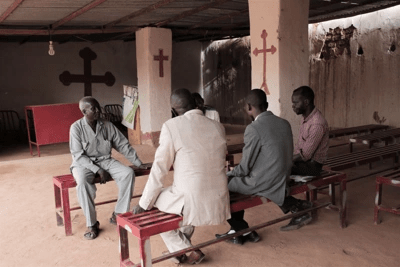
In one village in southeastern Fujian near the Guangdong border, Chinese believers told a remarkable story of God’s provision and power. An elderly brother had believed in the Lord for many years when the Communists took control of the area in 1949. The Blessed Old Man, as other believers affectionately dubbed him, came from an impoverished family and had never learned to read or write properly. Despite these simple impediments, after he received the Lord Jesus he proved to be a powerful evangelist, leading hundreds of people to faith in Christ throughout the district.

Hatching a plan to give Christianity a black eye and to show the supremacy of Marxism, the government decided to make an example of the old preacher by giving him the best house in the village and a generous supply of food. They also appointed him chairman of the village’s Communist committee, thinking that when he abandoned his religion they would display him as a shining example of the goodness of Communism and the futility of Christianity.

The Blessed Old Man, however, belonged to Jesus Christ. Instead of being seduced by the Communists,

…he used the large house he had been provided to hold house church meetings and distributed the food he was given to those believers in need. After some time, the government saw that their plan was badly backfiring, so they issued an ultimatum  to the “chairman”. He had to choose between his faith and the new lifestyle and status he had been afforded by the authorities. Although he knew that he would return to a life of extreme poverty and hardship, the old brother did not hesitate for a moment.  “ I choose Jesus!” he boldly declared.

The enraged officials threw him out of the house. He had nowhere to go, but another believer provided him with a small room on the side of a shack. China at the time was suffering terribly from Mao’s disastrous economic experiments, and millions of people were starving to death. Although the old man now had somewhere to stay, there was no food available to eat. All the meager crops were taken by the government, and the other Christians were too poor to help him.

For some days the old man wasted away in his tiny room, with no food passing his lips. He grew weak and ill and knew that his life would soon be snuffed out. Then one morning he awoke to find a hole in the bottom of the wall. He didn’t know what had caused it and repaired the damage. A few hours later he found another hole and started to wonder if these strange occurrences were from the Lord. While he was still pondering it, a large rat came through the hole with some food in its mouth. After entering the room, the rat dropped the food on the floor and then left. A short time later it returned and did the same again. A small collection of nuts and vegetables lay on the dirt floor!

Each morning the rat paid a visit to the elderly brother. In response to his commitment, God had saved the old man from starvation by instructing a rat to feed him! The miraculous provisions continued for several months. On some days the rat brought more food than usual. Those were the days when the old man was expecting a visitor!

Excerpt from Fujian – The Blessed Province – The China Chronicles, Paul Hattaway, Asia Harvest (Langham Global Library), p. 245-246

God says “I will not, I will not cease to uphold or sustain thee; I will not, I will not, I will not forsake someone in a state of defeat or helplessness in the midst of hostile circumstances.” (Expanded Greek Translation of Hebrew 13:5 by Dr. Kenneth Wuest.)

Be encouraged Saints… regardless of your circumstances. God sees you, is in you, and has not forsaken you.

Love,

Carl

Christianity, Islam and the double standards of leftist media

During a city council meeting last week, Dearborn Heights, Michigan Mayor Abdullah Hammoud uttered remarks that, in any other context, would have incited a nationwide media firestorm.

When a Christian resident objected to renaming a local road after a news publisher who glorified Hamas and Hezbollah, the mayor responded that he was simply “not welcome here.” The leftist media responded to this inflammatory comment by ignoring it.

During public comment, local resident Ted Barham registered his objection to the county renaming a section of Warren Avenue after Osama Siblani, the publisher of Arab American News, due to his support for terrorism in statements like, “The blood of the martyrs irrigates the land of Palestine.”

“The best suggestion I have for you is to not drive on Warren Avenue or to close your eyes while you’re doing it. His name is up there, and I spoke at a ceremony celebrating it because he’s done a lot for this community,” retorted Mayor Hammoud. He reviled Barham as “a bigot,” “racist,” and “an Islamophobe” before concluding, “Although you live here, I want you to know as mayor, you are not welcome here. And the day you move out of the city will be the day that I launch a parade celebrating the fact that you moved out of this city.” So much for inclusion.

“Dearborn is one of … a couple of cities now … that has a Muslim mayor. It has a … majority Muslim community,” responded former Brown University researcher Dr. Andrew Bostom. “From the mindset of a leader of really what’s a Muslim community, he did nothing wrong. He’s protecting the mores of this Muslim community … The problem is the non-Muslim political and religious leaders that are afraid to call out these behaviors and just label them as unacceptable.”

It would be simple to condemn Hammoud’s comments, if the media or Michigan Governor Gretchen Whitmer (D) cared to. Hammoud made these comments in an official meeting, on video, for the whole world to see. “He said this from the city council in his role as the mayor. So it wasn’t like he posted this somewhere on social media. He said it from his official post and capacity!” exclaimed FRC President Tony Perkins on “Washington Watch.”

But the only tune being played by the leftist media is crickets.

Perkins anticipated a critic’s response, “There are going to be people who say, ‘Well, you believe in religious freedom. What if a Christian was the mayor?’”

Consider the hypothetical scenario: a predominantly Christian community decides to name a street after the late James Dobson, to honor his labor for American families; a local LGBT activist stands up at a city council meeting to protest Dobson’s affirmation of a biblical view of marriage and sexuality; and the (openly Christian) mayor calls the activist a string of unpleasant names and invites him to pack his bags.

Of course, local Christian churches should be the first to rebuke such an un-Christian response. Christians want to see everyone come to know Jesus; they don’t want people to move away simply because they don’t yet know him. But equally certain is the ensuing denunciation across the leftist media landscape. Politico reporter Heidi Przybyla would write another breathless prediction about the imminent takeover of Christian nationalism. “60 Minutes” would sympathetically film an in-depth portrait of LGBT rights in the town. The New Yorker would run a snooty essay implying that they expected nothing less from a pack of rabid Bible-thumpers.

In other words, if the roles were reversed, the current media silence would swell into the roar of Niagara Falls!

So, why is the media silent now? Why does it show no interest in the exclusionary discrimination directed by a Muslim government official toward a Christian? Where are the condemnations of Islamic nationalism, or the pleas for non-sectarian neutrality?

To ask these questions is not to equate Christianity and Islam. “Christianity allows freedom,” Perkins pointed out, while Islam requires submission. The Muslims in Dearborn Heights want to honor a man who praised terrorism. If a Christian town did honor Dr. Dobson, they would honor a man who praised God’s design for the family. It’s also telling that the case of Muslim exclusion is real, while the case of Christian exclusion is hypothetical.

Such exclusion “is not considered negative from an Islamic perspective,” Bostom stated. “This is the way Christians are supposed to behave in a Muslim community. They are supposed to bend to the will of the Muslim majority and not do anything that offends the sensibilities of Muslims.”

In fact, “there’s not a single Muslim country or region where Christians are free and safe,” he continued. “Countries such as Nigeria, Congo, Burkina Faso, Cameroon, Niger, the Central African Republic have massacred or forcibly displaced millions of African Christians [as] jihadists [have been] allowed to roam free in these countries within the past 10 years.”

“Christians in many Muslim countries can be detained without trial, arrested, sentenced, and imprisoned,” Bostom added. “They’re incarcerated for their faith in Bangladesh and Iran. They’re being driven underground in places like Yemen and Algeria.”

In fact, it’s worth asking why the media says so little about the extensive persecution Christians face across the Muslim world. Sixteen million Christians have been driven from their homes across Africa, said Bostom, compared to two million residents of the Gaza Strip. But who gets all the media sympathy?

Notably, Muslims in Western nations do not suffer the same sort of religious discrimination that Muslims experience in Islamic nations. “Muslims … have a protected status in this country,” said Bostom. “There’s all kinds of public opprobrium cast upon anyone … who says something that’s deemed negative about Muslims.”

The difference is that Western nations have been influenced by the liberalizing values of Christianity (in the classical sense where “liberal” is simply a synonym for “free”). Thus, Western nations — at least before they became post-Christian nations — have long recognized inalienable human rights, based in a person’s inherent dignity, which ultimately comes from God. Christianity teaches that a man cannot be forced to believe anything against his will, so Western nations allow that man should not be forced to say anything against his will. Christianity extols the value of work, so Western nations protect the right of property.

These human rights are nowhere more secure than in America, where constitutional amendments have codified the right to free speech, free religion, free assembly, and more. “That’s why, in America, you have a Muslim mayor in a Muslim community,” said Perkins. “Not that I endorse it, but because of the freedom that’s allowed under the Christian ethic. You don’t see that in a Muslim-majority country.”

Islam, by contrast, is illiberal. In many nations conquered by Islam, the native population was forced to convert or die. To this day, many Islamic nations still have laws discriminating against non-Muslims, prohibiting any Muslim from changing his or her religion, and punishing anyone seeking to convert a Muslim. Where Muslim countries have moderated these laws, it has usually been due to diplomatic pressure from Western powers like the United States.

Countries are not guaranteed to maintain their character if their people and customs change theirs. For America, this means that our traditions of freedom will not survive an Islamic takeover. “What you’re seeing play out [in Dearborn is] what a lot of us have feared,” said Bostom. “In a predominantly Muslim enclave, city, town, etc., you will see application of Islamic law.”

“But is that the American way,” asked Perkins, “that we have to surrender our First Amendment freedoms, because we’re living in an enclave of Muslims?” Not according to the model of ordered liberty that prevailed in previous eras of U.S. history, he concluded. When President John Adams said the U.S. Constitution would only work for a “moral and religious people,” he said, “I would bet my life … that he was not referring to the Quran. He was referring to the Bible.”

“The problem is that we don’t have … the political strength, the religious strength, the social strength to just say, ‘This is intolerable,’” Bostom responded. That weakness is due to American culture unmooring itself from its “common religious ethic” in the word of God, said Perkins. For decades, an anti-Christian ideology has crept through the institutions, sowing division, mistrust, and the spirit of lawlessness (2 Thessalonians 2:7).

This refers, of course, to the Marxist ideology of the Left, which rejects the very notion of “good authority” in order to establish its own totalitarian rule. It offers a profane facsimile of freedom, which is merely a rejection of all norms. In practice, Marxism is every bit as illiberal as Islam, demanding submission and persecuting those who refuse.

Perhaps this ideological fraternity is the more fundamental reason why the leftist media has failed to criticize Islam’s persecution of Christianity.

Such conditions should surprise no Christian, because sinful nations — allied only because their common master is Satan — have joined forces to conspire against God’s people for at least 3,000 years. “Why do the nations rage and the peoples plot in vain? The kings of the earth set themselves, and the rulers take counsel together, against the Lord and against his Anointed,” wrote David (Psalm 2:1-2). The goal of sinful people and sinful rulers is to throw off God’s authority (Psalm 2:3), but God’s triumph is already sure (Psalm 2:4-9). It was true in David’s day, it was true in Jesus’s day (Acts 4:25-28), and it remains true today.

For this reason, Christians need not stoop to the censorious tactics of our enemies. God’s kingdom advances by open profession of the truth. “We persuade others” (2 Corinthians 5:11); we don’t silence them. Let evil men do what they will, but Christians rely on free and open debate, “We implore you on behalf of Christ, be reconciled to God” (2 Corinthians 5:20).


Originally published at The Washington Stand. 

Joshua Arnold is a senior writer at The Washington Stand, contributing both news and commentary from a biblical worldview.

Source: Christian Post

A Polynesian Ancient Tradition About Nimrod of Genesis

The following ancient tradition by the Polynesians was reported by English Missionary John Williams (1796-1839) who arrived in Tahiti in autumn of 1817 and was eaten by cannibals in November 1839 in the New Hebrides.

“…the heavens were originally so close to the earth that men could not walk, but were compelled to crawl” under them. “This was found a very serious evil; but at length an individual conceived the sublime idea of elevating the heavens to a more convenient height. For this purpose he put forth his utmost energy, and the first effort raised them to the top of a tender plant called teve, about four feet high. There he deposited them until he was refreshed, when by a second effort he lifted them to the height of a tree called Kauariki, which is as large as the sycamore. By the third attempt he carried them to the summits of the mountains; and after a long interval of repose, and by a most prodigious effort, he elevated them to their present situation.” For this, as a mighty benefactor of mankind, “this individual was deified; and up to the moment that Christianity was embraced, the deluded inhabitants worshipped him as the ‘Elevator of the heavens.” 1

“Now, what could more graphically describe the position of mankind soon after the flood, and the proceedings of Nimrod as Phoroneus, “The Emancipator,” than this Polynesian fable?

“While the awful catastrophe by which God has showed His avenging justice on the sinners of the old world was yet fresh in the minds of men, and so long as Noah, and the upright among his descendants, sought with all earnestness to impress upon all under their control the lessons which that solemn event was so well fitted to teach, “heaven,” that is, God, must have seemed very near to earth. To maintain the union between heaven and earth, and to keep it as close as possible, must have been the grand aim of all who loved God and the best interests of the human race.

“But this implied the restraining and discountenancing of all vice and all those “pleasures of sin,” after which the natural mind, unrenewed and unsanctified, continually pants. This must have been secretly felt by every unholy mind as a state of insufferable bondage. “The carnal mind is enmity against God, ” is “not subject to His law,” neither indeed is “able to be” so. It says to the Almighty, “Depart from us, for we desire not the knowledge of Thy ways.” So long as the influence of the great father” (Noah) “of the new world was in the ascendant, while his maxims were regarded, and a holy atmosphere surrounded the world, no wonder that those who were alienated from God and godliness, felt heaven and its influence and authority to be intolerably near, and that in such circumstances they “could not walk,” but only “crawl,”– that is, that they had no freedom to “walk after the sight of their own eyes and the imaginations of their own hearts.”

“From this bondage Nimrod emancipated them. By the apostasy he introduced, by the free life he developed among those who rallied around him, and by separating them from the holy influences that had previously less or more controlled them, he helped them to put God and the strict spirituality of His laws at a distance, and thus he became the “Elevator of the heavens,” making men feel and act as if heaven were afar off the earth, and as if either the God of heaven “could not see through the dark cloud,” or did not regard with displeasure the breakers of His laws. Then all such would feel that they could breathe freely, and that now they could walk at liberty. For this, such men could not but regard Nimrod as a high benefactor.

According to the system which Nimrod was the grand instrument in introducing, men were led to believe that a real spiritual change of heart was unnecessary, and that so far as change was needful, they could be regenerated by mere external means.

“Looking at the subject in the light of the Bacchanalian orgies, which, as the reader has seen, commemorated the history of Nimrod, it is evident that he led mankind to seek their chief good in sensual enjoyment, and showed them how they might enjoy the pleasures of sin, without any fear of the wrath of a holy God. In his various expeditions he was always accompanied by troops of women; and by music and song, and games and revelries, and everything that could please the natural heart, he commended himself to the good graces of mankind. “2

And so it continues in 2025 because when God confused the languages at Babel after the worldwide flood, the newly created language groups that dispersed around the world took with them the rebellious teaching of Babel and the worship of Nimrod into their new countries; therefore, today the nations are still in bondage to idols and false gods.

Thank you King Jesus for the Gospel that sets men free and brings them into your heavenly kingdom which one day will come to earth when You will reign from Jerusalem bringing justice.

Come Lord Jesus!

Carl. 1.Source: English Missionary John Williams (1796-1839) who arrived in Tahiti in autumn of 1817 and was eaten by cannibals in November 1839 in the New Hebrides. He wrote Narrative of Missionary Enterprises in the South Sea Islands which you can find on the internet for free.

2. Alexander Hislop, The Two Babylons (Or, The Papal Worship Proved To Be The Worship of Nimrod), Printed in United States 2013. Hislop (1807-1865) was a Scottish minister.

Persecuted Christians are starving for Bibles

Source: Christian Post (See note at end of article)

What would you do if you had no access to Scripture? Most Americans have multiple Bibles at home, dozens of translations at our fingertips, and devotional apps on every device. Yet for believers living in hostile areas and restricted nations, a single torn page of the New Testament is a treasure worth suffering for.

For many Christians around the world, owning a Bible is illegal. It can cost a believer their freedom or even their life. Yet, in the darkest prison cells and most hostile corners of the world, the Word of God remains the most desired possession. 

During 25+ years serving at The Voice of the Martyrs, I’ve had the honor to meet with persecuted Christians living and serving in the most dangerous and difficult places to follow Christ. Often, they share their inspiring testimonies.

Recently I came across five powerful stories about what having access to Scripture meant to imprisoned Christians.

1. Brother Joe

Brother Joe, a former prisoner in North Africa, received a smuggled portion of the Bible — just Psalms and part of the Gospel of John. For him, those verses were life itself. 

“I would cry over the words,” he said. “Not because I was sad, but because it was like Jesus Himself was sitting in my cell with me.” 

Even as Brother Joe endured torture, he began copying verses by hand to share with other prisoners. The guards tried to stop him, but the Word kept spreading. As the prophet Isaiah wrote, “The word of our God shall stand forever.”

2. Helen Berhane

Helen Berhane, an Eritrean gospel singer who was imprisoned in a metal shipping container for over two years, had no Bible at all — but she had memorized verses before her arrest. 

“The Word became my song, my food, my comfort,” she shared. “I had no book, but I had Him.”

Even today, years later, those memorized verses continue to sustain her.

3. Aaron

Aaron, a front-line worker, told me about a woman jailed for leading Bible studies in China, where the underground church is heavily persecuted. Fellow inmates, recalling verses they had memorized, pieced together entire chapters from memory. When a contraband Bible finally arrived, they tore it apart — not to destroy it, but to share it. 

“In that cell,” Aaron said, “the Bible wasn’t just a book — it was their breath.”

4.  Ali

Perhaps the most startling transformation came in the life of Ali, a former jihadist who encountered the Gospel of Luke in prison. The Bible turned his world upside down.

“I had studied violence all my life,” he said. “Then I met Jesus in a jail cell in the pages of that book. That Bible broke me.” 

Ali found, for the first time, a God who loves His enemies and sent His Son to die for them.

The Bible is more than print on paper — it’s living and active. The Word of God has the power to sustain people’s faith under the most intense persecution. For the millions of Christians in hostile nations, a Bible is not just a comfort. It is what carries them through their torture and suffering.

5. Iranian prisoner

Hormoz Shariat, the founder of Iran Alive Ministries known as “the Billy Graham of Iran,” shared how one Iranian prisoner risked his life to possess a single page of Scripture. That page became a spark. He memorized it and passed it to another inmate, who did the same. 

“They shared one torn page like it was gold,” Shariat said. “It was enough to bring light into total darkness.”

In Iran, where printing or importing Farsi Bibles is illegal, believers face prison or death for sharing God’s Word. And yet, they do it anyway. The hunger for the Bible is so deep that even a fragment — one Psalm, one parable — is worth everything.

Every April, VOM focuses on getting Bibles to persecuted Christians. This year, our ministry has identified 458,000 Christians, by name, who are waiting for a Bible in hostile areas and restricted nations.

Through front-line workers, the ministry is positioned to deliver these Bibles directly into the hands of those who need them most. Imagine being the reason a believer in prison experiences the presence of Christ in their darkest hour!

There are many lessons to learn from others who have suffered for their faith. The stories here are just a small example of the power of God’s Word to bring hope and strength to our brothers and sisters in Christ.

Maybe our first lesson is not to take for granted what others are risking everything to hold.

Todd Nettleton is Vice President for Message at The Voice of the Martyrs and host of The Voice of the Martyrs Radio. He is the author of When Faith Is Forbidden: 40 Days on the Frontlines with Persecuted Christians.

READER NOTE: Voice of The Martyrs charges $10 per Bible per their donation page. Asia Harvest charges $3 to print and deliver a Bible per their donation page. Asia Harvest and the underground church in China estimate that for every Bible given to a believer in China, at least one other individual comes to Christ. Not a bad $3 investment in the Kingdom of God!

Asia Harvest’s ministry is limited to Asia. They print Bibles in 163 different Asian languages. Our family has supported this effort for about three years.

Voice of the Martyrs ministry is worldwide evidently.

May you do your part to spread His Word in this dark world.

Blessings to all,

Carl

70 Christians beheaded in DRC church attack [by Islamic Terrorists] ‘Grim tapestry of violence’

By Anugrah Kumar, Christian Post Contributor Thursday, February 20, 2025

Seventy Christians were discovered beheaded inside a Protestant church in the Democratic Republic of Congo’s North Kivu Province, according to reports, which say the victims had been kidnapped by suspected Allied Democratic Forces terrorists.

The terrorists arrived in Mayba, a village in the territory of Lubero, at around 4 a.m. last Thursday and ordered residents to quietly get out, said Open Doors, adding that at least 20 Christian men and women had to leave their homes, leading to their capture.

Later, concerned residents gathered to plan a rescue, but the armed group is said to have surrounded the village and managed to seize 50 more believers. The abducted residents were then taken to a Protestant church in Kasanga, where they were found beheaded, said the ministry.

Families in the area could not immediately bury their relatives because of persistent security threats.

The U.S.-based persecution watchdog International Christian Concern called the attack “a brutal massacre,” and said the ADF held the hostages for days before executing them.

“This recent massacre, where 70 Christians lost their lives, is not an isolated incident but part of a grim tapestry of violence that has claimed over 6 million lives in the DRC over two decades of on-and-off war,” said ICC President Jeff King in a statement provided to The Christian Post. “The vast majority of the DRC’s residents are Christian, so this is a religious genocide carried out by radical Islamic terrorists (the ADF).”

He continued, “It’s time for more than prayers; we must demand an all-African military force to intervene in this failed state, to restore order and save countless more people from becoming victims of this endless cycle of bloodshed.”

Open Doors quoted a local primary school director, speaking from Kombo school, as saying that churches and health centers in the region had already halted operations due to widespread violence. They had to relocate all their activities.

Many Christians have reportedly fled Lubero for safety. One community elder from the local CECA20 church commented, “We don’t know what to do or how to pray; we’ve had enough of massacres. May God’s will alone be done.”

The ADF, which is associated with the Islamic State terror group, has intensified assaults in northeastern Congo for several years. In 2014, the group escalated attacks in Beni territory of North Kivu province, later expanding into Irumu and Mambasa in Ituri province.

A local news outlet reported that more than 200 individuals were killed in Baswagha chiefdom last month.

DRC moved six places higher on the World Watch List, ranking 35th in the most recent evaluation. Recorded deaths for faith-related reasons rose from 261 to 355 last year, and thousands of people were internally displaced.

Houses in affected regions have been looted, churches closed and some Christian villages left abandoned. In the midst of this turmoil, the presence of M23 rebels, reportedly supported by Rwanda, has contributed to the insecurity.

Rwanda has been accused of supporting M23 in the hope of annexing some of its mineral rich territory. Rwanda, in turn, has accused DRC of supporting anti-government militias in its territory and of harboring those responsible for the 1994 Rwandan genocide.

Amid the exchange of blame between Rwanda and the DRC, M23 recently claimed control of the eastern Congolese city of Goma. Local Christian leaders have pledged to work toward peace and harmony among neighbors.

Meanwhile, John Samuel, Open Doors’ legal expert for sub-Saharan Africa, described the violence as taking place “in a context of impunity, where almost no one is held accountable.”

Samuel urged the international Christian community to “remain in prayer for Christians and vulnerable communities in eastern DRC” and to seek “an end to violence” while advocating “impartial” and “transparent” efforts by the government.

A previous report by the U.S. State Department noted, “The Islamic State of Iraq and Syria-Democratic Republic of the Congo (ISIS-DRC), known locally as the Allied Democratic Forces (ADF), a U.S.-designated terrorist organization, continued to attack civilians indiscriminately in North Kivu and Ituri Provinces, on occasion targeting churches and religious leaders. The violence targeted all communities, but most victims were Christian, the religious majority.”

It is believed that there are around 7 million internally displaced people in the DRC, more than any other country in the world. Christian charity World Vision has called on the international community to do more to help child refugees in the country. Since 1998, it is believed that over 6 million people have been killed in the conflict.

A Christian response to the occult

By Christopher L. Reese and from Christian Post

Christians hold various opinions about Halloween, but one thing it certainly points to is the human fascination with the supernatural. Although many in the West pride themselves on being secular and scientific, everyone has an innate curiosity about what may lie beyond the world we experience with our five senses. History shows humans have always acknowledged the existence of the supernatural and engaged in practices to worship or manipulate it.

This is unsurprising in light of the fact that humans are spiritual beings (e.g., Matt. 10:28), and that we interact with the spiritual realm — for example, by entering into a relationship with God, who is also spirit (John 4:24). The author of Ecclesiastes tells us that God has “set eternity in the human heart” (Eccles. 3:11), and Augustine echoes this when he writes, “You have made us for yourself, O Lord, and our heart is restless until it rests in you.”1

Although humankind should seek transcendence in God, because of the fall, many seek it elsewhere. If one is coming into contact with the spiritual realm apart from God, they are interacting with the only other spiritual reality that exists, that of Satan and his demons — the world of the occult.

What C. S. Lewis perceptively wrote about demons also applies to the occult in general: “There are two equal and opposite errors into which our race can fall about the devils. One is to disbelieve in their existence. The other is to believe, and to feel an excessive and unhealthy interest in them.”2 In the same way, it is a mistake either to deny or underestimate the reality of the occult, or to spend a great deal of time and energy dwelling on it (unless one is called to a ministry that requires deeper engagement). Yet, since the occult is prevalent in the world, we should be aware, at least, of the main forms that it takes. As Paul wrote, “we are not unaware of [Satan’s] schemes” (2 Corinthians 2:11).

What is the occult and how widespread is it in the US?

The occult can be defined as “[Phenomena], events, and religious practices engaging a practitioner in a realm of the supernatural that is rooted in things secret or hidden.”3 More specifically, “The term frequently refers to certain practices (occult ‘arts’) that include divination, fortunetelling, spiritism (necromancy), and magic.”4

The US government doesn’t keep detailed records on religious affiliation, so precise numbers of occult-oriented religions aren’t available. But the Pew Research Center’s 2014 Religious Landscape Study estimated that 0.4% of the US population, about 1.3 million people, subscribe to a “New Age” religion, with most of these identifying as Wiccan or Pagan. By comparison, the Presbyterian Church (USA) has about 1.2 million members.5

In 2007, an executive with Barnes & Noble estimated the American “Pagan Buying Audience” as numbering 10 million people.6

What are some examples of occult groups and practices in the US?

Since the largest occult-oriented groups cited in the Pew survey above consist of New Age and Wiccan or Pagan adherents, we’ll examine the beliefs of those groups below, followed by a brief discussion of some of the most common occult practices. There is a tremendously diverse spectrum of beliefs among both New Agers and Pagans/Wiccans, so the following survey attempts to identify the beliefs most commonly shared by these respective groups.7

New Age movement

The New Age movement is a “loosely structured network of individuals and organizations who share a vision of a new age of enlightenment and harmony . . . and who subscribe to a common ‘worldview.’”8 As with Wiccans, there is a vast array of beliefs among New Agers (though many don’t necessarily identify with this label). Despite the diversity of beliefs, there are some commonalities, including the following.

  • An emphasis on personal experience and mysticism rather than dogma.
  • A belief in monism (all reality is one) or pantheism (everything is God).
  • Adoption of beliefs from a variety of world religions and/or mystical traditions.
  • Rejection of the idea that any single religion or belief system is exclusively true.
  • Humans are divine and don’t need salvation, but enlightenment, which involves embracing one’s true divine identity.
  • A belief in the sacredness of the earth, which is sometimes viewed as a living organism.
  • Belief that humans can bring about a utopia through enlightenment and personal transformation.
  • There are various organizations devoted to New Age beliefs, but most adherents engage in spiritual practices alone, or with a small group. Popular practices include astrology, the use of crystals (for meditation or healing), the pursuit of altered states of consciousness (sometimes using hallucinogenic drugs), attempting to interact with spiritual beings (through mediums or channeling), and the use of psychic powers to gain knowledge beyond the five senses.

Paganism/Wicca

Paganism is an umbrella term that encompasses modern attempts to revive pre-Christian religions (such as Greek, Roman, and Germanic), but mostly consists of those who identify as Wiccans (witches).9 There is no centralized Wiccan teaching authority, or set of beliefs that all adherents agree to, but the following are generally applicable.

  • An emphasis on practice and personal experience rather than dogma.
  • Belief in gods and goddesses, or pantheism (everything is God), or panentheism (everything is part of God), or animism (everything possesses a spiritual essence), or a combination of these.
  • Most Wiccans deny the existence of Satan.
  • Humans are basically good and divine, or potentially divine. Sin as defined by Christianity does not exist, but one can be in disharmony with oneself, others, or supernatural beings. Since there is no sin, salvation isn’t necessary.
  • All living things are sacred.
  • Magic (sometimes spelled with a “k” [magick] to distinguish it from tricks performed by illusionists) can be used to bring about change in people and the world, and can be used for both good and evil purposes.
  • Many Wiccans believe in some form of reincarnation.
  • Many Wiccans celebrate eight Sabbats (festivals) throughout the year, and perform rituals either privately or with other Wiccans. Some Wiccans meet in small, autonomous groups called covens.

Of these two groups, New Age beliefs are far more popular and prevalent in the US. Many of these ideas have taken root in popular culture and are promoted by celebrities, movies and TV shows, music, and bestselling books.

Practices

Necromancy

Necromancy refers to the attempt to contact the spirits of the dead in order to obtain otherwise hidden knowledge or to communicate with deceased relatives or friends, often for the purpose of emotional comfort or closure. Mediums claim the ability to act as a bridge between the living and the dead, and the attempt to contact spirits is sometimes called a séance (from the French word for “session”).

Divination

Divination is the attempt to gain knowledge of future events or other hidden knowledge by interpreting signs, contacting spiritual entities, or through supernatural powers. Divination has been practiced throughout human history and is still prevalent today. Modern forms include the use of tarot cards, psychic readings, astrology, palm reading, and Ouija boards.

Magic

Magic can be defined as the use of rituals or actions performed for the purpose of manipulating natural or supernatural forces or beings. Both necromancy and divination can be considered forms of magic, as well as the casting of spells, which often involve incantations, physical rituals, and the use of herbs, potions, or amulets.10

A Christian response

Space prohibits a detailed response to each of the beliefs and practices listed above, but the following comments briefly address some of the big-picture issues raised by the occult, along with most of the practices described above.11

First, occult beliefs and activities are an attempt to circumvent God’s authority and go beyond the revelation provided in Scripture. This temptation is as old as humankind itself and was precisely what Satan offered Adam and Eve in the garden. Satan insisted that there was knowledge to be had that God was withholding and that gaining this knowledge would elevate the human couple to a godlike status (Gen. 3).

In this light, it’s not surprising that Paul refers to false teachings as “things taught by demons” and that some who abandon the faith “follow deceiving spirits” (1 Tim. 4:1). Much of Satan’s activity in the world involves producing and disseminating ideas that contradict or distort God’s revelation.

The occult is also a form of idolatry — giving ultimate allegiance to someone or something other than God. Whether it’s the Mother Goddess worshiped by some Wiccans, or a deified self-pursued by New Agers, all occult belief systems replace the Creator who has revealed himself in Scripture with some type of counterfeit deity.

In addition, all of the categories of occult activities noted above (necromancy, divination, magic) are expressly prohibited in Scripture. As the Lord warned the Israelites before they entered the promised land:

Let no one be found among you who sacrifices their son or daughter in the fire, who practices divination or sorcery, interprets omens, engages in witchcraft, or casts spells, or who is a medium or spiritist or who consults the dead. Anyone who does these things is detestable to the Lord; because of these same detestable practices the Lord your God will drive out those nations before you (Deut. 18:10-12).

We are all tempted to try to discover what will happen in the future or to gain other knowledge not attainable through natural means. But as the late biblical scholar Merrill Unger pointed out:

“There is everything wrong in prying into the future, which God has not revealed and, for our own welfare, does not want us to know. Such knowledge is contrary to God’s Word and will, but it is the kind of knowledge that Satan and demons give. . . . Although God has revealed His general plan for the future for both the saved and the unsaved, it is not normally His purpose for us to know the specifics of that plan or the details of individual lives.”12

Thus, Moses told the people of Israel, “The secret things belong to the Lord our God, but the things revealed belong to us and to our children forever” (Deut. 29:29).

Finally, participation in occult activities opens a person up to demonic influence. This is true for both Christians and non-Christians. Paul warned the Corinthians that “the sacrifices of pagans are offered to demons, not to God, and I do not want you to be participants with demons. You cannot drink the cup of the Lord and the cup of demons too; you cannot have a part in both the Lord’s table and the table of demons” (1 Cor. 10:20-21).

The following true stories illustrate this danger.

Heath Adamson’s story

Heath Adamson, who is now a leader in his Christian denomination, became interested in the occult as a young boy. “What started out as intrigue and entertainment,” he writes, “quickly led to a lifestyle of encounter with the stuff of Hollywood lore. I remember watching a chair slide across the floor and a candle floating off the coffee table.” He continues, “I had night terrors so bad, so horrific, I was tormented for years. In junior high, the anxiety produced ulcers. Specialists couldn’t confirm what was wrong. I felt trapped, breathless, and alone.”

In high school, he had “regular encounters with the demonic realm, became addicted to numerous drugs, looked like a human skeleton, and lived life in quiet desperation.”

A classmate invited Heath to church, and afterward, at home he felt God’s presence for the first time. “I remember the warm tears falling down my face. Crying wasn’t something I did. It was almost as if the sky opened up and, for the first time in my life, I sensed real and pure love.”

Heath began to pray regularly and continued to attend church services with his classmate. On one Wednesday evening he responded to an invitation to receive Christ, and “[m]y body was supernaturally and instantaneously healed. My substance addictions vanished. It’s almost as if I met myself for the first time.” Like many others, Heath found deliverance from the occult through Jesus Christ.13

The minister and his sister

The late Christian apologist Walter Martin relates meeting a Christian minister and his wife in New York after one of Martin’s lectures. The minister shared with Martin that he had come from a family of spiritists who practiced mediumship and held séances. The minister had come to Christ many years ago, but his sister was still involved and frequently used an Ouija board to communicate with spirits. The minister was concerned about his sister, and one night he and his wife decided to confront her.

In an attempt to show his sister that the Ouija board was evil, he began asking it questions. “What do you feel toward me?” he asked the board, which then spelled out the answer “H-A-T-E.” “What do you think of the Bible?” he asked. The board replied with an obscenity. With that, the minister stood up and exclaimed, “I’ll have no more to do with this. It’s devilish,” and threw his Bible onto the middle of the board. He recounted to Martin what happened next:

At that moment, the board levitated off the table and flipped the Bible into the air with such force that it flew across the room and hit the wall. My sister and my wife screamed.

As I stood there looking at it, something smashed me in my stomach and knocked me to the floor. I was doubled over — breathless — with my head between my knees, and the only thing I could gasp was, “Jesus, Jesus, Jesus. Help!”

But I was lying on the floor in such a convincing position that my wife and sister came over to help me. When we pulled up my shirt, there was a red welt the size of a fist over my solar plexus! At that juncture, my sister recognized that I had been hit — but by nothing visible in that room. The next thing I knew, we were all having a prayer meeting. My sister came out of the occult to Christ, and the Ouija board was splintered and burned.14

Thus, the occult should never be taken lightly, even by Christians.

Deliverance from the occult

The following six steps are crucial for anyone who desires to break free from the occult.15

1. Receive Christ as your Lord and Savior

The first step in departing from the darkness and entering the light is to be born again into God’s kingdom through Jesus’ sacrificial death on the cross for your sins. Those who come to Christ are “called . . . out of darkness into [God’s] wonderful light” (1 Peter 2:9). One of the reasons Christ died was “so that by his death he might break the power of him who holds the power of death — that is, the devil — and free those who all their lives were held in slavery by their fear of death” (Heb. 2:14-15).

2. Confess the sin of involvement in the occult

Scripture declares that “If we confess our sins, [God] is faithful and just and will forgive us our sins and purify us from all unrighteousness” (1 John 1:9).

3. Destroy all occult objects

The book of Acts describes how many who had practiced sorcery in the city of Ephesus came to Christ and “brought their scrolls together and burned them publicly” (Acts 19:18-19). “Having occult items around such as game boards, cards, and statues may provide a source of temptation to return. Removing all such objects helps avoid facing that temptation and dealing with memories.”16

4. Break off all occult associations

Communication with spirits (which in reality are demons) must cease, and you must no longer associate with friends or others who remain involved in the occult. Seek out new friends who are mature Christians who can help you grow in your relationship with Christ, and find a Bible-believing church where you can worship and serve.

5. Immerse yourself in God’s Word

As Paul instructed the Christians in Rome, “Do not conform to the pattern of this world, but be transformed by the renewing of your mind. Then you will be able to test and approve what God’s will is — his good, pleasing and perfect will” (Romans 12:2). Our minds are transformed as we read, study, meditate on, and memorize God’s Word. Scripture is also the “sword of the Spirit” by which we repel Satan’s attacks (Eph. 6:17; see Jesus’ example of doing this in Matt. 4:1-11).

6. If necessary, seek additional help

If you find yourself struggling even after following the steps above, find a Christian counselor or minister to talk to, especially someone who has experience helping people formerly involved in the occult.

Notes

  1. Confessions, 1.1.
  2. C. S. Lewis, The Screwtape Letters (San Francisco: HarperOne, 2001), ix.
  3. Larry A. Nichols, George A. Mather, and Alvin J. Schmidt, Encyclopedic Dictionary of Cults, Sects, and World Religions (Grand Rapids, MI: Zondervan, 2006), 428.
  4. Ronald Enroth, “Occult,” in Evangelical Dictionary of Theology, ed. Daniel J. Treier and Walter A. Elwell (Grand Rapids, MI: Baker Academic, 2017), 608.
  5. Cited in Iqbal Ahmed, “The Many Faces of the Occult,” The Atlantic Selects, December 23, 2019, https://www.theatlantic.com/video/index/604084/pagans/. I’ve updated the estimate for the membership of the PCUSA, and tried to use a slightly more precise figure for the number of New Age adherents.
  6. Patheos, “How Many Pagans Are There?”, https://www.patheos.com/library/answers-to-frequently-asked-religion-questions/how-many-pagans-are-there.
  7. I’m indebted to the following sources for the description of beliefs and practices: Walter Martin, Jill Martin Rische, and Kurt Van Gorden, The Kingdom of the Occult, 5th ed. (Nashville: Thomas Nelson, 2008); Ron Rhodes, New Age Movement, Zondervan Guide to Cults and Religious Movements (Grand Rapids: Zondervan, 2016); Craig Hawkins, Goddess Worship, Witchcraft, and Neo-Paganism, Zondervan Guide to Cults and Religious Movements (Grand Rapids: Zondervan, 2016).
  8. Ron Rhodes, New Age Movement, Zondervan Guide to Cults and Religious Movements (Grand Rapids: Zondervan, 2016), 9-10.
  9. Sabina Magliocco, “Neopaganism,” in The Cambridge Companion to New Religious Movements, edited by Olav Hammer and Mikael Rothstein (Cambridge: Cambridge University Press, 2012), 150–66.
  10. “Magic (Supernatural),” in Wikipedia, https://en.wikipedia.org/w/index.php?title=Magic_(supernatural)&oldid=1110907032.
  11. For a more in-depth critique, see the volumes listed in footnote 7.
  12. Merrill F. Unger, What Demons Can Do to Saints (Chicago, IL: Moody Publishers, 1991), 26.
  13. Heath Adamson, “Her Prayers Helped Pull Me Out of Occult-Fueled Madness,” ChristianityToday.com, https://www.christianitytoday.com/ct/2018/november/heath-adamson-prayers-helped-pull-occult-madness.html.
  14. Martin, Rische, and Gorden, The Kingdom of the Occult, 5th ed. (Nashville: Thomas Nelson, 2008), 9-10.
  15. This list is a modified version of the one found here: Patrick Zukeran, “The World of the Occult: A Christian Worldview Perspective,” Probe Ministries (blog), May 27, 2003, https://probe.org/the-world-of-the-occult/.
  16. Ibid.

Originally published at The Worldview Bulletin Newsletter. 

Christopher L. Reese (MDiv, ThM) is a writer, editor, and journalist. He is the founder and editor of The Worldview Bulletin and a general editor of the Dictionary of Christianity and Science (Zondervan, 2017) and Three Views on Christianity and Science (Zondervan, 2021). His work has appeared in Christianity Today, Bible Gateway, Beliefnet, Summit Ministries, and other sites.     

Who are the ‘least of these’ and why does it matter?

By John Doane, Op-ed contributor Sunday, October 20, 2024

Lutheran reverend Yousef Zamgila (L) speaks to members of his congregation at the small improvised church they helped set up in a neighbours yard in Omdurman, Khartoums twin city, on August 22, 2019. Sudan’s Christians suffered decades of persecution under the regime of Islamist general Omar al-Bashir. | JEAN MARC MOJON/AFP via Getty Images

Several years ago Tony Campolo wrote, “I place my highest priority on the words of Jesus, emphasizing the 25th chapter of Matthew, where Jesus makes clear that on Judgment Day the defining question will be how each of us responded to those he calls ‘the least of these.’”

President Obama, speaking to the Pope at the occasion of his visit to the White House in 2015, stated “You call on all of us, Catholic and non-Catholic alike, to put the ‘least of these’ at the center of our concerns.” And then the President went on to identify “the poor and the marginalized” as the “least of these.”

Others identify those needing adoption or the homeless as “the least of these.” Former NIH director Francis Collins in his recent book The Road to Wisdom identified “the poor, the sick, the orphans, the prisoners, [as] the least of these that Jesus said we are most called to help.”

Since Jesus makes this such an important issue, it would behoove us to identify those whom the Bible itself would call the “least of these.”

Notice that in Matthew 25:40 Jesus said, “… inasmuch as you did it to one of the least of these my brethren, you did it to Me.” So the “least of these” are His brethren. Who are Jesus’ brethren? Hebrews 2:11 answers, “For both He who sanctifies and those who are being sanctified are all one, for which reason He is not ashamed to call them brethren.” Romans 8:29 calls Jesus “the firstborn among many brethren.” 1 John 3:13-14 counsels us “Do not marvel, my brethren, if the world hates you,” but “We know that we have passed from death to life because we love the brethren.”

So, love for the brethren (Christians) is a sign that we have eternal life, just as in Matthew 25 Jesus indicates that those who care for the least of His brethren are welcomed into His eternal Kingdom.

Some Christian writers have identified the brethren of Jesus in Matthew 25 as disciples called to preach the Gospel, such as those sent out by Jesus in Matthew 10. Those may indeed risk hunger, loneliness, nakedness and imprisonment, but the ones mentioned in Matthew 25 evidently refer to those who actually suffer such things.

Now we know from the rest of the Bible (e.g. Romans 4:3-8 and Romans 10:9) that our righteousness is based on our faith in the finished work of Jesus for the forgiveness of sins and belief in His resurrection. So, the works on behalf of the least of Jesus’ brethren mentioned in Matthew 25 do not earn us salvation. Rather, they are a sign that we are already saved, as James said, “I will show you my faith by my works” (James 2:18).

Why is this important? First of all, this passage from Matthew should not be used for virtue signaling, to drum up support for one’s favorite charity, or to promote a government program. Our salvation is never based on our works, however good they may seem. Secondly, notice that the passage in Matthew 25 is part of the so-called Olivet Discourse starting in Matthew 24 where Jesus spoke to his disciples in private. In that context, Matthew 25: 31-46 gives His brethren, His disciples, a way to distinguish between others “blessed of My Father” (v. 34) and those deserving of “everlasting fire prepared for the devil and his angels” (v. 41).

As in other places, Jesus was sorting out appearances from reality. For example, before the breakup of the Soviet Union, many leaders in the World Council of Churches and major Christian denominations refused to believe that Christians were in prison for their faith in communist countries, even when presented with exhaustive evidence. Such leaders preferred to associate with leaders of state-controlled churches in those countries. Other nominal Christians either deny that Christians were suffering persecution in communist countries, or they were indifferent about helping them. The ones suffering persecution were indeed in prison. Their families were naked and hungry, because they had no income, and the governments forbade others from helping them. Like St. Paul, they were made “the filth of the world, the offscouring of all things” (1 Corinthians 4:13), surely the “least” ones.

Meanwhile, laymen supported efforts to bring relief to families of Christian martyrs and those in prison. When the communist governments of Eastern Europe collapsed, more Christians understood the magnitude of the persecution that had occurred. More Christians also became involved in helping our persecuted brethren elsewhere.

Nevertheless, one can still discern differences in how Christians and the world respond to the persecution of Jesus’ brethren. Believers still suffer severe persecution in communist China, North Korea, and Cuba. Recently it has also become fashionable to discourage criticism of Islam. However, it’s not fashionable to help Christians persecuted by Muslims in Nigeria or Iran, by Hindus in India or by Buddhists in Myanmar.

The worldly media generally ignores or downplays such persecution, and so it takes effort by Christians to identify it. Christians suffering this persecution are the “least” of Jesus’ brethren, hated by the world (1 John 3:13). But while they are persecuted, practical help provides encouragement that they are not forsaken (2 Corinthians 4:9). One can “visit” them also through prayer and letter writing.

Our priority is always our own household (1 Timothy 5:8) and our brothers and sisters in the household of faith (Galatians 6:10). When we help our persecuted brothers and sisters we exhibit our love for Christ, since Christ dwells within each believer (Colossians 1:2 and 1:27). Unbelievers do not have that love, because suffering for the name of Christ is foolishness to them. It is God Himself who puts that love into our hearts, so it is no cause for boasting.

John Doane received a bachelor’s degree from Yale, a PhD from MIT, and worked in microwave technology for Bell Laboratories, Princeton University and General Atomics. He served on the Board of Directors of Jesus to the Communist World  (which later became Voice of the Martyrs). His recent articles have been published in the Creation Research Society Quarterly and The Christian Post.

Source: Christian Post

Worldview may have more impact on mental health than chemical imbalances: study

A new study suggests that the mental health crisis in the United States may be more closely related to a lack of a biblical worldview than to commonly cited causes like chemical imbalances.

The Cultural Research Center at Arizona Christian University released the study Tuesday, attributing the rise in mental health issues, such as anxiety, depression and fear, to what researcher George Barna calls “worldview deficiencies” rather than “psychological or chemical imbalances.”

The findings are based on interviews conducted in January with 2,000 U.S. adults aged 18 or older, with a sampling error of plus or minus 2 percentage points at the 95% confidence level.

The report highlighted mental health struggles among younger generations, noting that 56% of Generation Z and 49% of millennials regularly experience anxiety, fear or depression. Generation Z refers to the youngest group of American adults, while millennials are defined as those born between 1984 and 2002. In total, one in three adults from these generations has at least one diagnosable mental disorder.

Barna sees a direct correlation between mental health challenges and the lack of a biblical worldview, which the Cultural Research Center defines as “a means of experiencing, interpreting, and responding to reality in light of biblical perspectives.” The CRC evaluates an individual’s biblical worldview based on their answers to a series of belief-related questions.

Only 1% of Generation Z and 2% of millennials possess a biblical worldview, according to Barna. He commented that it is “not uncommon to find a young adult who trusts feelings more than facts, sees no inherent value to life, believes in Karma, and rejects the existence of the biblical God.”

“Add to this a lack of any sense of purpose or meaning, and the idea that truth is subjective,” Barna explained. “This common set of components results in a lifestyle that is inconsistent, chaotic, frustrating, and lacking hope. Anxiety, depression, and fear are virtually inescapable in such a life.”

Barna highlighted several beliefs he considers contributors to mental unrest among young people. Seven out of ten individuals under 40 said their life lacks a clear purpose, while four out of five who reject God reported frequent experiences of fear and anxiety.

“The lifestyle that results from these common worldview components is one of chaos and fear,” Barna said. “However, embracing a biblical worldview offers a sense of purpose, security, and peace that can alleviate many of these mental health challenges.”

Barna also pointed to syncretism — described as a “blend of conflicting beliefs drawn from various worldviews” — as the dominant worldview among young Americans, adding that it’s “not surprising that anxiety, depression and fear are rampant among young adults who adopt syncretism.”

“Without a solid foundation of truth, their lives become inconsistent and chaotic,” he said, emphasizing that “the biblical worldview, by contrast, provides a framework that fosters emotional stability.”

Barna acknowledged that some situations do require conventional mental health treatments, such as counseling, prescription drugs or physical therapy, but he said that other mental health struggles may stem from “worldview components that trigger and sustain the condition.”

“If people instead embraced the core tenets of the biblical worldview, their lives would not be perfect,” Barna concluded, “but they would avoid many of the emotional and psychological pitfalls we’re seeing today.”

The report also examined the mental health of individuals whose beliefs directly conflict with the biblical worldview. Among those disengaged from both political involvement and Christian faith, 82% reported frequent experiences of anxiety, depression and fear, compared to 67% of respondents who were more engaged.

Incidents of fear, anxiety and depression were higher (46%) among those who believe gifted mediums can communicate with the spirits of the dead, compared to 34% of those who do not share this belief.

Similarly, 40% of respondents who consider “Mother Earth or the Universe” as an important guide reported mental health challenges, compared to 25% who did not. Among individuals classified as “consistently liberal” on social and political issues, 38% experienced frequent anxiety, depression or fear, while only 22% of those who did not identify as consistently liberal reported the same challenges.

Ryan Foley is a reporter for The Christian Post. He can be reached at: ryan.foley@christianpost.com

A Sheepman’s Look At Psalm 23

David, when he composed Psalms 23, knew this. Looking at life from the standpoint of a sheep, he wrote “He [the Good Shepherd] leads me beside quiet waters.” In other words, he alone knows where the still, quiet, deep, clean, pure water is to be found that can satisfy His sheep and keep them fit.

Generally speaking, water for the sheep came from three main sources: dew on the grass, deep wells, or springs and streams.

Most people are not aware that sheep can go for months on end, especially if the weather is not too hot, without actually drinking, if there is heavy dew on the grass each morning. Sheep, by habit, rise just before dawn and start to feed. Or if there is bright moonlight they will graze at night. The early hours are when the vegetation is drenched would dew, and sheep can keep fit on the amount of water taken in with their forage when they graze just before and after dawn.

Of course, dew is a clear, clean, pure source of water. And there is no more resplendent picture of still waters than the silver droplets of dew hanging heavy on leaves and grass at break of day.

The good shepherd, the diligent manager, makes sure that his sheep can be out and grazing on this dew-drenched vegetation. If necessary, it will mean he himself has to rise early to be out with his flock. On the home ranch or afield he will see to it that his sheep benefit from this early grazing.

In the Christian life it is a more than passing significance to observe that those who are often the most serene, most confident, and able to cope with life’s complexities are those who rise early each day to feed on God’s Word. It is in the quiet, early hours of the morning that they are led beside the quiet, still waters where they imbibe the very life of Christ for the day. This is much more than mere figure of speech. It is practical reality. The biographies of the great men and women of God repeatedly point out how the secret of the success in their spiritual life was attributed to the quiet time of each morning. There, alone, still, waiting for the Masters voice, one is led gently to the place where, as the old hymn puts it, “The still dews of His Spirit can be dropped into my life and soul.”

One comes away from these hours of meditation, reflection, and communion with Christ refreshed in mind and spirit. The thirst is slaked and the heart is quietly satisfied.

In my mind’s eye I can see my flock again. The gentleness, stillness, and softness of early morning always found my sheep knee-deep in dew- drenched grass. There they fed heavily and contentedly. As the sun rose and the heat burned the dew drops from the leaves, the flock would retire to find shade. There, fully satisfied and happily refreshed, they would lie down to rest and ruminate through the day. Nothing pleased me more.

I am confident this is the same reaction in my Master’s heart and mind when I meet the day in the same way. He loves to see me contented, quiet, at rest, and relaxed. He delights to know my soul and spirit have been refreshed and satisfied.

But the irony of life, and tragic truth for most Christians, is that this is not so. They often try, instead, to satisfy their thirst by pursuing almost every other sort of substitute. For their minds and intellects they will pursue knowledge, science, academic careers, vociferous reading, or off-beat companions. But they are always left panting and dissatisfied.

Some of my friends have been among the most learned and highly respected scientists and professors in the country. Yet about them there is often a strange yearning, and unsatisfied thirst which all their learning, all their knowledge, all their achievements have not satisfied

To appease the craving of their souls and emotions, men and women will turn to the arts, to culture, to music, to literary forms, trying to find fulfillment.

And again, so often, these are amongst the most jaded and dejected of people.

Amongst my acquaintances are some outstanding authors and artists. Yet it is significant that to many of them life is a mockery. They have tried drinking deeply from the wells of the world only to turn away unsatisfied — unquenched in their soul’s thirst. There are those who, to quench this thirst in their parched lives, have attempted to find refreshment in all sorts of physical pursuits and activities.

They try travel. Or they participate feverishly in sports. They attempt adventures of all sorts or indulge in social activities. They take up hobbies or engage in community efforts. But when all is said and everything has been done, they find themselves facing the same haunting, hollow, empty, unfilled thirst within.

The ancient prophet Jeremiah put it very bluntly when he declared, “My people… have forsaken me, the spring of living water, and have dug their own cisterns, broken cisterns that cannot hold water”   (Jeremiah 2:13).

It is a compelling picture. It is an accurate portrayal of broken lives – shattered hopes – of barren souls that are dried up and parched and full of the dust of despair.

Among young people, especially the “beat” generation, the recourse to drugs, to alcohol, to sexual adventure in a mad desire to assuage their thirst is classic proof that such sordid indulgences are no substitute for the Spirit of the living God. These poor people are broken cisterns. Their lives are a misery. I have yet to talk to a truly happy “hippie”. Their faces show the desperation within.

And amid all this chaos of a confused, sick society, Christ comes quietly as of old and invites us to come to Him. He invites us to follow Him. He invites us to put our confidence in Him. For He it is who best knows how we can be satisfied. He knows that the human heart, the human personality, the human soul with this amazing capacity for God can never be satisfied with a substitute. Only the Spirit and life of Christ Himself will satisfy the thirsting soul.

From: W. Phillip Keller, A Shepherd Looks At Psalm 23 (Zondervan, 1970) p.61-64. Great book and I heartily recommend it to our readers. Carl

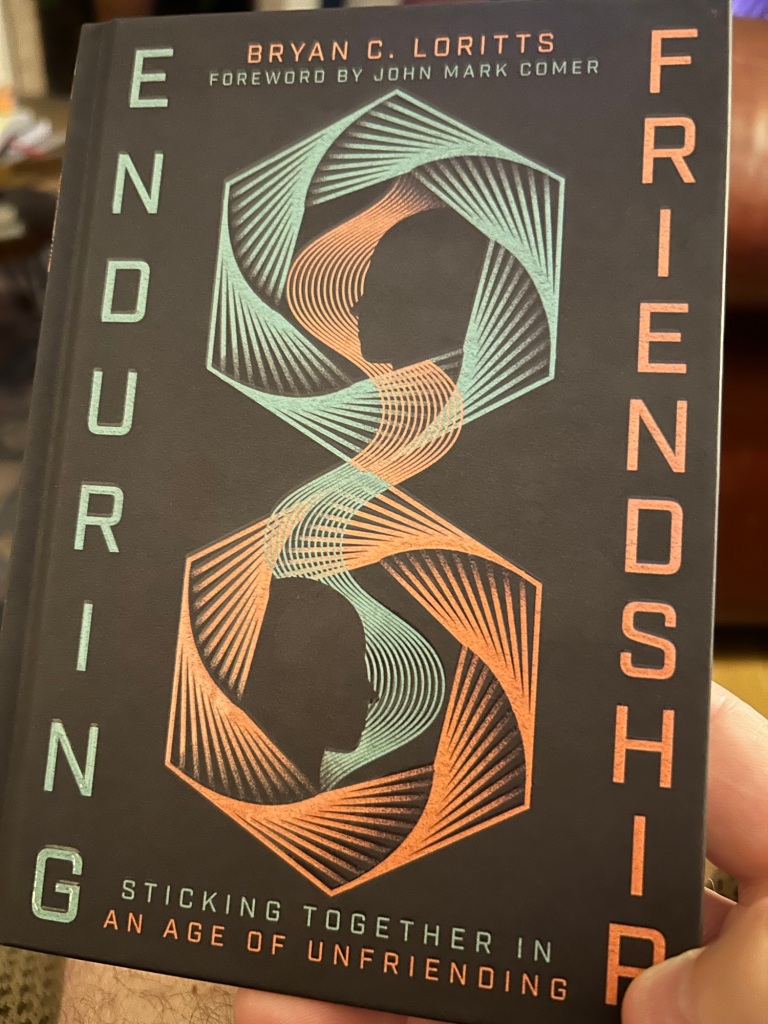
Enduring Friendship: Sticking Together in an Age of Unfriending

Bryan Loritts provides a great challenge to build relationships that last in his new book Enduring Friendships: Sticking Together in an Age of Unfriending. The book uses Paul’s New Testament letter to Philemon as a backdrop for thinking deeply about friendship. And it does challenge us to think deeply about our relationships. Onesimus, the slave to Philemon, who likely stole and then ran away from his servitude, making him deserving of severe consequences if not death. Philemon, the enslaver, and partner in the gospel with Paul. Paul, the missionary, who led both of these men to Christ and now pleads with them to do hard things for their relationship and for the glory of God.

  • He wants Onesimus to repent and go back and face his offended enslaver.
  • He wants Philemon to repent and receive Onesimus, not as a slave who stole from him, but as a brother who merits his embrace and partnership.
  • Paul himself wants to pay whatever is owed to Philemon. “Put it on my account.”

We don’t know “the rest of the story”, but can imagine that repentance was had, forgiveness was extended, and God was glorified, because Onesimus is later counted as a Bishop in the early church.

This book reminds us that relationships are hard but worth fighting for. And enduring relationships are costly and take courage to pursue through the messiness of life. What a mess the book of Philemon offers up. But what a beautiful picture of grace and forgiveness if Paul’s formula is lived out. The offender repents, the offended forgives, and the beauty of reconciliation is witnessed by all.

I wish I could say I didn’t have any tangled messes of relationships in my 49 years, but I can’t. I wish I could say that I’ve always done the right and hard thing for the sake of reconciliation. In ministry, the slights received often make us callous toward deep relationships and make it easier just to let people walk away or not make the journey back to the one we offended. People come and go. Sometimes close relationships are resisted because we begin to expect slights, disrespect, betrayal, and eventual departure. Enduring Friendships reminds us that relationships are worth it.

The key to it all of course is Jesus. He empowers us to forgive, to receive grace, and to repent. And he did the hardest thing of all so that we could experience reconciliation by offering up his own body on the cross.

Some great thinking and maturing to be stirred up by Bryan Loritts’ new book. Grab a copy.

Here’s a few of my favorite quotes:

  1. Soul-level friendship often feels like a full-time job with periods of bad compensation.
  2. The problem is relationships are drama, and I don’t mean that in a negative way. Whose life is not made up of mountaintops and deep valleys? If we’re not up for drama, we are not ready for relationships.
  3. A Christian who does not forgive is a contradiction in terms.
  4. There is no lasting friendship without grace.
  5. If you want to have sustained friendships over the course of your life, you must accept that you will at various points be Onesimus and Philemon – offender and offended.
  6. When we fail to allow for nuance and complication, we set the table for short-lived friendships that never resurrect from the graveyard of offense and betrayal.
  7. The journey of friendship is fraught with unavoidable hurt because those involved are marred by sin.
  8. Gossip is saying something behind a person’s back we would never say to a person’s face. Flattery is saying something to a person’s face we would never say behind their back.
  9. Pride is the #1 killer of friendship. Humility is the prime nourisher of healthy relationships.
  10. When we are at death’s door and inevitably stare into the rearview mirror of our lives, we will not take joy in our acts of retribution.
  11. An ungracious Christian is an oxymoron.
  12. Nothing illumines our witness and stands more in contradistinction to our world than when we fight to remain at the table of friendship with people who we have wronged and who have wronged us.

About Lane Corley

I am – Follower of Jesus Christ – Husband to the beautiful and patient Heather Corley – Father of three. – Church Planter/Church Planting Catalyst for Send Network – When I can, I’m reading, raised bed gardening, and on mission with my church. – Hoping to be helpful.

View all posts by Lane Corley

Former psychic blasts Fox News for divination segment with astrologer: ‘Extra deception’

Dear Reader: this post is an Christian Post article. I John 5:19 warns us that “… the whole world lies in the power of the evil one.” This pernicious one is intensifying his attack on humanity in our days to deceive as many as he can because he hates mankind. Do not be deceived. Let us flee to Jesus Christ who took the wrath of God for us because of our sins, was raised from the dead, lives forever more and defeated satan and all his demons. Yes, take shelter in Him. Carl

A former psychic who repented of occultism to become a Christian blasted Fox News for inviting an astrologer on “Fox & Friends” last week to read the horoscopes of the anchors, marking the second divination segment on the channel in recent months.

Jenn Nizza, an author and podcaster who runs Ex-PsychicSaved.com, told The Christian Post that she believes Fox News is driven solely by ratings and money, but that the network potentially poses a spiritual danger to its viewers by airing light-hearted interviews with occult practitioners.

Astrologer Susan Miller joined “Fox & Friends” hosts Steve Doocy, Brian Kilmeade, Ainsley Earhardt and Lawrence Jones last Thursday to explain how the moon and Monday’s solar eclipse could affect not just someone’s mood, but their entire life for at least six months.

“It’s not just your mood,” she said. “It’s everything if it touches a planet in your chart, and on AstrologyZone.com — which is my website — I delineate how specifically a solar eclipse is actually a new moon. I know it sounds [like] it should be a full moon, but it’s not. It’s the new moon, always. And it will affect you for six months or more.”

Miller went on to offer vague, broad predictions for each of the “Fox & Friends” anchors based on their astrological charts.

Earhardt, who offers a streaming Bible study on Fox Nation, replied to her horoscope reading by noting that she leans on God during hard times, and also pressed Miller to explain how she reconciles her astrological practices with her supposed Roman Catholic faith.

“God talks to me, actually,” Miller replied with a laugh before the segment wrapped up because of time.

Despite its breezy tone, Nizza is concerned that segments like the one with Miller could be used by dark spiritual forces “as a way to reach people that otherwise wouldn’t be aware as much of divination.”

“It makes it seem like it’s a big old joke, it’s just entertainment,” Nizza told CP. “If Satan masquerades as an angel of light, if he can make this seem like something that it’s not, if he can make it seem like this is light-hearted and just entertainment, he’s desensitizing people to it.”

Nizza emphasized the “extra deception” posed by Fox News effectively promoting divination with the aid of hosts who portray themselves as Christians.

“Fox is deceived, but they’re promoting themselves at times to be Christian, to care about God,” she said. “And then you have [the hosts] talking about God and talking about their Zodiac signs as if it’s just OK; as if you can comingle Christianity and the New Age, which is in direct rebellion to God. You can’t have both.”

“If the enemy can make you think that something is either holy or godly, then you would feel safer doing it; you would feel more comfortable doing it,” she continued. “But did you go to the Word and check? A lot of people aren’t going to. They’re relying on these people claiming to be Christian.”

“So unfortunately, the responsibility still lies on us to go to the Word and check and see what God says — to ‘test the spirits,’ of course,” she added, referencing 1 John 4:1.

Nizza, who said she is increasingly “fed up” with Fox News for broadcasting occult practices and drifting further into sensationalism, also accused the network in January of pushing a “demonic agenda” when opinion host Jesse Watters invited the so-called “English Psychic” Paula Roberts on his primetime show to divine the country’s political future with tarot cards.

Citing her own experience as a former medium, Nizza told CP at the time that the cardboard and pictures of the tarot do not offer any insight by themselves, but that the purported information psychics obtain from them is “channeled” from demonic sources.

“A tool of divination is one that’s actually accessing the demonic realm, the spirit realm, and you’re going against God’s will of boundaries; God says not to,” she said, citing Deuteronomy 18:10-12, which prohibits witchcraft and divination as “detestable” practices that incur divine judgment.

As with tarot cards and any other form of divination, Nizza said astrology taps into demonic sources of knowledge, which she said threatens to rope in practitioners even if the predictions are not always accurate. She has written about how dabbling with tarot cards at age 13 dragged her into a life of demonic oppression for years.

“They can get 100 things wrong and one thing right, and you can hang on to that one thing that’s right, because you’re going to be so intrigued,” she said. “And that’s the hook. That’s the proverbial carrot being dangled in front of your face.”

“Where planets were when you were born is meaningless,” she continued. “A planet doesn’t know if you’re wise with money, if you are personable, if you’re going to have a new love in your life. They just know nothing about you. There’s no wisdom in planets.”

“It bothers me,” she added regarding Fox’s occult content. “It’s a news channel. Why are you even reporting on divination? Why are you getting into the supernatural?”

Nizza also posted a TikTok video on Monday exhorting Fox News to stop promoting divination.

“Fox News, do me a favor: please stop putting diviners on your channel, I’m begging you,” she said, adding that “the devil is using you guys” to put divination in the minds of people who are simply trying to watch the news.

“This is what the devil does, this is his agenda,” she said. “I understand the desire for ratings and for money, but you’re not going to take that with you when you go. I would really think about that: serving God and pleasing God, not man.”

Last July, an investigation by The Blaze revealed that Fox Corporation was willing to match Fox News employee donations of up to $1,000 to a number of far-left organizations, including The Satanic Temple.

Fox News never publicly addressed the revelation that emerged from multiple sources within the company, though it reportedly removed The Satanic Temple from its giving portal days after Blaze Media founder Glenn Beck broadcast the story.

Flattery: A Tool of the Devil

I recently did a teaching on the book Jesus Calling by Sarah Young and how to tell the book is a channeled book. She is channeling an unidentifiable spirit being who self identifies as ‘Jesus Christ’. But by examining what this spirit tells her in the light of the New Testament, you can tell that it is not the real Jesus Christ but a deceiving, seducing, evil spirit whose goal is to lead God’s people into occultic practices.

There are many ways to discern this deception: by comparing what the spirit says to what the real Jesus Christ said and did in the New Testament, how she used God Calling*, another channeled occult book, as her inspiration, misquoted Scripture, plus others means.  

One of the ways you can tell is by the flattery and romantic non-sense that is used in the text.

Some examples are: 

Let My gold-tinged Love wash over you and soak into the depths of your being.

When you seek my Face in response to My love call, both of us are blessed.

Look into My Face and feel the warmth of My Love-Light shining upon you.

When your joy in Me meets My joy in you, there are fireworks a heavenly ecstasy.

Take time to rest in the Love-Light of My Presence.

When you trustingly whisper My Name, My aching ears are soothed.

When you walk through a day in trusting dependence on Me, My aching heart is soothed.

Feel your face tingle as you bask in My Love-Light.

I am aching to hold you in My everlasting arms, to enfold you in My Love.

As you listen to birds calling to one another, hear also my Love-call to you.

Now if you have read the New Testament, it does not take long for this type of verbiage to raise an alarm.  I never read in the New Testament where Lord Jesus talked to Peter, John, James, or any of the other disciples this way. I can see ole Peter shaking his head and saying that Jesus never talked to him that way.

Apostle Paul warns us about the enemy of our soul using flattery to entrap us:

“Now I urge you, brethren, keep your eye on those who cause dissensions and hindrances contrary to the teaching which you learned, and turn away from them. For such men are slaves, not of our Lord Christ but of their own appetites; and by their smooth and flattering speech they deceive the hearts of the unsuspecting.”  (Romans 16:17-18)

Paul warns us not to be ‘unsuspecting’ Christians, not to go through life thinking that the enemy does not have designs on us to bring us into captivity to their master satan. There are evil workers of the antichrist spirit (I John 4:3) who will use smooth and flattering speech to gain our trust and confidence resulting in our bondage.

Jude, the Lord’s half-brother, also warns us about flattery as a tool of deception:

“These are grumblers, finding fault, following after their own lusts; they speak arrogantly, flattering people for the sake of gaining an advantage.”   Jude v16

These sinners Jude is warning about are seeking power and control; power and control over you and me so we can help them accomplish their own wicked goals that are cloaked in a false robe of righteousness. The Lord warned us about those who look like sheep but speak like dragons (Rev.13:11).

The Old Testament prophet Daniel tells us that flattery (or smooth words) will be a tool of the ultimate human evil, the Antichrist. Daniel 11:32 says in part:

“…with flattery he will corrupt those who act wickedly toward the covenant…” (HCSB).

Truly what Proverb 26:28 says concerning flattery is true:

A lying tongue hates those it crushes, and a flattering mouth works ruin.  

Watch out for this tool of the devil. Protect yourself from religious deception. Read the New Testament and know the Truth that will set you free from bondage to religion and protect you from wolves in sheep’s clothing.

Bless God for His provisions!

Carl

The Degenerating Influence of Ritualism.

The tendency of all ecclesiastical ritualism is to produce

 a spirit of superstition to the subversion of faith,
 
of mere formality to the guidance of the Holy Spirit

and resting in our own good works

to the rejection of the finished work of Christ. 

The Word of God is practically set aside,

the Holy Spirit grieved,

and the heart laid open to the inroads of Satan. 

When faith is in lively exercise,

The Word of God strictly followed, 

and the promised guidance of the Comforter relied upon,

the soul is strong and vigorous in the divine life, 

and suggestions of the enemy are unheeded.

Satan is a keen observer 

of the different states of the believer's soul,

and of the professing Church.

He knows when he will be successful

 in his attempt 

against the individual believer or the Church:

he waits his time --

he watches for opportunity.

When he sees the mind taking a wrong direction,

he soothes, flatters, stimulates --

solemn thought for us all!  

Andrew Miller, Miller's Church History (Pickering and Inglis, LTD, London), p. 237

Rest and Satisfaction

God has so created man, that he does not find complete rest and satisfaction until his entire being is swallowed up in the sweet will of God.

Jesus told his disciples what makes “life” worthwhile and satisfying:

“For whoever would desire to save his soul, will lose it. But whoever will lose his soul for My sake and the gospel, will save it. For what shall it profit a man to gain the whole world and lose his soul? For what shall a man give in exchange for his soul? (Mark 8: 35-37)

Being properly related to Him as our Lord and Savior and to His mission, the gospel, brings our soul into rest and satisfaction in this world of unrest and dissatisfaction.

God has so created man, that he does not find complete rest and satisfaction until his entire being is swallowed up in the sweet will of God.

Some translations use “life” instead of “soul” in this verse. But ‘the Greek word is psuche which refers not to one’s physical existence (bios) and its need but to a person’s soul which is the part of man that wills, thinks, and feels, or in other words, to the will power, the reason, and the emotions, to the personality with all his activities, hopes, and aspirations.’ (Wuest)

It is interesting to me that I Peter 5: 8 warns us to ‘Be of sober spirit, be on the alert. Your adversary, the devil, prowls about like a roaring lion, seeking someone to devour’. ‘Devour’ means “to drink down or swallow up’.

If we allow the enemy to swallow us up, we will spend our lives trying to gratify our soul… and the flesh. We will lose that which alone makes the activity of the soul, worthwhile and satisfying; a biblical relationship with the only true God and Jesus, His Son.

Who has swallowed you up? God or the devil?

Carl

Source: compiled from Kenneth S. Wuest’s study of Gospel of Mark.

The Value of Your Soul

Ponder how valuable your soul must be for Satan to tirelessly pursue it, and the King to lay down his own life for it.

Ex-psychic repents of ‘demonic’ fixation on numerology: ‘A desire for control’

By Nicole Alcindor, CP Reporter

Unsplash/Scott Rogerson

Two former psychics who turned away from the occult and became Christians say the New Age practice of numerology is “demonic,” “deceptive” and addictive because it can potentially lead to an unhealthy fixation on satanic influences that are far from God. 

Former psychic Doreen Virtue joined ex-psychic Jenn Nizza on a recent episode of Nizza’s “Ex-Psychic Saved” podcast, where they warned listeners about what they say are the harmful effects of numerology. 

Numerology is the belief in a mystical relationship between numbers and their symbolism in people’s lives and futures. Both women shared that they know firsthand how tempting practicing numerology can be when someone is lured into the practice. 

“I was a psychic medium. I was not a numerologist. … But, I went to many. And then, when I would be doing psychic medium readings, numbers would be used because then, I had some sort of New Age understanding of what the demons told numerologists — what was channeled — and they would use numbers in my readings,” Nizza shared. 

Even though she wouldn’t describe herself as a former numerologist, Nizza said when she was a psychic medium, she taught a divination class in which she would use numbers and specific equations that she received from demons to deliver messages to her clients. 

At that time, Nizza said she desired wisdom that always seemed unattainable, and she would chase after what she believed was psychic knowledge. 

“That’s what divination really is. … You’re getting information. You’re wanting control. You don’t have it. You want power. This person thinks they have power. And then, you have to go to other psychics, probably, after that, or do manifesting, and you keep going back to the problem for the solution. … That’s my story with numerology. And of course, angel numbers and so on and so forth,” Nizza shared. 

Virtue said she too wanted power that always seemed out of reach. 

“This is a desire for control. It’s a desire for secret wisdom and hidden information, just like the serpent offered to Eve in Genesis 3. And so, I was no different. I was looking for a way to predict the future to control the future, manifest the future,” Virtue said.  

Virtue said she was led into numerology after having a detailed dream about her grandmother Pearl. Looking back now, 20 years later, she said she knows she did not really see her grandmother but rather a demon impersonating her grandmother.  

After having the dream, Virtue said she was led to study Pythagoras, which led her to explore numerology. 

“I learned the classical numerology, which by the way, is different for different teachers. And that’s another reason why New Age is not valid because …  depending on who you talk to, five could mean ‘change’ or five could mean ‘death’ or, you know, six can mean ‘materiality’ or in the Bible, it can be ‘the mark of the beast 666.’ The same number can mean different things to different systems. So, that shows you right there that the interpretation is not valid,” Virtue said. 

For her book Angel Numbers, Virtue said she would meditate on numbers and notice her thoughts and visions. And she would believe that “so-called Angels” were sending her messages. She later realized that the “angels” were really “Satan’s demons or minions” masquerading as angels of light. 

“I have a BA and MA in counseling psychology and I studied, you know, human psyche. … The mind looks for patterns because it’s wanting control. So, if you notice three’s all day long, your mind is going to want to try and pigeonhole what does this mean and try and find meaning out of it in a meaningless world, meaningless universe,” Virtue explained.  

“The only meaning of this universe is that it’s God’s universe. God made it and our purpose is to glorify Him, and doing divination is the opposite of glorifying God. He commanded us not to do any form of divination or look for signs or omens. That’s in the Old Testament and the New Testament. And the reason is because He loves us and doesn’t want us to be misled by the demons.” 

Instead of turning to “demonic” and “occult” practices, such as, numerology, God “wants us to turn to Him for wisdom through His Word, through His book, the Bible, and not to try and lean on our own understanding,” she continued. 

“It’s absolutely a trap. I followed numerology. I taught numerology. I repent and apologize that I was wrong.” 

Virtue advises listeners struggling to turn away from numerology to seek Christ and surrender their sinful desires to Him. 

“People all the time, ask me: ‘How do I get the obsession with numbers out of my head?’ Because once you learn these angel number patterns or numerology patterns and then, you know, let’s say you leave New Age — praise the Lord — [people in these scenarios] they have a hard time letting go of noticing the license plates, and the receipts and the telephone number patterns,” Virtue said. 

“As we talked about your brain goes to patterns trying to make order out of this world. So, what you want to do with any thoughts, whether it’s sexual tension, thought or selfish thought or a hateful thought is you always want to lay that at the foot of the cross,” she continued.  

“You can get on your knees and repent. Repent, of course, in Greek means metanoia, change your mind. You are apologizing to God, just like David showed us in the songs how he poured his heart out to God. He wasn’t worried about being politically correct. He was just raw with God and we want to be the same.”

Virtue said that numerology and divination are sinful acts that are punishable by God, as noted in Deuteronomy 18Acts 16:16Acts 19:19 and Revelation 22:15.  

“What you want to do is you can ask God, … to relieve you of these recurring patterns that are in you. You can ask Him, like in Psalm 139, to ‘purify you.’ You can ask God; ‘please purify my heart. Please purify my mind. Please purify my intentions,'” Virtue advised. “We have to understand what’s a biblical thought and what’s a nonbiblical thought and take them all to God.”

Nicole Alcindor is a reporter for The Christian Post. 

‘I was dead inside’: Ex-astrologer on bold mission to slay evil, demonic forces after escaping witchcraft, New Age

By Billy Hallowell, Contributor

istock/Thanumporn Thongkongkaew

Tailah Scroggins felt dead inside. After growing up in a Christian home, she somehow fell into the occult, embracing astrology, witchcraft and the New Age.

But after embarking on a dark journey and losing the will to live, she had an incredible interaction with Jesus that changed everything.

Today, Scroggins is an online evangelist, writer, and truth-teller on a mission to help others escape evil. She recently shared her story with “Billy Hallowell’s Playing With Fire Podcast,” explaining how she was raised in a Christian home and believed in God before stumbling into the occult.

She said she was first introduced to the New Age in high school when someone she trusted in her family told her about astrology.

“They had this big … textbook of everything astrology, and they were like, ‘This describes my personality so perfectly — look what it says about you,’” Scroggins said. “I was caught off-guard, and I remember … I was like, ‘But how can this be true? If God created all of us and he made our personalities, how can a planet dictate my future or dictate my personality?’”

She said this was the first “seed of deception” the devil planted in her life, and her perspective started to shift. With her family friend stating God created astrology as a system “He put in order,” she started down what she now believes was a dangerous path.

“They provided me some explanation that was totally false, but I didn’t know the word of God enough,” Scroggins said. “I knew a lot about God, but I didn’t know … what the Bible said about the occult — about the darkness, about the battle. I just knew the good things, and so I became an astrologer.”

Scroggins spent 11 years as an astrologer, describing it as her “worldview” and “life.”

Still, she attended church and clung to some Christian ideas. She said the entire experience opened her up to “so much deception and confusion” as she lived life as a “lukewarm Christian” plagued by her occultic practices.

As Scroggins entered college, she said she was disappointed in God, feeling frustrated He hadn’t answered her wants and whims on her timeline.

“It’s spiritual immaturity,” she said of her perspective at the time. We don’t trust God’s timing, and so I’m young, I’m 18 at this time, and I’m mad — I’m mad that God didn’t open the door that I wanted Him to open, and that’s just kind of part of being a baby Christian.”

Her spiritual immaturity also led her to join in on the party lifestyle. Scroggins said “the enemy lied” and she “took his bait” and began down a negative path, getting drunk every weekend.

“The more I rebelled and lived in this party lifestyle, the more I craved astrology, the witchcraft, the divination, and all of that,” Scroggins said. “It was like this hunger exploded … it was like this black hole … I needed to be consuming it.”

She said depression soon took hold and suicidal thoughts reigned. Scroggins would find herself crying for two hours every day for no reason, as she grappled with the emptiness left by the abandonment of her relationship with the Lord.

Scroggins added, “It was like I had no reason to live.”

A family friend aware of her situation ended up intervening — and the experience brought Scroggins true healing. The woman was at Scroggins’ home one day, and she candidly spoke with the then-college student.

“She just looked at me one day, and she said, ‘Today is the day of your freedom,’ and I said, ‘OK, I don’t know what that means, but I have no will to live,’” Scroggins recalled. “I hadn’t attempted to do anything or take my life, but I was dead inside. And so I was like, ‘You can pray and do whatever you want to me because there’s nowhere else for me to go. I’m already at rock bottom,’ and so she prayed for me.”

Those invocations, which Scroggins described as “deliverance prayers,” had a profound impact. Scroggins said they “cast every spirit of death and depression out,” and she immediately felt “huge weights being lifted off.”

She now believes the entire experience was “supernatural,” leading her to a fruitful and meaningful relationship with Christ.

“The depression never came back, the suicidal thoughts never came back — ever,” she said. “It’s been over six years. I was delivered.”

Scroggins continued, “God completely healed me, set me free.”

Over time, she abandoned her occultic practices and clung close to Jesus. A few years later, though, she found herself alarmed by how many others were being enraptured by the same world she had escaped.

Scroggins said she was shocked during COVID-19 to see how interest in witchcraft, Tarot cards, crystals, and the occult exploded online.

“It grieved me because that was my story,” she said. “I was into New Age. I was into the false spirituality in witchcraft.”

Realizing she had been “set free … by Jesus,” she decided to counter occultic videos getting millions of views with content of her own that would instead point people toward Jesus.

“I was like, ‘I’m gonna share my testimony, and I’m going to expose astrology. I’m going to expose the New Age, I’m going to expose all of it,’” she said. “And I just started telling people what I went through and what God saved me from. And what came into my life when I started doing those practices — and it was all evil.”

Listen to Scroggins explain her journey and why she’s openly shared her testimony.

This article was originally published by CBN’s Faithwire.

Source: Christian Post

What Christian Leaders and Pastors Need to Know – The Final Outcome of Practicing Contemplative Prayer

January 17, 2023 by Lighthouse Trails Editors

LTRP Note: With the majority of Christian colleges and seminaries now bringing in contemplative spirituality via Spiritual Formation programs, and with Christian leaders such as Rick Warren and Beth Moore endorsing the movement, and with countless pastors giving it a thumbs up to their congregations, isn’t it time professors, pastors, and leaders understand what the final outcome of contemplative prayer is? Isn’t it time they understand that leading Christians and church goers down this path is leading them away from the Cross, not toward it. At Lighthouse Trails, we believe it is beyond time for this understanding to occur.

One candle and Candles on old wooden background

 By Ray Yungen

The final outcome of contemplative prayer is interspirituality. If you have truly grasped the portrait I have tried to paint in my books and articles, you have begun to see what this term signifies. The focus of my criticism of mystical prayer must be understood in the light of interspirituality.

Just what exactly is interspirituality? The premise behind interspirituality is that divinity (God) is in all things, and the presence of God is in all religions; there is a connecting together of all things, and through mysticism (i.e., meditation) this state of divinity can be recognized. Consequently, this is a premise that is based on and upheld by an experience that occurs during a self-hypnotic trance linking one to an unseen world rather than to the sound doctrine of the Bible.

It is important to understand that interspirituality is a uniting of the world’s religions through the common thread of mysticism. Wayne Teasdale, a lay monk who coined the term interspirituality, says that interspirituality is “the spiritual common ground which exists among the world’s religions.”1 Teasdale, in talking about this universal church also states:

She [the church] also has a responsibility in our age to be a bridge for reconciling the human family . . . the Spirit is inspiring her through the signs of the times to open to Hindus, Buddhists, Muslims, Sikhs, Jains, Taoists, Confucians, and indigenous peoples. As matrix [a binding substance], the Church would no longer see members of other traditions as outside her life. She would promote the study of these traditions, seek common ground and parallel insights.2 (emphasis mine)

An article in my local newspaper revealed just how well received interspirituality has become in certain circles. One Presbyterian elder who was described as a “Spiritual Director” made it clear when she said:

I also have a strong interest in Buddhism and do a sitting meditation in Portland [Oregon] as often as I can. I considered myself ecumenical not only in the Christian tradition, but with all religions.3 (emphasis mine)

There is a profound and imminent danger taking place within the walls of Christianity. Doctrine has become less important than feeling, and this has led to a mystical paradigm shift. Sound doctrine must be central to this debate because New Ageism has a very idealistic side to it, offering a mystical approach to solve human problems. Everyone would like to have his or her problems solved. Right? That is the practical aspect I have written about before—a seemingly direct route to a happy and fulfilled life. However, one can promote the attributes of God without actually having God.

People who promote a presumably godly form of spirituality can indeed come against the truth of Christ. Then how can you be assured that what you believe and practice is of God?

The Christian message has been clear from the beginning—God has sent a Savior. If man only had to practice some kind of mystical prayer to gain access to God then the life, ministry, death, and resurrection of Jesus Christ was a fruitless, hollow endeavor.

Sound Christian doctrine comes from the understanding that mankind is sinful, fallen, and separated from God. Man needs a saving work by God! A teaching like panentheism (God is in everybody) cannot be reconciled to the finished work of Christ. How could Jesus be our Savior then? New Age constituents will say He is a model for Christ consciousness, but the Bible teaches He is the Savior of mankind. Therefore, panentheism cannot be a true doctrine.

The problem is that many well-intentioned people embrace the teachings of panentheism because it sounds so good. It appears less bigoted on God’s part. No one is left out—all are connected to God. There is a great appeal in this message. Nevertheless, the Bible does not teach a universal salvation for man. In contrast, Jesus said:

Enter ye in at the strait gate: for wide is the gate, and broad is the way, that leadeth to destruction, and many there be which go in thereat: Because strait is the gate, and narrow is the way, which leadeth unto life, and few there be that find it. (Matthew 7:13-14)

Christ’s message is the polar opposite of these universalist teachings. Many people (even Christians) today think only a few really bad people will be sent to hell. But in Matthew, the words of Jesus make it clear that this just is not so.

While God sent His Son, Jesus Christ, to die for the sins of the world, He did not say all would be saved. His words are clear that many would reject the salvation He provided. But those who are saved have been given the “ministry of reconciliation” (2 Corinthians 5:18) making an appeal to those who are perishing (2 Corinthians 4:3). The Christian message is not samadhi, Zen, kundalini, or the contemplative silence. It is the power of the Cross!

For the preaching of the cross is to them that perish foolishness; but unto us which are saved it is the power of God. (1 Corinthians 1:18)

Yes, perishing—and not just unaware of their “true self” (as contemplatives like Brennan Manning proclaim).

In an opinion poll, the startling results describe how Americans actually view God. Spirituality and Health magazine hired a reputable pollster organization to gauge the spiritual beliefs of the American public. This national poll revealed that 84 percent of those questioned believed God to be “everywhere and in everything” rather than “someone somewhere.”4 This means panentheism is now the more popular view of God. If true, then a high percentage of evangelical Christians in America already lean towards a panentheistic view of God. Perhaps many of these Christians are fuzzy about the true nature of God.

How could this mystical revolution have come about? How could this perspective have become so widespread? The answer is that over the last thirty or forty years, a number of authors have struck a deep chord with millions of readers and seekers within Christianity. These writers have presented and promoted the contemplative view to the extent that many now see it as the only way to “go deeper” in the Christian life. They are the ones who prompt men and women to plunge into contemplative practice. It is their message that leads people to experience the “lights” and the “inner adviser!”

Endnotes:

1.  Wayne Teasdale, “Mysticism as the Crossing of Ultimate Boundaries: A Theological Reflection” (The Golden String newsletter, http://clarusbooks.com/Teasdale.html, accessed 10/2009).
2. Wayne Teasdale, A Monk in the World (Novato, CA: New World Library, 2002), p. 64.
3. Jan Alsever quoted in Statesman Journal, January 27th, 1996, Religion Section.
4. Katherine Kurs, “Are You Religious or Are You Spiritual?” (Spirituality & Health Magazine, Spring 2001), p. 28.

(Photo from bigstockphoto.com; used with permission)

Christian Woman Tied to Tree, Beaten by Traditionalist Catholic Village Elders in Mexico

From the Christian Post, January 10, 2023. Please pray for this sister-in-Christ and the persecution of believers in Mexico.

A Christian woman who suffered severe internal injuries after being tied to a tree and beaten by traditionalist Catholic elders in her village in Mexico’s Hidalgo State is now hospitalized in critical condition. Police have made no arrests, according to a report.

The victim, identified as Maria Concepcion Hernández Hernández from the Great Commission Baptist Church in the community of Rancho Nuevo in Huejutla de los Reyes Municipality, was attacked on Dec. 21 by a group of people, all belonging to the Roman Catholic majority in the village, the U.K.-based group Christian Solidarity Worldwide reported last week.

Immediately before the attack, the bells of the local Roman Catholic church were ringing, CSW continued.

She was visiting her land as a neighbor had asked her to remove two trees because the local authorities had prohibited members of the religious minority from accessing or using their land for cultivating crops, the group said.

The pastor of the woman’s church, Rogelio Hernández Baltazar, was also detained for two hours after he sought to intervene to stop the attack, and threatened by the same authorities who declared they will not allow the victim’s body to be buried in the village if she does not recover from her injuries.

The pastor and other villagers are prohibited from meeting her, the group said, adding that no arrests had been made despite complaints having been filed with the Hidalgo State Human Rights Commission and the Hidalgo State Prosecutor’s Office.

The attackers have been identified as Benito Rocha, Fermín Hernández Hernández, Octaviano Gutierrez Hernández, Margarito Gutierrez Hernández, Francisco Wenses, and catechist Juan Hernández Hernández.

“The life of a woman hangs in the balance and a community is living in fear because, despite ample evidence of serious violations of freedom of religion or belief in Rancho Nuevo for more than seven years, the Mexican authorities have failed to intervene,” CSW’s Head of Advocacy, Anna Lee Stangl, said.

“Instead, Hidalgo State government officials, under the previous governor, have for years publicly denied the existence of cases of religious intolerance in the state,” Stangl continued.

This is not a one-off incident of Christian persecution in Mexico, which has risen due to drug cartel violence, persecution by traditionalist Catholics and violent discrimination by anti-Christian left-wing groups, Open Doors USA previously reported.

“In rural indigenous communities, anyone who turns away from traditional religious beliefs can face rejection and punishment in the form of fines, imprisonment, and forced displacement. Non-discrimination laws mean that any links between Christian faith and politics are placed under very strict legal scrutiny,” says the ministry on its website.

Unlike Christianity, traditionalist Catholicism relies on giving gifts to pagan gods in exchange for health, good fortune and protection from evil. They often participate in animal sacrifices to the gods and worship saints, incorporating practices from pagan Aztec beliefs. 

“In areas controlled by criminal groups or drug cartels, young men are exposed to indoctrination and forced recruitment. Those who do not accept it — for reasons of Christian faith or otherwise — face threats, potential abduction and even death,” says Open Doors USA.

“Families, too, are bribed and intimidated to force their children to obey the gangs. Church leaders are often victims of extortion because they are assumed to have access to church funds. Mexico also has the highest rate of human trafficking in the world, and women are easy targets for illegal armed groups to recruit or abduct.”

Last May, 16 indigenous Protestant Christian families in the southern state of Chiapas were pressured to pay illegal fines for the fourth consecutive year for not participating in a syncretic Roman Catholic festival that involves alcohol, CSW reported at the time.

In September 2021, two evangelical families from the First Baptist Church in the La Mesa Limantitla area in Hidalgo state’s Huejutla de los Reyes Municipality were threatened with being cut off from essential services or expelled from the community if they continued to refuse to deny their faith and pay a fine illegally levied against them, CSW reported at the time.

Faux term ‘Christian nationalist’ used in political warfare

By Jorge Gomez, Op-ed contributor, Christian Post (November 10, 2022), originally published at First Liberty

The label “Christian nationalist” is appearing more frequently and is being used to silence people of faith, according to experts.

Dr. Mark David Hall, an author and professor at George Fox University, recently discussed the history behind the term. He argues that the political Left started using it well over a decade ago “to label Christians who bring their faith into the public square for ends they don’t like.”

National security and intelligence expert Dr. Stephen Coughlin similarly argues the label is part of a politically driven effort to suppress religious opinions that defy modern orthodoxy and Leftist ideology:

“What they did was they created a faux term ‘Christian nationalism,’ and they gave it all these negative attributes and then used that to attack Christians. It’s part of what you call an ‘intersectional line of attack’ in a political warfare model, which is the Maoist insurgency model, which we believe is the premier principal form of Marxism.”

Former congresswoman and current dean of the Regent University School of Government, Michele Bachmann, contends the surge in use is no coincidence, especially so close to a midterm election. She explains:

“It’s all about holding on to power. That’s what it’s about. There’s only one party in power now in the United States, in Washington, D.C. They don’t want to let it go … And what they have seen is the power of the Church, the epicenter of power in the United States. Opposing their agenda is the Church and the principles of the Bible. They don’t like pastors preaching on issues. They don’t like congregants being inspired from the Bible. And so that’s why we’re the target. They want to silence us.”

What exactly does “Christian nationalism” mean? There is no settled definition, but broadly speaking, radicals use “Christian nationalism” to conflate racism, white supremacy and identity, religion, and patriotism. They often add in fascism, theocracy, and authoritarianism.

An attack on religious liberty and America’s founding values

The use of the “Christian nationalist” label contradicts the principles and values of our country. Its perpetual misuse is especially harmful to religious liberty.

Among the many problems is how it demonizes public prayer and virtually any other commonplace religious activity. Whether a political leader or an everyday person, anytime there is a public expression of faith, the term is leveled against them as wanting to establish a Christian theocracy.

In other words, if a citizen exercises their constitutionally protected and inalienable right to religious freedom, that person runs the risk of being labeled a “Christian nationalist.” And once you carry that label, it essentially means you’re a pariah, someone who should be vilified and not allowed to participate in the marketplace or society.

This, of course, is nothing new. As Dr. Coughlin explained, this is a tactic straight out of the Marxist playbook. Whenever a political force wants to wield power and authority, religious people and religious liberty are the first ones on the target list.

Radicals and dictators know fully well that houses of worship and people of faith are the ultimate check on authoritarian power. Their allegiance is not to the government. A free people know their loyalty is to God above all, the true provider and source of our freedoms. If a tyrant succeeds at destroying religious freedom and religious institutions, they can remove the most effective challenge to their rule.

Vilifying the faithful is a timeless tool of authoritarians. Liberally tossing around the “Christian nationalist” label and slapping it on anyone who lives out their faith is a direct attack on religious freedom. Make no mistake. Radicals want to normalize the use of this loaded term to chip away and destroy one of the building blocks of our republic.

Loving God and country

The political Left regularly screams “Christian nationalism” when a person of faith shows patriotism and pride in their country. If you say America was founded on Judeo-Christian principles, you’ll quickly be accused of trying to establish a theocracy. But that’s simply not true and is based on a wildly distorted view of our nation’s history.

This use of “Christian nationalism” typically relies on a misguided understanding of the “separation of Church and State,” which radicals interpret to mean that there can be no intersection between religion and government. They claim that any religious expression or influence in the public square cannot be tolerated, because it would violate this strict wall of separation.

Understood in context, however, the “separation of Church and state” does not mean religious exercise or prayer is banned on government property. This phrase doesn’t even appear in the text of the Constitution. The original intent was never to keep religion locked inside the walls of a church or synagogue. Instead, it was to protect houses of worship and religious people from state intrusion and harassment. It’s misleading to argue that government and religion should never, under any circumstances, be mixed together.

Additionally, no matter how much secularists or the political Left deny it, the United States was, in fact, founded by people who valued biblical principles. From George Washington to Thomas Jefferson, James Madison, and other Founders, an overwhelming majority of them expressed belief in the Divine, a Creator who is the ultimate grantor of our rights and freedoms, as is clearly referenced in the Declaration of Independence. One of the foremost constitutional theorists of the founding generation, John Adams, observed, “Our Constitution was made only for a moral and religious People. It is wholly inadequate to the government of any other.”

America’s Founders were a prime example that faith and patriotism are not mutually exclusive. They demonstrated that it’s possible to serve God and be committed to the American constitutional experience — to the cause of liberty, human rights, representative democracy, and the rule of law.

More than two centuries later, a strong majority of Americans still believe in this truth. Pew Research recently found 60% of Americans think the Founders originally intended the U.S. to be a “Christian nation.” However, 52% said the federal government should never declare an official religion. This shows that most people believe in the core principles of the First Amendment. That is, we can freely worship God while also cherishing our system of government.

Being a religious person who also loves their nation does not make one a “Christian nationalist.” Quite the opposite. Someone who serves God and country is embodying the best of America’s traditions. We’re a nation built on religious freedom, which means Christians — and people of any faith — do not have to be forced to choose between loving our republic and loving the One True God.