Defending child sacrifice: The ultimate expression of cultural relativism

By John StonestreetGlenn Sunshine, Wednesday, September 03, 2025

Unsplash/K. Mitch Hodge

Recently, a history teacher from Littleton, Colorado, went viral for praising the way the Incas, her favorite empire, sacrificed children. She also reprimanded “white education” for wrongly teaching generations of Americans that the practice was bad. I’m not making this up. 

After noting that human sacrifice was common within most ancient civilizations, the teacher clarified that the Incan version offered victims from the upper class because they were closer to the gods. Also, the Incas drugged children before leaving them to die of exposure on top of a mountain. Objections to this cultural practice, she continued, are primarily due to a white perspective, which focuses on the negative aspects of great civilizations while ignoring their wonderful accomplishments. 

Defending child sacrifice is the ultimate expression of cultural relativism. In this view, all cultures are equally valid, except white cultures that judge others. To paraphrase a former colleague, there is no difference between cultures that love their neighbors and cultures that eat their neighbors. 

Of course, this teacher’s innovative defense of the Incas misses a few important points. First, children as young as four were sacrificed. Even if they could consent at that age, does that make it any less horrific? But of course, they cannot. The teacher fails to mention evidence of a 4- to 5-year-old child who was tied up before being buried alive. The simplest explanation for drugging the young victims is minimizing resistance … not kindness. 

To that point, is there any scenario in which drugging a child and leaving her to die could be considered kind, even if that were the intent? Just as inconvenient to this narrative are the Incan sacrificial victims found who died from strangulation, suffocation, and being stabbed in the back.  

The most important motivator for this Incan practice is that it was considered an honor for a child to be chosen for sacrifice. So, children were frequently “volunteered” by parents in order to curry favor with the emperor. Children were offered when an Incan emperor died, on the birth of his heir, at times of crisis to lure the gods to their side, and for other ceremonial occasions. 

Another aspect of this conversation neglected by the teacher is, what changed? Why is this kind of child sacrifice today universally viewed as abhorrent. The answer is Christianity. 

Believing that every human being is made in the image of God, Christians from the earliest centuries argued for the inherent dignity of the marginalized in society, especially women, slaves, and children. Christians in Rome opposed the practice of infanticide, rescuing unwanted infants who were left to die and raising them as full members of the Christian community. They also opposed abortion. 

Thus, the defense of children became a feature of Christian witness throughout history. For example, in the 19th century, missionary Mary Slessor was known for rescuing twins who had been left to die. The tribal people of Nigeria believed one twin was always a child of a demon. Her actions ended that deadly practice.  

To be clear, sacrificing children continues to be one of the most consistent features of this fallen world. Today, aborted children are the victims of our wrong ideas about sexuality and the meaning of life. Most embryos created during the process of in vitro fertilization are deemed to be “excess,” and left to die in freezers or medical experiments. Children are taught to be confused about who they are and thus become experiments of medical sterilization and surgical mutilation, and victims of the latest religious hysteria of adults. Christians who oppose these practices today are in good company within Church history. 

As the western world detaches from its Christian foundations, we should expect that more children will be devalued and harmed in more ways. A consistent feature of pagan societies is for children to be in danger. We should expect the same as a society repaganizes.  

On the other hand, a consistent feature of Christians within a pagan society is that they worked to protect and defend children. This remains the calling of the Church today.

This article was originally published on Breakpoint.

John Stonestreet serves as president of the Colson Center, equipping Christians to live with clarity, confidence, and courage in today’s cultural moment. A sought-after speaker and author on faith, culture, theology, worldview, education, and apologetics, he has co-authored five books, including A Practical Guide to Culture, A Student’s Guide to Culture, and Restoring All Things. John hosts Breakpoint, the nationally syndicated commentary founded by Chuck Colson, and The Point, a daily one-minute feature on worldview and cultural issues. Previously, he held leadership roles at Summit Ministries and taught biblical studies at Bryan College (TN). He lives in Colorado Springs, Colorado, with his wife, Sarah, and their four children.

Glenn Sunshine is a professor of history at Central Connecticut State University, a Senior Fellow of the Colson Center for Christian Worldview, and the founder and president of Every Square Inch Ministries. He is a speaker, the author of several books, and co-author with Jerry Trousdale of The Kingdom Unleashed.

Source: Christian Post

Who are the ‘least of these’ and why does it matter?

By John Doane, Op-ed contributor Sunday, October 20, 2024

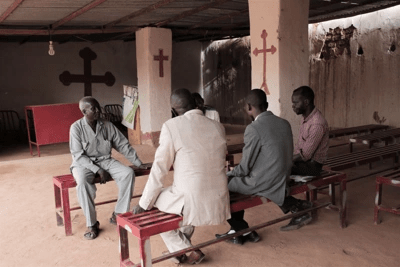
Lutheran reverend Yousef Zamgila (L) speaks to members of his congregation at the small improvised church they helped set up in a neighbours yard in Omdurman, Khartoums twin city, on August 22, 2019. Sudan’s Christians suffered decades of persecution under the regime of Islamist general Omar al-Bashir. | JEAN MARC MOJON/AFP via Getty Images

Several years ago Tony Campolo wrote, “I place my highest priority on the words of Jesus, emphasizing the 25th chapter of Matthew, where Jesus makes clear that on Judgment Day the defining question will be how each of us responded to those he calls ‘the least of these.’”

President Obama, speaking to the Pope at the occasion of his visit to the White House in 2015, stated “You call on all of us, Catholic and non-Catholic alike, to put the ‘least of these’ at the center of our concerns.” And then the President went on to identify “the poor and the marginalized” as the “least of these.”

Others identify those needing adoption or the homeless as “the least of these.” Former NIH director Francis Collins in his recent book The Road to Wisdom identified “the poor, the sick, the orphans, the prisoners, [as] the least of these that Jesus said we are most called to help.”

Since Jesus makes this such an important issue, it would behoove us to identify those whom the Bible itself would call the “least of these.”

Notice that in Matthew 25:40 Jesus said, “… inasmuch as you did it to one of the least of these my brethren, you did it to Me.” So the “least of these” are His brethren. Who are Jesus’ brethren? Hebrews 2:11 answers, “For both He who sanctifies and those who are being sanctified are all one, for which reason He is not ashamed to call them brethren.” Romans 8:29 calls Jesus “the firstborn among many brethren.” 1 John 3:13-14 counsels us “Do not marvel, my brethren, if the world hates you,” but “We know that we have passed from death to life because we love the brethren.”

So, love for the brethren (Christians) is a sign that we have eternal life, just as in Matthew 25 Jesus indicates that those who care for the least of His brethren are welcomed into His eternal Kingdom.

Some Christian writers have identified the brethren of Jesus in Matthew 25 as disciples called to preach the Gospel, such as those sent out by Jesus in Matthew 10. Those may indeed risk hunger, loneliness, nakedness and imprisonment, but the ones mentioned in Matthew 25 evidently refer to those who actually suffer such things.

Now we know from the rest of the Bible (e.g. Romans 4:3-8 and Romans 10:9) that our righteousness is based on our faith in the finished work of Jesus for the forgiveness of sins and belief in His resurrection. So, the works on behalf of the least of Jesus’ brethren mentioned in Matthew 25 do not earn us salvation. Rather, they are a sign that we are already saved, as James said, “I will show you my faith by my works” (James 2:18).

Why is this important? First of all, this passage from Matthew should not be used for virtue signaling, to drum up support for one’s favorite charity, or to promote a government program. Our salvation is never based on our works, however good they may seem. Secondly, notice that the passage in Matthew 25 is part of the so-called Olivet Discourse starting in Matthew 24 where Jesus spoke to his disciples in private. In that context, Matthew 25: 31-46 gives His brethren, His disciples, a way to distinguish between others “blessed of My Father” (v. 34) and those deserving of “everlasting fire prepared for the devil and his angels” (v. 41).

As in other places, Jesus was sorting out appearances from reality. For example, before the breakup of the Soviet Union, many leaders in the World Council of Churches and major Christian denominations refused to believe that Christians were in prison for their faith in communist countries, even when presented with exhaustive evidence. Such leaders preferred to associate with leaders of state-controlled churches in those countries. Other nominal Christians either deny that Christians were suffering persecution in communist countries, or they were indifferent about helping them. The ones suffering persecution were indeed in prison. Their families were naked and hungry, because they had no income, and the governments forbade others from helping them. Like St. Paul, they were made “the filth of the world, the offscouring of all things” (1 Corinthians 4:13), surely the “least” ones.

Meanwhile, laymen supported efforts to bring relief to families of Christian martyrs and those in prison. When the communist governments of Eastern Europe collapsed, more Christians understood the magnitude of the persecution that had occurred. More Christians also became involved in helping our persecuted brethren elsewhere.

Nevertheless, one can still discern differences in how Christians and the world respond to the persecution of Jesus’ brethren. Believers still suffer severe persecution in communist China, North Korea, and Cuba. Recently it has also become fashionable to discourage criticism of Islam. However, it’s not fashionable to help Christians persecuted by Muslims in Nigeria or Iran, by Hindus in India or by Buddhists in Myanmar.

The worldly media generally ignores or downplays such persecution, and so it takes effort by Christians to identify it. Christians suffering this persecution are the “least” of Jesus’ brethren, hated by the world (1 John 3:13). But while they are persecuted, practical help provides encouragement that they are not forsaken (2 Corinthians 4:9). One can “visit” them also through prayer and letter writing.

Our priority is always our own household (1 Timothy 5:8) and our brothers and sisters in the household of faith (Galatians 6:10). When we help our persecuted brothers and sisters we exhibit our love for Christ, since Christ dwells within each believer (Colossians 1:2 and 1:27). Unbelievers do not have that love, because suffering for the name of Christ is foolishness to them. It is God Himself who puts that love into our hearts, so it is no cause for boasting.

John Doane received a bachelor’s degree from Yale, a PhD from MIT, and worked in microwave technology for Bell Laboratories, Princeton University and General Atomics. He served on the Board of Directors of Jesus to the Communist World  (which later became Voice of the Martyrs). His recent articles have been published in the Creation Research Society Quarterly and The Christian Post.

Source: Christian Post