
(The following is an article from Biblical Archaeology Society by Lawrence Mykytiuk (bio at end of article). If you are interested in archaeology and its relationship to the Bible, we recommend looking at this organization.)
After two decades toiling in the quiet groves of academe, I published an article in BAR titled “Archaeology Confirms 50 Real People in the Bible.”a The enormous interest this article generated was a complete surprise to me. Nearly 40 websites in six languages, reflecting a wide spectrum of secular and religious orientations, linked to BAR’s supplementary web page.b Some even posted translations.
I thought about following up with a similar article on people in the New Testament, but I soon realized that this would be so dominated by the question of Jesus’ existence that I needed to consider this question separately. This is that article:
Did Jesus of Nazareth, who was called Christ, exist as a real human being, “the man Christ Jesus” according to 1 Timothy 2:5?
The sources normally discussed fall into three main categories: (1) classical (that is, Greco-Roman), (2) Jewish and (3) Christian. But when people ask whether it is possible to prove that Jesus of Nazareth actually existed, as John P. Meier pointed out decades ago, “The implication is that the Biblical evidence for Jesus is biased because it is encased in a theological text written by committed believers. What they really want to know is: Is there extra-Biblical evidence … for Jesus’ existence?”c
Therefore, this article will cover classical and Jewish writings almost exclusively.
Tacitus—or more formally, Caius/Gaius (or Publius) Cornelius Tacitus (55/56–c. 118 C.E.)—was a Roman senator, orator and ethnographer, and arguably the best of Roman historians. His name is based on the Latin word tacitus, “silent,” from which we get the English word tacit. Interestingly, his compact prose uses silence and implications in a masterful way. One argument for the authenticity of the quotation below is that it is written in true Tacitean Latin. But first a short introduction.

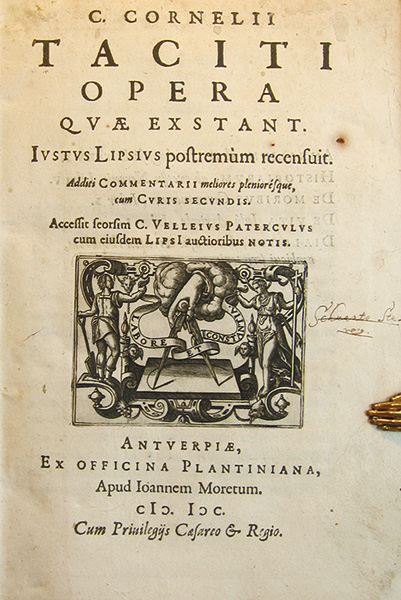
Tacitus’s last major work, titled Annals, written c. 116–117 C.E., includes a biography of Nero. In 64 C.E., during a fire in Rome, Nero was suspected of secretly ordering the burning of a part of town where he wanted to carry out a building project, so he tried to shift the blame to Christians. This was the occasion for Tacitus to mention Christians, whom he despised. This is what he wrote—the following excerpt is translated from Latin by Robert Van Voorst:
[N]either human effort nor the emperor’s generosity nor the placating of the gods ended the scandalous belief that the fire had been ordered [by Nero]. Therefore, to put down the rumor, Nero substituted as culprits and punished in the most unusual ways those hated for their shameful acts … whom the crowd called “Chrestians.” The founder of this name, Christ [Christus in Latin], had been executed in the reign of Tiberius by the procurator Pontius Pilate … Suppressed for a time, the deadly superstition erupted again not only in Judea, the origin of this evil, but also in the city [Rome], where all things horrible and shameful from everywhere come together and become popular.
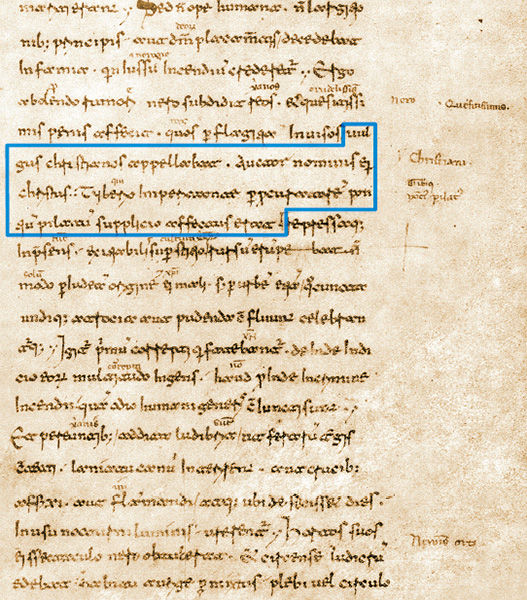
Tacitus’s terse statement about “Christus” clearly corroborates the New Testament on certain historical details of Jesus’ death. Tacitus presents four pieces of accurate knowledge about Jesus: (1) Christus, used by Tacitus to refer to Jesus, was one distinctive way by which some referred to him, even though Tacitus mistakenly took it for a personal name rather than an epithet or title; (2) this Christus was associated with the beginning of the movement of Christians, whose name originated from his; (3) he was executed by the Roman governor of Judea; and (4) the time of his death was during Pontius Pilate’s governorship of Judea, during the reign of Tiberius. (Many New Testament scholars date Jesus’ death to c. 29 C.E.; Pilate governed Judea in 26–36 C.E., while Tiberius was emperor 14–37 C.E.)
Tacitus, like classical authors in general, does not reveal the source(s) he used. But this should not detract from our confidence in Tacitus’s assertions. Scholars generally disagree about what his sources were. Tacitus was certainly among Rome’s best historians—arguably the best of all—at the top of his game as a historian and never given to careless writing.
Earlier in his career, when Tacitus was Proconsul of Asia, he likely supervised trials, questioned people accused of being Christians and judged and punished those whom he found guilty, as his friend Pliny the Younger had done when he too was a provincial governor. Thus Tacitus stood a very good chance of becoming aware of information that he characteristically would have wanted to verify before accepting it as true.
The other strong evidence that speaks directly about Jesus as a real person comes from Josephus, a Jewish priest who grew up as an aristocrat in first-century Palestine and ended up living in Rome, supported by the patronage of three successive emperors. In the early days of the first Jewish Revolt against Rome (66–70 C.E.), Josephus was a commander in Galilee but soon surrendered and became a prisoner of war. He then prophesied that his conqueror, the Roman commander Vespasian, would become emperor, and when this actually happened, Vespasian freed him. “From then on Josephus lived in Rome under the protection of the Flavians and there composed his historical and apologetic writings” (Gerd Theissen and Annette Merz). He even took the name Flavius, after the family name of his patron, the emperor Vespasian, and set it before his birth name, becoming, in true Roman style, Flavius Josephus. Most Jews viewed him as a despicable traitor. It was by command of Vespasian’s son Titus that a Roman army in 70 C.E. destroyed Jerusalem and burned the Temple, stealing its contents as spoils of war, which are partly portrayed in the imagery of their gloating triumph on the Arch of Titus in Rome. After Titus succeeded his father as emperor, Josephus accepted the son’s imperial patronage, as he did of Titus’s brother and successor, Domitian.


Yet in his own mind, Josephus remained a Jew both in his outlook and in his writings that extol Judaism. At the same time, by aligning himself with Roman emperors who were at that time the worst enemies of the Jewish people, he chose to ignore Jewish popular opinion.
Josephus stood in a unique position as a Jew who was secure in Roman imperial patronage and protection, eager to express pride in his Jewish heritage and yet personally independent of the Jewish community at large. Thus, in introducing Romans to Judaism, he felt free to write historical views for Roman consumption that were strongly at variance with rabbinic views.
In his two great works, The Jewish War and Jewish Antiquities, both written in Greek for educated people, Josephus tried to appeal to aristocrats in the Roman world, presenting Judaism as a religion to be admired for its moral and philosophical depth. The Jewish War doesn’t mention Jesus except in some versions in likely later additions by others, but Jewish Antiquities does mention Jesus—twice.
The shorter of these two references to Jesus (in Book 20) is incidental to identifying Jesus’ brother James, the leader of the church in Jerusalem. In the temporary absence of a Roman governor between Festus’s death and governor Albinus’s arrival in 62 C.E., the high priest Ananus instigated James’s execution. Josephus described it:
Being therefore this kind of person [i.e., a heartless Sadducee], Ananus, thinking that he had a favorable opportunity because Festus had died and Albinus was still on his way, called a meeting [literally, “sanhedrin”] of judges and brought into it the brother of Jesus-who-is-called-Messiah … James by name, and some others. He made the accusation that they had transgressed the law, and he handed them over to be stoned.
James is otherwise a barely noticed, minor figure in Josephus’s lengthy tome. The sole reason for referring to James at all was that his death resulted in Ananus losing his position as high priest. James (Jacob) was a common Jewish name at this time. Many men named James are mentioned in Josephus’s works, so Josephus needed to specify which one he meant. The common custom of simply giving the father’s name (James, son of Joseph) would not work here, because James’s father’s name was also very common. Therefore Josephus identified this James by reference to his famous brother Jesus. But James’s brother Jesus (Yehoshua) also had a very common name. Josephus mentions at least 12 other men named Jesus. Therefore Josephus specified which Jesus he was referring to by adding the phrase “who is called Messiah,” or, since he was writing in Greek, Christos. This phrase was necessary to identify clearly first Jesus and, via Jesus, James, the subject of the discussion. This extraneous reference to Jesus would have made no sense if Jesus had not been a real person.
Few scholars have ever doubted the authenticity of this short account. On the contrary, the huge majority accepts it as genuine. The phrase intended to specify which Jesus, translated “who is called Christ,” signifies either that he was mentioned earlier in the book or that readers knew him well enough to grasp the reference to him in identifying James. The latter is unlikely. First-century Romans generally had little or no idea who Christus was. It is much more likely that he was mentioned earlier in Jewish Antiquities. Also, the fact that the term “Messiah”/“Christ” is not defined here suggests that an earlier passage in Jewish Antiquities has already mentioned something of its significance. This phrase is also appropriate for a Jewish historian like Josephus because the reference to Jesus is a noncommittal, neutral statement about what some people called Jesus and not a confession of faith that actually asserts that he was Christ.
This phrase—“who is called Christ”—is very unlikely to have been added by a Christian for two reasons. First, in the New Testament and in the early Church Fathers of the first two centuries C.E., Christians consistently refer to James as “the brother of the Lord” or “of the Savior” and similar terms, not “the brother of Jesus,” presumably because the name Jesus was very common and did not necessarily refer to their Lord. Second, Josephus’s description in Jewish Antiquities of how and when James was executed disagrees with Christian tradition, likewise implying a non-Christian author.
This short identification of James by the title that some people used in order to specify his brother gains credibility as an affirmation of Jesus’ existence because the passage is not about Jesus. Rather, his name appears in a functional phrase that is called for by the sense of the passage. It can only be useful for the identification of James if it is a reference to a real person, namely, “Jesus who is called Christ.”
This clear reference to Jesus is sometimes overlooked in debates about Josephus’s other, longer reference to Jesus (to be treated next). Quite a few people are aware of the questions and doubts regarding the longer mention of Jesus, but often this other clear, simple reference and its strength as evidence for Jesus’ existence does not receive due attention.
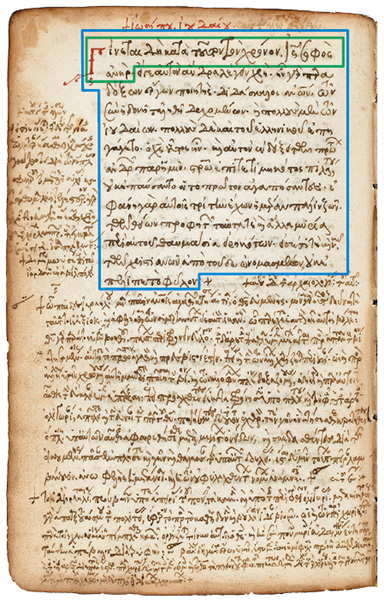
The longer passage in Josephus’s Jewish Antiquities (Book 18) that refers to Jesus is known as the Testimonium Flavianum.
If it has any value in relation to the question of Jesus’ existence, it counts as additional evidence for Jesus’ existence. The Testimonium Flavianum reads as follows; the parts that are especially suspicious because they sound Christian are in italics:
Around this time there lived Jesus, a wise man, if indeed one ought to call him a man. For he was one who did surprising deeds, and a teacher of such people as accept the truth gladly. He won over many Jews and many of the Greeks. He was the Messiah. When Pilate, upon hearing him accused by men of the highest standing among us, had condemned him to be crucified, those who in the first place came to love him did not give up their affection for him, for on the third day, he appeared to them restored to life. The prophets of God had prophesied this and countless other marvelous things about him. And the tribe of Christians, so called after him, have still to this day not died out.
All surviving manuscripts of the Testimonium Flavianum that are in Greek, like the original, contain the same version of this passage, with no significant differences.
The main question is: Did Flavius Josephus write this entire report about Jesus and his followers, or did a forger or forgers alter it or possibly insert the whole report? There are three ways to answer this question:
Alternative 1: The whole passage is authentic, written by Josephus.
Alternative 2: The whole passage is a forgery, inserted into Jewish Antiquities.
Alternative 3: It is only partly authentic, containing some material from Josephus, but also some later additions by another hand(s).
Regarding Alternative 1, today almost no scholar accepts the authenticity of the entire standard Greek Testimonium Flavianum. In contrast to the obviously Christian statement “He was the Messiah” in the Testimonium, Josephus elsewhere “writes as a passionate advocate of Judaism,” says Josephus expert Steve Mason. “Everywhere Josephus praises the excellent constitution of the Jews, codified by Moses, and declares its peerless, comprehensive qualities … Josephus rejoices over converts to Judaism. In all this, there is not the slightest hint of any belief in Jesus” as seems to be reflected in the Testimonium.
The bold affirmation of Jesus as Messiah reads as a resounding Christian confession that echoes St. Peter himself! It cannot be Josephus. Alternative 1 is clearly out.
Regarding Alternative 2—the whole Testimonium Flavianum is a forgery—this is very unlikely. What is said, and the expressions in Greek that are used to say it, despite a few words that don’t seem characteristic of Josephus, generally fit much better with Josephus’s writings than with Christian writings. It is hypothetically possible that a forger could have learned to imitate Josephus’s style or that a reviser adjusted the passage to that style, but such a deep level of attention, based on an extensive, detailed reading of Josephus’s works and such a meticulous adoption of his vocabulary and style, goes far beyond what a forger or a reviser would need to do.
Even more important, the short passage (treated above) that mentions Jesus in order to identify James appears in a later section of the book (Book 20) and implies that Jesus was mentioned previously.
The best-informed among the Romans understood Christus to be nothing more than a man’s personal name, on the level of Publius and Marcus. First-century Romans generally had no idea that calling someone “Christus” was an exalted reference, implying belief that he was the chosen one, God’s anointed. The Testimonium, in Book 18, appropriately found in the section that deals with Pilate’s time as governor of Judea, is apparently one of Josephus’s characteristic digressions, this time occasioned by mention of Pilate. It provides background for Josephus’s only other written mention of Jesus (in Book 20), and it connects the name Jesus with his Christian followers. The short reference to Jesus in the later book depends on the longer one in the earlier (Book 18). If the longer one is not genuine, this passage lacks its essential background. Alternative 2 should be rejected.
Alternative 3—that the Testimonium Flavianum is based on an original report by Josephus that has been modified by others, probably Christian scribes, seems most likely. After extracting what appear to be Christian additions, the remaining text appears to be pure Josephus. As a Romanized Jew, Josephus would not have presented these beliefs as his own. Interestingly, in three openly Christian, non-Greek versions of the Testimonium Flavianum analyzed by Steve Mason, variations indicate changes were made by others besides Josephus. The Latin version says Jesus “was believed to be the Messiah.” The Syriac version is best translated, “He was thought to be the Messiah.” And the Arabic version with open coyness suggests, “He was perhaps the Messiah concerning whom the prophets have recounted wonders.” Alternative 3 has the support of the overwhelming majority of scholars.
We can learn quite a bit about Jesus from Tacitus and Josephus, two famous historians who were not Christian. Almost all the following statements about Jesus, which are asserted in the New Testament, are corroborated or confirmed by the relevant passages in Tacitus and Josephus. These independent historical sources—one a non-Christian Roman and the other Jewish—confirm what we are told in the Gospels:
1. He existed as a man. The historian Josephus grew up in a priestly family in first-century Palestine and wrote only decades after Jesus’ death. Jesus’ known associates, such as Jesus’ brother James, were his contemporaries. The historical and cultural context was second nature to Josephus. “If any Jewish writer were ever in a position to know about the non-existence of Jesus, it would have been Josephus. His implicit affirmation of the existence of Jesus has been, and still is, the most significant obstacle for those who argue that the extra-Biblical evidence is not probative on this point,” Robert Van Voorst observes. And Tacitus was careful enough not to report real executions of nonexistent people.
2. His personal name was Jesus, as Josephus informs us.
3. He was called Christos in Greek, which is a translation of the Hebrew word Messiah, both of which mean “anointed” or “(the) anointed one,” as Josephus states and Tacitus implies, unaware, by reporting, as Romans thought, that his name was Christus.
4. He had a brother named James (Jacob), as Josephus reports.
5. He won over both Jews and “Greeks” (i.e., Gentiles of Hellenistic culture), according to Josephus, although it is anachronistic to say that they were “many” at the end of his life. Large growth in the number of Jesus’ actual followers came only after his death.
6. Jewish leaders of the day expressed unfavorable opinions about him, at least according to some versions of the Testimonium Flavianum.
7. Pilate rendered the decision that he should be executed, as both Tacitus and Josephus state.
8. His execution was specifically by crucifixion, according to Josephus.
9. He was executed during Pontius Pilate’s governorship over Judea (26–36 C.E.), as Josephus implies and Tacitus states, adding that it was during Tiberius’s reign.
Some of Jesus’ followers did not abandon their personal loyalty to him even after his crucifixion but submitted to his teaching. They believed that Jesus later appeared to them alive in accordance with prophecies, most likely those found in the Hebrew Bible. A well-attested link between Jesus and Christians is that Christ, as a term used to identify Jesus, became the basis of the term used to identify his followers: Christians. The Christian movement began in Judea, according to Tacitus. Josephus observes that it continued during the first century. Tacitus deplores the fact that during the second century it had spread as far as Rome.
As far as we know, no ancient person ever seriously argued that Jesus did not exist. Referring to the first several centuries C.E., even a scholar as cautious and thorough as Robert Van Voorst freely observes, “… [N]o pagans and Jews who opposed Christianity denied Jesus’ historicity or even questioned it.”
Nondenial of Jesus’ existence is particularly notable in rabbinic writings of those first several centuries C.E.: “… [I]f anyone in the ancient world had a reason to dislike the Christian faith, it was the rabbis. To argue successfully that Jesus never existed but was a creation of early Christians would have been the most effective polemic against Christianity … [Yet] all Jewish sources treated Jesus as a fully historical person … [T]he rabbis … used the real events of Jesus’ life against him” (Van Voorst).
Thus his birth, ministry and death occasioned claims that his birth was illegitimate and that he performed miracles by evil magic, encouraged apostasy and was justly executed for his own sins. But they do not deny his existence.
Lucian of Samosata (c. 115–200 C.E.) was a Greek satirist who wrote The Passing of Peregrinus, about a former Christian who later became a famous Cynic and revolutionary and died in 165 C.E. In two sections of Peregrinus—here translated by Craig A. Evans—Lucian, while discussing Peregrinus’s career, without naming Jesus, clearly refers to him, albeit with contempt in the midst of satire:
It was then that he learned the marvelous wisdom of the Christians, by associating with their priests and scribes in Palestine. And—what else?—in short order he made them look like children, for he was a prophet, cult leader, head of the congregation and everything, all by himself. He interpreted and explained some of their books, and wrote many himself. They revered him as a god, used him as a lawgiver, and set him down as a protector—to be sure, after that other whom they still worship, the man who was crucified in Palestine because he introduced this new cult into the world.
For having convinced themselves that they are going to be immortal and live forever, the poor wretches despise death and most even willingly give themselves up. Furthermore, their first lawgiver persuaded them that they are all brothers of one another after they have transgressed once for all by denying the Greek gods and by worshiping that crucified sophist himself and living according to his laws.
Although Lucian was aware of the Christians’ “books” (some of which might have been parts of the New Testament), his many bits of misinformation make it seem very likely that he did not read them. The compound term “priests and scribes,” for example, seems to have been borrowed from Judaism, and indeed, Christianity and Judaism were sometimes confused among classical authors.
Lucian seems to have gathered all of his information from sources independent of the New Testament and other Christian writings. For this reason, this writing of his is usually valued as independent evidence for the existence of Jesus.
This is true despite his ridicule and contempt for Christians and their “crucified sophist.” “Sophist” was a derisive term used for cheats or for teachers who only taught for money. Lucian despised Christians for worshiping someone thought to be a criminal worthy of death and especially despised “the man who was crucified.”
Other testimony that has some value, but much less, as evidence regarding the existence of Jesus appears in the writings of the following people:
- Celsus, the Platonist philosopher, considered Jesus to be a magician who made exorbitant claims.
- Pliny the Younger, a Roman governor and friend of Tacitus, wrote about early Christian worship of Christ “as to a god.”
- Suetonius, a Roman writer, lawyer and historian, wrote of riots in 49 C.E. among Jews in Rome which might have been about Christus but which he thought were incited by “the instigator Chrestus,” whose identification with Jesus is not completely certain.
- Mara bar Serapion, a prisoner of war held by the Romans, wrote a letter to his son that described “the wise Jewish king” in a way that seems to indicate Jesus but does not specify his identity.
Other documentary sources are doubt-ful or irrelevant.
One can label the evidence treated above as documentary (sometimes called literary) or as archaeological. Almost all sources covered above exist in the form of documents that have been copied and preserved over the course of many centuries, rather than excavated in archaeological digs. Therefore, although some writers call them archaeological evidence, I prefer to say that these truly ancient texts are ancient documentary sources, rather than archaeological discoveries.
Some ossuaries (bone boxes) have come to light that are inscribed simply with the name Jesus (Yeshu or Yeshua‘ in Hebrew), but no one suggests that this was Jesus of Nazareth. The name Jesus was very common at this time, as was Joseph. So as far as we know, these ordinary ossuaries have nothing to do with the New Testament Jesus. Even the ossuary from the East Talpiot district of Jerusalem, whose inscription is translated “Yeshua‘, son of Joseph,” does not refer to him.
As for the famous James ossuary first published in 2002,d whose inscription is translated “Jacob, son of Joseph, brother of Yeshua‘,” more smoothly rendered, “James, son of Joseph, brother of Jesus,” it is unprovenanced, and it will likely take decades to settle the matter of whether it is authentic. Following well-established, sound methodology, I do not base conclusions on materials whose authenticity is uncertain, because they might be forged. Therefore the James ossuary, which is treated in many other publications, is not included here.
As a final observation: In New Testament scholarship generally, a number of specialists consider the question of whether Jesus existed to have been finally and conclusively settled in the affirmative. A few vocal scholars, however, still deny that he ever lived.
Lawrence Mykytiuk is Emeritus Professor of Library Science and former Associate Professor of History (courtesy) at Purdue University. He holds a Ph.D. in Hebrew and Semitic Studies and is the author of Identifying Biblical Persons in Northwest Semitic Inscriptions of 1200–539 B.C.E. (2004).
MLA Citation
Mykytiuk, Lawrence. “Did Jesus Exist? Searching for Evidence Beyond the Bible,” Biblical Archaeology Review 41.1 (2015): 45–51, 76.


 Psalm 119: 38