When Thou Risest…..

(The following is an excerpt from a tract written by Reformer John Wycliffe (1324-1384); hence, the ole English vocabulary. Hope you are built up and encouraged by the words of this precious saint. Carl)

“First, when thou risest, or fully wakest, think upon the goodness of thy God; how for his own goodness, and not for any need, he made all things out of nothing, both angels and men, and all other creatures, good in their kind.

The second time, think on the great sufferings and willing death that Christ suffered for mankind. When no man might make satisfaction for the guilt of Adam and Eve, and others more, neither any angel might make satisfaction therefore, then Christ, of his endless charity, suffered such great passion and painful death, that no creature could suffer so much.

 Think the third time, how God hath saved thee from death and other mischief, and suffered many thousands to be lost that night, some in water, some in fire, and some by sudden death, and some to be damned without end. And for this goodness and mercy thank thy God with all thine heart, and pray him to give thee grace to spend in that day, and evermore, all the powers of thy soul, as mind, understanding, reason, and will; and all the powers of thy body, as strength, beauty, and thy five senses, in his service and worship, and in nothing against his commandments, but in ready performance of his works of mercy, and to give good example of holy life, both in word and deed, to all men about thee.

 Look afterward that thou be well occupied, and no time idle, for the danger of temptation. Take meat and drink in measure, not too costly, nor too lickerous, and be not too curious thereabout. But such as God sendeth thee with health, take it in such measure, that thou be fresher in mind and understanding to serve God. And always thank him for such gifts.

 Besides this, look thou do right and equity to all men, thy superiors, equals, and subjects, or servants; and stir all to love truth, and mercy, and true peace, and charity; and suffer no men to be at dissension, but accord, if thou canst, in any good manner.

Also, most of all, fear God and his wrath; and most of all, love God, and his law, and his worship: and ask not principally for worldly reward, but in all thine heart desire the bliss of heaven in mercy of God, and thine own good life and think much of the dreadful doom of pains of hell, to keep thee out of sin; and on the endless great joys of heaven, to keep thee in virtuous life; and according to thy skill teach others the same doing.

 In the end of the day, think wherein thou hast offended God, and how much, and how oft, and therefore have entire sorrow, and amend it while thou mayst. And think how many God has suffered to perish that day, many ways, and to be damned everlastingly, and how graciously he hath saved thee; not for thy desert, but for his own mercy, and goodness, and therefore thank him with all thine heart. And pray him for grace that thou mayest dwell and end in his true and holy service, and real love, and to teach other men the same doing.”

Excerpt from A SHORT RULE OF LIFE, FOR EACH MAN IN GENERAL, AND FOR PRIESTS, AND LORDS, AND LABOURIRS IN SPECIAL, HOW EACH SHALL BE SAVED IN HIS DEGREE Reformer John Wycliffe (1324-1384)  (paragraph structure added)               

Faith Under Fire: Are You Growing In It or Fleeing From It

By Cedric H. Fisher – From Lighthouse Trails

God’s Word gives us examples of faith in the fire, faith in the flood, faith when outnumbered by the enemy, faith when facing an indomitable foe, faith in prison, faith during torture, faith when destitute, hungry, and thirsty, faith on stormy seas, faith to lose everything and faith to receive it all back again, faith to procreate though infertile, and faith to die. Every instance of faith thus described is manifested in adversity or great need. To find examples in Scripture of faith operating in a peaceful and bountiful climate would be a difficult task. I’m not sure there are any at all.

The Bible likens God’s way of purifying the faith of a believer to the refining process of gold. Peter writes:

. . . that the trial of your faith, being much more precious than of gold that perisheth, though it be tried with fire, might be found unto praise and honour and glory at the appearing of Jesus Christ. (1 Peter 1:7)

The refining process of gold requires that it be heated to a molten condition whereby the impurities (dross) float to the top and are skimmed off. The prophet Malachi describes this process as an illustration of how God purifies the believer:

[A]nd he shall sit as a refiner and purifier of silver: and he shall purify the sons of Levi, and purge them as gold and silver, that they may offer unto the Lord an offering in righteousness. (Malachi 3:3)

Some might contend that the peaceful climate is the result of faith. That may be true, but it is not faith in operation. Good health is the result of exercise, but it is not exercise. If our comfortable status is faith, then the testings of faith would not require adversity. Further, there would be no biblical examples of godly men and women exercising faith to overcome adversity.

The obvious truth is that the appearance of faith tends to be relatively dormant in times of peace. We are sustained by the benefits of our relationship with God. However, when a true Christian believes he can go through life without any adversity, such a person is being set up to be “channeled.” Now, what I am referring to by “channeled” is this: when someone tries to avoid adversity, he is actually setting himself up to be manipulated and channeled by Satan who is always at work to make it difficult and painful for devoted believers to obey God’s will.

Let me elaborate on this line of thought. If a Christian believer intends to be a light that shines in darkness, he becomes a target of evil entities. If he stands up for and speaks the truth, he will suffer. If he accepts, assimilates, and defends the values of godliness, he will suffer. If he refuses to go with the flow of nominal Christianity or worse, apostasy, he will suffer. If he refuses to deviate from God’s Word in a time of great compromise, he will suffer. If he has a prophetic calling, he might even lose his life for Christ’s sake.

Consider this scenario: A professing Christian has witnessed the suffering of a fellow believer who is being a true witness for Jesus Christ. The professing Christian has tried to do the same and experiences similar sufferings and consequences. As a result, he decides to avoid manifesting any fruit of Christianity that causes contention, rejection, or persecution. He is considered one of the nicest, most gregarious, kindly, friendly, and positive people. Everyone loves him and speaks well of him. What’s more, he is flexible and capable of mingling with any belief system. Nearly everyone enjoys associating with him, and he has excellent rapport with all of them. Secular and religious people of all stripes laud him as an example of a true Christian. And he does not want to lose that status, so he makes every attempt to make sure he doesn’t end up suffering again.

However, such a Christian does not match the examples of what the Bible describes as true Christianity, nor does he match the example of Christ Himself. In reality, such professing Christians, in their efforts to avoid the consequences and sufferings of true Christianity, are being “channeled” by Satan and his imps. Upon seeing this compromising attitude, these adversaries of our souls can re-circumvent lives (i.e., change the direction one is going) by causing situations that re-direct that person in his walk because he wants to avoid suffering, ridicule, and rejection for standing in and defending the faith.

These re-directed channeled Christians have, in effect, turned down their light to a non-offensive level. In fact, they are not actually lights at all, but shadows; they lie somewhere between light and darkness. The path they walk weaves around every uncomfortable and inconvenient situation; they walk in a state of delusion because deceit has become the norm for them. Christ warned about this type of fruitless follower.

Woe unto you, when all men shall speak well of you! for so did their fathers to the false prophets. (Luke 6:26)

The apostle Paul described what would befall the ones who truly desire to live godly in Christ. “Yea, and all that will live godly in Christ Jesus shall suffer persecution” (2 Timothy 3:12). Peter also wrote about the suffering of true followers of Christ. He mentioned the suffering of believers eighteen times in his first letter.

Beloved, think it not strange concerning the fiery trial which is to try you, as though some strange thing happened unto you: But rejoice, inasmuch as ye are partakers of Christ’s sufferings; that, when his glory shall be revealed, ye may be glad also with exceeding joy. (1 Peter 4:12-13)

Isn’t it interesting (and tragic) that so many modern-day Christians believe it is strange to suffer and that it is not God’s will. They believe they are supposed to be constantly happy, blessed, healthy, wealthy, and peaceful, while enjoying life in this temporal realm. The terms “happy,” “blessed,” “peaceful,” etc, are relative. Those emotions are based on a life ordered by them, not by God. They avoid all negativity. They have no productivity because it is inconvenient.

Heretics find a willing audience in these individuals because they never resist darkness. To do so would be too uncomfortable and painful. Their lives are empty, swept, and ordered (Matthew 12:44).  They’ve maintained a shiny neon shell of godliness, but there is no substance inside. The will of God is not included in their order. Standing up for truth, being a true light that exposes evil, obeying God when the price is rejection, or worse, harsh persecution, are not in their order of things to do.

The focus of that type of professing Christian is on milking God’s Word and kingdom of all the benefits without incurring the costs of genuine relationship. They are “professors,” but not possessors. They never exercise faith because they avoid the situations where faith is needed. There is no sense of true victory in them. There must be constant stimulation from a source other than God and His Word. . . .

In the apostle Paul’s letter to the Philippians, he so eloquently describes the role and the results of our willingness to suffer for Christ’s sake:

But what things were gain to me, those I counted loss for Christ. Yea doubtless, and I count all things but loss for the excellency of the knowledge of Christ Jesus my Lord: for whom I have suffered the loss of all things, and do count them but dung, that I may win Christ, And be found in him, not having mine own righteousness, which is of the law, but that which is through the faith of Christ, the righteousness which is of God by faith: That I may know him, and the power of his resurrection, and the fellowship of his sufferings. (Philippians 3:7-10)

Christians who do not exercise their faith but rather run from it end up in a miserable and decrepit spiritual condition. And allowing such a thing to happen does not honor God at all. For one thing, it ignores and rejects all He has given us for victory, the “precious promises” He gives us for living godly lives consecrated to Him. To such people, the substance of faith is more a happy thought or luck charm than it is a supernatural infusion of iron will to fight the good fight and win:

[W]hereby are given unto us exceeding great and precious promises: that by these ye might be partakers of the divine nature, having escaped the corruption that is in the world through lust. And beside this, giving all diligence, add to your faith virtue; and to virtue knowledge; and to knowledge temperance; and to temperance patience; and to patience godliness; and to godliness brotherly kindness; and to brotherly kindness charity. For if these things be in you, and abound, they make you that ye shall neither be barren nor unfruitful in the knowledge of our Lord Jesus Christ. (2 Peter 1:4-8)

The damage of the so-called “positive confession” aka “Word of Faith” heresy has been to strip out the heart of a warrior and replace it with the heart of entitlement-mindedness. Even committed followers of Jesus Christ can be affected by this fallacy if they are not watchful. When they suffer and feel alone and rejected, they wonder if God has abandoned them. That is actually an opportunity for faith to go from embers to blazing brilliance.
As long as we are humans and children of God, we need the trials. When distraction and disfocus dim our view of God’s glory or our humanity incrementally cools us to a temperature less than hot, we need the fiery trials. In essence, we must embrace them. Paul said he actually took pleasure in them (because he knew the benefits of them):

And he said unto me, My grace is sufficient for thee: for my strength is made perfect in weakness. Most gladly therefore will I rather glory in my infirmities, that the power of Christ may rest upon me. Therefore I take pleasure in infirmities, in reproaches, in necessities, in persecutions, in distresses for Christ’s sake: for when I am weak, then am I strong. (2 Corinthians 12:9-10)

From my own experiences during fiery trials, I can testify that the pain, the angst, and other suffering are conquered the instant I surrender to the flames. It is like falling backwards off a steep cliff into the hands of God. There is no parachute and no stopping halfway. If He doesn’t catch you, then you will hit the bottom and die. That is literally the goal of faith—to trust God with your life and everything in it. All that is not put into His hands is unprotected and causes us angst and suffering. However, when all is surrendered, we receive a deep serenity that the fire will not burn anything except what needs to be consumed. That’s when the gold shines.

Wherein ye greatly rejoice, though now for a season, if need be, ye are in heaviness through manifold temptations: That the trial of your faith, being much more precious than of gold that perisheth, though it be tried with fire, might be found unto praise and honour and glory at the appearing of Jesus Christ: Whom having not seen, ye love; in whom, though now ye see him not, yet believing, ye rejoice with joy unspeakable and full of glory: Receiving the end of your faith, even the salvation of your souls. (1 Peter 1:6-9; emphasis added)

Remember, the destiny of Christ was a cross. Our destiny is also a cross. Only when we accept that destiny, will we understand. Newness of life has its birth and growing pains. But the heart of a believer in Jesus Christ holds this proverb by its roots:

For I reckon that the sufferings of this present time are not worthy to be compared with the glory which shall be revealed in us. (Romans 8:18; emphasis added)

In the meantime, let us not grow weary of the trials and tribulations of this life, knowing that God is doing His work within us for His glory:

But he knoweth the way that I take: when he hath tried me, I shall come forth as gold. (Job 23:10)

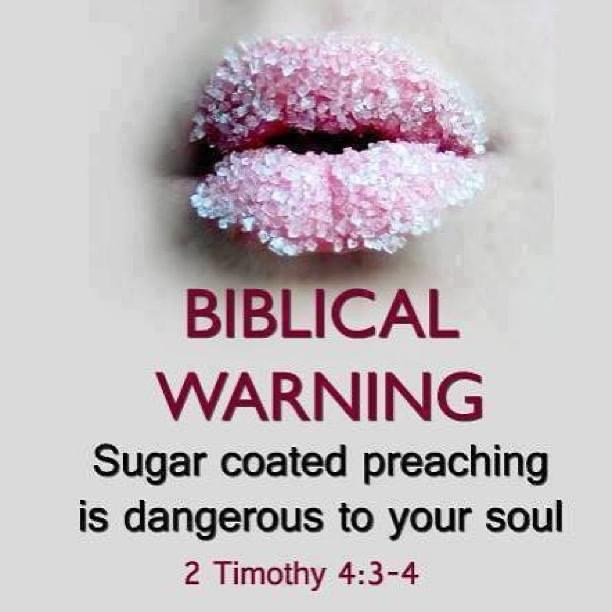
Sugar Warning

How The Christian Life Works.

“I used to ask God to help me. Then I asked if I might help Him. I ended up by asking God to do His work through me.”

Hudson Taylor (21 May 1832 – 3 June 1905, British Christian missionary to China, founder of the China Inland Mission, now OMF International)

Source: Berean Call

As The Shining Moon and Glittering Stars

Even as the shining moon and the glittering stars give the most light and adorn the blue expanse of heaven the most gloriously, in the darkest nights, so it was also after A. D. 1000, as regards spiritual matters, which concern the honor of God and the salvation of the souls of men.

For, about the year 1000, as well as many years before and after but particularly then, the world lay sunken, as it were, in an arctic, six-month’s night, through the thick, and palpable darkness, which had arisen, with heavy vapors of superstitions, from the Roman pit. Yet, notwithstanding the state of the times, some undefiled persons, as bright heavenly signs, and stars, began to shine forth the more, and to let their light of evangelical truth illumine the dark nights of papal error. Yea, some, like the polar star, served as a sign to sail by; I mean, to accomplish safely and in a godly manner, through the turbulent waves of perverted worship and human inventions, the journey to the heavenly fatherland. Others, like the morningstar, or the lovely, blushing Aurora, announced the approaching day; we mean, they pointed to the true day of the Christian and evangelical worship of God, and revealed it, as much as they were able, to those who sat in the darkness of error.

We will no longer speak by simile; what we mean is this: That there were men in those dark times, who maintained God’s truth, in various points, according to the needs of that time, and bore witness to and sealed it not only with the mouth, but with the deed, yea, with their blood and death.

Martyrs Mirror – from chapter: AN ACCOUNT OF THOSE WHO SUFFERED IN THE ELEVENTH CENTURY: SUMMARY OF THE MARTYRS IN THE ELEVENTH CENTURY – page 265 -266, compiler T.J. Van Braght, 1660

May we, like the martyrs of the 1100s, stand for God’s truth as found in the Holy Scriptures; not only with the words of our mouth but with our actions, for the commandments and teachings of men continue today to produce a spiritual darkness that blinds the souls of men to eternal destruction. Let us be light in the darkness and guide others to the only safe harbor of Jesus, the Savior and Lord of Lords.

Carl

Rebellion Speaks To The Heart

Transgression [like an Oracle] speaks to the wicked deep in his heart.

There is no fear or dread of God before his eyes.

For he flatters and deceives himself in his own eyes,

That his iniquity will not be found out and be hated.

…he does not reject or despise evil.

Psalms 36: 1-2,4b Amplified

I believe King David wrote this Psalms out of his own personal experience with sin. The person in the psalm is called “the ungodly” (NASB) or “the wicked” (Amplified). The main fundamental characteristic of this person is there is no fear or dread of God before his eyes. He does not reject or despise evil.

Transgression signifies “willful deviation from, and therefore rebellion against, the path of godly living (Vines). You can not rebel against something unless it has been applied to you as a restraint. This is one reason I believe King David is speaking from his personal battle with sin. We will use the Bathsheba and Uriah scandal (II Samuel 11) to illustrate our point.

Transgression speaks pure rebellion against God’s revealed will in the heart of the ungodly or wicked person. In Scripture the heart is described as the hidden man, the “real me”, who I really am when the exterior facade that people see is stripped off. As the heart is hidden within the body of man, so the “real me” is hidden from the view of others…but not from God’s view. It is here, the heart, where this person has rejected  God’s lordship.

Rebellion speaks “like an Oracle”. This means man’s heart hears transgression or rebellion as an authoritative voice, it sounds true and correct in what it says because man’s heart is exceedingly wicked, who can know it. In ancient times an oracle was someone who heard from the pagan gods (demons) and was sought out by the powerful and the not so powerful who needed to know “the will of the gods”. Whatever the oracle said settled the matter. For example, Alexander The Great sought out the Temple of Apollo oracle at Delphi in Ancient Greece for “godly” advice.

This spirit of rebellion speaks with authority deep in the heart of this person. The common characteristic of the ungodly or wicked is that there is no fear or dread of God before their eyes. Fear” is obedient, reverential respect or awe for God. They do not have it. “…no …dread” means he does feel extreme reluctance to face God if he offends Him (Vines). In the midst of his willful rebellion toward God, he does not think about having to give an account before a Holy God. Because this measuring stick, the fear and dread of the Lord is not before the eyes of his understanding, he does not realize that he is deceiving himself. He is blinded with his own cravings or lusts and the desire to please man, or himself, instead of pleasing God.

Oh, there is a way that seems right to man but the ends thereof are death.

The reason he does not think about God in these matters is because rebellion flatters the heart to soothe his conscience, that organ that convicts of right and wrong. The flattery “sears the conscience” so it ceases to work, therefore, they have no moral compass. They are morally blind, i.e. if it feels good do it. The deception is necessary to prevent the inner man, especially in a Christian, from discovering his own iniquity and, consequently, hating his iniquity. Instead he, the Christian, goes on in his rebellion against God’s revealed will.

In David’s case, he went nine months being deceived by his transgression concerning his adultery with Bathsheba and murder of Uriah, her husband and David’s loyal soldier. It was only when Nathan, God’s prophet, rebuked David did he awaken from transgression’s deceiving flattery and the fear or dread of the Lord returned to his understanding. Transgression flattered him with things like: “Your the king, do what you wish”; “You work hard and deserve this;” or “Your a strong warrior and smart leader, it is unfortunate that good men (i.e. Uriah) have to die”.

As born again Christians, if we discover our iniquity in the light of the Holy Spirit’s conviction, we will hate it, for our true born again nature is to be Christ-like and not devil-like. If we can only repent of our sin in “words” but not in “practice”, then we will get on our knees and beg God to deliver us from the sin because we know He hates it; therefore, we hate it. By true repentance and the mercy of God, we can escape the bondage that our sin has delivered us into. Paul said:

Do you not know that when you present yourselves to someone as slaves for obedience, you are slaves of the one whom you obey, either of sin resulting in death, or of obedience resulting in righteousness? But thanks be to God that though you were slaves of sin, YOU BECAME OBEDIENT FROM THE HEART to that form of teaching to which you were committed….

(Romans 6: 16-17 emphasis added)

The fear of the Lord includes the hatred of evil but a person in this condition, does not reject or despise evil (verse 4). Instead they embrace it and hold it close to their heart. They deceive themselves and others about what they are doing or so they think. David describes this person’s conduct:

The words of his mouth are wickedness and deceit;

He has ceased to be wise and to do good.

He plans wickedness upon his bed;

He sets himself on a path that is not good;

He does not despise evil.

(Psalms 36: 3-4 Amplified emphasis added)

If we have rebellion flattering us in our hearts concerning something WE KNOW is sin, displeasing to God, we need to get into God’s word and let Him teach us the fear or reverence of the Lord so we can truly hate our sin. We all like the song Good Good Father by Chris Tomlin but the apostle Peter says if we call God “Father” we need to live in the fear or reverence of the Lord:

If you address as Father the One who impartially judges according to each one’s work, CONDUCT YOURSELVES IN FEAR during the time of your stay on earth; knowing that you were not redeemed with perishable things like silver or gold from your futile way of life inherited from your forefathers, but with precious blood, as of a lamb unblemished and spotless, the blood of Christ.

(I Peter 1:17-19 emphasis added)

I know to some Christians, maybe most, fearing or reverencing the Lord is a foreign concept due to the emphasis on “love” in the New Testament church and the sugar coated preaching many hear today.  In future post we will look at how the early Christian church conducted itself in the fear of the Lord  and that Lord Jesus, the Messiah, delighted in the fear of the Lord.

Think on these things. Examine yourself. If need be, learn to walk in the wholesome, healthy, profound, adoring, awed respect (i.e. the fear of the Lord) of the Ancient of Days, our Heavenly Father, and Lord Jesus.

Oh by the way, did you see your self in what David said?

Carl

Thou art Coming

“Thou art coming, O our Saviour!
  Coming, God’s anointed King!
Every tongue Thy Name confessing,
  Well may we rejoice and sing.
Thou art coming! Rays of glory
  Through the veil Thy death has rent,
Gladden now our pilgrim pathway,
  Glory from Thy presence sent.
”Thou art coming! Thou art coming!
  We shall meet Thee on Thy way;
Thou art coming! We shall see Thee,
  And be like Thee on that day.
Thou art coming! Thou art coming!
  Jesus, our beloved Lord; 
Oh, the joy to see Thee reigning,
  Worshipped, glorified, adored!
”Thou art coming! Not a shadow,
  Not a mist, and not a tear,
Not a sin, and not a sorrow,
  On that sunrise grand and clear,
Thou are coming! Blessed Saviour,
  Nothing else seems worth a thought:
Oh, how marvelous the glory,
  And the bliss Thy pain hath bought.
”Thou are coming! We are waiting 
  With a ‘hope’ that cannot fail,
Asking not the day or hour,
  Anchored safe within the veil.
”Thou are coming! At Thy table
  We are witnesses of this,
As we meet Thee in communion,
  Earnest of our coming bliss.”

Frances Havergal

In The Heavenlies [Ephesians Bible Study] --H.A. Ironside, LITT.D

Awake Up

“Awake up righteously, and sin not; for some have no knowledge of God: I speak this to move you to shame.” 1st Corinthian 15:34 (KJV)

Paul is writing to the Corinthian believers about the Corinthian believers. The “some” are not the unbelievers on the streets of Corinth who do not know God and run to idols but Paul is addressing those in the church who were teaching the error of no resurrection of the believer’s physical body.

Amid the assembly of believers there were those who had “no knowledge of God”.  Sounds like an oxymoron, a Christian believer with no knowledge of God.  In the Greek “no knowledge” does not mean “mere ignorance” (agnoia) but “reprehensible ignorance” (Vines).  They were not just lacking facts, but they were guilty before God for their own sloth (spiritual apathy and inactivity) and slight of God.

How do we slight God? They were guilty of treating God with indifference, treating His revealed will and ways as something of truly little importance, and pursuing their spiritual growth and relationship with Him in a careless manner.

The Amplified Bible puts it this way:

“…for some of you have not the knowledge of God [ you are utterly and willfully and disgracefully ignorant, and continue to be so, lacking the sense of God’s presence and all true knowledge of Him]. I say this to your shame.”  (emphasis added)

Denying the resurrection was giving evidence of this type of ignorance in some of the people.

Are we guilty of slighting God?  Are we living our lives in a manner that displays indifference to God’s will and ways, considers them of little importance and pursuing our spiritual growth and our Kingdom of God responsibilities in a careless manner?  Are we “gathering” with the Lord Jesus or “scattering”?

Not everyone in the Corinth Church believed this error. The “you “ in the latter part of the Scripture refers to the whole body of believers in Corinth. Paul is saying that because they pride themselves on their wisdom and intelligence, the spread of this error in their midst “displayed their culpable inability to recognize the character and power of God” (Henry). For this, the whole body should be ashamed, experience grief or inward pain because they now realized that they did not measure up to what they thought they were, in God’s eyes.

And herein is the danger of our walking in pride.

 In the first half of the Scripture Paul tells them “Awake up righteously, and sin not…”.

Their pride, rooted in their perceived wisdom and intelligence, had put them in a state of spiritual stupefaction. A state where the saint experiences a profound spiritual drowsiness or stupor. They had drunk deeply of the poison, their delusional pride, by comparing themselves among themselves and measuring themselves by themselves and not measuring themselves against God’s standard. Oh, how we need to heed Paul’s admonition in 1st Corinthians 10: 12 “…let him who thinks he stands take heed lest he fall”.

This produced in the church a state of spiritual lethargy where they were devoid of spiritual energy and interest. They had grieved (Ephesians 4:30) and quenched (1st Thessalonians 5:19) the Holy Spirit with their pride.  He is the Giver of the desire and will “to work for His good pleasure”.  (Philippians 2:13) His ministry was stopped by the pride in their lives. Now the Church was not a place of spiritual edification but a place of danger for the saints.  God now opposed them (James 4:6)!!!

Therefore, Paul commands them “Awake up righteously and stop sinning…”. The NASB says “Become sober minded as you ought and stop sinning,”. The Amplified Bible says “Awake [from your drunken stupor and return] to sober sense and your right minds, and sin no more.”

 Matthew Henry (1700s) says:

“Rouse yourselves, break off your sins by repentance: renounce and forsake every evil way, correct whatever is amiss, and do not by sloth and stupidity, be led away into such conversation and principles that will sap your Christian hopes, and corrupt your practice.”

This is what the Holy Spirit is telling the Corinthians through the pen of Paul.

What saith we? Do we see ourselves in Paul’s rebuke of the Corinthian believers? Oh, Father God remove the blinders of pride from our understanding that keeps us in darkness.

Do we need to wake up, to rouse ourselves, to become sober minded about our spiritual state?  Have we quenched and grieved the Holy Spirit in our life?  Have we stopped the rivers of living water (John 7:38) that are supposed to flow out of our innermost being and replaced it with a muddy slough of arrogance, self-indulgence, and worldly ways from our carnal nature.

Are we slighting God?

If the rapture of the believers happened today and we, in the twinkling of an eye, went from earth to His presence, what would be in our hand, in our mind and in our heart?  Would we be ashamed of what He caught us doing, thinking about, and craving for?

 It is going to happen one day. Let us be sober minded. Get right (with God) and ready (to stand in His Presence).

Believer, the Judgement Seat of Christ is also drawing closer. Are you ready to stand before your Savior and give an account of what you have done in this earthly life? Are we ready to receive our rewards or will we suffer loss ….for eternity?

Will He have to “wake us up” for the momentous occasion?

May Paul’s words to Timothy move us to self-examination in the light of His Word:

“Pay close attention to yourself…” (1st Timothy 4:16)

With repentance, love, and concern for the Church,

Carl

Chinese Proverbs

Therefore, my dear brothers and sisters, stand firm. Let nothing move you. Always give yourselves fully to the work of the Lord, because you know that your labor in the Lord is not in vain. –I CORINTHIANS 15:58

Chinese proverbs are common and often have stories behind them. The proverb “pulling up a crop to help it grow” is about an impatient man in the Song Dynasty.  He was eager to see his rice seedlings grow quickly, so he would pull up each plant a few inches. After a day of tedious work, the man surveyed his paddy field.  He was happy that his crop seemed to have “grown “ taller.  But his joy was short-lived.  The next day, the plants had begun to wither because their roots were no longer deep.

In 2 Timothy 2:6, the apostle Paul compares the work of being a minister to the gospel to that of a farmer.  He wrote to encourage Timothy that, like farming, making disciples can be continuous, hard labor. You plow, you sow, you wait, you pray. You desire to see the fruits of your labor quickly, but growth takes time. And as the Chinese proverb so aptly illustrates, any effort to hurry the process won’t be helpful. 

As we labor faithfully, we wait patiently on the Lord, who makes all things grow (I Corinthian 3:7).

Source: – Poh Fang – author

Heavenly Minded

“Those who are the most heavenly minded are also of most earthly use.”

William Wilberforce (24 August 1759 – 29 July 1833, British politician, philanthropist, and one of the leaders of the movement to ban the slave trade).

Source: Berean Call

Fellowshipping With Your First Love

“But I have this against you, that you have left your first love.” Lord Jesus in Revelation 2:4

I have a book, Deeper Experiences of Famous Christians, that has a story about Billy Bray, one of God’s quaint vessels. He would offend some Christians today, but he had a real experience of salvation and he did not know what to do except express himself. They made fun of Billy Bray and laughed at him. “Why, Billy Bray, you are so happy, so joyous, all the time. Suppose you discovered you are not saved at all, you are really not a child of God, and suppose when you die you go to hell?” Billy Bray said, “Well, I suppose if I die and I discovered I am not a Christian and I go to hell, Jesus has been so real and wonderful and precious to me in life I will just have to shout all the way to hell. When I get down to hell I will have to run up and down the streets of hell shouting ‘Hallelujah, praise the Lord.’ The devil will come over to me and say, ‘Billy Bray, we cannot stand that down here; we cannot put up with that. We will just have to send you to heaven.” That is the joy of salvation.

Exploring 1.2.3 John – Jerry Vines (1989)

Dear born again Christian, how is your joy level right now?

 Is it full and overflowing? Maybe it has been a while since you had fellowship with the Joy-Givers, our Heavenly Father and His Mighty Son Jesus, your First Love. There is real, deep joy around their throne and, as His child, He wants our joy to be made complete. Why not “wash your feet” in the precious blood of Jesus (John 13:3-10) and get rid of that unconfessed sin in your life which prevents your fellowship with the Joy-Givers. After that, spend some time in prayer and Bible readings in His presence. Read I John 1: 4-10 for example and think on the awesome privilege you have in being called into fellowship with the Creator and Sustainer of all things, including you.

 In your First Love’s presence there is fullness of joy (Psalm 16:11). Return to your First Love today! Do not be a carnal Christian who is running around on his First Love, loving the devil’s world and their old, stinking, fleshly, sinful ways.

Instead, may rivers of living water, the Holy Spirit (John 7:38), flow out of you today and every day and may the people around you be watered by this spiritual, life-giving, river of God.

Carl

Matthew Maury’s Paths of the Sea

  Today’s oceanography and meteorology owe a great debt to Matthew Maury. He exemplified the biblical principle that whatever we do, we should do it “to the glory of God” (1 Corinthians 10:31). Maury’s scientific research revered God’s Creatorship while benefiting hisfellowman.1

  On a monument erected by the state of Virginia to his memory is found a plaque that reads as follows: “Matthew Fontaine Maury, Pathfinder of the Seas, the genius who first snatched from the oceans and atmosphere the secret of their laws. His inspiration, Holy Writ, Psalm 8:8; Ecclesiastes 1:6.”2  

Genius indeed! Maury epitomizes the godly investigator whose creation science begins with the Creator’s written revelation—the Bible.3

  “I have been blamed by men of science, both in this country and in England, for quoting the Bible in confirmation of the doctrines of physical geography. The Bible, they say, was not written for scientific purposes, and is therefore no authority in matters of science. I beg pardon! The Bible IS authority for everything it touches.”1

  As a child, Maury was taught the Psalms at home, and that divine book of praises imprinted upon his intelligent, investigative mind. Decades later Maury would live out his lifelong commitment to doxological creation science.4 Maury recognized the Holy Bible as perfect in whatever it taught, including being authoritatively relevant and accurate in scientific matters.1,4 Among the insights he gleaned are:  

1. The Gulf Stream washes nutrients from the Gulf of Mexico into the North Atlantic, benefiting whales, seabirds, and other oceanic creatures. This illustrates the scriptural principle of God’s providential care for animals (Job 38:41; Psalm147:9; Matthew 10:29; Luke 12:6).

  2. The general system of atmospherical circulation is referred to in Ecclesiastes 1:6.

  3. The water cycle matches Ecclesiastes 1:7.

  4. Atmospheric pressure is a geophysical reality mentioned in Job 28:25 as the “weight for the wind.”

  5. Maury’s most famous Scripture-based insight is that the oceans have subsurface currents with regular circulation patterns—the “paths of the seas” in Psalm 8:8.5

  Maury trembled at the privilege of uncovering the logic God carefully built into His creation, noting that scientific discovery is discovering God’s own mind.

  As a student of physical geography, I regard earth, sea, air, and water as parts of a machine, pieces of mechanism, not made with hands….And when, after patient research, I am led to the discovery of one of these [mechanisms], I feel, with the astronomer of old [Johannes Kepler],“as though I had thought one of God’s thoughts,” and tremble. Thus, as we progress with our science, we are permitted now and then to point out here and there in the physical machinery of the earth a design of the Great Architect when He planned it all.6

  Virginia’s monument to Matthew Maury reminds us of his historic testimony and scientific achievements. The more important “monument” to his godly work is the ongoing impact of Maury’s life of reverent research in God’s service, which has secured for him “treasures in heaven” (Matthew 6:19-21).  

  References  
1. Major, T. J. 1995. Honor to Whom Honor…Matthew Fontaine Maury (1806-1873). Creation Research Society Quarterly. 32 (2): 82-87, quote from page 83.

2. Gish, D. Paths of the Seas. Days of Praise, October 6, 1993. “One day, while reading Psalm 8, [Maury] was struck by an important truth in the 8th verse…‘the fowl of the air, and the fish of the sea, and whatsoever passeth through the paths of the seas.’ He immediately saw the great practical significance of that verse, recognizing that there must be currents of water in the oceans, just like vast rivers, as well as in the atmosphere (Ecclesiastes 1:6).”

3. Maury, M. F. 1855. The Physical Geography of the Sea and Its Meteorology. Mineola, NY: Dover Publications, Inc

4. Johnson, J. J. S. An Oceanographer’s Insight, for Researching and Analyzing Oceanic and Littoral Ecosystem Dynamics, Guided by ‘High-Definition’ Biblical Philology, presented at the Creation Research Society Conference, Dallas, Texas, July 31, 2015, especially pages 3-13 and 17

5. Adapted from Major, Honor to Whom Honor, 85.

6. Meyer, J. R. 1982. The Life and Philosophy of Matthew Fontaine Maury, Pathfinder of the Sea. Creation Research Society Quarterly. 19 (2): 91-100, quoting from page 95 (from Maury’s keynote address “at the laying of the corner-stone for the University of the South in the Sewanee Mountains in East Tennessee on Nov. 30, 1860”). https://www.icr.org/article/matthew-maury-paths-of-the-sea/

Credulity Or Berean?

…We must be very careful to examine the words and fruits of those who speak in the name of God. Credulity is dangerous.  We can be led astray and lose our souls.

It is said that when Alexander the Great went to war against Darius, King of the Persians, he took a bath and caught cold. His friend, Philip, a physician, cared for him. Just at that time, Alexander received a letter from his most faithful commander advising him to be suspicious of Philip and not to take his medicine because the physician was in collusion with King Darius to poison him. Philip had allegedly received money and the promise of Darius’ sister for his wife. When the physician entered the room with his medicine, Alexander took the glass in one hand and with the other drank while Philip read. Then Alexander said to him, “I have confidence in your medicine and in your friendship.” He regained his health.

This example is often quoted in sermons to suggest that if we can have such confidence in man, then we can have even more in God –our greatest Friend.

It is my firm conviction that, assuming Alexander really responded in this manner and the story is not legend, he was misguided. Many kings and rulers have been poisoned by their physicians. Many of Stalin’s comrades were killed in this manner.

Jesus taught, “Beware of men” (Mt. 10:17). We must beware of men in material things, financial matters, and everyday affairs. Even more, we must not easily give our confidence when the eternal destiny of the soul is at stake.

If anyone desires salvation and sanctification, he might find a religious teacher who is trusted with speaking the oracles of God but be very choosy. 

The Oracles of God – Richard Wurmbrand, p.68-70

Brother Richard warns us that “credulity” is dangerous.  Credulity is the state of being credulous which is being gullible; ready to believe without proof.  Don’t be credulous.

 Be a Berean. Acts 17:10-11 tells us the brethren “sent Paul and Silas away by night to Berea; and when they arrived, they went into the synagogue of the Jews. Now these were more noble-minded than those in Thessalonica, for they received the word with eagerness, examining the Scriptures daily, to see whether these things were so.

They were checking what Paul said about the Messiah against what the Old Testament Scriptures said.  They were not gullible. They wanted to see it in the Scriptures for themselves.

It is prudent for us to read our Bible daily asking the Holy Spirit to teach us the truth. He was sent to lead us into all truth. We need to let Him.

Read your Bible. Be a Berean!

God bless you and be wise!

Carl

Who Is Jesus?

Jesus died. He rose from the dead. And the world changed forever.

But what’s the significance of these events? Why did Jesus die, and what does His resurrection mean? How has the world changed?

When we think about someone’s death, we can’t really appreciate its significance unless we know who we’re talking about. The significance of Abraham Lincoln’s death can only be fully felt when we understand who Lincoln was—and the same goes for other historical figures. Their lives changed the world, and their death did too.

From a purely historical point of view, there’s no one in human history whose life changed the world more than Jesus. More biographies have been written about Him than any other person (Lincoln is second). Indeed, the original four biographies of Jesus, collected together in the New Testament gospels, are a large part of why the
Bible is the number-one-selling book every year. In fact, The New York Times Best Seller ignores the Bible; otherwise, it would top the list every week.

No one’s teaching has had a deeper impact on culture, politics, morality, justice, philosophy, and human character than Jesus Christ’s. Two thousand years later, He’s regularly quoted (consciously and unconsciously) even in our increasingly secular world. His moral teaching likewise forms the bedrock for billions around the world –such as the Golden Rule and the importance of compassion, forgiveness, and mercy. Indeed, Jesus continues to set a standard that our modern world fails to live up to.  How well do we love our enemies? Do we pray for those who persecute us?

And all of that is only taking into account the Jesus of history. What about when we consider who He was according to His own claims? According to Jesus and His first followers, He wasn’t an ordinary man. He was God’s appointed king who came in fulfillment of promises made centuries before. He came to reveal God to us through His own embodiment of the divine nature. He was, and is, God the Son, who by His own claim existed  from the very beginning. He’s the One through whom His Father created the entire cosmos – including the humanity of which Jesus Himself chose to partake. If these claims are believed, there can be no question that Jesus was the most significant man who ever walked the earth.

When we realize that the One through whom humanity was crafted died as a man, we begin to see the depths of this event. In fact, once we understand who Jesus is, we shouldn’t at all be surprised that He would rise again from the dead. The truly remarkable thing is that He died at all! How could the Author of life be put to death? How could the Creator be killed by His own creation?

The answer is love. As the Apostle John says, “God is love.” (I John 4:8) and the gift of His eternal Son is the ultimate demonstration of His love. Jesus chose to take up human life and to lay down His life so that we broken, rebellious, proud human beings might be brought into loving relationship with our heavenly Father –our Maker and our Judge. If Christmas celebrates God’s gift of Jesus into our world, Easter celebrates what that Gift came to do. He came to die that we might live. His death spells our life because of who He is. He’s God Himself come to us as one of us so that He might bring us home with Him.

If Christ’s death can only be appreciated by understanding who He is, so too His resurrection from the dead. Lazarus was raised from the dead (by Jesus), but his resurrection did not change the fate of humanity. So why did Christ’s change humanity? For starters, Lazarus had to die again one day. His resurrection didn’t permanently overcome death. It didn’t destroy death. But when Jesus was resurrected, He overpowered death. He conquered the last great enemy of humanity—death itself. That is why Jesus will never die again, unlike Lazarus. He rose victorious over death, and death no longer has any claim on Him. Death could literally not hold Him down.

While death still has its way with us, Jesus promised through Him death would not have the last word. No one who hopes in Jesus will stay dead. He promised that one day He’ll call each of us by name. He’ll call us out of our graves, and we’ll literally live again. Our bodies will be resurrected like His. Death will have no further claim on us. Death will die.

That is why that first Easter was the most important weekend in human history. God remade humanity in three days through the death and resurrection of one man. The ultimate man died the ultimate death so that our ultimate fate would be eternal life with Him.

This Easter let’s pursue Jesus, the One who first came in pursuit of us. 

Source: Con Campbell, vice-president of global content, Our Daily Bread

Dear Reader, this article was written for Easter but I encourage you to pursue Jesus today. If you do not know Him as Lord and Savior, ask Him today to save you from your sins, to forgive you, and become your Lord and Savior. He will not fail you or reject you.  Enter His rest and cease from your works to be good enough or religious enough to earn His favor.  We all are sinners in need of His mercy. He will not reject you.  Turn to the Living Son of God today and be saved for eternity.

All that the Father gives Me shall come to Me, and the one who comes to Me I will certainly not cast out.    Quote from Jesus — John 6:37

Carl

The Reformation: Why Martin Luther Was Angry.

Last post we discussed the 503rd anniversary of the beginning of the Reformation. (You may scroll down past this post to read last post) We saw that Martin Luther was infuriated by the selling of indulgences to the German people. Having begun to read the New Testament, he knew that salvation from sin was not for sale by God.

Following are statements from contemporary documents which reveal, to those who know their Bible, that this was all devilish. It caused people to put their trust in the Pope and his word instead of the Holy Bible and what it says about the finished work of Christ on the Cross for sinful man.


Luther wrote the following concerning the Dominican monk named Johann Tetzel who was selling the indulgences for Pope Leo X:

  1. “…with might and main he sold grace for money as dearly or as cheaply as he could.

2. He had grace and power from the Pope to offer forgiveness even if someone had slept with the holy Virgin Mary*, the mother of God, as long as a contribution will be put into the coffer.

3. Furthermore, The Red Cross of indulgences and the papal coat of arms on the flag in the churches was as powerful as the cross of Christ.

4. Moreover, even if Saint Peter were here now, he would have no greater grace or power than he (Tetzel) had.

5. Furthermore, he would not want to trade places in heaven with Saint Peter, for he had redeemed more souls with his indulgences than Peter with his sermons.

6. Furthermore, if anyone put money into the coffer for a soul in purgatory** the soul will leave purgatory** for heaven in the moment one can hear the penny hit the bottom.

7. Furthermore, it is not necessary to show remorse or sorrow or to do penance for sins when purchasing indulgences or a letter of indulgence.

8. He even sold indulgences for future sins.

9. Such abominable things he did abundantly, he was merely interested in money. ” 

Martin Luther, Wider Hans Worst, 1541 (WA 51, 538)

The sale of the indulgence for the construction of Saint Peter’s in Rome was regulated by a ‘Summary Instruction’ issued by Albert of Hohenzollen, Archbishop of Magdeburg and Mainz. Two details set forth in the instructions are:

  1. “The first of the four graces that could be obtained is the complete remission of all sins. Nothing can be called greater than this grace, since man, living in sin and deprived of divine grace, obtains complete forgiveness by these means an enjoys anew the grace of God. Moreover, through such forgiveness of sins the punishment which one is obliged to undergo in purgatory on account of the offense of the divine Majesty is all remitted and the pain of purgatory** altogether done away with.”
  2. “The 4th distinctive grace is for those souls which are in purgatory**, and is the complete remission of all sins, which remission the Pope brings to past through his intercession, to the advantage of said souls, in this wise: that the same contribution shall be placed in the chest by a living person as one would make for himself.” ( from Intructio Summaria (W. Kohler, Dokumente zum Ablasstreit, pp. 104-16.)

In closing, Martin Luther knew what Tetzel was doing for Pope Leo X was an abomination to Holy God.  God is not for sale and neither is His marvelous grace. And especially not the precious blood of Jesus that was shed for payment for our many, many sins.  You can not bribe or buy God off. 

**And I pray, Dear Reader, that you know there is no such thing as purgatory in the Bible.  Hebrews 10:27 says, “…It is appointed for men to die once and after this comes judgement.” Almighty God only recognizes the precious blood of Jesus as the payment for man’s sin.  The fires of this cooked-up purgatory is not going to purify anyone of their sins. The forgiveness of our sins had better be settled before we take our last breath on earth. Once we die, our permanent destination in the next world is set: heaven or the place of torment. There is no moving around.

Purgatory is a great money maker for the Roman Catholic Church but it was cooked up in hell and given to men who had seared consciences to deceive the unsuspecting (I Timothy 4: 1-3).

*Mary, the mother of Jesus, realized she need a Savior just like everyone else. She said “My soul exalts the Lord, and my spirit has rejoiced in God, my Savior (Luke 1: 46). She is blessed among women but she is not the co-redeemer of man and no one should be praying to her or other dead people. Read Deuteronomy 18: 10-14 where God forbids this.

Luther was just in being angry about all these lies. How we need a Reformation today, a Luther to rise up and expose these dangerous errors that still lead lost, religious man to eternal ruin!

Carl

Note: All quotations are from The Reformation – A Narrative History Related By Contemporary Observers and Participants by Hans Hillerbrand, Editor

The Reformation Born 503 Years Ago Today

In 1517 a Dominican Friar named Johann Tetzel had been selling indulgences near Wittenberg to raise money for constructing Saint Peter’s in Rome. According to Tetzel, those who purchased an indulgence would receive remission of purgatory. Indulgences could also be purchased on behalf of dead relatives and friends. The punchline of Tetzel’s sermon was, “As soon as the coin in the coffer rings, the soul from purgatory springs.”

The sale of these indulgences infuriated Martin Luther, the professor of biblical studies at the University of Wittenberg, and he decided to hold a disputation with other faculty members on the subject. A professor interested in holding a disputation would nail the theses to be discussed on the cathedral door. Luther posted his 95-Theses on the great wooden door of Castle Church in Wittenberg, Germany, on October 31st, 1517.

Some of Luther’s points for discussion were: (1) “Our Lord and Master Jesus Christ in saying, “Repent Ye”, intended that the whole life of believer should be penitence”. (32) “Those who believe that, through letters of pardon, they are made sure of their own salvation, will be eternally damned, together with their teachers.” (37) “Every true Christian, whether living or dead has a share and all the benefits of Christ and of the Church, given by God, even without letters of pardon”.  (62) “The true treasure of the Church is the Holy Gospel of the glory and grace of God.”

Luther knew from his own repentance and conversion that paying an indulgence could not achieve forgiveness of sins. Shortly before posting the 95- Theses, Luther had begun studying the Greek New Testament, and his studies persuaded him that the Greek word for repentance, metanoia, meant a change of heart, not mere performance of outward works, as theologians of his day defined it.

Luther wrote the 95-Theses in Latin, intending them to be discussed by scholars, not circulated among the populace. But as Luther himself acknowledged, “A fortnight they flew all over Germany.” Translated into German and sold as far away as Rome, the 95-Theses became much more than a University exercise.

For the next two decades, Luther enjoyed seeing the Reformation grow. Many regions in Germany accepted the evangelical doctrines that Luther and other reformers discovered in the Scriptures. Luther lived to see a second generation of evangelicals sing the hymns he had written, read his German translation of the Bible, and learn his catechism from their early childhood.

Throughout his life he preached and taught God’s promise of redemption to the repentant sinner. On his deathbed he prayed, “O Lord Jesus Christ, I commend my poor soul to Thee. O Heavenly Father, I know that, although I shall be taken from this life, I shall live forever with thee. God so loved the world that he gave his only begotten Son that whosoever believeth on him should not perish but have everlasting life. Father into Thy hands I commend my spirit.”

Luther died on February 18, 1546, at the age of sixty-two in Eisleben, the city where he was born. As word of his death spread to Wittenberg, bells tolled, and people crowded the streets, wanting to pay their last respects to their leader.

On Monday, February 22, 1546, accompanied by caravan that included his wife, Katie, his four children, and a throng of his followers, Luther’s casket was born through the door of Castle Church in Wittenberg, on which, more than twenty-eight years before, the young monk had nailed his theses.

Reflection

Little did Martin Luther realize the forces that would-be set-in motion by the posting of his 95-Thesis. He merely felt it necessary to speak out against the error of his day. He was willing to stand up and be counted for truth and God used him to change the world. Do you ever feel that you should speak out against error? There is no predicting how God will honor your faithfulness.

They should gently teach those who oppose the truth. Perhaps God will change those people’s hearts, and they will believe the truth.     II Timothy 2:25

Source: The One Year Christian History – E. Michael and Sharon Rusten

Chicago Schools Drop TM

Why Did Chicago Public Schools Just Quietly Drop Transcendental Meditation?  

Three years ago, as a part of its mission to teach Transcendental Meditation to a million at-risk kids, the David Lynch Foundation partnered with the University of Chicago’s Urban Labs and Chicago Public Schools(CPS) to test whether Transcendental Meditation (TM) could reduce crime and improve school performance.

Two thousand students in five high schools located in high crime Chicago neighborhoods participated in the $3 million study through its “Quiet Time” (QT) program.   Earlier this month, in response to a direct email inquiry, RD was notified by a CPS official that “CPS is no longer allowing for the official Quiet Time Program through David Lynch Foundation to be offered in CPS schools.” But why would CPS quietly drop such a high-profile program?

Though CPS decline to elaborate further, a July 26, 2019 article in the Chicago Tribune provides a clue. Hannah Leone’s article includes some disturbing information about the program based on the harrowing recollections, before the Chicago Board of Education, of Dasia Skinner, a substitute teacher, and Jade Thomas, a fourteen-year-old high school student.    After hearing their testimony, the CPS chief education officer noted that while she personally visited the QT program at Bogan High School, none of the information reported in the presentations was shared with her. So what didn’t they tell her about this “simple… non-religious technique,” as the David Lynch Foundation’s brochure describes TM?   

According to Skinner, the 60 students she spoke with shared a similar experience, Jade Thomas among them. Thomas told the Chicago Board of Education that her experience began with a mandatory “initiation into the meditation program” (elsewhere in TM materials referred to as a puja, a ceremony performed by Hindus, as well as many Buddhists and Jains). Students are taken by a QT “facilitator,” two at a time, to a dark, incense-filled room with all the windows covered.   

According to Thomas, they were made to hold flowers in their hands while the instructors “chanted in a foreign language, threw rice, seasonings, [and] oranges on a pan in front of a picture of a man, ”after which they were to place the flowers on the pan. Following the ritual, they were given their mantras and were told “don’t tell anyone else your word.”(Keeping one’s mantra a secret, it should be noted, is common in some sects of Hinduism.) Thomas also notes that students were told they would be sent to the dean’s office if they declined to participate and that they would be threatened with reduced grades if they talked during the twice-daily QT sessions. She describes feeling uncomfortable about her participation because the ceremony went against the Christian religion she practiced in her home. 

  Unless this ceremony departed from the standard TM puja, as described by Business Insider, the man in the picture was likely Swami Brahmananda Saraswati, or ‘Guru Dev,’ with whom the founder of TM, Maharishi Mahesh Yogi, “studied the Upanishads, the segments of the four ancient Sanskrit books of scripture known as the Vedas that focus on the self and its relationship to God.” And yet this is “an act that the Maharishi did not consider to be compromising to his practice’s secularity.”  

According to Professor Candy Gunther Brown, author of Debating Yoga and Mindfulness in Public Schools, the federal appellate case of Malnak v.Yogi (1979) ruled that teaching TM in public schools constitutes an impermissible “establishment of religion.” Indeed, the court’s ruling against TM left little room for debate:   Although defendants have submitted well over 1500 pages of briefs, affidavits, and deposition testimony…defendants have failed to raise the slightest doubt as to the facts or as to the religious nature of the teachings of the Science of Creative Intelligence [TM’s Hindu underpinnings] and the puja.

The teaching of the SCI/TM course in New Jersey public high schools violates the establishment clause of the first amendment, and its teaching must be enjoined.    TM proponents argue that the case is over 40 years old and no longer relevant. In an exchange in the Wall Street Journal 3 years ago, Lynch Foundation CEO Bob Roth wrote,    “TM is not a religion. Over 8 million people of all religions practice TM. It is taught in public schools, on military bases, and in large and small businesses. In each case, a team of legal experts has done due diligence and researched the accusations and claims and found them to have no basis.”   

When I pointed out in response that the puja ceremony is exactly the same today as it was in 1977, and that the establishment clause has not changed, Roth responded, “In the nearly 40 years since the 1979 court case you cite, tens of thousands of students have learned to meditate as part of voluntary Quiet Time programs with the full support of school boards and parents.”    That may be strictly true, but given what we’re learning about the Chicago case, that support may be largely due to the fact that TM isn’t entirely forthcoming in what it shares with school boards and parents regarding the explicitly religious content that permeates the program.       

But not all is bliss in the TM world. For example, TM teachers created “checking notes,” as a guide to handle pain and discomfort that might arise even within the first days of TM instruction. The existence and use of the checking notes document that the TM organization is well aware of these potential problems. Shaking and body movements, as well as overpowering thoughts, are frequent enough even during the first few meditations that an entire section of the checking procedure is devoted to these severe symptoms. 

More generally, a non-profit called Cheetah House, which is affiliated with Brown University, Harvard, and a number of other prestigious institutions, exists to provide “information and resources about meditation-related difficulties to meditators-in-distress.” And this is a major part of the mission of a proponent of meditation. In addition, while the UK’s National Health Service notes that meditation can be very helpful in many cases, “The serious, long-lasting nature of some of the negative experiences reported [in a recent study], however, are cause for concern.” These potential issues may be perfectly acceptable for adults voluntarily participating in TM workshops, but for children and adolescents required or even urged to participate it hardly seems appropriate. 

It took three years for CPS to conclude that TM is more than a secular relaxation method to reduce stress. And while it’s still unclear whether they dropped the program due to issues with the establishment clause, potential risks to students’ health, or both, one thing that is clear is that TM proponents will not be deterred from approaching other school systems and institutions. You might say that their belief in the benefits of TM is… religious.    https://religiondispatches.org/exclusive-why-did-chicago-public-schools-just-quietly-drop-transcendental-meditation/    

Source: Berean Call

Discouraged? Run Over? Down in A Valley?

We all feel this way at times. The way out of the valley is to start giving God thanks; remembering all the good He has done for you. That will lead into praising and worshipping Him for who He is and how great He is. Soon you have risen to an elevation above the worries of this world. Remember, you are not alone. The Holy Spirit has not left you and the world is full of your brother and sisters who are going through the same things you are. Refocus on the Father and Jesus and away from the worries of the world. Click on the following link to join in with Maverick City Music, a Christian music group, as they extol God’s miraculous love for His children: Love Is A Miracle.

Hypocrite vs True Christian

“The hypocrite is like the waterman*, that looks one way and rows another; the true Christian like the traveller, that has his journey end in his eye. The hypocrite soars like the kite**, with his eye upon the prey below, which he is ready to come down to when he has a fair opportunity; the true Christian soars like the lark, higher and higher, forgetting the things that are beneath.” A Commentary On The Whole Bible – Matthew Henry (1721)- Vol. 5, page 81

“If then you have been raised up with Christ, keep seeking the things above, where Christ is, seated at the right hand of God. Set your mind on the things above, not on the things that are on earth. For you have died and your life is hidden with Christ in God.” Paul in Colossians 3: 1-3

Carl

*The person rowing a boat ** Eagle-like bird of prey feeding predominately on fish

Have A Desire For God?

Desire is not merely a simple wish; it is a deep seated craving; an intense longing, for attainment. In the realm of spiritual affairs, it is an important adjunct to prayer. So important is it, that one might say, almost, that desire is an absolute essential of prayer.

A sense of need creates or should create, earnest desire. The stronger the sense of need, the greater should be the desire, the more earnest the praying. The “poor in spirit” are eminently competent to pray.

Hunger is an active sense of physical need. It prompts the request for bread. In like manner, the inward consciousness of spiritual need created desire, and desire breaks forth in prayer. Desire is an inward longing for something of which we are not possessed, of which we stand in need –something which God has promised, and which may be secured by an earnest supplication of His throne of grace.

Desire is the will in action; a strong, conscious longing, excited in the inner nature, for some great good. Desire exalts the object of its longing, and fixes the mind on it. It has choice, and fixedness, and flame in it, and prayer, based thereon, is explicit and specific. It knows its need, feels and sees the thing that will meet it, and hastens to acquire it.

Spiritual desire, carried to a higher degree, is the evidence of the new birth. It is born in the renewed soul:

As newborn babes, desire the sincere milk of the word, that ye may grow thereby.”

The absence of this holy desire in the heart is presumptive proof, either of a decline in spiritual ecstasy, or, that the new birth has never taken place.”

Bless are they which do hunger and thirst after righteousness: for they shall be filled.”

These heaven-given appetites are the proof of a renewed heart, the evidence of a stirring spiritual life…spiritual desires belong to a soul made alive to God. And as the renewed soul hungers and thirsts after righteousness, these holy inward desires break out into earnest, supplicating prayer.

One might well ask, whether the feebleness of our desires for God, the Holy Spirit, and for all the fulness of Christ, is not the cause of our so little praying, and languishing in the exercise of prayer? Do we really feel these inward pantings of desire after heavenly treasure? Do the inbred groanings of desire stir our souls to mighty wrestlings? Alas for us! The fire burns altogether too low. The flaming heat of soul has been tempered down to a tepid lukewarmness. This, it should be remembered, was the central cause of the sad and desperate condition of the Laodicean Christians, of whom the awful condemnation is written that they were “rich, and increased in goods and had need of nothing,” and knew not that they “were wretched, and miserable, and poor, and blind.”

Again: we might inquire–have we that desire which presses us to close communion with God, which is filled with unutterable burnings, and hold us there through the agony of an intense ands soul-stirred supplication? Our hearts need much to be worked over, not only to get the evil out of them, but to get the good into them. And the foundation and inspiration to the incoming good , is strong, propelling desire. This holy and fervid [i.e. very hot] flame in the soul awakens the interest of heaven, attracts the attention of God, and places at the disposal of those who exercise it, the exhaustless riches of Divine grace.

The dampening of the flame of holy desire, is destructive of the vital and aggressive forces in church life. God requires to be represented by a fiery Church, or He is not in any proper sense, represented at all. God, Himself, is all on fire, and His Church, if it is to be like Him, must also be at white heat. The great and eternal interests of heaven-born, God-given religion are the only things about which His Church can afford to be on fire. Yet, holy zeal need not to be fussy in order to be consuming. Our Lord was the incarnate antithesis of nervous excitability, the absolute opposite of intolerant or clamorous declamation, yet the zeal of God’s house consumed Him; and the world is still feeling the glow of His fierce, consuming flame and responding to it, with an ever-increasing readiness and an ever-enlarging response. ” Source: The Necessity of Prayer – Edward M. Bounds, p. 44-48

Father, we praise your name. Please increase our desire for You. Set our souls aflame for You and Christ. Forgive us for our coldness and lukewarmness. Forgive us where we have let the “worry of the world and the deceitfulness of riches and the desire for other things” choke out your word in our lives and make us unfruitful. Cause us to be consumed with your zeal so that we may be pleasing to you and effective in witnessing to this lost and adulterous generation. We ask this in the precious Name of Jesus. Amen.