
Who are the ‘least of these’ and why does it matter?

By John Doane, Op-ed contributor Sunday, October 20, 2024
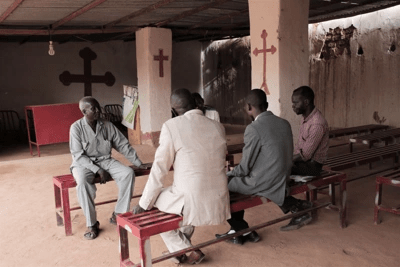
Lutheran reverend Yousef Zamgila (L) speaks to members of his congregation at the small improvised church they helped set up in a neighbours yard in Omdurman, Khartoums twin city, on August 22, 2019. Sudan’s Christians suffered decades of persecution under the regime of Islamist general Omar al-Bashir. | JEAN MARC MOJON/AFP via Getty Images

Several years ago Tony Campolo wrote, “I place my highest priority on the words of Jesus, emphasizing the 25th chapter of Matthew, where Jesus makes clear that on Judgment Day the defining question will be how each of us responded to those he calls ‘the least of these.’”

President Obama, speaking to the Pope at the occasion of his visit to the White House in 2015, stated “You call on all of us, Catholic and non-Catholic alike, to put the ‘least of these’ at the center of our concerns.” And then the President went on to identify “the poor and the marginalized” as the “least of these.”

Others identify those needing adoption or the homeless as “the least of these.” Former NIH director Francis Collins in his recent book The Road to Wisdom identified “the poor, the sick, the orphans, the prisoners, [as] the least of these that Jesus said we are most called to help.”

Since Jesus makes this such an important issue, it would behoove us to identify those whom the Bible itself would call the “least of these.”

Notice that in Matthew 25:40 Jesus said, “… inasmuch as you did it to one of the least of these my brethren, you did it to Me.” So the “least of these” are His brethren. Who are Jesus’ brethren? Hebrews 2:11 answers, “For both He who sanctifies and those who are being sanctified are all one, for which reason He is not ashamed to call them brethren.” Romans 8:29 calls Jesus “the firstborn among many brethren.” 1 John 3:13-14 counsels us “Do not marvel, my brethren, if the world hates you,” but “We know that we have passed from death to life because we love the brethren.”

So, love for the brethren (Christians) is a sign that we have eternal life, just as in Matthew 25 Jesus indicates that those who care for the least of His brethren are welcomed into His eternal Kingdom.

Some Christian writers have identified the brethren of Jesus in Matthew 25 as disciples called to preach the Gospel, such as those sent out by Jesus in Matthew 10. Those may indeed risk hunger, loneliness, nakedness and imprisonment, but the ones mentioned in Matthew 25 evidently refer to those who actually suffer such things.

Now we know from the rest of the Bible (e.g. Romans 4:3-8 and Romans 10:9) that our righteousness is based on our faith in the finished work of Jesus for the forgiveness of sins and belief in His resurrection. So, the works on behalf of the least of Jesus’ brethren mentioned in Matthew 25 do not earn us salvation. Rather, they are a sign that we are already saved, as James said, “I will show you my faith by my works” (James 2:18).

Why is this important? First of all, this passage from Matthew should not be used for virtue signaling, to drum up support for one’s favorite charity, or to promote a government program. Our salvation is never based on our works, however good they may seem. Secondly, notice that the passage in Matthew 25 is part of the so-called Olivet Discourse starting in Matthew 24 where Jesus spoke to his disciples in private. In that context, Matthew 25: 31-46 gives His brethren, His disciples, a way to distinguish between others “blessed of My Father” (v. 34) and those deserving of “everlasting fire prepared for the devil and his angels” (v. 41).

As in other places, Jesus was sorting out appearances from reality. For example, before the breakup of the Soviet Union, many leaders in the World Council of Churches and major Christian denominations refused to believe that Christians were in prison for their faith in communist countries, even when presented with exhaustive evidence. Such leaders preferred to associate with leaders of state-controlled churches in those countries. Other nominal Christians either deny that Christians were suffering persecution in communist countries, or they were indifferent about helping them. The ones suffering persecution were indeed in prison. Their families were naked and hungry, because they had no income, and the governments forbade others from helping them. Like St. Paul, they were made “the filth of the world, the offscouring of all things” (1 Corinthians 4:13), surely the “least” ones.

Meanwhile, laymen supported efforts to bring relief to families of Christian martyrs and those in prison. When the communist governments of Eastern Europe collapsed, more Christians understood the magnitude of the persecution that had occurred. More Christians also became involved in helping our persecuted brethren elsewhere.

Nevertheless, one can still discern differences in how Christians and the world respond to the persecution of Jesus’ brethren. Believers still suffer severe persecution in communist China, North Korea, and Cuba. Recently it has also become fashionable to discourage criticism of Islam. However, it’s not fashionable to help Christians persecuted by Muslims in Nigeria or Iran, by Hindus in India or by Buddhists in Myanmar.

The worldly media generally ignores or downplays such persecution, and so it takes effort by Christians to identify it. Christians suffering this persecution are the “least” of Jesus’ brethren, hated by the world (1 John 3:13). But while they are persecuted, practical help provides encouragement that they are not forsaken (2 Corinthians 4:9). One can “visit” them also through prayer and letter writing.

Our priority is always our own household (1 Timothy 5:8) and our brothers and sisters in the household of faith (Galatians 6:10). When we help our persecuted brothers and sisters we exhibit our love for Christ, since Christ dwells within each believer (Colossians 1:2 and 1:27). Unbelievers do not have that love, because suffering for the name of Christ is foolishness to them. It is God Himself who puts that love into our hearts, so it is no cause for boasting.

John Doane received a bachelor’s degree from Yale, a PhD from MIT, and worked in microwave technology for Bell Laboratories, Princeton University and General Atomics. He served on the Board of Directors of Jesus to the Communist World  (which later became Voice of the Martyrs). His recent articles have been published in the Creation Research Society Quarterly and The Christian Post.

Source: Christian Post

Why We Should Prepare to Meet God

“The greatest reason why you should prepare to meet your God is because you MUST meet your God.”

It is not optional.

No excuse slips will be accepted. Your physical death nor your grave will keep you from it. There will be no back door to escape. No escape anywhere. No escape.

Unless your case is settled out of court through a meeting with the Savior, the Lord Jesus Christ, you MUST appear before the judgment bar of God and you are going to meet with yourself in the presence of God.

What a terrifying thought to meet with yourself! All your evil thoughts, evil words and sinful actions revealed in the presence of a pure, sinless Holy God who hates sin. A Holy God whose Son you have rejected as your Savior and whose precious blood that was shed for the forgiveness of your sins, you have trampled under your feet. A Holy God who is described as a consuming fire.

But we are sure that the judgment of God is according to truth against them which commit such things. And thinkest thou this, O man, that judges them which do such things, and doest the same, that thou shall escape the judgement of God.”

Romans 2: 2 tells us that man’s judgement will be according to truth. Every individual sees himself in the distorted mirror of his own imagination. We have seen mirrors in amusement parks which make a tall man look short and a thin man look fat. The human imagination makes the individual see himself in some sort of comparison with others, and always in a light more favorable than is justified by the truth. The coming of God’s judgment will destroy that distortion; a “hail shall sweep away the refuge of lies” (Isa. 28:17).

You will be forced to look upon yourself as you truly are, in the sight of a Holy God, who hates sin.

And Romans 2:3 says that there will be no escape. No escape. Don’t forget that –no escape.

No, there is no escape. But wait! There is a way of having your case settled out of court. You must move fast. You must come to Christ now. For now is the accepted time. Now is the day of salvation. The Bible teaches us that the issues of eternity are settled in this life. There is no second chance. The Lord said, If you “die in your sins; where I am going, you cannot come….for if you believe not that I am He, you shall die in your sins” (John 8:21, 24).

Today His mercy calls. You are guilty, but you can yet escape God’s wrath, through Christ. If you refuse God’s mercy, you must face Him.

There is no escape.

Come Today To Christ!

Carl

Excerpts from Donald Grey Barnhouse, Romans 1, pp. 12-14, 22

Progressive Christianity: Trading Sola Scriptura for Prima Scriptura

TBC: “Prima Christianity” “has other sources of divine revelation” such as “the ‘Holy Spirit,’ created order, traditions, charismatic gifts, mystical insight, angelic visitations, conscience, common sense, the views of experts, the spirit of the times or something else.” For the full article, please click the link below.]

During the sixteenth century battle between the reformers and the Roman Catholic church, the reformers developed the Five Solas which demonstrated their core beliefs in contrast to the Catholic Church from whom they were separating. The first of the five was Sola Scriptura – Scripture alone. Over the preceding centuries, Rome had developed a tradition that placed the teaching magisterium (College of Cardinals) in union with the Pope, as the final authority for faith and practice. As we point out in “Thus Saith Rome,” the view of the Roman Catholic Church was and continues to be that Scripture is inspired by the Holy Spirit, which we also believe. However, in addition, the Roman Catholic Church held that their church tradition is likewise inspired by the Holy Spirit, and both sources are on an equal par with one another. Additionally, the Roman Catholic Church held that the College of Cardinals in conjunction with the Pope is the only authentic, infallible interpreter of Scripture and tradition. This allowed Rome to have continually evolving doctrines, far removed from what the scriptures actually teach. We have a short sampling of the effects of Prima Scriptura – the Roman Catholic position – showing some of the changing doctrines of Rome since the 4th Century
.
Interestingly, this position of evolving doctrine also tends to be the view of today’s Progressives. One of the major areas this impacts for Progressives is morality and human sexuality. We touched on this a bit in “Is Progressive Christianity Christian?” Progressives want to be viewed as Christian and see the need to include the Bible and a modified Jesus in their faith in some way for credibility and validation. Prima Scriptura provides the vehicle through which “mystical insight,” “the views of experts, the spirit of the times or something else” is given a heavy hand in assessing “truth,” apart from –and overriding – the clear teachings of scripture on a given subject.

For the last 8-10 years, The Reformation Project, founded by Matthew Vines, author of God and the Gay Christian, has been making a concerted effort to replace the clear teaching of the word of God with an experience, “the views of experts, the spirit of the times or something else” as inspired truth equal or even superior to Scripture. Jennifer Hatmaker, who shocked much of the evangelical church in 2016 when she called for full inclusion of the LGBTQ+ community in the church, is a speaker at the 2021 Reconcile and Reform National Conference put on by The Reformation Project. The title of both the conference and the organization is clear. However, unlike The Reformation of the 16th century, this reformation is not to bring the church back to the Word of God as the final authority for faith and practice, but to “reform” the church in the opposite direction, embracing Prima Scriptura in order to reconcile and embrace LGBTQ+ as acceptable and pleasing to God. They do claim to be a “Bible-based, Christian organization,” but the Bible is definitely not the final authority for faith and practice, for them or Jen Hatmaker.

The Progressive leaders at The Reformation Project assert, “The Christian tradition doesn’t address sexual orientation.” Notice they do not claim or even hint that sexual activity isn’t discussed in Scripture or the writings of the early church. Instead, they sanction LGBTQ+ based upon “the views of experts, the spirit of the times or something else.” They implicitly admit additional revelation “for what a believer should believe and how they should live” when they write: “Affirming Christians are not overturning the Christian tradition on LGBTQ people. Until recent decades, there has been no Christian tradition on LGBTQ people.”

This is misleading at best. Indeed, we don’t find LGBTQ, with or without the +, in either scripture or church dogma. The term had not yet been invented. So, although the words in current usage are not found, the teaching on these behaviors most definitely is. The Scriptures and church tradition are very clear – sex outside of the marriage of a male and female is sin. That includes adultery, fornication, homosexuality, incest, bestiality, and more.

The LGBTQ+ issue is rather a prominent flashpoint in our time. But there are many ways that people of our age are attempting to justify their behavior, to turn right and wrong upside down. Self-justification is a deadly pursuit in the end, and so useless. It’s not a matter of good people vs bad people, because everyone has transgressed God’s standards. There are no “good people” in their own right. (Romans 3:10) Jesus Christ is the only One who never transgressed God’s perfect standard. Christians are people who believe (about themselves) what God says is true and gladly accept His gift of a pardon. Without God’s loving provision on our behalf, no one would be considered by God as “righteous.” God justifies those who believe that He has saved them, through absolutely no goodness of their own.

The scripture teaches there is a Day when God will judge mankind based upon His Holy standards. It’s rather appropriately called “Judgement Day.” Any person whose name is not written in the Lamb’s (Jesus’s) Book of Life shall stand before God in that Judgment. (Revelation 20:11-15)

A person’s only hope for eternity lies not in challenging God’s clear position of right and wrong, but in reconciling him or herself to God through the sacrifice of Jesus Christ. How will one come to God and accept His full pardon if he refuses to acknowledge his or her sin? We beg of you today to give up the fight of prideful self-justification and accept God’s gracious pardon.
https://midwestoutreach.org/2021/10/28/progressive-christianity-trading-sola-scriptura-for-prima-scriptura/

Source: The Berean Call