What would you do if you had no access to Scripture? Most Americans have multiple Bibles at home, dozens of translations at our fingertips, and devotional apps on every device. Yet for believers living in hostile areas and restricted nations, a single torn page of the New Testament is a treasure worth suffering for.
For many Christians around the world, owning a Bible is illegal. It can cost a believer their freedom or even their life. Yet, in the darkest prison cells and most hostile corners of the world, the Word of God remains the most desired possession.
During 25+ years serving at The Voice of the Martyrs, I’ve had the honor to meet with persecuted Christians living and serving in the most dangerous and difficult places to follow Christ. Often, they share their inspiring testimonies.
Recently I came across five powerful stories about what having access to Scripture meant to imprisoned Christians.
1. Brother Joe
Brother Joe, a former prisoner in North Africa, received a smuggled portion of the Bible — just Psalms and part of the Gospel of John. For him, those verses were life itself.
“I would cry over the words,” he said. “Not because I was sad, but because it was like Jesus Himself was sitting in my cell with me.”
Even as Brother Joe endured torture, he began copying verses by hand to share with other prisoners. The guards tried to stop him, but the Word kept spreading. As the prophet Isaiah wrote, “The word of our God shall stand forever.”
2. Helen Berhane
Helen Berhane, an Eritrean gospel singer who was imprisoned in a metal shipping container for over two years, had no Bible at all — but she had memorized verses before her arrest.
“The Word became my song, my food, my comfort,” she shared. “I had no book, but I had Him.”
Even today, years later, those memorized verses continue to sustain her.
3. Aaron
Aaron, a front-line worker, told me about a woman jailed for leading Bible studies in China, where the underground church is heavily persecuted. Fellow inmates, recalling verses they had memorized, pieced together entire chapters from memory. When a contraband Bible finally arrived, they tore it apart — not to destroy it, but to share it.
“In that cell,” Aaron said, “the Bible wasn’t just a book — it was their breath.”
4. Ali
Perhaps the most startling transformation came in the life of Ali, a former jihadist who encountered the Gospel of Luke in prison. The Bible turned his world upside down.
“I had studied violence all my life,” he said. “Then I met Jesus in a jail cell in the pages of that book. That Bible broke me.”
Ali found, for the first time, a God who loves His enemies and sent His Son to die for them.
The Bible is more than print on paper — it’s living and active. The Word of God has the power to sustain people’s faith under the most intense persecution. For the millions of Christians in hostile nations, a Bible is not just a comfort. It is what carries them through their torture and suffering.
5. Iranian prisoner
Hormoz Shariat, the founder of Iran Alive Ministries known as “the Billy Graham of Iran,” shared how one Iranian prisoner risked his life to possess a single page of Scripture. That page became a spark. He memorized it and passed it to another inmate, who did the same.
“They shared one torn page like it was gold,” Shariat said. “It was enough to bring light into total darkness.”
In Iran, where printing or importing Farsi Bibles is illegal, believers face prison or death for sharing God’s Word. And yet, they do it anyway. The hunger for the Bible is so deep that even a fragment — one Psalm, one parable — is worth everything.
Every April, VOM focuses on getting Bibles to persecuted Christians. This year, our ministry has identified 458,000 Christians, by name, who are waiting for a Bible in hostile areas and restricted nations.
Through front-line workers, the ministry is positioned to deliver these Bibles directly into the hands of those who need them most. Imagine being the reason a believer in prison experiences the presence of Christ in their darkest hour!
There are many lessons to learn from others who have suffered for their faith. The stories here are just a small example of the power of God’s Word to bring hope and strength to our brothers and sisters in Christ.
Maybe our first lesson is not to take for granted what others are risking everything to hold.
Todd Nettleton is Vice President for Message at The Voice of the Martyrs and host of The Voice of the Martyrs Radio. He is the author of When Faith Is Forbidden: 40 Days on the Frontlines with Persecuted Christians.
READER NOTE: Voice of The Martyrs charges $10 per Bible per their donation page. Asia Harvest charges $3 to print and deliver a Bible per their donation page. Asia Harvest and the underground church in China estimate that for every Bible given to a believer in China, at least one other individual comes to Christ. Not a bad $3 investment in the Kingdom of God!
Asia Harvest’s ministry is limited to Asia. They print Bibles in 163 different Asian languages. Our family has supported this effort for about three years.
Voice of the Martyrs ministry is worldwide evidently.
May you do your part to spread His Word in this dark world.
By John Doane, Op-ed contributor Sunday, October 20, 2024
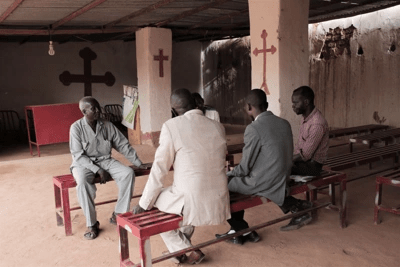
Lutheran reverend Yousef Zamgila (L) speaks to members of his congregation at the small improvised church they helped set up in a neighbours yard in Omdurman, Khartoums twin city, on August 22, 2019. Sudan’s Christians suffered decades of persecution under the regime of Islamist general Omar al-Bashir. | JEAN MARC MOJON/AFP via Getty Images
Several years ago Tony Campolo wrote, “I place my highest priority on the words of Jesus, emphasizing the 25th chapter of Matthew, where Jesus makes clear that on Judgment Day the defining question will be how each of us responded to those he calls ‘the least of these.’”
President Obama, speaking to the Pope at the occasion of his visit to the White House in 2015, stated “You call on all of us, Catholic and non-Catholic alike, to put the ‘least of these’ at the center of our concerns.” And then the President went on to identify “the poor and the marginalized” as the “least of these.”
Others identify those needing adoption or the homeless as “the least of these.” Former NIH director Francis Collins in his recent book The Road to Wisdom identified “the poor, the sick, the orphans, the prisoners, [as] the least of these that Jesus said we are most called to help.”
Since Jesus makes this such an important issue, it would behoove us to identify those whom the Bible itself would call the “least of these.”
Notice that in Matthew 25:40 Jesus said, “… inasmuch as you did it to one of the least of these my brethren, you did it to Me.” So the “least of these” are His brethren. Who are Jesus’ brethren? Hebrews 2:11 answers, “For both He who sanctifies and those who are being sanctified are all one, for which reason He is not ashamed to call them brethren.” Romans 8:29 calls Jesus “the firstborn among many brethren.” 1 John 3:13-14 counsels us “Do not marvel, my brethren, if the world hates you,” but “We know that we have passed from death to life because we love the brethren.”
So, love for the brethren (Christians) is a sign that we have eternal life, just as in Matthew 25 Jesus indicates that those who care for the least of His brethren are welcomed into His eternal Kingdom.
Some Christian writers have identified the brethren of Jesus in Matthew 25 as disciples called to preach the Gospel, such as those sent out by Jesus in Matthew 10. Those may indeed risk hunger, loneliness, nakedness and imprisonment, but the ones mentioned in Matthew 25 evidently refer to those who actually suffer such things.
Now we know from the rest of the Bible (e.g. Romans 4:3-8 and Romans 10:9) that our righteousness is based on our faith in the finished work of Jesus for the forgiveness of sins and belief in His resurrection. So, the works on behalf of the least of Jesus’ brethren mentioned in Matthew 25 do not earn us salvation. Rather, they are a sign that we are already saved, as James said, “I will show you my faith by my works” (James 2:18).
Why is this important? First of all, this passage from Matthew should not be used for virtue signaling, to drum up support for one’s favorite charity, or to promote a government program. Our salvation is never based on our works, however good they may seem. Secondly, notice that the passage in Matthew 25 is part of the so-called Olivet Discourse starting in Matthew 24 where Jesus spoke to his disciples in private. In that context, Matthew 25: 31-46 gives His brethren, His disciples, a way to distinguish between others “blessed of My Father” (v. 34) and those deserving of “everlasting fire prepared for the devil and his angels” (v. 41).
As in other places, Jesus was sorting out appearances from reality. For example, before the breakup of the Soviet Union, many leaders in the World Council of Churches and major Christian denominations refused to believe that Christians were in prison for their faith in communist countries, even when presented with exhaustive evidence. Such leaders preferred to associate with leaders of state-controlled churches in those countries. Other nominal Christians either deny that Christians were suffering persecution in communist countries, or they were indifferent about helping them. The ones suffering persecution were indeed in prison. Their families were naked and hungry, because they had no income, and the governments forbade others from helping them. Like St. Paul, they were made “the filth of the world, the offscouring of all things” (1 Corinthians 4:13), surely the “least” ones.
Meanwhile, laymen supported efforts to bring relief to families of Christian martyrs and those in prison. When the communist governments of Eastern Europe collapsed, more Christians understood the magnitude of the persecution that had occurred. More Christians also became involved in helping our persecuted brethren elsewhere.
Nevertheless, one can still discern differences in how Christians and the world respond to the persecution of Jesus’ brethren. Believers still suffer severe persecution in communist China, North Korea, and Cuba. Recently it has also become fashionable to discourage criticism of Islam. However, it’s not fashionable to help Christians persecuted by Muslims in Nigeria or Iran, by Hindus in India or by Buddhists in Myanmar.
The worldly media generally ignores or downplays such persecution, and so it takes effort by Christians to identify it. Christians suffering this persecution are the “least” of Jesus’ brethren, hated by the world (1 John 3:13). But while they are persecuted, practical help provides encouragement that they are not forsaken (2 Corinthians 4:9). One can “visit” them also through prayer and letter writing.
Our priority is always our own household (1 Timothy 5:8) and our brothers and sisters in the household of faith (Galatians 6:10). When we help our persecuted brothers and sisters we exhibit our love for Christ, since Christ dwells within each believer (Colossians 1:2 and 1:27). Unbelievers do not have that love, because suffering for the name of Christ is foolishness to them. It is God Himself who puts that love into our hearts, so it is no cause for boasting.
John Doane received a bachelor’s degree from Yale, a PhD from MIT, and worked in microwave technology for Bell Laboratories, Princeton University and General Atomics. He served on the Board of Directors of Jesus to the Communist World (which later became Voice of the Martyrs). His recent articles have been published in the Creation Research Society Quarterly and The Christian Post.
Iranian Christians attend the New Year mass at the Saint Targmanchats Armenian Church in Tehran on Jan. 1, 2023. | Atta Kenare/AFP via Getty Images
(Dear Reader please pray for our brother and sisters in Iran. Carl)
As the underground Church continues to grow in Muslim-majority Iran, Bible translators are putting their lives on the line to bring the Gospel into the local dialects so that their friends and neighbors can have access to the written word of God for the first time.
Through the work of the translation agency unfoldingWord, Christians in Iran and across the globe have been able to translate the Gospel themselves into more native languages.
The Christian Post interviewed a representative from unfoldingWord, Evan Thompson, who preferred to use a fake name or pseudonym for his safety.
“There are 1.45 billion people in the world who speak about 5,500 languages that do not have the whole Bible in their heart languages. … The Church has expanded exponentially in the last 20 years. And what these folks have learned is that you can lead someone to Christ, but if they don’t have a church, they don’t survive on their own,” Thompson said.
“You can start a church, but if that church doesn’t have the Bible in its heart language, it will typically only last one generation. Iran, for example, has churches operating underground. And there are thousands of underground churches in many other parts of the world,” he added.
UnfoldingWord, a nonprofit organization that has been around for roughly seven years, “works with Church leaders around the world who are seeking to establish their churches in sound doctrine, but lack access to Bible translations in the languages their people speak.”
A day in the life of Iranian Bible translators
The Christian Post heard from two Iranian women risking their lives to help translate unfoldingWord’s Open Bible story resources from Farsi into other Iranian dialects for evangelizing.
Both women Bible translators have chosen not to give their real names for this article to protect their identities and maintain their safety.
The first woman, using the name Miriam, said she gave her heart to Christ after coming to the realization that she is “God’s child and daughter.”
Miriam is part of a people group in Iran that is made up of millions of natives. She says she is often treated as a second-class citizen because of how those from other people groups view her status in her people group.
Miriam’s life could be in danger if the Iranian government finds out that she follows Jesus in the Islamic Republic, which Open Doors ranks as the eighth-most hostile country for Christians.
“God is my Father. I feel deeply honored to be part of this work of bringing God’s Word to my people,” Miriam said.
Despite having children and knowing that her life is at risk for believing in Jesus, Miriam said she will not stop working to translate the Gospel into her heart language.
“I cannot even imagine leaving this work unfinished. I must complete this work and see the result. I want to see my beloved ones experience salvation in Christ. This is my dream; that my people can talk about God and speak His name freely without any hesitation; without any fear they can talk about God,” she said.
Miriam was introduced to Christianity through a friend in college who gave her a Farsi New Testament. She had to read the Bible alone and in secret, an act that left her without much of a clear understanding of the Christian faith.
After college, Miriam married into a strict Muslim family. But, no matter how hard she tried to adapt to the strict religious practices of Islam, she could not find God as a Muslim.
Miriam said she didn’t give her life entirely to Jesus until after she heard about Transform, an online class offered in Iran that covered the basic teachings of Christianity.
She watched the classes secretly through various digital platforms. And during one of the class sessions, she gave her life to Christ.
Following her conversion, Miriam’s husband caught her one day watching the Transform Iran pastor on television.
Miriam could no longer hold back the truth about her faith from her husband.
“By the grace of God, he did not get angry. He said, ‘I know you are a serious-minded woman, and if this is important to you, it’s OK,'” Miriam recalled.
Miriam’s husband began watching the class with her, and several months later, he also gave his life to Christ.
Before her husband’s conversion, the Transform Iran pastor asked her if she would get involved in Bible translation because of her expertise in her heart language.
Miriam accepted the offer even if that meant risking her life to help translate the Bible into more Iranian tongues.
“We are not allowed to study our heart languages in Iranian public schools. This is a limitation for our people. I have this language specialty and experience, this expertise so that I can help my own people. People like my mother can read this book,” Miriam said.
“I have a Bible in Farsi, and I can read it. But I cannot understand the more complicated concepts in it because Farsi is not my heart language. I couldn’t establish a relationship with the Bible in Farsi. I’m very fluent in Farsi. I studied hard and had great teachers. Still, I cannot establish a relationship with the Bible in Farsi,” she continued.
“How about other people who don’t have my educational advantages? My family and friends? Having the Gospel in my heart language makes it much easier to talk to my family about Jesus. They can understand and accept Him easily.”
‘Jesus fed me’
Another Iranian Bible translator who is using the pseudonym Stella accepted Jesus into her heart after her husband died of cancer.
Following her husband’s death, Stella was left alone to care for her young son. During that time, she relied on the peace of God as her only hope.
“God has helped me. The Name of Jesus Christ was in my life. I didn’t need anybody. Jesus fed me, put clothes on me and gave me peace,” she said.
Stella learned more about God through a Bible translated into Farsi. At first, she thought Christianity was a religion. But, now she understands that Christianity is a relationship.
“When I was a new believer, I was thinking that, ‘OK, I’m going to just switch religions.’ But, when I got to know the Holy Spirit, I understood that this is a relationship, not religion,” Stella said.
Stella is currently working on a Bible translation in her heart language. Her sister-in-law became a Christian thanks to her work translating the Bible. Stella worked for five years alongside her family as they helped her review the translation of the Bible, and now she works as part of a larger Bible translating group.
“I love my mother language. I’m telling the poetry; I write the context. I write the sentence. I record it. … I know all of this is God’s work for us. God wants us to do this. … I am thinking about my mom, my father, my childhood. And everyone that doesn’t have it right now. I really want to bring God to my town and my people,” she said.
A dire need for Bible translations
Before unfoldingWord was launched, traditional Bible translation agencies across the globe have done “marvelous work” and continue to do so, Thompson noted.
However, he said the number of Western Bible translators that Bible translation agencies can send overseas is dropping, and the demand for Bible translation is increasing rapidly.
“The group that founded unfoldingWord developed a way to address this problem. We call it church-centric Bible translation. … It’s Bible translation incorporated into the life of the Church as part of its discipleship,” Thompson noted.
“Most of those unreached people have neighbors who know Christ, and they’re taking the Gospel to them. And what unfoldingWord does is we equip the Church in every people group with a goal of translating the Bible in every language.”
To help local churches translate the Bible, unfoldingWord provides people groups with open-source software and open-licensed biblical content that’s breaking the copyright barriers to source texts.
The organization also has comprehensive translation guides to answer difficult Bible translation questions. The organization offers essential doctrinal education to protect the theological integrity of the translations.
“unfoldingWord provides training for indigenous Bible translation teams over Zoom and sometimes in neutral locations,” Thompson said.
The training locations are kept secret to protect participants in certain countries where practicing Christianity is not accepted.
“Our training allows for indigenous Bible translation teams to be able to use best practices when they are translating the Bible for themselves. One of the ways that I like to say it is: ‘We don’t make Bible translations. We help develop Bible translators.’ Because that’s what the Church really needs all over the world.”
Issues bringing translations to Iran
Thompson said unfoldingWord has aided Iranian natives who have translated the Bible into dozens of native languages.
However, he said there are some unfortunate limitations to the organization’s ability to aid translators in Iran. He cited strict government policies prohibiting Iranians from studying their heart languages or their native tongues in public schools.
“All of these oppressive countries, like Sudan, like Iran, and some others we could name, are trying to Islamasize their whole population. And one of the ways that they do that is by forcing them to speak this one national language, and it’s causing their heart languages to die out,” Thompson said.
In Iran, the government recognizes Farsi as the national language. However, many natives speak other Iranian dialects more fluently.
“It’s very much like anybody that comes to America from someplace else, and we put them in American schools to learn English. Unless their family makes it a point to keep their native languages … alive in their families, by the second or third generation, the kids can’t speak their native language anymore,” Thompson said.
The few responsible for the many
Miriam believes God has blessed her with a huge responsibility to help translate the Bible into more Iranian languages.
“This is not just a scientific book. This is God’s Word. I felt some tension. I was scared that I would not do the work well enough, but I’m very happy to make it available so that my people can establish a relationship with the Bible. That’s why I got involved with this Bible translation project,” she said.
When asked if she can imagine the day when the Bible is completed in even more Iranian languages, Miriam said it will take many years, and she doesn’t know if she’ll live long enough to see the project’s conclusion.
“I want my children to experience the result of my work so that they can know Jesus through their heart language. I never thought this project would grow like this. But I’ve learned that it’s not just about me,” Miriam said.
“I need this team that has been pulled together. For safety, we have many people working on this project secretly. There may be several Christians in one Iranian family, but they cannot share their faith with each other openly,” she continued.
“We need more people who can speak my heart language to continue working on this project. … I want to ask for prayer … to recruit people into the project who know our language well.”
8. Believers in Yemen Especially Vulnerable in Civil War and Famine
An ongoing civil war in Yemen has created one of the worst humanitarian crises in recent memory, making an already difficult nation for Christians to live in even harder. The chaos of war has enabled radical groups to take control over some regions of Yemen, and they have increased persecution of Christians. Even private worship is risky in some parts of the country. Christians are suffering from the general humanitarian crisis in the country, but Yemeni Christians are additionally vulnerable since emergency relief is mostly distributed through Islamic organizations and local mosques, which are allegedly discriminating against all who are not considered to be pious Muslims. Converts to Christianity from Islam face additional persecution from family and society. In Yemen, the small church is composed mostly of Yemeni Christians with a Muslim background who must live their faith in secret. They face persecution from the authorities (including detention and interrogation), their families, and radical Islamic groups who threaten converts with death if they don’t denounce Christ and re-convert.
9. IRAN: Illegal to convert, illegal to preach
In this gateway to the Middle East, Christians are forbidden from sharing their faith with non-Christians. Therefore, church services in Persian, the national language, are not allowed. Converts from Islam undergo persecution from the government; if they attend an underground house church, they face the constant threat of arrest. Iranian society is governed by Islamic law, which means the rights and job possibilities for Christians are heavily restricted. The government sees them as an attempt by Western countries to undermine Islam and the Islamic regime of Iran. Leaders of groups of Christian converts have been arrested, prosecuted and have received long prison sentences for “crimes against the national security.” In December, to crack down on Christians sharing their faith, Iranian police arrested 100 Christians in one week, making a blatant statement to both Christians and Muslims. Iran is also infamous for its prisons and inhumane treatment of Christians in places like Evin Prison where well-known house church pastor Yousef Nardarkhani is serving a 10-year sentence.
Dear Reader: Let us remember our brothers and sisters in prayer as they suffer in Yemen and Iran; especially those imprisoned for their faith. May the Holy Spirit fill them with boldness and confidence in Christ, as they live as sheep among wolves. May grace upon grace be upon them.
Thank you for your time spent educating yourself on the state of the Body of Christ in the earth.



 Psalm 119: 38