
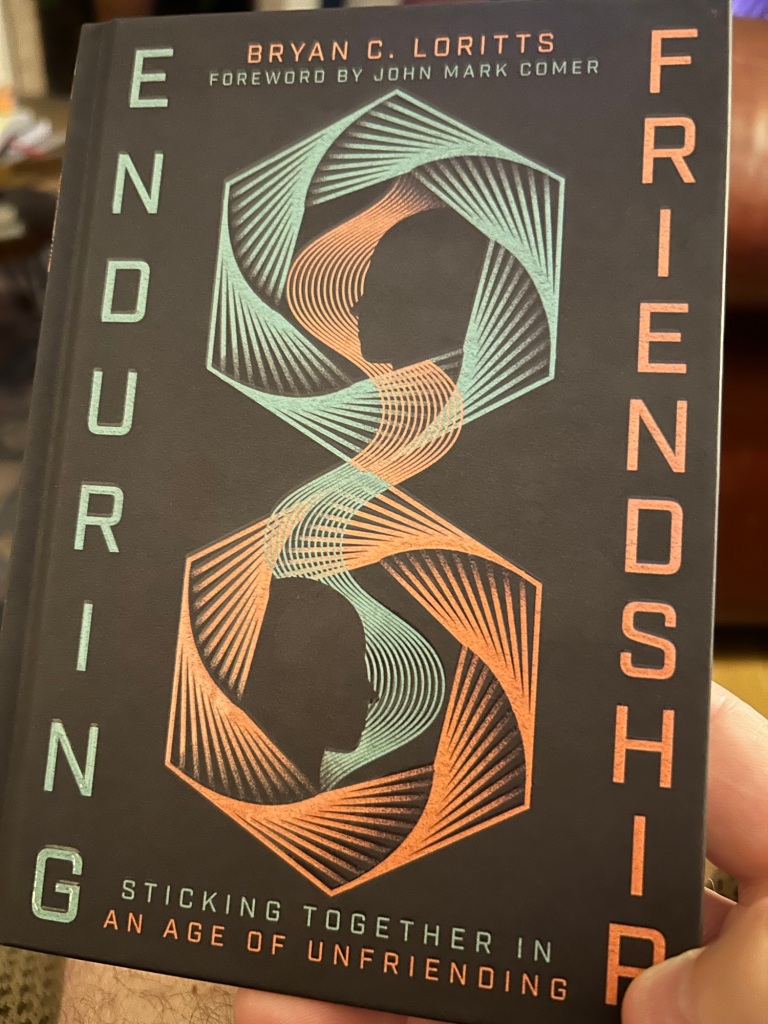
Enduring Friendship: Sticking Together in an Age of Unfriending

Bryan Loritts provides a great challenge to build relationships that last in his new book Enduring Friendships: Sticking Together in an Age of Unfriending. The book uses Paul’s New Testament letter to Philemon as a backdrop for thinking deeply about friendship. And it does challenge us to think deeply about our relationships. Onesimus, the slave to Philemon, who likely stole and then ran away from his servitude, making him deserving of severe consequences if not death. Philemon, the enslaver, and partner in the gospel with Paul. Paul, the missionary, who led both of these men to Christ and now pleads with them to do hard things for their relationship and for the glory of God.

  • He wants Onesimus to repent and go back and face his offended enslaver.
  • He wants Philemon to repent and receive Onesimus, not as a slave who stole from him, but as a brother who merits his embrace and partnership.
  • Paul himself wants to pay whatever is owed to Philemon. “Put it on my account.”

We don’t know “the rest of the story”, but can imagine that repentance was had, forgiveness was extended, and God was glorified, because Onesimus is later counted as a Bishop in the early church.

This book reminds us that relationships are hard but worth fighting for. And enduring relationships are costly and take courage to pursue through the messiness of life. What a mess the book of Philemon offers up. But what a beautiful picture of grace and forgiveness if Paul’s formula is lived out. The offender repents, the offended forgives, and the beauty of reconciliation is witnessed by all.

I wish I could say I didn’t have any tangled messes of relationships in my 49 years, but I can’t. I wish I could say that I’ve always done the right and hard thing for the sake of reconciliation. In ministry, the slights received often make us callous toward deep relationships and make it easier just to let people walk away or not make the journey back to the one we offended. People come and go. Sometimes close relationships are resisted because we begin to expect slights, disrespect, betrayal, and eventual departure. Enduring Friendships reminds us that relationships are worth it.

The key to it all of course is Jesus. He empowers us to forgive, to receive grace, and to repent. And he did the hardest thing of all so that we could experience reconciliation by offering up his own body on the cross.

Some great thinking and maturing to be stirred up by Bryan Loritts’ new book. Grab a copy.

Here’s a few of my favorite quotes:

  1. Soul-level friendship often feels like a full-time job with periods of bad compensation.
  2. The problem is relationships are drama, and I don’t mean that in a negative way. Whose life is not made up of mountaintops and deep valleys? If we’re not up for drama, we are not ready for relationships.
  3. A Christian who does not forgive is a contradiction in terms.
  4. There is no lasting friendship without grace.
  5. If you want to have sustained friendships over the course of your life, you must accept that you will at various points be Onesimus and Philemon – offender and offended.
  6. When we fail to allow for nuance and complication, we set the table for short-lived friendships that never resurrect from the graveyard of offense and betrayal.
  7. The journey of friendship is fraught with unavoidable hurt because those involved are marred by sin.
  8. Gossip is saying something behind a person’s back we would never say to a person’s face. Flattery is saying something to a person’s face we would never say behind their back.
  9. Pride is the #1 killer of friendship. Humility is the prime nourisher of healthy relationships.
  10. When we are at death’s door and inevitably stare into the rearview mirror of our lives, we will not take joy in our acts of retribution.
  11. An ungracious Christian is an oxymoron.
  12. Nothing illumines our witness and stands more in contradistinction to our world than when we fight to remain at the table of friendship with people who we have wronged and who have wronged us.
About Lane Corley

I am – Follower of Jesus Christ – Husband to the beautiful and patient Heather Corley – Father of three. – Church Planter/Church Planting Catalyst for Send Network – When I can, I’m reading, raised bed gardening, and on mission with my church. – Hoping to be helpful.

View all posts by Lane Corley

True Conquerors

“…those that forgive are the conquerors.”

“…those that revenge are the conquered.”

“Do not be overcome by evil, but overcome evil with good.” (Romans 12:21)

Do not be overcome by evil.” Let not the evil of any provocation that is given you, or make such an impression upon you, as to dispossess you of yourselves, to disturb your peace, to destroy your love, to ruffle and discompose your spirits, to transport you to any indecencies, or to bring you to study or attempt revenge. He that cannot quietly bear an injury is perfectly conquered by it.”

But overcome evil with good, with the good of patience and forbearance*, nay, and of kindness and beneficence to those that wrong you. Learn to defeat their ill designs against you, and either change them, or at least to preserve your own peace. He that hath this rule over his spirit is better than the mighty.”

Matthew Henry -Romans 12: 19-21 *forbearance means a suspension of wrath.

May it be so in our lives,

Carl

“Secrets for Sufferers” From A Sufferer

Dear Reader the following was written by Richard Wurmbrand (1909-2001) who was imprisoned in communist Romania for fourteen years because of his faith in Christ. In 1965, he and his family was ransomed out of Romania for $10,000 and eventually moved to the U.S where he started a global ministry that became known as The Voice of the Martyrs. He testified before the U. S. Congress to the cruel treatment of Christians under communism. Removing his shirt, he showed the Senators and Representatives the stripes and wounds he received from the communist. Pray for those who are suffering everyday for Christ. Pray that the comfort of the Holy Spirit would be with them and they would be faithful unto death if need be. Be encouraged, do your part for the church, and prepare yourself. Carl

“Jesus promised “not peace but a sword” (Matthew 10:34), and ever since He uttered those words, committed Christians have been targeted relentlessly by pagan and religionist alike: crucified, burned at the stake; tortured on the rack; hunted in mountain passes, forests and caves; starved; beaten; brainwashed; tormented.

Only a devil could brew the consummate evil that has been meted out to Christ’s humble disciples over the centuries, reaching a horrendous climax in our own bloody era.

Is suffering, whether intended or circumstantial, a waste, or can it be redemptive? How should Christians respond? Jesus said, “Love your enemies” (Matthew 5:44) — but can you love the devil incarnate in another human being, evil personified?

I would like to propose that today’s Christians in repressive countries can provide a model for those of us in the free world.

Christians in the West often quote the text, “I can do all things through Christ who strengthens me” (Philippians 4:13), giving it a positive spin. But Paul had just said he had learned to endure all things –humiliation, hunger and want, as well as the satisfaction of his needs. Persecuted believers take Paul’s words as a promise that Christ will strengthen them to endure suffering, because they know a Christian can’t escape tribulation.

I think of a young girl of our Romanian underground church whose activities were discovered by the secret police. She had been guilty of secretly distributing Gospels and teaching children about Christ. To make her arrest as painful as possible, they decided to wait a few weeks for her wedding day.

When she dressed for the event every woman looks forward to, the police suddenly broke in. Anticipating their intentions, she held out her hands, which they handcuffed roughly, looked lovingly at her groom, then kissed the chains, saying, “I thank my heavenly Bridegroom for this jewel He has presented to me on my marriage day. I thank Him that I am worthy to suffer for Him.”

She was dragged off to prison, leaving behind weeping Christians and a weeping bridegroom. Five years later she was released, haggard, broken, looking 30 years older. She had remained faithful. And her intended had waited for her.

A Soviet prisoner who was mocked unmercifully said, “Many fear suffering: in the past, I too feared. But the presence of the Lord in jail has given me so many happy experiences that I would not have changed them for years of easy living in freedom.”

How impressive is the prayer of a woman in a Siberian camp: “O God, accept all my sufferings, my tiredness, my humiliations, my tears, my nostalgia, my being hungry, my suffering with the cold, all bitterness accumulated in my soul….Dear Lord, have pity also on those who persecute and torture us day and night. Grant them, too, the divine grace of knowing the sweetness and happiness of Your love.”

How do the persecuted view their torturers, who often take fiendish delight in inflicting maximum pain? May are able to look at them with love, knowing that without Christ they are eternally lost. Believers exemplify what Jesus preached: “Love your enemies … pray for those who spitefully use you and persecute you.” And they practiced what He taught: “Father forgive them, for they know not what they do.”

Once when I was in prison, a pastor was thrown into our cell. He had been horribly beaten and was covered with blood. Some prisoners cursed the communists. Half dead, groaning in pain, he said, “Please don’t curse them. Be quiet! I want to pray for them.”

Once I was in the same cell with a man I had brought to Christ. He left behind a wife and six starving children. I asked him, “Have you any resentment toward me for bringing you to Christ and for the fact that your family is in such misery?”

His reply typifies the attitude of so many martyrs down through the centuries: “I have no words to express my thankfulness that you have brought me to the wonderful Savior. I would not have it any other way!”

In Ukraine, the Christian Terelya was put in a psychiatric asylum. The sadist psychiatrist told him, “The fact that you call yourself a Christian shows already you have a serious and irremediable sickness. Faith in God is a mass psychosis, a kind of schizophrenia.”

But instead of brooding about his suffering, Terelya brought officers of the secret police to Christ. They provided him with paper and pencil and smuggled out a whole notebook of his with joyous poems praising God.

Out of the mire of suffering grows the lily of joy in the Lord. ”

Richard Wurmbrand–faithful witness and pastor under Stalin’s communism, founder of The Voice of the Martyrs