“Whatever you do, He will make good of it. But not the good He had prepared for you if you had obeyed Him. That is lost forever.” C.S. Lewis
While the government is not God—a truth they tend to forget from time to time—their burgeoning relationship with the companies developing artificial intelligence serves as a helpful parable for understanding a key component of our relationship with the Lord.
Scripture is clear that when our sin takes us outside of God’s will, there will be consequences (Galatians 6:7). And though that cost may be delayed at times, it doesn’t go away. As such, it is much better to work with God than to wait for him to correct us when we go off the right path. That doesn’t mean the Lord can’t redeem our mistakes, but it’s still far better to have never committed them in the first place.
C. S. Lewis described this principle well when he said of God, “Whatever you do, He will make good of it. But not the good He had prepared for you if you had obeyed Him. That is lost forever.”
As Christians, we must not make the mistake of giving up the good that God has prepared for us simply because it’s not what appeals to us in the moment. The Lord wants to direct our path because he alone knows what is ultimately best for us and for his kingdom. But he also loves us enough to give us the freedom to make that choice for ourselves.
So which path will you choose?
Will you take the road that seems best to you, deciding that it’s worth the risk of God “bringing down the hammer” to correct you in the future? Or will you let the Lord lead and submit to his will as you partner with him in advancing his kingdom?
Put that way, the choice should be simple. And, ultimately, it is. But it’s also one that all of us get wrong from time to time when we lose sight of what is really at stake.
So take some time now to pray and ask God if there are any ways that you have strayed from his will. If the Holy Spirit brings any to mind, repent and commit to whatever steps are required to correct those mistakes.
And don’t wait to do so. Every day spent outside of his will is filled with moments and opportunities you can’t get back.
Let’s make sure we don’t miss them today.
Source: Ryan Denison, PhD,Is “Safe, Secure, and Trustworthy” AI Possible? Biden Issues Executive Order on Artificial Intelligence. November 3, 2023, Denison Forum.
Today, over 3,000 people groups have no missionary presence and likely have no access to the Good News of Jesus Christ.
The lack of accurate knowledge about God’s saving grace is not limited to just these distant groups. You and I are surrounded by THE LOST every day regardless of what nation we live in.
Fellow Christian, what are you doing to fulfill the Lord’s commandment to:
“Go therefore and make disciples of all the nations, baptizing them in the name of the Father and the Son and the Holy Spirit, teaching them to observe all that I commanded you…” (Matthew 28: 18-20)
(Dear Reader: This ministry was recommended to us by a friend who served in Communist China for years and it is worthy of your support. May God bless you and the church in China. Carl)
This newsletter shares insights into the current situation in China, both politically and for the Body of Christ. In addition to our standard newsletter, we want to share links to articles and videos that give further context into some of the claims we have made.
For those who are serious about learning more of the situation in China today, please click on this link to go to a page with a list of links to extra resources on the situation in China.
Please note we have selected just a few of the most interesting and helpful pages out of hundreds that are available online. Pages from other websites should open in separate windows on your browser.
President Xi Jinping and His Role in the World
“How long, Lord, will the wicked, how long will the wicked be jubilant? They pour out arrogant words; all the evildoers are full of boasting. They crush your people, Lord; they oppress your inheritance….
Does he who disciplines nations not punish? Does he who teaches mankind lack knowledge? The Lord knows all human plans; he knows that they are futile.” – Psalm 94:3-5, 10-11
OVER THE PAST SEVERAL YEARS many people from around the world have asked us to help them understand what’s going on in China.
Many Christians are shocked, because for years all they heard was how revival was bringing millions of Chinese into God’s kingdom.
Suddenly, all news from the Church in China stopped in its tracks, as a new Emperor, Xi Jinping, caused the Body of Christ to adopt a defensive posture.
Who is this man who has “purged” (i.e., killed or imprisoned) hundreds of thousands of people, and who has created such a stench across Asia that 20 neighboring countries — from Central Asia to India and the Philippines — now have disputes with China.
Let’s take a closer look at this man who has so enlarged the Chinese military and covert influence that a World War seems inevitable if things continue on their present trajectory.
We deliberately used the term “Emperor” to describe Xi Jinping. While technically he is the atheistic head of the Chinese Communist Party, for thousands of years China was ruled by Emperors whose authority was absolute.
There were no elections, debates, or protests against emperors. Any perceived hesitancy to obey an emperor’s edict was met with swift and severe punishment. In there paranoia, many Chinese emperors killed millions of their subjects to consolidate their power.
Although emperors have not officially ruled China since 1912, in reality Communist leaders like Mao and Xi have been emperors in all but name. It is important to understand that Chinese emperors were never viewed merely as leaders of China.
You may know that the Chinese name for their country, Zhong Guo, means “Middle Kingdom.” The belief that their country is the center of the world is deeply ingrained in the hearts and minds of every Chinese generation.
Emperors are believed to have a “Mandate of Heaven,” by which they receive the authority to rule. This philosophy, which dates back 2,500 years, assumes that because there is only one heaven, there can only be one emperor and one state with legitimacy in the whole world.
Over the years we have frequently met Chinese from all walks of life who are glad and proud that China is now throwing its weight around in the world. From taxi drivers in Singapore to businessmen in San Francisco, countless Chinese believe that now is the time for China to rise up and seize its destiny as world leader—economically, culturally, and militarily. It
is not so much a desire as a statement of fact. Even among Chinese Christians we have met few who would ever dare to openly criticize Xi Jinping or his decisions. After all, he is the emperor, appointed by heaven itself. Opponents are seen as evildoers and are mercilessly crushed. Just ask people in Hong Kong how life has changed since Xi came to power.
The Mandate of Heaven philosophy spread to many parts of East Asia in the centuries before Christ. It explains why countries like North Korea have been unable to throw off its heavy yoke of rule by the Kim family for so long, Japanese emperors were also seen as heaven- sent leaders who were invincible because of the Mandate of Heaven. The Japanese belief of invincibility abruptly ended when two atomic bombs fell on Japan in 1945.
In 2016, we began to report that a major shift was happening in China, and the new dynamic would change the way Christians function in China, while the country itself would become a huge threat to democracies.
China decided it was time to throw off its “Century of humiliation” at the hands of foreign powers and take its rightful place as leader of the world, with Xi Jinping on the throne.
A Prediction…
WE DO NOT BELIEVE THE RISE OF CHINA will lead to world domination.
“Emperor” Xi’s harsh authoritarian rule, as he has consolidated absolute power in China and made enemies all around Asia and the world, has not been working out too well.
The economy in China is in tatters (far worse than reports in Western media), and a growing number of Chinese are beginning to quietly question if their leader is taking the country on a path that will end well for them.
Many nations now see China as the number one threat to global security and Xi’s aggressive stance has brought about the formation of military alliances to counter his plans.
It has been said that “power corrupts, and absolute power corrupts absolutely.” Strongmen like Xi Jinping believe they operate with impunity, as it is their birthright. Above all else, the thing they desire most is regime survival.
For that reason, Xi constantly purges his leaders, isolating himself more and more while at the same time changing the constitution to guarantee he will never be replaced. Emperors of China were never changed. They ruled for life.
Do we think that Xi and the Chinese Communist Party will reach their goals of world domination?
No, for the following SEVEN REASONS:
1 GOD HAS THE FINAL SAY.
We believe it is not a coincidence that as soon as China launched its campaign to systematically destroy Christianity in 2016-17, their economy began to disintegrate. Ultimately, the battle for the 1.4 billion souls of China is what is at stake.
The Lord Jesus Christ has purchased a pure bride numbering over 100 million believers in China. They are the apple of His eye, and He will not stand by and let His precious inheritance be decimated.
2 THE DEMOGRAPHICS FOR CHINA ARE A NIGHTMARE.
With a rapidly ageing population and a lack of young people of tax-paying age to pay for Xi’s military expansion, things are likely to stagnate and deteriorate in China.
Some economists estimate that China needs 400 million more people of working age to keep its economy going forward and fund their military aspirations, but they have “sown the wind and reaped the whirlwind.” (Hosea 8:7)
The Communist Party’s one-child policy, accompanied by hundreds of millions of forced abortions, has wiped out a generation of Chinese. The very people they need to pay for their plans don’t exist. They were sacrificed on the altar of the Communist Party death cult.
3 THE POPULATION OF CHINA IS ALREADY IN RAPID DECLINE
with some provinces shrinking by millions of people each year. Some experts calculate that by the end of this century the population of China may be half of what it is now. Two years ago, it was hardly noticed when the government lowered the national population by 121 million from previous inflated figures.
An increasing number of young people in China today have no desire to have children, which are considered an economic inconvenience. That unnatural instinct has been suppressed by generations of Marxist propaganda that work and money—not faith in God and a loving family—are the keys to happiness.
4 STRETCHED TO BREAKING POINT.
Xi’s reign has been greatly helped by his access to technology that previous rulers like Mao Zedong could never have dreamed of.
A friend who recently returned from his first visit to China in several years was shocked at the changes he experienced. He said:
“Everywhere I experienced anti-foreign sentiment from unfriendly people, and I saw many people paying for things with their faces. By allowing their faces to be scanned, payments are deducted directly from their accounts. No phone or bank card is needed, and cash is practically unheard of.”
With more than 400 million facial recognition cameras watching and evaluating their every move, and Xi demanding complete obedience to the Marxist-socialist agenda, many people feel stretched to breaking point and are increasingly fed up with the system.
5 XI HAS TRIED TO REPLACE GOD WITH A CULT OF HIMSELF.
He wants to be all-seeing, all- knowing, and all-powerful. He has erected giant billboards and posters of his face (like the one on the cover of this newsletter) and he demands unwavering devotion and commitment to his cause. In tens of thousands of churches across China, crosses and Scripture verses have been forcibly removed and replaced with posters of Xi and Mao, or with Chinese flags.
The Chinese Communist Party always claims there is no God, while setting themselves up as gods who must be obeyed and worshipped at all times.
Interestingly, in churches where posters of the Ten Commandments were displayed, instead of the authorities removing them they just scratched out the first commandment that says: “You shall have no other gods before me.”
They didn’t object to any of the other nine commandments, but only the first one upset them. Why? Because like Satan, they desire to fill the role of God in people’s lives.
6 A GENERAL MALAISE HAS COME UPON THE YOUTH OF CHINA.
After studying hard all their lives, tens of millions of university graduates can’t find any work at all, and a new expression, tang ping, or “lying down flat” swept over many Chinese young people.
Countless millions have lost the desire to excel, and they now see life as meaningless.
More recently, during Xi’s harsh Covid restrictions, tang ping has been replaced by a new catch-phrase: bai lan, meaning “let it rot.” These developments refer to a voluntary retreat from pursuing goals and will expediate decay in Chinese society and the economy.
7 XI JINPING SEEMS TO HAVE A PERSONAL HATRED FOR CHRISTIANITY.
After systematically expelling almost all foreign Christians from China over the past 6 or 7 years, a widespread persecution has afflicted God’s people in every part of the nation, but especially in the border provinces.
The Communist Party has even been working on a new Bible, removing passages they don’t like, and replacing them with socialist teachings.
One proposed change is the story of the woman at the well. The Communist Party didn’t like that she was forgiven, so they are reportedly changing it.
So instead of Jesus telling her, “Go and sin no more,” the new Communist Bible has Jesus picking up a stone and stoning her to death! Let’s see if God will allow such blatant blasphemy and corruption of His holy Word to go unpunished.
How did the Bible trigger the West’s passion for medical advancement?
Vishal Mangalwadi: Mainstream Hinduism taught that matter (including the human body) was evil—illusion or maya. In contrast, the first chapter of the Bible declared the material realm, including the human body, to be very good. Genesis 3 taught that sickness and death came as a curse upon human sin. The Lord Jesus came to give us abundant and eternal life. His soul did not reincarnate. His crucified body was resurrected and glorified. The Bible teaches that God will resurrect our perishable bodies as immortal and glorified bodies.
Because of God’s high view of the human person, including his body, the Lord Jesus healed the sick and commissioned his disciples to a ministry of healing. Therefore, medieval Roman Catholic monasteries did not simply pray, preach, and practice piety. Many of them took care of the sick. They studied, and taught medicine. The Schola Medica Salernitana became the world’s first medical school in the South Italian city of Salerno. It grew out of a 9th century dispensary in a monastery. This monastic tradition blossomed into modern medicine after the 16th century biblical Reformation.
What is the biblical ideal of human dignity and how did it inform the West’s social structure?
Vishal Mangalwadi: Gautam Buddha, the founder of Buddhism, saw human life as suffering. Thomas Hobbes, the only atheist in English Enlightenment, viewed life as “nasty, brutish, and short.” Pope Innocent III detailed “The Misery of Man.” Secular intellectuals have no option but to see man as nothing more than an evolved animal.
Species, races, and individuals do not evolve equal. Evolution does not bestow any rights upon any animal. Western notions of human dignity, equality, and inalienable rights are the Bible’s unique contribution to the modern world. Pico della Mirandela (1463-94) articulated the Bible’s case for human dignity in An Oration on the Dignity of Man. His case rested upon (a) creation of man in God’s own image and (b) God’s incarnation in the Jesus of Nazareth.
God became man in order to save man, because man was made in God’s image – precious and immortal. Full implications of these doctrines are still being worked out. Yet, much of our future will be shaped by the question: Is man merely another animal (organic intelligence) or is he uniquely God’s image—so precious to God that He would come to this earth to save him?
How did the Bible equip the West to cultivate compassion?
Vishal Mangalwadi: Through parables such as that of the Good Samaritan, the Lord Jesus explained the command ‘Love your neighbor as yourself.’ He exemplified it by blessing those who cursed and killed him. Jesus courted the wrath of religious establishment by caring for the sick even on Sabbath. He reinforced prophets such as Isaiah, Jeremiah, and Amos, by teaching that God’s holy law was made for man’s good. Therefore, a religiosity that did not care for individuals was worse than worthless. It was obnoxious. What we do for the littlest of his brothers, we do for him.
What is your response to people who say the Bible subjugates women?
Vishal Mangalwadi: The women’s lib movement started in America because social inequality between men and women was obvious. Many women got paid less then men for the same work. They were allowed to serve coffee after worship, but not communion during the worship. They could play piano in a church but not pray. Yet, crucial questions are: who told America that men and women were created equal; that sin brought subjugation as a curse; that the curse was nailed upon the cross of Calvary? The question that triggered my reflections was: Why didn’t the Saudi women burn their burqas and their bras? What empowered American women to launch the women’s lib movement? Was it because American women were more oppressed than the Muslim of Hindu women? Or was it because something had already made American women stronger than other women around the world? My counter-intuitive discovery was that it was the Bible that empowered women.
No culture has ever required a husband to love his wife. Every culture, including Jewish and post-Christian Western cultures, have permitted husbands to divorce their wives and/or take other women. In 1831-32, French magistrate Alexis de Tocqueville observed that American women had become much stronger than European women because the biblical ideal of marriage had had the biggest impact in America. No country in the world will even try to impeach a president who lies about his private sex life.
The Bible emancipated Western women because it alone asserted theological equality of male and female and also because it defined God’s idea of marriage as a one-man one-woman lifelong and exclusive relationship. A woman is liberated to develop herself and to strive for her dignity when she knows that her fallen husband is not permitted to despise her, divorce her, covet his neighbor’s wife or to take another woman as a girlfriend, concubine, or wife. He has to love her, irrespective of the level of her intelligence, charm, abilities, and fallenness.
Roman wives were the victims of Rome’s playboy culture. Many of them followed and financed the Apostle Paul and (over time) won the Roman empire for Christ, because they understood better than modern feminists that Paul was emancipating them.
Men and women are equal, but husbands and wives (like parents and children and all other formal relations) have to live in a hierarchical relationship. No institution can function on the basis of equality-without-hierarchy. Christian marriages are being destroyed because the Western church has surrendered to the world’s folly that equality precludes authority. The Christian idea of marriage is unique. It can be sustained only if we take seriously the Bible’s idea of the fallenness of men and women and the necessity of wives submitting to fallen husbands, and husbands loving fallen wives.
How is human equality a biblical principle?
Vishal Mangalwadi: Sociologically, the modern idea of human equality was born when Martin Luther discovered the New Testament doctrine of the “priesthood of all believers.” Gradually, this truth began to challenge the West’s social/racial injustices.
George Whitfield was the first white revivalist in America, who began preaching to the blacks. His preaching evoked protests: “Do you really want us to kneel with our slaves and drink communion from the same cup?”
In order to counter deep rooted prejudices, in 1740, Whitfield began writing a series of articles. These explained how and why the Bible teaches human equality. Whitfield’s writings created the consensus which Thomas Jefferson articulated in the original draft of the Declaration of Independence as, “We hold these truths to be sacred and undeniable that all men are created equal.” By “sacred” Jefferson meant derived from sacred Scriptures. Under pressure from Benjamin Franklin, the Declaration was changed to read, “We hold these truths to be self-evident that all men are created equal.”
To Indian sages, inequality was self-evident. That is why they invented the caste-system which still survives. Equality was “self-evident” even to American Deists because their worldview was shaped by the Bible. Now that evolution is shaping everyone’s intellectual lenses, only a fool will be able to assert that all men have evolved equal.
What role did the Bible play in the establishment of the university?
Vishal Mangalwadi: No Hindu ashram ever grew into a university. No Orthodox Christian monastery developed into a university in Eastern Europe, Greece, or Russia. Augustinian monasteries and Cathedral schools blossomed into West European universities such as Oxford, Cambridge, Paris, Prague, Heidelberg, and Wittenberg because St. Augustine taught that the human mind was God’s supreme gift to mankind. The mind was made in God’s image, therefore, in order to be godly, one had to cultivate the mind as well as piety.
These monasteries were different than every other center of religious education. Young boys came to a monastery to learn to pray and become a priest. But in these monasteries they had to study logic, literature, philosophy, mathematics, and rhetoric as well. This is what created the West’s uniquely rational religious leader, who prayed as well as studied birds and the solar system.
Following the Reformation, Christian thinkers realized that God wants all men to be saved and come to the knowledge of the truth (1 Timothy 2:4-7). In order to know truth, man has to study three books: The book of God’s words (the Bible), the book of God’s works (in nature and culture), and the book of God’s reason (logic and mathematics that run the human mind and physical universe.) This insight was captured in Harvard Crest in 1643. VERITAS is written on these three books. Today, the university has degenerated into a factory producing laborers for the market and the state because, without God’s word, the university has been forced to shy away from the very concept of truth.
Since the Bible is not a “fax from Heaven,” explain how sentences written by humans can be considered the Word of God?
Vishal Mangalwadi: Prophet Elijah said to king Ahab, “As the Lord, the God of Israel, lives, before whom I stand, there shall be neither dew nor rain these years, except by my word” (1 Kings 17:1). By the end of the chapter, the Sidonian widow of Zarephath exclaimed, “Now I know that you are a man of God, and the word of the Lord in your mouth is truth.” (vs. 24). Eventually Ahab was forced to acknowledge that Elijah’s words—a man’s words—were, in fact, the word of God.
God said to Jeremiah, “Behold, I have put my words in your mouth…I am watching over my word to perform it.” (Jeremiah 1:8-11). God’s word includes the words He gives His men and also men’s words which He watches to perform, fulfill, and honor. Daniel and his friends were willing to go into the lions’ den and fiery furnace because 70 years of Jewish history had confirmed to them that Jeremiah’s words, disregarded by their fathers, were in fact God’s word.
The gospel is that Jesus Christ died “according to the Scriptures,” was buried and rose again the third day, “according to the Scriptures” (1 Corinthians 15:3-4). That means that Jesus didn’t have to die. In the Garden of Gethsemane Peter gave him the opportunity to evade arrest. During his trial, Pilate gave to Jesus plenty of room to escape crucifixion. The Lord Jesus sacrificed his life because he believed that the words of Scripture, written by fallen and fallible men, were in fact God’s words.
As you observe the West’s treatment of the Bible, where do you see western society headed?
Vishal Mangalwadi: Germany, the birthplace of biblical Reformation, became the arch villain of the 20th century, because during the 19th century, German theology undermined the Bible’s authority. I see post-biblical America as the greatest terror to the 21st century. I think the future of greed-driven American capitalism is best captured by James Cameron in his terrible, pagan, and commercially hit movie, Avatar.
Muslim nations cannot be the world’s biggest threats because while Islam can build a strong Caliphate, it does not and cannot build nations. Protestantism has built history’s greatest nations; therefore, the world has the most to fear from Protestant nations that destroy the very foundations of their morality and civility.
What are your thoughts about Bible Gateway as a way to reinvigorate civilization’s soul?
Vishal Mangalwadi: Bible Gateway is the only site I use to get into the Bible. (Though I am yet to cultivate the discipline to use everything that it offers.) I appreciate this interview because the new generation needs to learn why the Bible must be studied, trusted, obeyed, and applied.
Is there anything else you’d like to say?
Vishal Mangalwadi: Christianity has lost America because the church forgot that “God wants all men to be saved and come to the knowledge of the truth…” for this reason Paul the apostle was appointed a “preacher” and a “teacher of the gentiles in faith and truth” (1 Timothy 2:4-7). The American church has the capacity to disciple the nation, but for over a century it has lacked the theology for discipling nations. It has been preoccupied with saving souls, not with discipling nations.
The good news is that the state of Minnesota just started an education revolution that can disciple America. Students will enroll in an accredited college, but go to the local church to study online as a cohort in a face-to-face mentorship with a credentialed Academic Pastor. A student will get a college degree for under $10,000 a year. Check out www.VirtuesCampus.com.
Bio: Vishal Mangalwadi, LLD, was born and raised in India. He studied eastern religion and philosophy in India, Hindu ashrams, and at L’Abri Fellowship in Switzerland. He is a dynamic and engaging speaker who has lectured in 35 countries. He is a social reformer, political columnist, and author of 14 books. Christianity Today calls him ‘India’s foremost Christian intellectual.’
(Blog note: every Christian needs to read this article. Please share it with someone you know. Carl)
Part 1
What triggered the West’s passion for scientific, medical, and technological advancement? How did the biblical notion of human dignity inform the West’s social structure and how it intersects with other worldviews? How did the Bible create a fertile ground for women to find social and economic empowerment? How has the Bible uniquely equipped the West to cultivate compassion, human rights, prosperity, and strong families? What is the role of the Bible in the transformation of education? How has the modern literary notion of a hero been shaped by the Bible’s archetypal protagonist?
Why did you dedicate The Book That Made Your World to Arun Shourie, a Hindu who is critical of the Bible?
Vishal Mangalwadi: In 1994, Arun Shourie, at that time one of India’s foremost public intellectuals, attacked Western missions and the Bible. He powerfully rehashed some of Thomas Paine’s arguments from The Age of Reason (1793-94). Mr. Shourie studied in the best Christian college in India before getting a PhD from an American university that had been founded by Methodists. I realized that this good and learned gentleman was clueless about what the Bible is and what it has done because his Christian professors in India and in America had no idea.
In spite of Western skepticism, many Chinese intellectuals sense that the Bible was the foundation of the West’s amazing development. In contrast, Hindus such as Mr. Shourie follow ill-informed, in fact, arrogant and foolish, Western repudiation of the Bible. They think that India can be made a great nation by returning to Hindu worldview, which destroyed India in the first place.
One book will not convince skeptics, but it can become a seed that multiplies into many PhD theses, popular books, TV shows, and films. I dedicated the book to Arun Shourie to help intelligent Indians discover the rock upon which India can realize its potential to be a great civilization—a blessing to all the nations.
You write that your book is not so much about the Bible as it is about great literature, art, science, technology, heroism, and virtues. Explain what you mean.
Vishal Mangalwadi: My book is not “Bible study.” It is a study of the global impact of the Bible and it’s worldview. The Bible was the book of the last millennium. No other book was translated, published, distributed, studied, or debated like it. What impact did it have on the world? That is the question my book explores.
Why do you call the Bible the soul of Western civilization?
Vishal Mangalwadi: Although the West has amputated its soul, I call the Bible the soul of Western Civilization because it propelled the development of everything good in the West: its notion of human dignity, human rights, human equality, justice, optimism, heroism, rationality, family, education, universities, technology, science, culture of compassion, great literature, heroism, economic progress, political freedom. Take, for example, democracy.
The myth that modern democracy came from Greece was invented only in the 20th century by John Herman Randall of Columbia College (New York) and Mortimer Adler and Robert Maynard Hutchins of the University of Chicago. The reality is that in his classic, Republic, Plato, the greatest of Greek philosophers, had already condemned democracy as Mobocracy—the worst of all political systems. Plato proposed that the ideal republic should be ruled by philosopher-kings. His disciple, Aristotle, trained Alexander-the-Great to be a philosopher-king, who turned out to be one of the most ruthless conquerors in history. In turn, Alexander inspired India’s first empire builder, Chandragupta Maurya.
Later Alexander inspired Machiavelli’s The Prince—which examines how a successful prince acquires and retains power. Machiavelli was the flowering of European Renaissance that produced tyrants such as Napoleon. The biblical Reformation led to the birth of modern democracy. Without the Bible, western democracy will become obnoxious as did the Greek democracies.
To give another example, the West’s confidence in human reason came not from Greece, but from the Bible via Augustine. Hinduism, Buddhism, and their products such as Greek gnosticism knew that unaided intellect cannot know truth. The Enlightenment corrupted western confidence in reason by (over time) separating it from revelation. After Nietzsche and Freud, everyone knows that here is no reason to trust human reason, unless it is made in the image of Logos and strives to conform to it.
Why do you begin your book recounting the suicide of rock musician Kurt Cobain and then contrasting him with Johann Sebastian Bach?
Vishal Mangalwadi: The first chapter uses music as an entry point into the West’s soul. It contrasts Christian West with (post-Christian) West without its soul. The chapter inquires: What made the West a uniquely optimistic and musical civilization, able to sing “Joy to the world (fallen, miserable and full of suffering)?”
Bach and Cobain were musical geniuses. Both lost their parents at nine. Bach’s parents died and Cobain’s separated. Bach’s faith in resurrection enabled him to celebrate “The Passion” (Suffering) of St. Matthew and St. John. Cobain inherited Bach’s musical tradition without its philosophy. Therefore, his music could only scream at suffering, making him an icon of a generation lost without a map of reality. Buddhism offered no hope to Cobain. Therefore, he cursed life and committed suicide.
Buddhism originated in India. Its pessimistic philosophy gave us great art and literature, but no hope, music, or musical instruments. Islam (and Orthodox Christianity) also ruled out music; therefore, it too pre-empted development of technology.
The German publisher published 10,000 copies of the first chapter as a stand-alone booklet. It is proving to be an excellent work of worldview evangelism. I hope someone will print it in Japanese, since Bach is Japan’s fifth evangelist.
How was the Bible “the force that created modern India”?
Vishal Mangalwadi: Why are “native” Americans Indians? Why are “native” Australians Indians? Why is Indonesia, Indian-Asia? Why were Columbus and Vasco de Gama looking for sea-routes to India (and not to “Spice-land”)?
The European mind was fascinated with India, because India, not Japan, Korea, or China, is the Eastern-most land mentioned in the Bible (Esther 1:1). By “India” the Persians meant “Sindustan,” the land around the river Sind (now in Pakistan). Up until the 1850s, no one living in Bengal or Kerala ever thought that he was living in “India.” That is why Michael Madhusudan Dutt (1824-1873), the pioneer of ‘Indian’ nationalism, actually wrote only about ‘Bengali nationalism.’
The pre-Columbus European concept of geographic India came from the Roman Catholic reading of the Bible. That is why Vasco de Gama’s coming to Kerala and Goa was the sea-route to “India.” Protestant reading of the Bible coined the ‘abstract’ concept of India as a geo-political nation state, half-a-century before England actually made India a nation in 1858. Prior to William Carey, no “Indian” had ever existed who started a paper (or organization) such as Friend of India (1818).
Lord Thomas Babington Macaulay, persuaded British Parliament in 1833, that Britain must govern Indians in such a way as to train them to govern themselves as an independent nation. Macaulay grew up in the company of the evangelical member of Parliament, William Wilberforce, in the Calpham community. He followed up his rhetoric by coming to India to give us the ‘Indian Penal Code’ along with the Jewish-biblical idea of rule of law. He helped transform our education and civil services. He played a critical role in the establishment of our first universities in Calcutta, Bombay, and Madras in 1858. These began as examination-conducting institutions to fulfil the vision of Macaulay’s brother-in-law, Charles Travelyan. The latter had defined the mission of Christian education in 1838 in his classic On the Education of the People of India. The objective of that herculean mission, he said, was to prepare Indians to govern themselves as a free nation.
After Macaulay and Travelyan, it took five more decades before an Englishman could inspire a few graduates of Calcutta’s Christian education to create the “Indian National Congress” (1885). Then it took 70 more years to prepare leaders such as Gandhi, Ambedkar, and Nehru, who could, in fact, lead and govern a free India.
India became a free nation in 1947. It could have attained that status if it had even one Indian, who thought of India as a nation during the “Mutiny” of 1857. When Indian soldiers started killing Englishmen and liberated Delhi, educated Brahmins and Hindu merchants organized prayer meetings around the country to pray for British victory over Indian mutineers. This was partly because the rebels who succeeded in defeating the British in Meerut and Delhi decided to revive the Mogul Empire by declaring Bahadur Shah as their emperor.
Most Hindu, Muslim, and Sikh soldiers and rulers disapproved of the revival of that exploitative and useless empire. Many decided to fight against fellow Indians to defend the British Raj. This was because, contrary to current, ill-informed (or deceptive?) debaters such as Shahi Tharoor, most of the Indians who actually lived under the British, perceived it as better than all other options available to “India”.
Mogul Empire had been so corrupt and inept that in 1738-39, the Persian invader Nadir Shah, met hardly any resistance as he travelled 1000 KMs. within the Mogul’s (Indian) empire, from Ghazani to Delhi to plunder the Mogul capital. The Empire’s rottenness had encouraged the Marathas to conquer and plunder Hindu and Muslim kingdoms. This threat of the Marathas and/or invaders from the Khyber Pass had forced Hindu/Muslim kings to take refuge under the Company Raj. Most Indians opposed the 1857 Mutiny, now called the First War of National Independence, because they could not trust Indians to rule India with justice and equity.
While the Hindu and Muslim rulers, intelligentsia, and merchants preferred the Company Raj over Indian rajas, it was the Bible-shaped conscience that saw the Company as a “gang of public robbers” (Macaulay) and its rule as the “rule of evil genii.” Yet, Independent India chose to remain a member of British Commonwealth and import its political, economic, and social ideals and institutions, because the Bible succeeded in (a) transforming India’s governance under the British, and (b) training enough Indians to govern India as a modern, democratic, nation-state.
Dr. Babu Verghese’s massive study, Let There Be India: The Bible’s Impact on Nation-Building, details how the Bible translators created modern India by turning our dialects into literary languages, bringing modern education, printing, literature, and modern press, and the modern ideas of human equality, dignity, and rights (his book is available from ManagerGoodBooks@gmail.com).
Part 2 will follow Part 1 on Psalm 119:38 Blog. Thank you, Carl
The tendency of all ecclesiastical ritualism is to produce

 a spirit of superstition to the subversion of faith,

of mere formality to the guidance of the Holy Spirit

and resting in our own good works

to the rejection of the finished work of Christ.

The Word of God is practically set aside,

the Holy Spirit grieved,

and the heart laid open to the inroads of Satan.

When faith is in lively exercise,

The Word of God strictly followed,

and the promised guidance of the Comforter relied upon,

the soul is strong and vigorous in the divine life,

and suggestions of the enemy are unheeded.

Satan is a keen observer

of the different states of the believer's soul,

and of the professing Church.

He knows when he will be successful

 in his attempt

against the individual believer or the Church:

he waits his time --

he watches for opportunity.

When he sees the mind taking a wrong direction,

he soothes, flatters, stimulates --

solemn thought for us all!

Andrew Miller, Miller's Church History (Pickering and Inglis, LTD, London), p. 237
“Do not be overcome by evil, but overcome evil with good.” (Romans 12:21)
“Do not be overcome by evil.” Let not the evil of any provocation that is given you, or make such an impression upon you, as to dispossess you of yourselves, to disturb your peace, to destroy your love, to ruffle and discompose your spirits, to transport you to any indecencies, or to bring you to study or attempt revenge. He that cannot quietly bear an injury is perfectly conquered by it.”
“But overcome evil with good, with the good of patience and forbearance*, nay, and of kindness and beneficence to those that wrong you. Learn to defeat their ill designs against you, and either change them, or at least to preserve your own peace. He that hath this rule over his spirit is better than the mighty.”
Matthew Henry -Romans 12: 19-21 *forbearance means a suspension of wrath.
Martin Luther was one of the famous Reformers in the Protestant Reformation. He unknowingly started the Reformation on October 31, 1517.
There was a time in his life when he confessed:
“I actually hated the righteous God who punishes sinners…”
In 1505 he became a Roman Catholic monk by entering a monastery at Erfurt in Saxony Germany. In 1533 he described his life as a monk:
“I was indeed a pious monk and kept the rules of my order so strictly that I can say: “If ever a monk gained heaven through monkery, it should have been I. All my monastic brethren who knew me will testify to this. I would have martyred myself to death with fasting, praying, reading, and other good works had I remained a monk much longer.”
Luther was a very pious, moral, Roman Catholic monk trying to work his way to heaven. A heaven which is ruled by a righteous God who he confessed hating.
Why did Luther hate God? At the root of it was his ignorance. Apostle Paul writing about the unbelieving Gentiles says they are “excluded from the life of God because of the ignorance that is in” them (Ephesians 4:17-18). Such was Luther’s case. The following explains, in his own words, what happened:
“Meanwhile, that same year I had again turned to the exposition of the Psalter, confident that after the academic treatment of the Epistles of St. Paul to the Romans and Galatians and the Epistle of the Hebrews I was better trained. Certainly, I had been possessed by an unusually ardent desire to understand Paul in his Epistle to the Romans. Nevertheless, in spite of the ardour of my heart I was hindered by the unique word in the first chapter: ‘The righteousness of God is revealed in it.’ I hated that word ‘righteousness of God’, because in accordance with the usage and custom of the doctors I had been taught to understand it philosophically as meaning, as they put it, the formal or active righteousness according to which God is righteous and punishes sinners and the unjust.”
“As a monk I led an irreproachable life. Nevertheless, I felt that I was a sinner before God. My conscience was restless, and I could not depend on God being propitiated by my satisfactions [good works]. Not only did I not love, but I actually hated the righteous God who punishes sinners…. Thus a furious battle raged within my perplexed conscience, but meanwhile I was knocking at the door of this particular Pauline passage, earnestly seeking to know the mind of the great Apostle.”
“Day and night I tried to meditate upon the significance of these words: ‘The righteousness of God is revealed in it, as it is written: The righteous shall live by faith.’ Then, finally, God had mercy on me, and I began to understand that the righteousness of God is that gift of God by which a righteous man lives, namely, faith and that this sentence -The righteousness of God is revealed in the Gospel – is passive, indicating that the merciful God justifies us by faith, as it is written: ’The righteous shall live by faith.’ Now I felt as though I had been reborn altogether and had entered Paradise. In the same moment the face of the whole of scripture became apparent to me. My mind ran through the scriptures, as far as I was able to recollect them, seeking analogies in other phrases, such as the work of God, by which he makes us strong, the wisdom of God, by which he makes us wise, the strength of God, the salvation of God, the glory of God.”
“Just as intensely as I had before hated the expression ‘the righteousness of God’, I now lovingly praised this most pleasant word. This passage from Paul became to me the very gate to Paradise.”*
In another place Luther writes about this experience,
“At first whenever I read or sang the Psalm: ‘Deliver me in thy righteousness’, I was frightened, and I hated the words ‘the righteousness of God’ and ‘the work of God’, for I believed that the righteousness of God meant his severe judgment. Were he to save me accordingly, I should be damned for ever. But the words ‘the mercy of God’ and ‘the help of God’ I liked better. Thanks to God, when I understood the matter and learned that the righteousness of God means that righteousness by which he justifies us, the righteousness bestowed as a free gift in Jesus Christ, the grammar became clear and the Psalter more to my taste.”*
And in one last place he writes,
“These words ‘righteous’ and ‘righteousness of God’ struck my conscience as flashes of lightning, frightening me each time I heard them: if God is righteous, he punishes. But by the grace of God, as I once mediated upon these words in this tower and heated room: The righteous shall live by faith’ and the ‘righteousness of God’, there suddenly came into my mind the thought that if we as righteous are to live by faith, and if the righteousness of faith is to be for salvation to everyone who believes, then it is not our merit , but the mercy of God. Thus my soul was refreshed, for it is the righteous of God by which we are justified and saved through Christ. These words became more pleasant to me. Through this word the Holy Spirit enlightened me in the tower.”*
As we can read, Luther goes from a ‘God hater’ to a ‘God lover’ once he is no longer ignorant of the following verse:
‘For in it [the gospel] is the righteousness of God revealed from faith to faith; as it is written, The just shall live by faith.’ (Romans 1:17)
Martin was no longer “excluded from the life of God because of the ignorance that is in” him. By the Lord’s revelation to him, Martin went from being a lost Roman Catholic monk seeking to be saved by his good works to a person who was saved by God’s grace by faith ALONE. He says this truth ‘became to me the very gate to Paradise’. Now he could participate in the life of God with a clear conscience knowing that his sins were forgiven in Christ. He realized his good works amounted to nothing when it came to being saved from the guilt and penalty of his sin.
All of his anger and hate toward God was due to not properly understanding God’s ‘righteousness’. The Roman Catholic doctors who had taught Luther only understood one side of the ‘righteousness’ coin. In His heart Luther knew he was a sinner and he had been taught that this “righteousness” was responsible for God punishing sinners and the unjust. And he said he hated this righteous God because of this.
Unfortunately, Luther’s teachers had received an unbiblical, false work-based salvation from their Roman Catholic ancestors and could not teach Luther the other side of the “righteous” coin. This being that when sinners place their faith in the finished work of Jesus Christ on the Cross ALONE for salvation, this very righteousness is imputed or credited to their account and thereby they stand before God legally as if they had never sinned. All because of what Jesus Christ did and they are now in Him through their faith and God’s grace.
His teachers did not believe this.
The believer becomes the ‘righteousness of God’ in-Christ Jesus (II Corinthian 5:21). All of God’s moral excellence and virtue is imputed or credited to the believing sinner’s account. Hallelujah!
What about you?
Is your ignorance about God hindering your relationship with Him?
Do you have a clear conscience before Him or in your heart of hearts you know something is not right, maybe very, very wrong.
Have you ever checked God and Jesus Christ out by reading the New Testament yourself? If not, I encourage you to do so.
If your relationship with the God of the Holy Bible needs a correction or is non-existent, I pray that you will not rest until you are at peace with God the Father through Jesus Christ alone.
“The Lord … is patient toward you, not wishing for any to perish but for all to come to repentance.” (Peter – II Peter 3: 9)
Carl
* Martin Luther quotes from Hans Hillerbrand, Editor, The Reformation – A Narrative History Related by Contemporary Observers And Participants (Baker Book House, 1972) pp. 27-28
ORLANDO — Eric Metaxas isn’t afraid to speak difficult truths into an increasingly secularized culture, and he’s issuing a clarion call to the American Church to do likewise, warning that neglecting this call will lead to disastrous consequences.
“There are many pastors and Christian leaders being silent in the face of evil today,” the bestselling author and radio host told The Christian Post. “They are not all consciously working for the devil, they are, nonetheless, effectively working for the devil because they are unaware that what they’re doing is not what God calls His Church to do.”
Metaxas penned his latest book, Letter to the American Church, out of a conviction that the Church must “wake up” to the realities of evil and stand for biblical truth. In it, he draws from both history and the Bible to highlight the need for the church to speak out against societal evils.
“There are all kinds of figures from history and in the Scripture who understand that, ‘My duty is to God, and if that makes me unpopular, if that makes me attacked, who cares?’” he said.UnmuteAdvanced SettingsFullscreenPauseUp Next
According to Metaxas, the Church’s silence on critical issues effectively aids the forces of evil.
In his book, he draws sobering parallels between the modern church and the German Church of the 1930s, in which “pastors were somehow fooled into buying the idea that … we’re not supposed to go against the governing authorities.”
“What the German church did in the ’30s, they had no idea that they were getting this stuff wrong. They had all kinds of theological reasons why they thought it was good not to comment on politics,” he said. “We now see what the results were; it was a nightmare out of the pit of Hell. The evil that was unleashed because of the silence of the German Church is part of the ugliest history imaginable.”
“We look at Germany, and it’s very easy for us to say, ‘Oh, they should have spoken out against the Nazis,’” he added. “But we have pastors today who are effectively not speaking out against the Nazis. The Chinese Communist Party is as wicked as the Nazis ever were, with infinitely greater technology. They are doing satanic things. The Uighur Muslims in China are being murdered for their organs, which can be sold for a lot of money that accrues to the Communist Party. Where is the Church on that issue? How can you not be outraged?”
The Bonhoeffer: Pastor, Martyr, Prophet, Spy author added that many Americans have been sheltered from the harsh realities faced by others in the world and thus fail to recognize the value of their freedoms and the need to defend them. Just like the German Church, he said, the American Church has grown “complacent.”
“The German Church woke up when it was too late, and evil overtook that nation in Europe,” he said. “The blame lies at the foot of the German Church. And I think the same can be said of the American Church today if we don’t wake up.”
“What we have is a blessing from God, entrusted to us to protect, to keep and to give to our children and grandchildren,” he stressed. “If you don’t get that, it just sort of drifts away. We are at a moment where it’s drifting away very quickly.”
Metaxas contended that the cultural zeitgeist and misguided interpretations of biblical principles have led to the belief that the Church should remain apolitical — an idea he dismisses as nonsensical. The Church, Metaxas said, must understand its duty to God and not prioritize personal comfort or congregational numbers over speaking the truth.
“Imagine if a pastor got up and said, ‘I have no position on slavery. I have no position on legalized racism and apartheid. I have no political position on Jim Crow laws.’ You wouldn’t go to that church. You’d say, ‘What an idiot, what a moral pygmy that he thinks that he can be a pastor and not have an opinion on those issues,’” Metaxas said.
Pastors are called to speak out on all issues that affect human lives and dignity, he stressed: “You have an obligation to speak truth on these issues,” he said. “So any pastor that has his head in the sand on these issues, God will hold him responsible.”
While avoiding controversial or divisive topics might seem appealing, the author emphasizes that it ultimately “devalues the Gospel” and hinders evangelism.
“For every person that’s going to get ticked off that you said something, there’s another person that’s going to say, ’Thank goodness somebody is saying this; I didn’t know where to look anymore.’”
People are “looking for leadership from Christians,” Metaxas said. He pointed out that pastors who have been boldly speaking out against the “lunacy” of transgender ideology, cultural Marxism, critical race theory, open borders and defunding the police have seen their congregations surge in attendance.
“Things have gotten so bad that a lot of people finally are understanding, ‘OK, maybe I missed something. Maybe we had it so good that we forgot that evil is still alive, that we haven’t defeated evil, and we have to do what God calls us to do in the midst of it, and we haven’t been doing it,’” he said.
Historically, when the Church has drifted along with culture,” it has gone “dramatically badly,” Metaxas said.
“The issues are always different issues, but the results are always the same, and the guilt is always the same. God wants us to be alive to what is happening,” he said.
“Everything’s at stake. God has always looked to His Church, and we have dramatically disappointed Him in the past. I don’t believe it’s His will that we disappoint him this time, but it really is up to individual Christians.”
Prominent pastor and author Voddie Baucham has identified three signs a church is abandoning Scriptural truths for modern, Neo-Marxist ideology in a culture where truth is under attack and Christianity is increasingly marginalized.
In an interview with The Christian Post, the 54-year-old dean of theology at African Christian University in Zambia highlighted several concerning trends in modern churches that he fears are eroding the foundations of Christianity, beginning with a de-emphasis of the Bible, where there is a lack of commitment to systematically teach and exposit the Scriptures.
“There’s not a commitment to a systematic exposition of the Bible, and what we hear from the pulpit is rooted and grounded in more psychology and philosophy than text and theology,” Baucham said.
The second red flag involves the church’s alignment with post-Christian culture. Baucham noted that some leaders preach messages that resonate with the values and agendas of the secular world, including issues related to LGBTQ+ concerns.
“You begin to hear things in the church, from the pulpit, from the leadership that resonate with this post-Christian culture, for example, the LGBTQ-plus, whatever agendas,” he said.
Finally, he said apologizing for essential Christian doctrines is another red flag indicating a departure from true, biblical Christianity.
“We’re apologizing for the ‘creation myth.’ We’re apologizing for the Gospel. We’re apologizing for the Reformation. We’re apologizing for Christian morality, these sorts of things. These are some signs that things have gone very wrong,” he said.
A May 2021 survey from Evangelical pollster George Barna found that just 6% of Americans have a “biblical worldview.” Similarly, survey data compiled in January 2020 showed that only 2% of millennials hold a biblical worldview, even though 61% identify as Christian.
Baucham, who is gearing up for a revised release of his 2004 book The Ever-Loving Truth: Can Faith Survive in a Post-Christian Culture?explained that for many decades, the Western Church has assumed and then forgotten the essence of the Gospel, leading to a foundation built on shifting sand rather than the solid rock of Christ.
The ramifications of that, he lamented, are becoming increasingly visible in today’s post-Christian America.
“For a long time, because of the assumptions of the culture, one of the things that we did was we assumed the Gospel,” Baucham said. “The message of the Gospel is an offensive message in a lost and dying world. But we assumed the Gospel. Then, after we assumed the Gospel, we forgot the Gospel and we left the Gospel behind. And we begin to build churches — and really, I use that term loosely because, in many instances, they aren’t churches — and gather people based on commonalities that were not Gospel-centered. We gathered people because we liked the same kind of music or we were in the same social class. We had those things as our foundation instead of having the Gospel as our foundation.”
Baucham, who previously served as pastor of Grace Family Baptist Church in Texas, stressed that the Gospel message is considered “offensive to the world.” And, in an attempt to avoid offense, many churches have neglected its transformative power. He warned that such churches, lacking a Gospel-centered foundation, are ill-prepared for the challenges of the post-Christian era.
“In this post-Christian era, where we’re all being sort of painted with the same brush, people who have not relied on the Gospel to build solid foundations are seeing their sheep scattered. They’re really not legitimate sheep in the first place, and they also don’t really know how to respond, because the response in many instances has been, ‘No, no, no, no, we’re not like them.’ And ‘them,’ of course, are conservative, Bible-believing Evangelicals, those people who have always been vilified by the culture at large.
“But that’s not working anymore,” he said, “because it’s not enough to just not hold firmly to the truths of the Gospel and to not hold firmly to those things that the culture finds offensive. Any identification now with Christianity, which is seen as the sort of ultimate hegemonic boogeyman in modern, Neo Marxist culture, is offensive. So, a lot of people are caught off guard because of compromises that they made a long time ago that looked like they were paying off.
Baucham issued an urgent call for a bold return to the core of Christianity: the unadulterated Gospel. He emphasized the need for churches to stand firm on biblical truths without compromise, even in the face of cultural pressure and vilification.
“We need to prepare ourselves for the opposition, not only the opposition coming, but for the opposition that’s already here,” he said. “We need to know what we believe and why we believe it. We need to be prepared to give an answer to those who ask us for the reason for the hope that is in us. We need to be prepared to speak to this post-Christian culture. Finally, we need to be prepared to accept the consequences of doing so, which are unpleasant.”
The Ever-Loving Truth: Can Faith Survive in a Post-Christian Culture? will be released on Sept. 16.
Barbed wire was invented shortly after the Civil War. Though first resisted by open range cattlemen, it eventually came to be widely used.
I recently read an article concerning large cattle ranches in Texas, California, Montana, and Kansas in the late 1800s and early 1900s using their barbed wire fences for a new technology, telephones. The telephone was invented 1876.
The XIT ranch (1885 -1912) in the Texas Panhandle covered more than 4500 square miles with three million acres enclosed by barbed wire fencing. You can imagine the communication problems cowboys on horseback faced trying to manage such a vast cattle operation. In the early 1900s a great many telephones were placed on the ranch to help solve this problem.
Where possible the top line of barbed wire on the fences was used as a telephone line. Though the service was ‘atrocious’ it did allow for quick communication concerning emergencies such as grass fires that required immediate help.
The cowboys, always an inventive lot, improved the call quality by using the broken necks of whiskey bottles and soda pop bottles to lift the wire off the fencepost to improve conductivity. This made the signal go further and clarified the voices they carried.
Historian Don Anderson, who earned a doctorate in electrical engineering from Stanford University, said that barbed wire phone systems led to the conclusion that “using whatever is already in place is smart planning”.
When rural Texas wanted to extend phone service from town to town, the engineers came up with the idea that they could use the existing rural power lines, already installed by the Rural Electrification Act and run the phone signal right through the electric lines – just at a different frequency. That saved a lot of money and brought phone service along with electricity to rural areas.
The philosophy espoused by Mr. Anderson also applies to spreading the Good News of Jesus Christ.
God wants to use ‘whatever is already in place’ in your community and state. You and I, the Christ followers, are the ‘asset’ that is already in place. We do not have to reinvent the wheel so to speak, i.e., bring in some professional person.
The hope giving message of salvation can flow through us along with all the other daily living activities that flow through us.
When we let the Holy Spirit send His power and desire through us, just like the phone current went through the barbed wire fence, it is a joyous privilege to use our hands to give someone a Gospel tract, our mouth to speak edifying words to a person who needs an encouraging word, to send our money to missionary organizations spreading the Gospel in hostile places around the world, use our money to purchase Bibles for the underground church where it is estimated each Bible brings 2-3 new believers into the church, our feet to go help hurting people who need to see the love of Jesus in action plus hear the saving message, use our resources to help the poor in our community, or do one of a million other task to tell and show people that,
‘For God so loved the world, that He gave His only beloved Son, that whoever believes in Him should not perish, but have eternal life.’ (John 3:16)
May you and I be the ‘barbed wire’ for God’s love and power to flow through to reach our neighbors and fellow human beings!
May it be so,
Carl
Sources: Texas Standard article: Atrocious but efficient: How ranchers used barbed wire to make phone calls and Texas Coop Power Magazine (January 2022 issue)
Our survey of wisdom in the NT sees significant continuity with the OT. Jesus is the epitome of God’s wisdom, or, perhaps better, the very incarnation of God’s wisdom. He is the one on whom the Spirit of the Lord rests. His delight is in the fear of the Lord.*
Thus, the church is called to relationship with him and to inculcate** and demonstrate the same fear that is the beginning of wisdom. Christians are God-fears who submit to the instruction of Christ. The book of James urges Christians to seek wisdom from above (from God) and to demonstrate that wisdom in their speech, their relationships with others, their planning, their handling of money –indeed, in all of life.
Tremper Longman III, The Fear Of The Lord Is Wisdom (Baker Academic, 2017), p.256
* The Scripture reference is Isaiah 11: 1-3 and is a prophecy about Jesus Christ:
Then a shoot will spring from the stem of Jesse, And a branch from his roots will bear fruit. And the Spirit of the Lord will rest on Him, The spirit of wisdom and understanding, The spirit of counsel and strength, The spirit of knowledge and the fear of the Lord. And He will delight in the fear of the Lord… (NASB)
**inculcate: to teach and impress by frequent repetitions or admonitions
“The men who have done the most for God in this world have been early on their knees. He who fritters away the early morning, its opportunity and freshness, in other pursuits than seeking God will make poor headway seeking Him the rest of the day. If God is not first in your thoughts and efforts in the morning, He will be in the last place the remainder of the day.”
If you access news from Asia, you will know that for decades—and especially during the past four or five years—the military junta that rules Myanmar has increasingly committed atrocities against their own people.
Whatever chaos your country may have faced during the last few years of Covid lockdowns, it is probably little compared to the people of Myanmar, who in addition to Covid restrictions, have been forced to endure civil war, a genocidal campaign by the government, indiscriminate shooting of people in the streets, starvation, deprivation, economic collapse, and a military that has systematically raped and slaughtered many segments of the population, especially in the Christian tribal areas.
There is clear evidence that the evil genocide sweeping Myanmar has been conducted with the explicit help of the Chinese Communist Party, which seems to view Myanmar as a virtual vassal state of China. The bullets, bombs, tanks, and even air assaults have been done with machinery supplied by China. The stories and pictures we have seen from Myanmar are too gruesome to share here.
Amid this chaos, the stubborn pride that has kept generations of Buddhist Burmese from believing in Jesus Christ has been eroded, and in their state of humiliation and brokenness, tens of thousands of Burmese have repented and given their lives to God. Truly, “God opposes the proud but gives grace to the humble” (James 4:6).
From across the densely populated plains of Myanmar—inhabited by Buddhist peoples like the Burmese, Chaungtha, Mon and Rakhine—reports have emerged of families and sometimes whole communities being transformed by the Lord Jesus Christ. People who were dead in their sins have been given new hearts; the hopeless now have hope and purpose in their lives; families that have worshipped idols for centuries are now praising the Living God; and many broken people are being put back together as the Lord Jesus has pity on the suffering Burmese and declares: “I will have mercy on whom I have mercy, and I will have compassion on whom I have compassion” (Romans 9:15).
Despite the wonderful breakthrough among groups in Myanmar that have long been considered resistant to the Gospel, the revival at this stage is numerically small compared to the tens of millions of lost Buddhist people there. But it is a blessed start. Please pray the Holy Spirit will continue to fan the flames, and that millions of people throughout Myanmar will find Christ and glorify His Name.
God is doing a new thing through this revival. In the two centuries since Adoniram Judson arrived in Myanmar, the Christian landscape in the country became very denominational, reflecting many of the divisions seen in the Western world. Countless Baptist, Presbyterian, Methodist, Anglican, Assemblies of God, and other churches filled the land. The faith of many Christians became nominal and dry, however, and the Body of Christ was in desperate need of a heavenly visitation.
The current revival has almost exclusively occurred through house church discipleship networks, where faith has been stripped of many man-made religious traditions and brought back to its basic, pure form. Gone is the division between paid clergy and “laymen.” Now, new believers from this revival are considered “kings and priests to serve our God” (Revelation 5:10), and all members of the Body of Christ are encouraged to use their God-given gifts to build up others and to reach the lost.
The current move of God is also unlikely to produce a single visible church building. Myanmar does not need one more cathedral or church building. Now, tens of thousands of newly redeemed brothers and sisters with a simple yet powerful faith gather in homes, basements, shops, halls, thatch huts, teahouses, or wherever else they may choose to meet.
Here at Asia Harvest, we have never had any interest in funding church buildings or visible places of worship. In fact, in the 35 years we have been serving in Asia, we have helped local believers plant thousands of fellowships of vibrant believers, but not once have we ever funded or constructed a church building.
There are practical reasons for our stance. In the countries we serve in, church-going Christians are easily identified and persecuted by militant Hindus, Muslims, Buddhists, or Communists. Our goal when we help Asian believers establish a fellowship is that it is flexible from the start and able to go “underground” as soon as it needs to. It’s very difficult for the enemies of the Cross to destroy God’s children when they cannot locate them easily and there are no buildings adorned with crosses that point the way for the persecutors to go.
The nature of the current revival, which has been gathering steam for several years, is that many thousands of sinners have repented and surrendered to Jesus Christ. Each believer then disciples others, and in that way the Gospel has spread rapidly to their friends and relatives, who then share it with their contacts. Like every movement where many people come to faith there are challenges, but the Holy Spirit has brought peace and love to communities that for centuries had been trapped in spiritual darkness and depravity.
In this remarkable recent photo from Myanmar, new believers—mostly people from a Buddhist background—joyfully receive Burmese Bibles for the first time. Similar scenes are being repeated throughout the country as revival spreads.
A Rare Opportunity to Impact an Entire Country
Although no one except God currently knows the extent of the revival in Myanmar, what we can tell you is that when our co-workers there (who we have known for 30 years) began to field requests for Burmese Bibles, in a short space of time requests flooded in from more than 100 different Myanmar church and ministry leaders, begging for the Word of God so that new believers could be established in the faith and the gains from the revival would not fall by the wayside.
(Note: Although the Bible Society exists in Myanmar, Bibles tend to be very difficult to obtain from them and are priced so high that most normal believers cannot afford to buy a single copy.) All Bibles provided by Asia Harvest are distributed free of charge to believers, via existing ministries, which have to account for what they receive by sending us reports and photos of their distributions.
As a result of this first round of requests, we have printed 80,000 full Burmese Bibles, and as you read this newsletter they are being distributed to grateful believers throughout Myanmar. At $3 each, the amount of money needed to do such a project soon becomes large, but we are thankful for our supporters who have prayed and given to our Asia Bible Fund, which allows us to implement large printings like this.
After the initial 80,000 Bibles have been distributed and reports have been received, we envisage there will be a need for at least another 80,000 Burmese Bibles, plus thousands more in other minority languages. We will then evaluate the project, but in our experience in China and other parts of Asia, when much needed Bibles reach thirsty and desperate new Christians, the result is that the Scriptures act like fuel being added to a fire, causing the blaze to burn much brighter. This, in turn, results in a surge in the number of new believers, who also need Bibles, and so the need escalates.
As we were writing this newsletter, our long-term Myanmar Bible co-workers sent us this message: “Including the 80,000 now being distributed, we have received requests to print at least 150,000 more Burmese Bibles. Because of the civil war many people are turning to Christ. Buddhism doesn’t help the heart, but Jesus does.”
The main role of Asia Harvest in this move of God in Myanmar is to provide the Word of God to new believers. We expect to be busy doing this for at least the next few years. Please pray with us for the success of this project, so that God’s flock may be spiritually nourished and anchored in truth and grace.
We hope to give updates on the revival and testimonies from Burmese believers in future newsletters. It is a great privilege to be involved, and we see it as a wonderful, God-given opportunity to impact not only a people group, but an entire country for the kingdom of God.
ASIA Bible Fund
Current totals: 19,134,787 Bibles printed in 156 languages.
The Asia Bible Fund provides the Scriptures in numerous languages of China, Southeast Asia, the Indian subcontinent, and anywhere in Asia where God’s people need His Word. These Bibles are distributed free of charge, equipping the Body of Christ and helping fuel the flames of revival.
Each Bible costs just $3.00 to print and deliver. We also print millions of Gospel booklets for evangelism through this project.
We invite you to join hands with us in praying for the revival in Myanmar. Please pray that all 150 people groups there will soon have vibrant Christian communities that are reaching the lost and glorifying the Living God.
If you would like to help provide Bibles to new Christians in Myanmar, please fill out the yellow response form in this newsletter and send it back along with your gift. One-time or monthly donations to the Asia Bible Fund or our other projects can be made via our secure website.
As always, our policy is that 100 percent of donations received for a project will only go directly to support that project. Nothing is taken out for administration or any other expense.
Epaphras is an unsung hero in the New Testament. He’s mentioned only a few times. He started and led churches in three significant cities. He made Paul’s list of faithful companions in Colossians 4. That’s where we learn the most about him. His character has stuck out to me this past year as a model for life and leadership. Who was Epaphras?
A Faithful Friend
As Paul wrote to the Colossians, he called Epaphras “one of you.” Making him a hometown hero of sorts. Paul also calls him “dearly loved” signaling that his reputation was thorough as a friend to all.
How faithful was Epaphras? Well, Paul calls him a “fellow prisoner.” So he was faithful even to the point of voluntarily going to jail with Paul. Tracing his story, we see that Epaphras was one of several companions who traveled to Rome to be with Paul during his imprisonment. This speaks of his love for Paul and his willingness to sacrifice his own life for his friend and the gospel, as his alliance with Paul would have made him a conspirator in Paul’s supposed crimes. So he was a Faithful Friend through thick and thin.
Faithful friendship modeled by Epaphras can be as simple as following the One Another’s in the New Testament. And Epaphras’ friendship included the hard ones: Carry One Another’s Burdens, Suffering with One Another, etc.
Who has known my faithful friendship through thick and thin?
Disciple Maker
Paul calls Epaphras a “faithful minister” and a “faithful servant.” And he reminds the Colossian believers that they “learned it (the gospel) from Epaphras” Col 1:7. This tells us that Epaphras likely started the church in Colossae. Later in chapter 4, Paul says that Epaphras also “works hard” for churches in Laodicea and Hierapolis, two neighboring cities to Colossae.
So, Epaphras was faithful to Jesus’ Great Commission. He made disciples as he went and where he lived. People heard the gospel first from him. As a Disciple of Christ, He leveraged his relational network along with the word of God and the Spirit’s work in the world, and people were saved, groups and churches were started, and eternal destinies were changed. That’s what disciple-makers do.
If you are a Christian, Jesus wants you to be a Disciple Maker. Who has learned the gospel from me? is a question we should ask as we think about Epaphras. It should be a personal ministry. And not just for the super spiritual or classically trained. Beginning a disciple-making ministry can be as simple as this:
Make a list of friends who are far from God.
Pray for them every day.
Initiate Gospel conversations with those who express spiritual interest.
Gather them around God’s word to learn the Gospel.
Teach them to reach their friends too.
Simple churches may be formed as obedience to the Great Commission happens.
Epaphras did this in Colossae, then possibly in Laodicea – about 9 miles away, and Hierapolis – about 25 miles away. Imagine the three cities closest to yours having a new witness to the gospel, born out of your disciple-making efforts.
Prayer Warrior
Probably what Epaphras, if known, is most known for, is his life of prayer. His life could be the subject of a book called How to Be a Prayer Warrior. That’s really what the verses in Colossians 4 emphasize for us about his life.
Four words in Colossians 4:12 summarize for us the Epaphras model for prayer that we should all seek to emulate – He was “always wrestling for you.” And Paul tells us what he prayed for: 1) so they will stand, 2) so they will grow, 3) so they will know God’s will. Epaphras prayed for strong, mature, knowledgeable disciples.
In verse 13, Paul continues to describe Epaphras’ life and prayer acknowledging that he “works hard” for the believers and has “deep concern” for their well-being.
Could these descriptions be used to label my life as a prayer partner? Always, Wrestles, For You, Works Hard, Deep Concern. Who have I wrestled/struggled for in prayer? Honestly, compared to Epaphras, my prayer life has been inconsistent, weak, selfish, and apathetic.
How to Be A Prayer Warrior:
Looking at Epaphras as a model for prayer, how can we become prayer warriors?
1. Commit to Pray Everyday, All Day – “ALWAYS”
Research has shown that only 15% of Christians pray every day. Maturing Christians have a daily time to meet with God. Do you have time set aside to meet with God, to pray, to listen? If not, make that time today.
2. Devote Energy and Attention to Prayer – “WRESTLING”
To describe prayer as wrestling is to say that this is the kind of prayer that is focused and attentive. This is not praying on the way to work in the car. Or just a rote prayer before meals. Or a quick prayer before an important meeting.
Wrestling, struggling, and fighting in prayer is to set aside everything else and focus the energy of your heart and mind on a need and beg God for a solution, an answer, a breakthrough.
Jesus said to go into your private room and shut the door. Jesus went up on a mountain to pray. He was talking about wrestling and struggling in prayer.
Prayer warriors don’t do drive-by praying. They devote time, energy, and attention to prayer.
3. Take Prayer and the Needs of Others Personally – “DEEP CONCERN” – “WORKS HARD”
To be a prayer warrior, you need to prioritize your deep concerns. There are so many things lobbying for our deep concern. Politics, Pleasure, People. The disciple-making, prayer warrior is deeply concerned about the souls of people around them, about the glory of God, about obedience to the Great Commission. Deep concern is where your prayer life is defined. If we’re not prioritizing our deep concerns around the deep concerns of God then we’ll never become prayer warriors. Epaphras was deeply concerned for the needs of his fellow believers and it drove him to pray.
I long to be the kind of friend and disciple-maker that prays like Epaphras. Don’t you?
Reflection:
Faithful Friendship – Who has known my faithful friendship through thick and thin?
Disciple Maker – Who has learned the Gospel from me?
Prayer Warrior – Who have I wrestled/struggled for in prayer?
“As the outward man is not fit for work for any length of time unless he eats, so it is with the inner man. What is the food for the inner man? Not prayer, but the Word of God—not the simple reading of the Word of God, so that it only passes through our minds, just as water runs through a pipe. No, we must consider what we read, ponder over it, and apply it to our hearts.” —George Müller
The question I asked myself today is if I really believe the Scriptures below concerning what Jesus and the New Testament say about the “second death”, what would I do differently today?
My answer was to seize the opportunities that present themselves to share the gospel with a fellow human being. And that is what I was able to do.
What would you do differently?
Revelation 20:14- “And death and Hades were thrown into the lake of fire. This is the second death, the lake of fire.”
Revelation 21:8 – “But for the cowardly and unbelieving and abominable and murders and immoral persons and sorcerers and idolaters and all liars, their part will be in the lake that burns with fire and brimstone, which is the second death.
Revelation 2:11 – “He who has an ear, let him hear what the Spirit says to the churches, He who overcomes will not be hurt by the second death.
Revelation 20:6 -“Blessed and holy is the one who has a part in the first resurrection; over these the second death has no power, but they will be priests of God and of Christ and will reign with Him for a thousand years.”
Matthew 10:28 – Jesus says: “Do not fear those who kill the body but are unable to kill the soul; but rather fear Him who is able to destroy both soul and body in hell.”
John 3:16 – Jesus says: “For God so loved the world, that He gave His only begotten Son, that whoever believes in Him should not perish, but have eternal life. “
(“Perish” means to experience the second death.)
Romans 5: 8-10 – “But God demonstrates His own love toward us, in that while we were yet sinners, Christ died for us. Much more then, having now been justified by His blood, we shall be saved from the wrath of God through Him. For if while we were enemies, we were reconciled to God through the death of His Son, much more, having been reconciled, we shall be saved by His life.
(“the wrath of God” – the second death is the ultimate expression of His just wrath.)
Ephesians 2:7-9 – “…in order that in the ages to come He might show the surpassing riches of His grace in kindness toward us in Christ Jesus. For by grace you have been saved through faith; and that not of yourselves, it is the gift of God…”
If you possess this “gift” of salvation, please find a way to share it with the hopeless and dying souls all around us that are unknowingly headed to a second death.
Be faithful to God the Father and our Lord Jesus Christ,
(The following is written by four Chinese pastors from the underground church in Communist China. They have or are experiencing persecution from the Communist China government simply because they are born again Christians. They have spent a combined total of 47 years in prison for their faith in Jesus Christ. The source of the article is omitted due to security issues. Carl)
“In recent years—especially since the start of the Covid pandemic—many believers around the world have contacted us to ask if we can share insights or do interviews into how Christians can survive persecution, as they see the storm clouds of persecution gathering on the horizon in their countries.
First, we point out that we have written more than a dozen books on the Church in China, each containing principles and testimonies of how God has not only helped His children survive six decades of persecution, but has caused them to thrive, so that China is still experiencing the greatest revival in Christian history.
When we try to help church leaders and believers in the West prepare for persecution, after more dialogue it usually emerges that they are not really looking for straight answers. Often, what people mean when they ask these questions is: “How can we survive persecution in our current church structures, so we don’t have to suffer or change?”
The answer to this is… you cannot!
True, physical persecution (e.g. when Christians are being arrested, beaten, imprisoned, or even killed) will not leave most current church structures intact. It will completely dismantle them!
Gone will be the denominations, emphasis on church buildings, Reverends, division between “clergy” and other believers, and all kinds of church traditions and outward imagery that are not found in Scripture. They will be swept away.
This pattern is what happened when persecution was ramped up against believers in China, North Korea, Vietnam, Laos, and other countries we work in.
We don’t know if severe persecution is coming to your part of the world soon, but we must be prepared. The Lord Jesus said, “Then they will deliver you up to tribulation and kill you, and you will be hated by all nations for My name’s sake” (Matthew 24:9), while the Apostle Paul told Timothy that “everyone who wants to live a godly life in Christ Jesus will be persecuted” (2 Timothy 3:12).
We would like to conclude by sharing five important truths about persecution, which we hope will bring encouragement and focus to our fellow believers:
God is always in control! If He allows persecution to come, it’s for the good of His kingdom. In China, believers only experienced the full joy of intimacy with Jesus when they were in the furnace of affliction and after they came out the other side.
Persecution is the last thing our flesh desires, but our faith must rest on the fact that the Lord Jesus will not let us down, and He will never leave nor forsake us. Persecution cannot destroy our relationship with Him: “Who shall separate us from the love of Christ? Shall trouble or hardship or persecution or famine or nakedness or danger or sword?” (Romans 8:35).
Importantly, when intense hardship comes, we shouldn’t see only the hand of Satan in persecution. In China, God’s people looked back later and realized that it was actually the Lord Jesus overseeing the entire process out of love for His children. He is zealous to remove the dead religious structures that trap people in bondage and keep millions of unbelievers from being able to see the true Gospel.
Persecution is a pruning process, when the Holy Spirit removes half-hearted believers from among the flock. In China, when fierce persecution first broke out in the 1950s, around two-thirds of churchgoers fell away from the faith. The Lord Jesus told us this would occur: “When trouble or persecution comes because of the Word, they quickly fall away” (Mark 4:17). Friends, if two-thirds of Chinese Christians fell away at the onset of persecution, how might things be in your part of the world?
For those who do not give up, persecution often brings great revival. In China, the number of Christians has grown from less than one million to over 100 million after 60 years of brutal Communist persecution! All glory to God. When that realization dawned on believers, many learned not only to grimly endure persecution, but to embrace it as a special blessing from God.
May God Almighty continue to bless and multiply His church in Communist China. May the church in the West return to its New Testament roots before the fires of persecution makes it return to that unchanging guidance He has given us! Carl
For the grace of God that brings salvation has appeared to all men, teaching us that, denying ungodliness and worldly lusts, we should live soberly, righteously, and godly in the present age, looking for the blessed hope and glorious appearing of our great God and Savior Jesus Christ, who gave Himself for us, that He might redeem us from every lawless deed and purify for Himself His own special people, zealous for good works.
For we ourselves were also once foolish, disobedient, deceived, serving various lusts and pleasures, living in malice and envy, hateful and hating one another.
But when the kindness and the love of God our Savior toward man appeared, not by works of righteousness which we have done, but according to His mercy He saved us, through the washing of regeneration and renewing of the Holy Spirit, whom He poured out on us abundantly through Jesus Christ our Savior, that having been justified by His grace, we should become heirs according to the hope of eternal life. (Titus 2:11-14; 3:3-7)
Praise Almighty God for His grace that has appeared to us! Bless His Holy and Righteous Name. May we all respond fully to the teaching of His Spirit contained in that ancient book, the Bible.



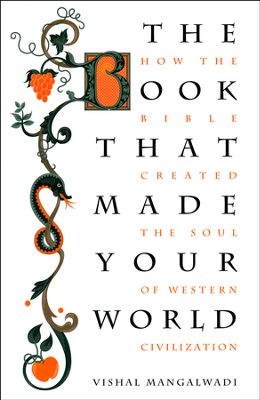






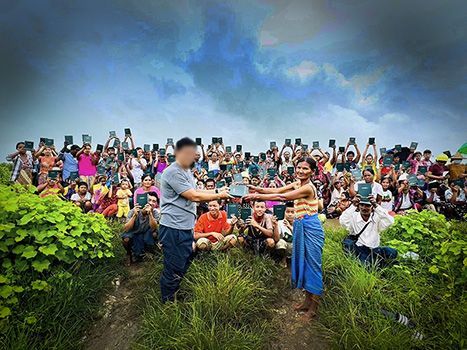

 Psalm 119: 38